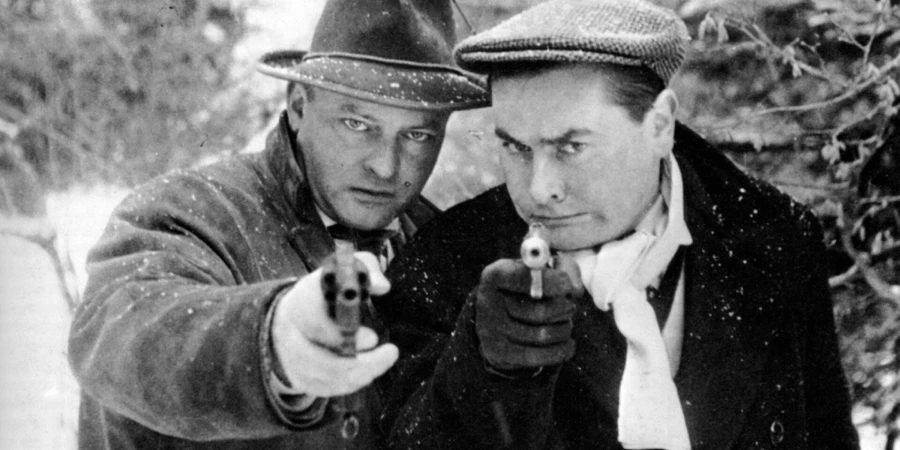

François Truffaut took a pulpy American crime novel, dropped it into a rain-soaked Paris café, and somehow turned a gangster story into a meditation on love, regret, and the price of reinvention. Shoot the Piano Player (1960) follows a man hiding from his own past behind a bar piano, only for that past to come crashing back in the most violent way possible. It is funny, melancholic, and utterly unpredictable, often within the same scene. Truffaut plays with genre conventions the way a jazz musician plays with melody: he acknowledges the rules, then cheerfully ignores them.
Detailed Summary
A Stranger in the Night
Charlie Koller (played by Charles Aznavour) works as a modest piano player in a small Paris bar called the Café Alex. He is quiet, withdrawn, and almost aggressively unremarkable. Nobody who sees him nursing his keys at closing time would suspect he was once a celebrated concert pianist named Édouard Saroyan.
However, the film opens not with Charlie but with his brother Chico, who comes sprinting down a dark street, fleeing two gangsters. A chance encounter with a stranger softens the tension briefly, injecting an absurd warmth into what should be a tense chase. Truffaut signals immediately that this will not behave like a normal crime film.
The Bar, the Woman, and the Reluctant Hero
Charlie befriends Léna, a waitress at the café who clearly has feelings for him. She is warm, perceptive, and far more alive to the world than Charlie allows himself to be. In contrast, Charlie narrates his own paralysis in interior monologues, debating with himself about whether to take her hand, whether to speak up, whether to act at all.
Meanwhile, Chico’s trouble follows him directly into Charlie’s world. Two bumbling gangsters, Momo and Ernest, show up at the café looking for Chico and his other brother Richard. They drag Charlie into a conflict he desperately wants nothing to do with.
The Flashback: Édouard Saroyan
Truffaut interrupts the story to reveal Charlie’s real identity through a sustained flashback. As Édouard Saroyan, he was a gifted concert pianist with a loving wife named Thérèse and a promising career. His manager Schmeel informed him that a path to stardom existed, but it required Thérèse to sleep with Schmeel to make it happen.
Thérèse agreed, without telling Édouard, and his career soared. Édouard eventually learned the truth, and Thérèse, overwhelmed by guilt and shame, threw herself out of a window and died. For instance, this single act of tragic sacrifice explains every inch of Charlie’s emotional shutdown. His retreat into anonymity was not cowardice but grief calcified into a survival mechanism.
Kidnapping, Comedy, and Escalation
Momo and Ernest kidnap Léna and Fido (Charlie’s younger brother) to use as leverage against Chico and Richard. Truffaut laces the kidnapping scenes with genuine comedy: the gangsters are hapless, chatty, and oddly philosophical. One of them delivers a long, rambling speech to Léna about whether or not his girlfriend has small breasts, a moment so bizarre it becomes iconic.
Charlie, meanwhile, kills the café owner Plyne after Plyne attempts to assault Léna. This act of violence is sudden and shocking, partly because Charlie has spent the entire film avoiding any decisive action. Consequently, the moment lands with real weight; it shows that Charlie still has something worth protecting.
The Chase into the Snow
Charlie, Léna, Chico, and Richard all converge at the family’s remote farmhouse in the countryside. Momo and Ernest close in. A prolonged standoff in the snow follows, with shooting, chaos, and black humor all colliding at once. Richard and Chico do their best to hold off the gangsters.
Truffaut shoots these sequences with a loose, almost documentary energy. Furthermore, the snowy landscape strips away any glamour the film might have flirted with, leaving something raw and genuinely sad.
Movie Ending
Léna dies in the crossfire during the gunfight in the snow. She is not killed dramatically or heroically; a stray bullet catches her, and she slides lifelessly down a snowbank. It is abrupt, unglamorous, and devastating precisely because of that. Truffaut refuses to give her death any cinematic grandeur.
Charlie watches the woman he had finally allowed himself to love die in front of him. In contrast to the film’s comedic interludes, this ending carries a quiet, crushing finality. The gangsters are dealt with, the brothers survive, but none of it feels like a victory.
Notably, the final shot returns to Charlie behind his piano at the café, back where he started. A new waitress exists in the background. Life, indifferent and relentless, simply continues. Truffaut’s point is almost cruel in its clarity: Charlie’s tragedy is not that bad things happen to him, but that he cannot escape the cycle of loss he seems to carry wherever he goes. His return to the piano signals not resilience but resignation.
For audiences wondering whether Charlie finds any peace, the answer is effectively no. He is exactly where he was at the start, emotionally frozen and professionally diminished. The ending refuses catharsis deliberately, which is what makes it so memorable and so honest.
Are There Post-Credits Scenes?
Shoot the Piano Player contains no post-credits scenes. Films of this era did not use that device, and Truffaut had no interest in it stylistically. When the film ends, it ends completely.
Type of Movie
Shoot the Piano Player occupies a fascinating generic space. Truffaut drew from American film noir and the hardboiled crime genre, but filtered those influences through the sensibility of the French New Wave. The result is part gangster film, part romantic tragedy, part absurdist comedy.
Tonally, it shifts without warning between melancholy and farce. That tonal instability is not a flaw; it is the point. Truffaut wanted a film that felt as unpredictable and contradictory as real life, and he succeeded.
Cast
- Charles Aznavour – Charlie Koller / Édouard Saroyan
- Marie Dubois – Léna
- Nicole Berger – Thérèse
- Michèle Mercier – Clarisse
- Albert Rémy – Chico Saroyan
- Claude Mansard – Momo
- Daniel Boulanger – Ernest
- Serge Davri – Plyne
- Claude Heymann – Lars Schmeel
- Richard Kanayan – Fido Saroyan
Film Music and Composer
Georges Delerue composed the score for Shoot the Piano Player, beginning his long and celebrated collaboration with Truffaut. Delerue brought a lyrical, slightly melancholic quality to the music that perfectly mirrored Charlie’s interior world. His work here helped establish a template for the sound of the French New Wave.
In addition to Delerue’s orchestral contributions, the film features piano pieces performed and interpreted through the context of Charlie’s character. The music functions almost as a second narrator, filling the emotional gaps that Charlie himself refuses to articulate.
Filming Locations
Truffaut shot the film primarily in Paris, using real streets, bars, and interiors rather than studio constructions. This approach gave the film its gritty, lived-in texture, entirely consistent with the French New Wave’s preference for location shooting over controlled studio environments.
The climactic sequences were filmed in snowy rural locations outside Paris. That shift from the city to a frozen, isolated countryside amplifies the story’s emotional drift from urban comedy to rural tragedy. The landscape itself becomes a kind of dramatic argument.
Awards and Nominations
Shoot the Piano Player did not accumulate a significant awards record upon its initial release. However, it has since earned its place in film history through critical reappraisal and retrospective recognition, including its presence on numerous lists of essential world cinema.
Behind the Scenes Insights
- Truffaut followed up his debut feature The 400 Blows (1959) with this film, deliberately choosing a genre project to prove his range as a director.
- Charles Aznavour was already a beloved French-Armenian singer and entertainer before this role; casting him added a layer of public persona to Charlie’s hidden-talent backstory.
- Truffaut was deeply influenced by American B-movies and wanted to pay homage to Hollywood genre filmmaking while simultaneously deconstructing it.
- The film was shot quickly and on a modest budget, which encouraged the improvisational energy visible throughout.
- Truffaut reportedly told Aznavour to underplay everything, trusting the audience to read the emotion beneath Charlie’s stillness.
- Daniel Boulanger, who played Ernest, was also a novelist and screenwriter; he co-wrote several other French New Wave films.
Inspirations and References
Truffaut based the film on the novel Down There (also published as Shoot the Piano Player) by American crime writer David Goodis, published in 1956. Goodis specialized in noir fiction populated by men in decline, men who had once touched greatness and retreated into obscurity. His sensibility mapped perfectly onto Truffaut’s own preoccupations.
Truffaut also drew openly from the visual language of American film noir, citing directors like Samuel Fuller and the broader tradition of Hollywood B-pictures as touchstones. On the other hand, his French New Wave instincts pushed him to break those genre conventions rather than simply reproduce them.
Alternate Endings and Deleted Scenes
No widely documented alternate endings or significant deleted scenes from Shoot the Piano Player appear in the public record. Truffaut’s working method on this film was fast and instinctive, which suggests the final cut reflects his original vision closely. No major alternate version has surfaced in retrospectives or restoration projects.
Book Adaptations and Differences
Shoot the Piano Player adapts David Goodis’s novel Down There, but Truffaut treated the source material with considerable freedom. Goodis’s novel is set in Philadelphia, grounded in American urban decay, and carries a heavier, more relentlessly bleak noir atmosphere. Truffaut relocated the story to Paris and injected a playfulness entirely absent from the book.
In addition, Truffaut amplified the absurdist comedy, particularly through the gangster characters, who barely register as comic figures in Goodis’s original. Some of Charlie’s interior monologue sequences have no direct equivalent in the novel. Truffaut essentially used the book as a skeleton and built something distinctly French around it.
Memorable Scenes and Quotes
Key Scenes
- Ernest’s long, rambling monologue about his girlfriend’s physique during the kidnapping, delivered with complete seriousness, perfectly captures the film’s tonal chaos.
- Thérèse’s suicide: she steps through the window after confessing to Édouard, shown with brutal economy; Truffaut cuts away fast, making the impact worse.
- Charlie’s interior monologue debate about whether to take Léna’s hand, in which he argues himself out of every human impulse, is both funny and painfully sad.
- Léna sliding down the snowy bank after being shot: one of French cinema’s quietest and most devastating endings.
- Charlie killing Plyne in a sudden burst of violence that reframes everything we thought we knew about him.
Iconic Quotes
- “If anything bad happens to a lady, may I drop dead on the spot.” (Ernest’s oath, which Truffaut immediately undercuts with a comic cutaway.)
- Charlie’s internal monologue as he considers reaching for Léna’s hand: a rapid-fire self-negotiation that ends, predictably, in inaction.
Easter Eggs and Hidden Details
- Truffaut includes a brief visual nod to American gangster film posters visible in the background of certain café scenes, quietly acknowledging his Hollywood influences.
- Charlie’s piano playing is partially dubbed; Aznavour’s hands appear on screen but some of the more technically demanding passages involved a piano double.
- Ernest’s comic oath about harm coming to women functions as a dark joke: women in this film suffer consistently, and no oath protects them.
- Truffaut frames several scenes with Charlie partially obscured or in shadow, visually reinforcing his status as a man trying to disappear.
Trivia
- Charles Aznavour was not Truffaut’s first choice for the role, but his casting turned out to be essential to the film’s quiet, interior tone.
- David Goodis was reportedly pleased that his novel received a film adaptation, though the French setting surprised him.
- Shoot the Piano Player was initially considered a commercial disappointment in France, performing well below The 400 Blows.
- Truffaut considered the film a personal favorite among his own work, despite its modest initial reception.
- The film’s blend of tones directly influenced later directors, including Martin Scorsese, who has cited Truffaut as a formative influence.
- Georges Delerue would go on to score several more Truffaut films, cementing one of French cinema’s most productive director-composer partnerships.
Why Watch?
Shoot the Piano Player offers something genuinely rare: a film that can make you laugh and break your heart within the space of two minutes. Aznavour’s performance is a masterclass in controlled stillness. Moreover, Truffaut’s direction proves that genre films can carry real emotional and philosophical weight without losing their sense of fun.
Director’s Other Movies
- The 400 Blows (1959)
- Jules and Jim (1962)
- The Soft Skin (1964)
- Fahrenheit 451 (1966)
- Stolen Kisses (1968)
- The Wild Child (1970)
- Day for Night (1973)
- Small Change (1976)
- The Last Metro (1980)
- Confidentially Yours (1983)
Recommended Films for Fans
- Breathless (1960)
- Jules and Jim (1962)
- Bob le Flambeur (1956)
- Le Samourai (1967)
- Band of Outsiders (1964)
- Alphaville (1965)
- Night and the City (1950)
- McCabe and Mrs. Miller (1971)