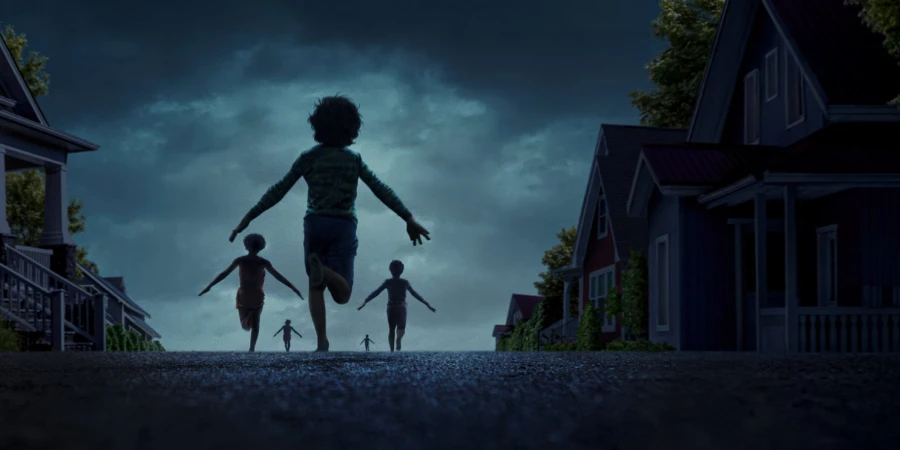

At 2:17 in the morning, seventeen children walked out of their homes with their arms flung behind them and never came back. Zach Cregger built an entire town’s nightmare around that one image, then dared audiences to laugh at it. Weapons is a horror mosaic, a grief essay, and a very mean joke about suburban blame. Every spoiler follows below.
Detailed Summary
The Night Seventeen Children Vanished
A child’s voice opens the film like a campfire story. She explains that every kid in Mrs. Gandy’s class, except one, ran into the dark at the same minute. Doorbell cameras catch them sprinting with palms up, like paper planes.
Maybrook wakes to empty beds and no bodies. Police find no ransom note, no pattern, no suspect. Grief curdles into suspicion within days.
Justine Gandy Becomes the Town’s Villain
Julia Garner plays Justine, the teacher who lost an entire classroom. Parents scream at her during public meetings. Somebody paints threats on her house, and the school quietly suspends her.
She drinks through the fallout and leans on Paul Morgan, a local cop with his own mess. Meanwhile, she starts investigating alone, because she has nothing left to protect. Her first stop is Alex Lilly, the only student still sitting in his seat.
That visit to the Lilly house goes badly. Alex’s parents behave like mannequins, smiling with nothing behind it. Justine leaves rattled and certain that something inside that home is deeply wrong.
Archer Graff Runs His Own Investigation
Josh Brolin’s Archer lost his son Matthew, and he refuses to wait for detectives. He collects security footage from neighbors and builds a timeline across his wall. His dreams keep replaying the same figure running into darkness.
Archer tails Justine, breaks into her house, and treats her as his prime suspect. Grief has nowhere useful to go, therefore it points at the nearest available target. Eventually that same stubbornness saves lives.
Officer Paul Morgan and the Missing Gun
Alden Ehrenreich plays Paul as a man drowning in small corruptions. He skims from the evidence room and lies to everyone, including himself. His chapter quietly reveals how thin the town’s competence really is.
Paul answers a break-in call at the Lilly house and finds nothing worth reporting. However, his service weapon ends up in the wrong hands soon afterward. That loose gun matters enormously once the finale arrives.
James, the Burglar Who Picked the Wrong House
Austin Abrams plays James, a homeless addict hunting for anything he can sell. He picks the Lilly place because it looks sleepy and unguarded. Aunt Gladys is waiting in the dark.
Gladys does not call the police. Instead, she marks him, feeds him, and turns him into a guard dog with a human face. From there, James obeys orders he cannot refuse.
Principal Marcus and the Attack on Justine
Benedict Wong’s Marcus tries holding the school together while parents demand blood. Gladys gets to him too, and his personality vanishes between one scene and the next. Whatever leaves that encounter is no longer Marcus.
He arrives at Justine’s house after dark and attacks without a word. She fights back and kills him in her own kitchen. Consequently, any chance of convincing the authorities dies right there on the floor.
Alex Lilly and the Truth About Aunt Gladys
Cary Christopher’s chapter reframes everything. Alex came home one afternoon to find a sick, beaming great-aunt on the couch and his parents already charmed. Gladys took over the household in stages, like mold.
Hair, photographs, and crude dolls did the work. Using those tools, she hollowed out his mother and father until both became furniture. Still, one aging witch needs constant fuel to keep breathing.
So Alex received his assignment: steal something personal from every classmate, one item at a time. Seventeen effigies went onto her workshop table. At 2:17 that night, the spell called every child to her front door, and they have stood in her basement ever since.
Movie Ending
Justine returns to the Lilly house alone, because nobody in Maybrook will listen to her. Downstairs she finds seventeen children standing in rows, awake, breathing, and silent. Gladys catches her before a single kid moves.
A quick mark on the arm, and Justine belongs to the old woman exactly like Marcus did. Archer arrives moments later, still hunting Matthew, and walks straight into a house full of puppets. Fists fly, furniture splinters, and Gladys keeps smiling through all of it.
Alex ends the fight. He slips into her workshop, turns her own charms against her, and wakes his classmates from the trance. Then he gives them a two word instruction.
What follows plays as slapstick and nightmare at once. Seventeen children swarm Gladys, drag her through her own hallway, and beat her to death on the front lawn. Nobody rescues them; they rescue themselves.
Gladys dies, and every spell dies with her. Justine drops the knife and returns to herself mid-swing. Archer finds Matthew in the crowd, and that reunion lands harder than any jump scare in the film.
Alex gets no clean happy ending, though. His parents survive, yet the version of them that comes back is barely there. Our narrator closes by admitting that the kids remember almost nothing and the adults never received a real explanation.
Cregger keeps his theme in plain sight the whole time. Adults spend two hours aiming blame at each other, while the actual weapons are the children. Gladys simply loaded them.
Are There Post-Credits Scenes?
No. Weapons finishes with its closing narration and rolls credits without a stinger. Sit through the crew names for the score if you like, but nothing else plays.
Cregger has favored clean endings before, and this story needs no epilogue. Everything worth knowing about these characters already happened onscreen.
Type of Movie
Weapons is a supernatural horror mystery with a loud streak of black comedy. Cregger structures it as an anthology, handing each chapter to a different broken adult.
Tonally the film swings hard and often. One scene builds dread through long silences; the next earns a real laugh from a lunatic performance or a badly timed insult. Think folk horror logic dropped into a beige American subdivision.
Cast
- Julia Garner – Justine Gandy
- Josh Brolin – Archer Graff
- Alden Ehrenreich – Paul Morgan
- Amy Madigan – Aunt Gladys
- Austin Abrams – James
- Benedict Wong – Marcus
- Cary Christopher – Alex Lilly
Film Music and Composer
Brothers Ryan Holladay and Hays Holladay wrote the score, and it functions like a pressure gauge. Their cues favor low drones, warped tones, and abrupt silence over orchestral swells.
Repeated figures return whenever the story circles back to that night. As a result, each chapter feels like a variation on one bad memory rather than a fresh start.
Both composers built reputations on experimental and location-based music projects instead of traditional studio work. Notably, that outsider background suits a movie allergic to standard horror stingers. Silence does the heaviest lifting in the basement sequences.

Filming Locations
Production shot primarily in and around Atlanta, Georgia. Ordinary neighborhoods there stand in for the fictional town of Maybrook.
Anonymity is exactly the point. Wide streets, matching mailboxes, and tidy lawns leave the horror nowhere to hide. Every cul-de-sac looks like somewhere the audience has actually lived.
Interiors of the Lilly house carry most of the dread. Cregger keeps the camera low and the hallways long, so a normal home starts feeling like a burrow.
Awards and Nominations
Critics embraced the film, and Amy Madigan‘s performance drew the loudest awards-season attention, particularly from critics’ groups. Its biggest win, however, was commercial: a modest budget turned into a worldwide gross north of $250 million.
Behind the Scenes Insights
- Cregger wrote the script while processing the death of his friend and comedy partner Trevor Moore, and he has described the film as a grief story first and a horror movie second.
- The screenplay set off a studio bidding war before New Line Cinema and Warner Bros. landed it.
- Pedro Pascal originally signed on for the role that eventually went to Josh Brolin, but scheduling pushed him out.
- Cregger has repeatedly cited Magnolia (1999) as the structural model for the chapter format.
- Madigan worked closely with the makeup and hair team so Gladys would look homemade and off, not monstrous.
- Child performers handled the arms-back run themselves, and that pose became the film’s entire marketing campaign.
- Cregger edited aggressively for rhythm, cutting anything that slowed the handoff between chapters.
Inspirations and References
Grief drives the whole project. Cregger has said the central disappearance grew from a sudden personal loss, and the film keeps circling parents who cannot accept an unexplained absence.
Structurally, Magnolia is the obvious reference point. Overlapping chapters and a wry narrator braid strangers into one event.
Folk horror supplies the rest of the toolkit. Gladys works with hair, photographs, and effigies, the oldest instruments in the witchcraft playbook, and nobody ever explains where she learned any of it.
Small-town panic stories echo here as well. Maybrook’s rush to blame one young woman for something inexplicable rhymes with every witch hunt in American folklore, which is a good joke given that a literal witch caused the problem.
Alternate Endings and Deleted Scenes
No alternate ending exists in any released version. Warner Bros. put out a single cut, and the finale audiences saw in theaters is the one Cregger wanted.
Trimming happened at the script and edit stage rather than after test screenings. Cregger has discussed tightening chapters to protect the mystery’s momentum, though no substantial deleted footage has surfaced publicly.
Book Adaptations and Differences
Weapons is not based on a book. Cregger wrote an original screenplay, so no source novel exists for comparison.
Readers chasing a similar feeling can look toward Stephen King’s small-town horror or Shirley Jackson’s studies of communities turning on one woman. Neither inspired the film directly, yet both share its DNA.
Memorable Scenes and Quotes
Key Scenes
- Doorbell camera footage of seventeen children sprinting into the dark, arms trailing behind them.
- Justine’s first visit to the Lilly house, where Alex’s parents smile at absolutely nothing.
- James waking under Gladys’s care, already claimed and unable to walk out.
- Marcus attacking Justine in her kitchen with a blank, expressionless face.
- Alex’s chapter, which drops the mystery entirely and shows how one great-aunt dismantled a family.
- The basement reveal: rows of children standing awake in the dark.
- That final swarm, with seventeen kids chasing Gladys across her own lawn.
Iconic Quotes
- Our child narrator’s opening account of the 2:17 disappearance, delivered with the flat calm of a playground rumor.
- Gladys introducing herself as family, in a voice pitched between grandmother and game show host.
- Justine’s blunt insistence that she never touched those children, repeated until the town hears it as a confession.
- Archer’s accusation aimed at Justine, delivered by Brolin at a volume that could strip paint.
- Alex’s two word command to his classmates downstairs, easily the biggest crowd reaction of the film.
- Marcus’s cheerful hallway small talk, funny on a first watch and sinister on a second.
Easter Eggs and Hidden Details
- 2:17 appears on clocks, reports, and marketing materials, anchoring every chapter to the same minute.
- That arms-back running pose mirrors a plane in flight, reframing the kids as objects launched at a target.
- Chapter titles named for characters mimic a children’s picture book, matching the storybook narration.
- Gladys’s dolls carry real hair and stolen keepsakes, telegraphing the rules of her magic long before Alex spells them out.
- Alex’s artwork and classroom behavior flag the trouble at home well before any adult notices.
- The title works on three levels: the children, the town’s accusations, and Gladys’s household of controlled adults.
- Nobody ever explains Gladys’s origin, and the film treats that gap as a feature rather than a hole.
Trivia
- Cregger’s follow-up to Barbarian (2022) opened at number one and became one of 2025’s biggest original horror hits.
- Runtime runs past two hours, unusually long for a modern studio horror release.
- Julia Garner appeared in another huge summer 2025 release, The Fantastic Four: First Steps, weeks before this one.
- Word of mouth carried the box office well past $250 million worldwide on a modest budget.
- Gladys turned into an instant meme, which is impressive for a villain with no franchise behind her.
- Interestingly, the film keeps its supernatural rules unspoken for roughly ninety minutes before Alex explains anything.
Why Watch?
Horror rarely swings this wide and lands this cleanly. Cregger juggles mystery, grief, and genuine belly laughs without dropping any of them. Amy Madigan alone justifies the ticket price. Stay for a finale that pays off every question the film bothers to ask.
Director’s Other Movies
- Miss March (2009)
- Barbarian (2022)
Recommended Films for Fans
- Barbarian (2022)
- Hereditary (2018)
- Magnolia (1999)
- Obsession (2026)
- Get Out (2017)
- Sinister (2012)
- Talk to Me (2022)
- Longlegs (2024)
- The Empty Man (2020)
- It Follows (2014)