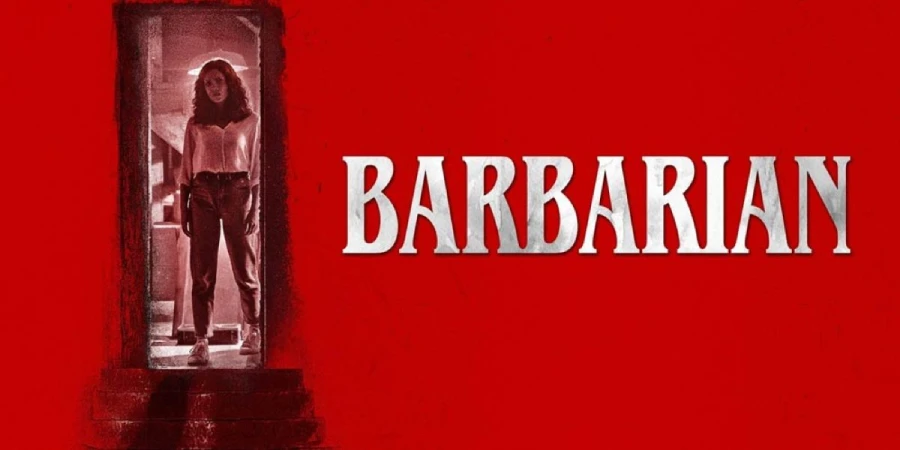

A stranger already holds the keys to your Airbnb, and that is the least alarming thing about Barbary Street. Zach Cregger’s Barbarian turns a booking mix-up into a plunge through decades of Detroit rot. Its monster hides first behind good manners, then behind a Hollywood résumé. Few horror films have yanked the rug this gleefully.
Detailed Summary of Barbarian (2022)
A Double-Booked Rental on Barbary Street
Tess Marshall (Georgina Campbell) drives into a rainy Detroit night for a job interview. Her rental lockbox sits empty. Someone is already inside the house.
That someone is Keith Toshko (Bill Skarsgård), who says a rival booking site sold him the same address. He offers her the bedroom and claims the couch. Every gesture reads as kindness, which is precisely why the sequence feels like a countdown.
Cregger stages this act as a lesson in threat assessment. Tess watches Keith open the wine, then declines the glass he pours. Naturally, she locks the bedroom door behind her.
Daylight, Brightmoor, and a Warning in the Street
Morning arrives and the dread evaporates. Tess nails her interview with a documentary filmmaker, then drives back through a neighborhood of gutted, boarded-up homes. Only her rental looks cared for.
A man shouts at her car and follows her toward the porch. She makes it inside. Meanwhile, Keith returns with groceries and behaves like a thoroughly decent guy, which tightens the screws further.
The Room Behind the Basement Wall
Hunting for toilet paper, Tess ends up trapped in the basement until Keith frees her. Curiosity wins later, and she goes back down alone.
A sliding wall hides a second room. Inside sit a filthy mattress, a bucket, a video camera on a tripod, and a bloody handprint. Nothing there suggests spare towels.
Keith Goes First
Tess sprints for her car, then hears Keith shouting from below. He has already climbed into a tunnel network running under the block. Guilt drags her back inside.
Something enormous arrives in the dark. It seizes Keith by the head and drives him into the concrete ceiling until his skull gives way. That death lands roughly forty minutes in, and it murders the movie you thought you were watching.
Fleeing deeper, Tess passes cells, a squalid nursery, and a shelf of VHS tapes. One recording shows an old man calmly buying rope, chloroform, and duct tape. Then the Mother (Matthew Patrick Davis) collects her, cradles her, and forces her to nurse.
A Hard Cut to Los Angeles
Sunshine, a convertible, and a man belting along to the radio. AJ Gilbride (Justin Long) is a working actor whose agent calls with news of a rape accusation from a co-star.
AJ protests his innocence to a friend while describing an encounter that sounds exactly like assault. His jobs vanish overnight. To fund lawyers, he starts liquidating property, including a rental he owns on Barbary Street.
The Landlord Takes Measurements
AJ arrives, cracks a beer, and measures rooms for the listing. One closet comes up short, so he shoves through the false wall and celebrates the bonus square footage. Down he strolls, tape measure in hand.
In the tunnels he finds a cage, and inside it a battered Tess. She warns him about what lives down there. Listening has never been his strength.
A Trip Back to the 1980s
Cregger rewinds to Barbary Street in its prime: mown lawns, sunshine, station wagons at the curb. Frank (Richard Brake) borrows sugar from a neighbor and quietly measures her windows.
His shopping list matches the tape Tess found. Cregger never films the crimes; implication does all the work. Frank abducted women, imprisoned them below, and fathered children on them across generations.
That cycle produced the Mother. She is enormous, deformed, and utterly convinced that anyone she drags underground is her baby.
The Police Drive Away
Tess and AJ reach the surface and flag down a squad car. Officers smell alcohol, hear a wild story about a creature beneath a rental house, and refuse to step inside. Their disbelief is the film’s cruelest joke.
Tess goes back anyway. AJ, unsurprisingly, ends up underground a second time.
Andre’s Warning and Frank’s Last Act
Andre (Jaymes Butler), the man who shouted at her car, pulls Tess into a nearby squat. He explains the house, the man behind the tunnels, and hands her a revolver. His fear is specific, earned, and completely justified.
AJ meanwhile climbs a ladder into the boarded-up house next door. He finds an elderly Frank surrounded by photographs, waiting in the dark. Frank puts a shotgun under his chin and fires.
Movie Ending
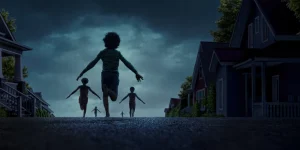
Tess and AJ burst out of the house with the Mother behind them and scramble up a derelict water tower. Rain, rust, no plan. AJ climbs fast, because AJ always saves AJ.
When the creature reaches the platform, AJ shoves Tess off the tower. She drops, breaks badly, and lands conscious on the ground below. His calculation is simple: give the thing something else to want.
What follows delivers the film’s thesis. The Mother climbs down, gathers Tess up, and rocks her with something close to tenderness. Monstrous as she is, her instinct here is protection.
AJ descends and tries to talk his way into being the hero. Instead, the Mother takes his head in her hands and destroys it, thumbs first, echoing Keith’s death exactly. Karma arrives with a very heavy grip.
Tess then raises Andre’s revolver and shoots the Mother through the head at point-blank range. That kill plays as grief rather than triumph. After all, the creature is also a product of Frank’s basement.
Final image: Tess alone on wet asphalt, alive, surrounded by bodies. No rescue arrives. No explanation follows.
Audiences most often ask what the Mother actually is. She is a human being, born from generations of captivity and abuse in Frank’s tunnels, raised on nothing but stolen caregiving rituals.
AJ’s fate raises the second big question. His death is not random cruelty; the film has spent an hour arguing that the charming, successful man poses more danger than the obvious threat.
Does Tess survive? Yes, though Barbarian refuses to call that a happy ending. She trusted her instincts from the first scene onward, and it still cost her nearly everything.
Are There Post-Credits Scenes?
No. Barbarian ends where it ends, and the credits roll without a stinger, a teaser, or a final jolt.
Staying seated buys you Anna Drubich’s music and little else. No sequel has followed either, which suits a film built entirely on surprise.
Type of Movie: Genre and Tone
Barbarian is a horror film that swaps subgenres roughly every thirty minutes. Act one runs as a slow-burn thriller about stranger danger. Act two becomes a creature feature in a subterranean labyrinth.
Act three turns into pitch-black satire about male entitlement. Cregger threads real comedy through the whole thing, most of it courtesy of AJ’s obliviousness. Tonally, imagine Psycho spliced with a panic attack, played dead straight rather than winking.
Barbarian Cast
- Georgina Campbell – Tess Marshall
- Bill Skarsgård – Keith Toshko
- Justin Long – AJ Gilbride
- Matthew Patrick Davis – The Mother
- Richard Brake – Frank
- Jaymes Butler – Andre
- Kurt Braunohler – Doug
Film Music and Composer
Anna Drubich composed the score, and her work handles much of the film’s misdirection. Early cues stay restrained, letting rain and silence carry the tension.
Once the tunnels open up, the music shifts to low drones, groaning brass, and warped lullaby figures. That lullaby motif matters enormously. It belongs to the Mother, and it frames her as tragic long before the finale confirms it.
Drubich, a Moscow-born composer working in Hollywood, has scored genre titles including Werewolves Within. Her approach here favors texture over melody. As a result, several of the biggest scares land with almost no music at all.

Filming Locations
Bulgaria hosted most of the shoot, with production based in and around Sofia. Building Barbary Street and the tunnel network as sets kept the budget low and handed Cregger total control of the underground geography.
Detroit still matters enormously to the story. Brightmoor’s real history of abandonment explains why one maintained house sits on a block of ruins, and why nobody responds to screaming.
AJ’s sequences trade all that gloom for pools and palm trees. In contrast, Michigan appears almost exclusively at night, in rain, under sodium light.
Awards and Nominations
Barbarian earned strong reviews and genre-circuit attention rather than major industry trophies. Critics placed it across year-end horror lists, and Georgina Campbell’s performance drew particular praise.
Behind the Scenes Insights
- Cregger came up through sketch comedy with The Whitest Kids U’ Know, which makes Barbarian a startling first solo turn behind a horror camera.
- Production costs stayed near $4.5 million, yet the film grossed roughly ten times that worldwide.
- Bulgaria doubled for Michigan, letting the crew construct the labyrinth as a controlled set instead of hunting for a location.
- Matthew Patrick Davis stands around six feet eight inches tall, and prosthetics plus physical performance carry the creature rather than a digital body.
- Cregger has described writing without a rigid outline, which explains the film’s willingness to abandon its own protagonist mid-story.
- Marketing sold act one and buried everything after it; the trailers barely acknowledge the tunnels.
- Justin Long’s motor-mouthed comic timing keeps AJ funny and repulsive at the same time, a balance the third act depends on completely.
- Word of mouth drove the box office after a modest September opening, turning the film into a genuine sleeper hit.
Inspirations and References
Cregger has pointed to The Gift of Fear, Gavin de Becker’s book about ignored danger signals, as a key spark. That influence shows in every beat of act one, where Tess repeatedly overrides her own alarm bells to stay polite.
Structurally, the film borrows from Psycho. Killing your apparent lead partway through remains one of horror’s boldest moves, and Cregger runs the trick twice.
Its underground half owes a debt to The Descent and to the crumbling-house tradition of The People Under the Stairs. Meanwhile, the real backdrop is American urban abandonment, where entire blocks can empty out and nobody notices what remains beneath them.
Alternate Endings and Deleted Scenes
No alternate ending has surfaced publicly, and the theatrical cut remains the only version in circulation. Home releases leaned on featurettes rather than a substantial reel of discarded material.
That absence suits a film built on architecture. Losing or reshaping a single act would collapse the entire trick, so there is little room for a meaningfully different version.
Book Adaptations and Differences
Barbarian is not based on a book. Cregger wrote an original screenplay, so no source novel exists for comparison.
One nonfiction title does hover over the material. The Gift of Fear argues that people talk themselves out of legitimate warnings, and that idea shapes the logic of the opening act far more than any horror novel does.

Memorable Scenes and Quotes
Key Scenes
- The wine glass. Keith pours, Tess watches, and she quietly refuses to drink. Few horror scenes have made basic caution this tense.
- The sliding wall. Discovery of the hidden room reframes the entire house in about ten seconds.
- Keith’s death. Brutal, abrupt, and staged to destroy every assumption the audience carried into act two.
- The tape measure. AJ celebrating extra square footage while standing in a torture chamber is the film’s funniest and ugliest joke.
- The 1980s flashback. Sunlit, quiet, and more disturbing than anything in the tunnels.
- Frank’s shotgun. A monster who simply grew old and waited, then removed himself in one shot.
- The water tower. Two people, one creature, and a shove that defines an entire character.
Iconic Quotes
- “Mother.” The creature’s single spoken word, delivered as a demand rather than a name.
- Keith’s insistence that Tess take the bedroom, a line that sounds like courtesy on first viewing and like menace on the second.
- AJ’s whooping reaction to the hidden square footage, the exact moment greed overrides self-preservation.
- Andre’s flat warning about the house, delivered by a man who has watched that block for years.
- AJ’s account of the accusation against him, in which he narrates an assault while insisting it was a misunderstanding.
Easter Eggs and Hidden Details
- Barbary Street gives the film its title, and the word applies to Frank rather than to the creature.
- AJ measures rooms with a tape; Frank measured windows the same way. Both men treat a home as inventory.
- Only one house on the block looks maintained, a detail hiding in plain sight throughout the daylight scenes.
- The Mother’s caregiving mimics rituals she never chose, learned entirely inside the prison where she was born.
- Frank’s tapes were shot on the camera still standing in the hidden room, meaning the equipment outlasted his victims.
- Tess refuses every offered drink and survives; AJ accepts all of them and does not.
- Casting works as a wink in itself, since Bill Skarsgård arrives carrying It baggage that the film uses against the audience.
- Andre is introduced as a threat and turns out to be the only unambiguously helpful stranger in the story.
Trivia
- Zach Cregger co-directed the comedy Miss March in 2009, making Barbarian his first solo feature.
- Bill Skarsgård played Pennywise in It, so casting him as the nice guy is a joke aimed squarely at horror fans.
- Justin Long brings his own genre history, including Jeepers Creepers and Tusk.
- Richard Brake has specialized in menace for years, notably as the Night King on Game of Thrones and as Joe Chill in Batman Begins.
- Georgina Campbell broke through with the Black Mirror episode “Hang the DJ” before landing this lead.
- 20th Century Studios released the film in September 2022, traditionally a quiet slot that horror keeps conquering.
- Cregger followed it with Weapons in 2025, confirming his move from comedy into horror was permanent.
Why Watch?
Watch it for the sheer nerve. Cregger destroys his own premise twice, hides a satire inside a creature feature, and still lands genuine scares. Few modern horror films reward a second viewing this generously, and almost none stay this unpredictable.
Director’s Other Movies
- Miss March (2009)
- Weapons (2025)
Recommended Films for Fans
- Psycho (1960)
- The Texas Chain Saw Massacre (1974)
- The People Under the Stairs (1991)
- The Descent (2005)
- Obsession (2026)
- Don’t Breathe (2016)
- Get Out (2017)
- Hereditary (2018)
- Malignant (2021)
- Speak No Evil (2022)
- Talk to Me (2022)