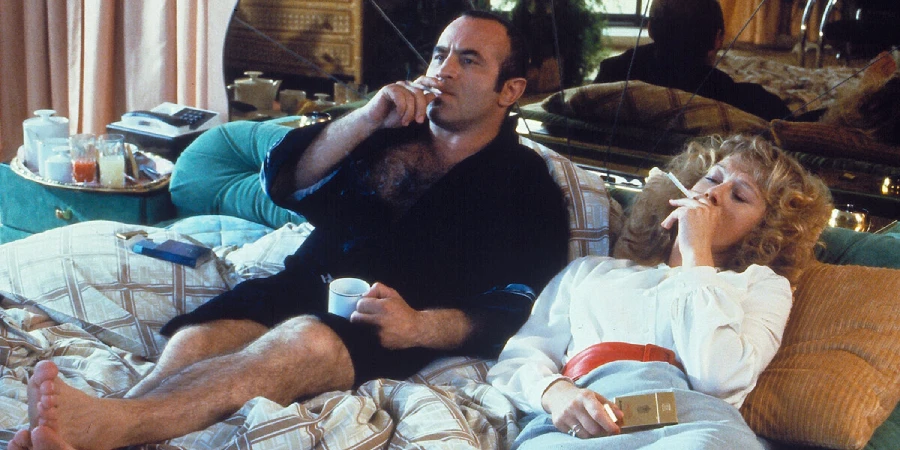

Harold Shand is a man who built an empire on concrete and corpses, and he spends the entire runtime of The Long Good Friday watching it crumble in real time. This 1980 British crime film, directed by John Mackenzie and written by Barrie Keeffe, delivers one of cinema’s most electrifying performances courtesy of Bob Hoskins. It is a film about power, paranoia, and the precise moment a kingpin realizes he has already lost.
Detailed Summary
Harold’s Big American Dream
Harold Shand runs London’s East End underworld with an iron grip and considerable personal charm. He has spent years cultivating legitimate business connections, and now he stands on the verge of his greatest deal: a massive property development project backed by American Mafia money.
His American contact, Charlie, arrives in London alongside his associate Colin. Harold wants to impress them with the scale of his vision, showing off his yacht, his restaurants, and his political connections. He genuinely believes he is about to go straight, or at least straighter.
Everything Explodes at Once
On Good Friday, Harold’s world detonates, almost literally. A bomb destroys his Rolls-Royce, killing his driver. Meanwhile, another explosion rips through one of his pubs, and a third device targets his casino.
Harold has no idea who is behind the attacks. He suspects the IRA, rival gangs, or perhaps a betrayal from within his own organization. As a result, his carefully constructed image of control starts cracking in front of his American guests.
Harold Hunts for Answers
Harold responds the only way he knows how: with brutal, systematic violence. He rounds up every villain, informant, and associate he can find, hanging them upside down on meat hooks in an abattoir for interrogation. This scene remains one of British cinema’s most viscerally memorable sequences.
His loyal enforcer Jeff works alongside him throughout the investigation. However, the answers Harold extracts only deepen the mystery rather than resolve it.
The IRA Connection Surfaces
It slowly emerges that Harold’s organization has an unexpected and deeply dangerous connection to the Irish Republican Army. Years earlier, one of Harold’s men, Colin (not the American visitor, but a member of Harold’s crew), had been involved in the death of an IRA operative in Northern Ireland.
Colin turns up murdered in a swimming pool, a direct message from the IRA. In addition, Harold’s associate Tony is revealed as a police informant, adding another layer of treachery to Harold’s crumbling empire.
Victoria and the Bigger Picture
Harold’s girlfriend, Victoria, played with steely composure by Helen Mirren, serves as his most articulate voice of reason. She understands politics, presentation, and the Americans far better than Harold does. Victoria repeatedly urges caution, but Harold cannot operate in cautious mode.
Her role is not merely decorative. She functions as Harold’s conscience and his most valuable diplomatic asset, yet he consistently bulldozes past her warnings.
Harold Confronts the IRA
Harold eventually identifies the IRA as the source of his problems. He arranges a meeting with their representative, believing he can negotiate his way out. Harold offers money, territory, and influence in exchange for peace.
The IRA refuses. For them, this is not business; it is a matter of political principle and retribution. Harold cannot comprehend an enemy that does not respond to financial incentive, and that incomprehension proves fatal.
The Americans Walk Away
Charlie and his associates witness the chaos surrounding Harold’s operation and decide London is simply too dangerous for their investment. They pull out of the deal entirely. Harold has spent years building toward this moment, and it collapses in an afternoon.
Consequently, Harold loses both his future and his composure simultaneously. His empire, already bleeding from the IRA campaign, now has no legitimate exit strategy.
Movie Ending
Harold believes he has one final move. He confronts the corruption within his circle, specifically targeting the police contact who has been feeding information to his enemies. His fury is volcanic, and for a brief moment he looks like a man who might claw his way back from the abyss.
Then the IRA takes him. Harold gets into what he assumes is a safe car, only to find himself surrounded by young IRA operatives. He realizes instantly that he has been captured and that no amount of money or muscle will save him now.
What follows is one of cinema’s great closing shots. Harold sits in the back of the car, and Bob Hoskins holds the screen for a sustained, wordless sequence as his character cycles through every possible emotion: shock, fury, contempt, bargaining, and finally, a profound and terrible understanding. He knows he is going to die. He knows there is nothing he can do about it. The camera simply watches him reckon with that fact.
Notably, the film never shows Harold’s death on screen. It does not need to. That final close-up communicates everything about the cost of Harold’s choices, the limits of brute force, and the arrival of a political conflict that operates entirely outside his comprehension. It is, without question, one of the finest endings in British film history.
Are There Post-Credits Scenes?
The Long Good Friday contains no post-credits scenes whatsoever. Credits roll after that devastating final image, and the film offers no epilogue, no coda, and no relief. The silence after the screen cuts to black is very much part of the experience.
Type of Movie
The Long Good Friday is a British crime thriller with strong elements of political drama. Its tone is tense, often darkly funny, and relentlessly atmospheric. This is not a glossy gangster fantasy; it operates closer to tragedy.
In contrast to many crime films of its era, it treats its villain as a genuinely complex protagonist without ever asking the audience to excuse his brutality. The genre trappings serve a serious political argument about Britain in the early 1980s.
Cast
- Bob Hoskins – Harold Shand
- Helen Mirren – Victoria
- Derek Thompson – Jeff
- Bryan Marshall – Harris
- Eddie Constantine – Charlie
- Paul Freeman – Colin
- Pierce Brosnan – First IRA Man
Film Music and Composer
Francis Monkman composed the score for The Long Good Friday. His work blends synthesizer-driven tension with more melodic, almost elegiac passages that reflect Harold’s grandiose self-image. The music constantly reminds you that this man sees himself as a visionary, not a thug.
Monkman had a background in progressive rock as a founding member of Curved Air. His score remains an underrated gem of British film music from this period, perfectly calibrated to the film’s shifting emotional registers.
Filming Locations
Principal photography took place across London, with heavy use of East End locations, the River Thames, and Docklands areas. These settings were not merely backdrops; they were central to the film’s argument. Harold’s development ambitions literally map onto the actual geography being filmed.
The Docklands sequences carry particular resonance because, in reality, that area was on the cusp of massive redevelopment at the time of filming. The film inadvertently documented a London on the edge of transformation. Harold’s fictional scheme and the real city’s future were briefly, eerily aligned.
Awards and Nominations
The Long Good Friday won the BAFTA Award for Best Actor in a Leading Role for Bob Hoskins. Helen Mirren also received recognition for her performance during this period of her career.
Furthermore, the film received considerable critical acclaim and has frequently appeared on lists of the greatest British films ever made, cementing its status as a landmark of the crime genre.
Behind the Scenes Insights
- HandMade Films, the production company co-founded by George Harrison, initially distributed the film in the UK after its original distributor held it back, partly over concerns about the IRA content.
- Bob Hoskins reportedly modeled aspects of Harold Shand on real East End criminal figures he researched during preparation for the role.
- Director John Mackenzie insisted on shooting many sequences on location rather than in studio sets, giving the film its gritty, documentary-adjacent texture.
- Pierce Brosnan appears in a small but pivotal role as one of the IRA operatives in the film’s final scenes, in one of his earliest screen appearances.
- The film sat unreleased for a significant period because its distributors were nervous about its political content and its sympathetic-yet-complex portrayal of criminal power structures.
- Screenwriter Barrie Keeffe drew on extensive knowledge of East End London culture and the specific criminal networks that operated there during the late 1970s.
Inspirations and References
Barrie Keeffe wrote the screenplay as an original work, not as an adaptation of any existing novel or play. However, the film clearly draws on a tradition of British social realism and the kitchen-sink drama movement, applied to the crime genre.
The political dimension, specifically the IRA subplot, reflects the very real tensions of the period. Britain in the late 1970s and early 1980s lived under the shadow of IRA bombings on the mainland, and Keeffe wove that anxiety directly into the narrative. In this sense, Harold’s downfall functions as a metaphor for old power structures meeting a new, ideologically driven form of violence they cannot buy off or bully into submission.
Alternate Endings and Deleted Scenes
No widely documented alternate endings or officially released deleted scenes exist for The Long Good Friday. The film’s distributor issues led to some re-editing concerns during its troubled release period, but the version audiences know today appears to represent Mackenzie’s intended cut.
Specifically, the famous closing sequence was always central to the film’s conception. No credible sources suggest a version existed in which Harold escapes or survives.
Book Adaptations and Differences
The Long Good Friday is not based on a book. Barrie Keeffe wrote an original screenplay specifically for the film. Consequently, there is no source novel to compare it against, and no significant divergence from prior source material to analyze.
Memorable Scenes and Quotes
Key Scenes
- The meat hook interrogation sequence, in which Harold questions a row of suspects suspended upside down in an abattoir, remains one of the most chillingly inventive scenes in British crime cinema.
- Harold’s yacht party establishes his ambition and charm in the film’s opening act, showing exactly what he stands to lose before the film begins dismantling it.
- The IRA negotiation scene, in which Harold realizes his financial leverage means nothing to his opponents, marks the precise moment the protagonist’s worldview collapses.
- The final car sequence, a sustained close-up of Hoskins cycling through every stage of a man confronting his own death, represents some of the finest screen acting British cinema has ever produced.
- Victoria’s diplomatic dinner performance, in which Mirren navigates American guests and Harold’s volatility simultaneously, demonstrates why her character is the sharpest mind in the room.
Iconic Quotes
- “I’m not a politician. I’m a businessman.” Harold’s self-definition, delivered with complete sincerity, encapsulates everything about why he is doomed.
- “We’re in a critical moment of our history. And it’s the quality of our response that determines our future.” Harold speaking to the Americans, revealing his genuine belief in his own legitimacy.
- “What I’m looking for is someone who can contribute to what England has to offer.” Harold at his most aspirational, pitching his vision of a new, entrepreneurial Britain.
Easter Eggs and Hidden Details
- Pierce Brosnan’s casting as an IRA operative carries an ironic charge: an Irish actor playing a republican militant in one of his first screen roles, years before becoming one of cinema’s most recognizable British icons as James Bond.
- The film’s setting on Good Friday is not accidental. The religious resonance of betrayal, sacrifice, and a figure who believes in his own resurrection underlies the entire narrative structure.
- Harold’s yacht, named The Coronation, subtly signals his monarchical self-image. He sees himself as royalty in his domain.
- Many of the Docklands locations photographed during production were, within a few years, genuinely transformed by the redevelopment Harold’s character fantasized about, giving the film an accidental documentary quality.
- Harold’s consistent references to America as the promised land of legitimate business reflect the cultural shift in British aspiration during the late 1970s, when American-style capitalism began reshaping the country’s economic conversation.
Trivia
- Bob Hoskins had relatively little major film experience before this role; his performance here effectively launched his international career.
- Helen Mirren has cited The Long Good Friday as one of the films she is most proud of from her early career.
- George Harrison’s HandMade Films became involved with the film after its original distributor, Lew Grade’s ITC Entertainment, was reluctant to release it due to its political content.
- Barrie Keeffe wrote the screenplay over an extended period, meticulously researching the East End criminal milieu before committing the story to paper.
- John Mackenzie shot the film on a relatively modest budget, which contributed to the gritty, authentic visual texture that became one of its defining qualities.
- Despite its initial difficult release, the film quickly found critical champions and entered the conversation about great British cinema within a short time of its distribution.
Why Watch?
Bob Hoskins delivers a career-defining performance that belongs in any serious conversation about great screen acting. Moreover, the film functions simultaneously as a gripping thriller, a political allegory, and a portrait of a man destroyed by his own limitations. Few British films pack this much intelligence into their genre framework.
Director’s Other Movies
- Sense of Freedom (1979)
- The Honorary Consul (1983)
- Cal (1984)
- The Fourth Protocol (1987)
- The Last of the Finest (1990)
Recommended Films for Fans
- Get Carter (1971)
- Mona Lisa (1986)
- Performance (1970)
- The Hit (1984)
- Nil by Mouth (1997)
- In Bruges (2008)
- Layer Cake (2004)