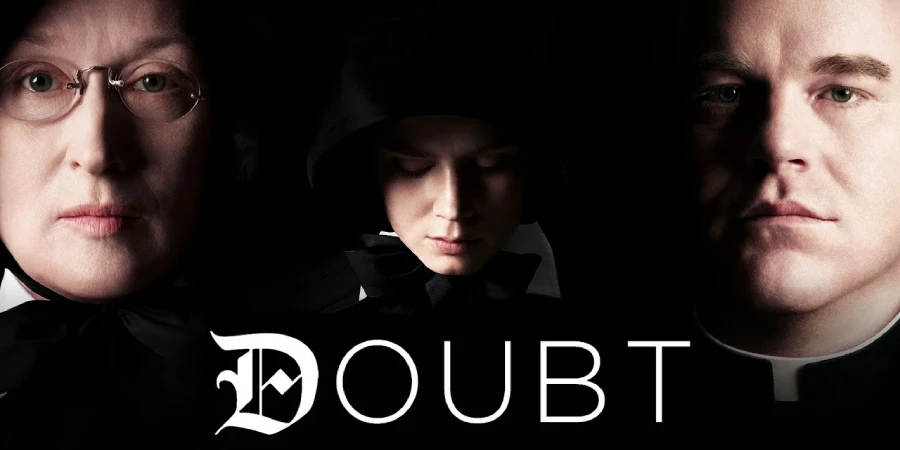
Meryl Streep walks into a confessional and says absolutely nothing, yet you feel her certainty like a cold draft through a church door. Doubt (2008) is a film about conviction without proof, a courtroom drama where no courtroom exists and no verdict ever arrives. Director John Patrick Shanley adapted his own Pulitzer Prize-winning play, and he kept the stage’s suffocating pressure completely intact. Every scene feels like a trap closing around someone.
Detailed Summary
Setting the Stage: St. Nicholas Church School, 1964
We open in the Bronx, autumn 1964, inside a Catholic parish school run with iron precision by Sister Aloysius Beauvier. She surveys her classrooms like a general inspecting troops. Ballpoint pens are contraband. Secular pop music is a moral threat.
Father Brendan Flynn delivers a sermon about doubt, arguing that uncertainty can be as powerful a bond as faith. It is a beautifully constructed opening move by Shanley, planting the film’s central thesis before a single conflict has emerged. Flynn is warm, modern, and well-liked by the students.
A Suspicion Takes Root
Young Sister James notices that Donald Miller, the school’s only Black student, returns from a private meeting with Father Flynn smelling of alcohol, visibly shaken. She reports this to Sister Aloysius. What follows is not an investigation so much as a verdict being constructed around a suspicion.
Sister Aloysius immediately concludes that Flynn has abused Donald. She has no witness, no physical evidence, and no confession. Her certainty is total and terrifying, and Streep plays it with a jaw set so tight it looks physically painful.
The Confrontations Begin
Sister Aloysius summons Father Flynn under the guise of discussing the school’s Christmas pageant. Flynn explains the altar wine incident: Donald was caught drinking by another priest, and Flynn handled it privately to protect the boy from expulsion. His explanation is plausible. It is also exactly the kind of explanation an abuser would construct.
Shanley is disciplined enough never to tip the scales. Flynn’s calm confidence reads simultaneously as innocence and practiced deflection. Sister James begins to waver, wanting to believe in Flynn’s goodness.
Mrs. Miller Enters the Picture
Sister Aloysius arranges a meeting with Mrs. Miller, Donald’s mother, played by Viola Davis in a performance that lasts roughly eight minutes and overshadows nearly everyone else on screen. Mrs. Miller delivers the film’s most morally uncomfortable speech: she knows something happened between Flynn and her son, she suspects her son may be gay, and she wants Donald to survive the year and graduate. She will not pursue it.
Her reasoning is unflinching. A Black boy with a protective priest at his back has better odds in 1964 than one without. It is a brutal calculation, and Davis delivers it with shaking hands and a completely still face. She is not a victim. She is a woman doing math in a world that has never favored her.
Sister Aloysius Escalates
Unable to get the parish priest or the archdiocese to act, Sister Aloysius escalates. She claims, in a direct confrontation with Flynn, that she has contacted his former parish and spoken to a nun who confirmed prior inappropriate behavior. Flynn shatters. His composure cracks entirely as he leans over her desk, his voice dropping into something threatening and raw.
He demands to know who she spoke to. She refuses to answer. This scene is the film’s pivot point, and Philip Seymour Hoffman plays it with a physical desperation that feels completely unscripted, even though every word is from the original play.
Flynn’s Departure
Flynn requests and receives a transfer to a larger parish, and then a promotion to pastor. Sister Aloysius views this as confirmation of guilt. Sister James sees it as a man fleeing a baseless accusation. Both readings fit the same set of facts.
Before he leaves, Flynn delivers a final sermon about gossip as sin, clearly aimed at Sister Aloysius. She sits in the front pew, unmoved. He leaves. She wins, sort of.

Movie Ending
After Flynn departs, Sister Aloysius calls Sister James to the garden. Something in her has given way. She confesses, without irony and without comfort, that she lied. She never called Flynn’s former parish. She invented the previous accusation entirely. It was a bluff designed to break him, and it worked.
Then comes the line that makes the film worth everything that preceded it. Streep’s voice fractures slightly as Sister Aloysius says she has doubts. Not doubts about Flynn’s guilt, necessarily, but doubts about everything: her methods, her certainty, her faith. She weeps. Sister James, the one character who had been the emotional center of the audience’s confusion, can only watch.
Shanley refuses to resolve the central question. We never learn whether Father Flynn abused Donald Miller. Flynn’s transfer and promotion could mean guilt protected by institutional hierarchy. It could mean an innocent man destroyed by a determined woman with no evidence. Both possibilities remain standing at the end credits.
What Shanley does resolve is Sister Aloysius’s internal story. She weaponized her faith against a man she could not prove guilty, and she knows it. Her doubt is not about Flynn. It is about herself. That distinction is what separates this ending from a simple moral puzzle and makes it genuinely unsettling.
Are There Post-Credits Scenes?
No. Doubt contains no post-credits scenes of any kind. Once the credits roll, nothing follows. Sit with the discomfort; that is the point.
Type of Movie
Doubt is a psychological drama with strong elements of moral thriller. Its tone is cold, deliberate, and relentless. There is no action, no comic relief worth naming, and no catharsis.
Pacing is slow by design. Shanley treats silence as a weapon, and every conversation functions like a deposition. Audiences expecting resolution will be frustrated in exactly the way the filmmaker intends.
Cast
- Meryl Streep – Sister Aloysius Beauvier
- Philip Seymour Hoffman – Father Brendan Flynn
- Amy Adams – Sister James
- Viola Davis – Mrs. Miller
- Joseph Foster – Donald Miller
- Alice Drummond – Sister Veronica
- Audrie Neenan – Sister Raymond
Film Music and Composer
Howard Shore composed the score. Shore is best known for his work on The Lord of the Rings trilogy, but his work on Doubt shows a completely different instinct: restraint. Large stretches of the film have almost no music at all.
When the score does appear, it leans heavily on strings played at low register, creating unease rather than emotion. Shore avoids telling the audience how to feel, which perfectly mirrors Shanley’s narrative strategy. It is one of the most underrated scoring jobs of his career.
Filming Locations
Principal photography took place largely in the Bronx, New York, the same borough where the play is set. Production used an actual Catholic school building to ground the visual world in authentic institutional architecture: the long corridors, the heavy wood, the frosted glass in office doors.
Cinematographer Roger Deakins shot the film with a cold, desaturated palette. Exterior scenes frequently feature overcast skies and wind bending the trees, a deliberate pathetic fallacy that keeps the atmosphere unstable. Deakins uses dutch angles sparingly but precisely, tilting the frame during confrontation scenes to suggest that the moral ground itself is uneven.
Awards and Nominations
The film received five Academy Award nominations: Best Actress (Streep), Best Supporting Actor (Hoffman), Best Supporting Actress (Davis), Best Supporting Actress (Adams), and Best Adapted Screenplay (Shanley). It won none. Streep and Hoffman both lost in a notably competitive year.
Viola Davis’s nomination from only eight minutes of screen time became one of the most discussed nomination stories of that awards cycle. Davis herself has spoken about that scene as one of the defining moments of her early film career.
Behind the Scenes Insights
- John Patrick Shanley had not directed a film in nearly two decades before Doubt. His only previous feature was Joe Versus the Volcano (1990).
- Meryl Streep wore a prosthetic nose to physically alter her appearance into something more severe and less recognizable as herself.
- Philip Seymour Hoffman actively resisted playing Flynn as guilty or innocent. He reportedly refused to decide which interpretation was correct, even privately, to preserve his own ambiguity on screen.
- Viola Davis filmed her entire scene in two days. She and Streep reportedly had very little rehearsal time together before shooting, which may account for the authentic tension in their confrontation.
- Amy Adams has described playing Sister James as one of the more emotionally demanding roles of her career, precisely because the character has no satisfying resolution to her internal conflict.
- Shanley kept the physical geography of the film deliberately confined, mirroring the stage production’s spatial limitations even when the camera had no technical reason to stay small.
Inspirations and References
Shanley based the play, and by extension the film, on his own experiences growing up Catholic in the Bronx. He attended Catholic school and has spoken about specific priests and nuns who influenced the characters directly, though he has always stopped short of naming them.
The play was first produced in 2004 and won both the Pulitzer Prize for Drama and the Tony Award for Best Play. Shanley dedicated it to “the ones who said no,” a dedication that pointedly refuses to specify who was being protected or from what.
The broader context of the Catholic Church abuse scandals, which were in full public view by the time both the play and film appeared, is impossible to separate from the text. Shanley has acknowledged that context while also insisting the story is not a thesis about institutional guilt.
Alternate Endings and Deleted Scenes
No alternate ending was released publicly, and Shanley has not discussed filming one. Given how completely the film’s ending mirrors the play’s conclusion, a significantly different version seems unlikely to have existed.
No deleted scenes were included in the standard home release. Shanley’s background in theater likely meant the script arrived on set already stripped of any material he was willing to cut.
Book Adaptations and Differences
Doubt is adapted from Shanley’s own stage play, Doubt: A Parable. It is not based on a novel. The playwright wrote both the stage version and the screenplay himself, which explains how faithfully the film preserves the play’s structure and dialogue.
The most significant difference between stage and screen is scope. Shanley opened the world just enough to include exteriors, the school corridors, and the meeting with Mrs. Miller in a garden rather than indoors. These additions give the film visual breathing room without altering a single thematic beat.

Memorable Scenes and Quotes
Key Scenes
- Sister Aloysius and Sister James’s first private conversation, where Aloysius articulates her suspicion with zero hesitation and complete authority, establishing the film’s moral dynamic in under three minutes.
- The garden confrontation between Mrs. Miller and Sister Aloysius, where Viola Davis delivers her speech about Donald and survival while her hands visibly shake throughout every word.
- Flynn’s eruption when Sister Aloysius claims to have spoken to his former parish; Hoffman leans across the desk, his breath audible, his body suddenly too large for the room.
- Flynn’s sermon on gossip, delivered directly after his confrontation with Sister Aloysius, where the camera cuts to her face in the pew and she does not blink once.
- The final scene in the garden, where Streep’s voice breaks on the word “doubts” and the camera holds on her face without cutting away until the discomfort becomes almost unbearable.
Iconic Quotes
- “I have my certainty.” (Sister Aloysius, to Sister James, delivered as both a declaration and a warning)
- “You have no proof.” / “I have my certainty.” (the exchange that defines the film’s central argument)
- “Doubt can be a bond as powerful and sustaining as certainty.” (Father Flynn, opening sermon)
- “When you take a step to address wrongdoing, you are taking a step away from God, but in His service.” (Sister Aloysius, justifying her methods)
- “I have doubts. I have such doubts.” (Sister Aloysius, the film’s final line)
Easter Eggs and Hidden Details
- Roger Deakins uses dutch angles almost exclusively during scenes where Father Flynn holds authority over other characters, subtly suggesting instability beneath his confident surface without declaring it.
- Sister Aloysius’s office is lit consistently warmer than the rest of the school, a counterintuitive choice that makes her spaces feel less cold than her personality, suggesting the film does not want viewers to simply read her as the villain.
- Flynn is consistently filmed from slightly below eye level in early scenes, a composition associated with power and authority. After Sister Aloysius’s bluff, the camera angles on him flatten noticeably.
- The wind appears in nearly every outdoor scene, almost always bending trees toward the church building. Production design and Deakins collaborated to ensure exterior shots reinforced a sense of pressure coming from the institution itself.
- Donald Miller is never shown in a scene alone with Father Flynn on screen. Every interaction or reference to their relationship is filtered through a third party’s account, making direct observation permanently impossible for the viewer.
Trivia
- The film marks the only time Meryl Streep and Philip Seymour Hoffman appeared together in a leading capacity on screen.
- Amy Adams and Viola Davis both received Best Supporting Actress nominations for the same film, a relatively rare occurrence at the Academy Awards.
- Shanley has stated in interviews that he genuinely does not know whether Flynn is guilty, and that this uncertainty was built into the writing intentionally from the first draft of the play.
- Philip Seymour Hoffman was reportedly skeptical about the project initially, concerned that a stage-to-screen adaptation would feel airless. Roger Deakins’s involvement helped convince him the visual approach would be cinematic rather than merely photographed theater.
- The film was shot in winter conditions, and the actors’ visible breath in outdoor scenes was not artificially enhanced; the temperature was genuinely that cold during filming.
- Shanley cast Adams partly because he wanted Sister James to read as genuinely innocent rather than naive. He felt Adams carried an authentic quality of goodness that could not be faked or manufactured through technique alone.
Why Watch?
Philip Seymour Hoffman leans across that desk, and for roughly four seconds you stop breathing. That is the case for this film: two performers of that caliber, given material this precise, produce something that a hundred better-budgeted movies fail to approximate. Streep’s final breakdown works because she spent ninety minutes making Sister Aloysius look invincible.
Director’s Other Movies
- Joe Versus the Volcano (1990)