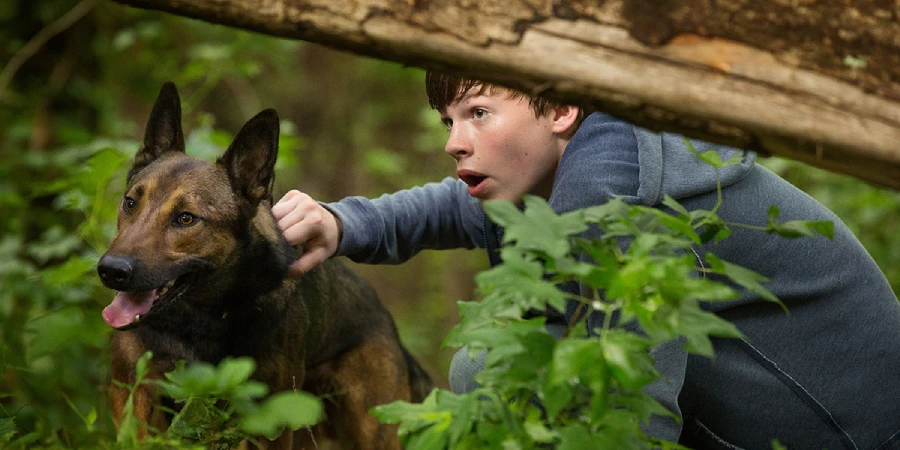

A Belgian Malinois named Max sits beside a flag-draped coffin, refusing to leave, and within two minutes Max (2015) has already done something most family films avoid entirely: it shows grief without softening the edges. Director Boaz Yakin frames this opening funeral with a stillness that feels genuinely heavy. Max is a military working dog who bonded with Marine Kyle Wincott overseas, and when Kyle dies under suspicious circumstances, Max gets assigned to Kyle’s teenage brother Justin. What follows is part family drama, part thriller, and the film earns more than people give it credit for.
Detailed Summary
Kyle Wincott Dies in Afghanistan
Early in the film, we see Kyle Wincott (played by Robbie Amell) working alongside Max during a weapons cache discovery in Afghanistan. His fellow Marine, Tyler Harne, is present. Something goes wrong during the mission, and Kyle is killed. Max witnesses the death and becomes emotionally withdrawn afterward, making him unfit for further military service.
Kyle’s family, back in Lufkin, Texas, receives the news. His parents, Ray and Pamela Wincott, and his teenage brother Justin are devastated in different ways. Ray struggles with pride and guilt. Justin barely knew his older brother and now carries a complicated grief.
Max Comes Home
Because Max bonded so deeply with Kyle, the military decides the dog needs a familiar connection to recover. Kyle’s handler suggests placing Max with the Wincott family. Ray is resistant, but eventually agrees.
Justin initially wants nothing to do with Max. Max, in turn, is aggressive, unpredictable, and clearly traumatized. A pivotal early scene shows Max lunging at strangers and refusing commands from everyone except Justin, who Max recognizes carries Kyle’s scent. That detail, quiet but specific, explains why this particular boy is the only person Max tolerates.
Justin and Max Begin to Bond
Justin’s friend Chuy introduces him to Carmen, Chuy’s cousin, who has experience handling dogs. Carmen becomes an important figure in training Max and in Justin’s life more broadly. She teaches Justin that Max needs structure, not just affection.
Gradually, boy and dog start functioning as a unit. Yakin shoots these bonding sequences with a warm, naturalistic light. You watch Justin’s posture change around Max, less tense, more grounded, and it reads as genuinely earned rather than rushed.
Tyler Harne Arrives and Suspicion Builds
Tyler Harne (Josh Wiggins’s foil in the adult world, played by Luke Kleintank) returns from deployment and presents himself as Kyle’s loyal friend. He visits the Wincotts and wins over Ray. Justin, though, notices Max reacts with pure aggression whenever Tyler is near.
Justin trusts Max’s instincts and starts digging. He finds a video file Kyle sent home before his death, hidden on a memory card. The footage shows Tyler selling stolen military weapons to a cartel operative named Emilio. Kyle apparently discovered this and was going to report it. Max was there when Kyle died, which means Max saw what Tyler did.
The Weapons Trafficking Plot Escalates
Tyler is actively working with Emilio to continue the weapons pipeline even back in the States. Justin shares what he knows with Carmen and Chuy. Chuy, it turns out, has his own complicated ties to Emilio’s operation, which adds a layer of local danger to the story.
Ray, a veteran himself, remains blind to Tyler’s corruption because Tyler represents a version of military brotherhood Ray respects. This dynamic is one of the film’s sharper ideas: the way loyalty to an institution can stop people from seeing what’s directly in front of them.
Justin Confronts Real Danger
Emilio’s crew begins threatening Justin after realizing he knows too much. A tense scene in the woods puts Justin, Carmen, and Max against armed men connected to the cartel. Max goes into full working-dog mode here, and the action is more visceral than you’d expect from a PG family film.
Chuy ends up trapped between his family loyalty to the cartel connection and his friendship with Justin. His arc resolves with him making the right choice, though it costs him something real.
Movie Ending
Tyler corners Justin and tries to recover the incriminating video evidence. He has a gun. Justin is alone except for Max, and what follows is the film’s best sequence: Max attacks Tyler with the full force of a trained military dog, pinning him and giving Justin enough time to survive. Kleintank plays Tyler’s desperation well in these final minutes, all twitchy self-preservation with the charm finally stripped away.
Emilio also meets his end during the climactic forest confrontation. Local law enforcement, tipped off partly by events set in motion by Justin and Carmen, arrives in time to close out the threat. Tyler’s crimes are exposed, and the truth about Kyle’s death finally surfaces.
Ray, confronted with proof that his trusted Marine friend murdered his son, has to absorb something brutal. The film gives Ray a quiet moment of reckoning that works better than any speech could. He doesn’t collapse dramatically; he just goes still.
Justin is cleared of any wrongdoing, and Max, rather than being returned to service or euthanized, gets to stay with the Wincott family permanently. Justin formally adopts him. It is a simple, clean ending, but it lands because the film spent real time building that bond. Max lying next to Justin at the close feels like relief, not sentimentality.
Are There Post-Credits Scenes?
Max does not include any post-credits scenes. Once the final scene ends, the film is done. You can leave when the credits start.
Type of Movie
Max is a family adventure drama with a genuine thriller subplot running underneath. The tone sits closer to a late-1990s live-action family film than a modern blockbuster, grounded, slightly earnest, and unafraid of real emotional weight. There are action sequences, but grief and loyalty drive everything.
Cast
- Josh Wiggins – Justin Wincott
- Thomas Haden Church – Ray Wincott
- Robbie Amell – Kyle Wincott
- Luke Kleintank – Tyler Harne
- Lauren Graham – Pamela Wincott
- Mia Xitlali – Carmen
- Dejon LaQuake – Chuy
- Carlos AVila – Emilio
- Max – Himself (the dog, portrayed primarily by a Belgian Malinois named Carlos)
Film Music and Composer
Trevor Rabin composed the score for Max. Rabin is best known for his rock background with the band Yes and for his film work on action-heavy productions. His score here is warmer and more restrained than his usual output, relying on acoustic textures to support the film’s emotional beats rather than overwhelm them.
The score does its job without calling attention to itself, which is exactly right for this kind of story. A few country-influenced cues ground the Texas setting effectively.
Filming Locations
Max shot primarily in and around New Orleans, Louisiana, standing in for Lufkin, Texas. Louisiana’s film tax incentives made it a practical choice, and the production used wooded areas and suburban neighborhoods that read convincingly as East Texas.
Some military sequences and opening Afghanistan-set scenes used controlled locations designed to suggest a combat environment. The thick forest scenes in the film’s third act benefit from Louisiana’s genuine dense tree coverage, giving those sequences a claustrophobic texture that a studio backlot could not replicate.
Awards and Nominations
Max did not receive major awards attention from mainstream critics’ circles or guilds. It found its audience through family and dog-loving communities rather than awards campaigns.
Behind the Scenes Insights
- The dog who played Max was a Belgian Malinois named Carlos. Training a Malinois for film work is significantly more intensive than training a German Shepherd, because Malinois are higher-energy and more reactive.
- Josh Wiggins had no prior major film experience before landing the lead role. Director Boaz Yakin cast him partly for his natural, unpolished quality on screen.
- The production worked closely with consultants familiar with military working dog programs to get the behavioral details of Max’s PTSD-like symptoms accurate.
- Thomas Haden Church reportedly worked to bring genuine complexity to Ray, pushing back against a purely one-note “stern father” reading of the character.
- Multiple trained dogs shared the role of Max across different scenes depending on what specific behaviors were needed in each shot.
Inspirations and References
The film draws on real awareness of military working dogs and the challenges they face when handlers are killed or when they return from combat with behavioral trauma. Programs that place retired military dogs with veterans’ families provided a factual foundation for the central premise.
Boaz Yakin has spoken about wanting to frame the dog’s grief as parallel to human grief, drawing from documented cases where military dogs refused to leave their handler’s side after death. The opening funeral scene directly echoes real events that received media attention in the early 2010s.
Alternate Endings and Deleted Scenes
No officially released alternate endings or significant deleted scenes have been made publicly available for Max. The home release did not include a substantial behind-the-scenes package with cut content.
Book Adaptations and Differences
Max is an original screenplay, not based on a book or pre-existing source material. A novelization was released to accompany the film, written by Jennifer Li Shotz, which expanded the story for young readers. The novelization follows the film’s plot closely rather than diverging into new territory.


Memorable Scenes and Quotes
Key Scenes
- The funeral: Max lies against the flag-draped coffin, whining softly. Nobody can move him. The camera holds on his face, not the family’s, and that choice says everything about whose grief the film centers first.
- Max recognizes Justin: The first moment Max calms down around Justin, sniffing him and then pressing his head against Justin’s leg. Wiggins goes completely still, barely breathing, and you feel exactly how fragile that trust is.
- Justin watches the memory card footage: His face cycles from confusion to horror in a close-up with no dialogue. It is the best bit of acting Wiggins delivers in the film.
- Max attacks Tyler: Shot with actual urgency. The dog’s speed is startling, and Kleintank sells the fear convincingly with his body, not just his face.
- Ray goes still: After learning Tyler killed Kyle, Thomas Haden Church delivers pure silence. No tears, no speech, just a man absorbing something that breaks him internally.
Iconic Quotes
- “He picked you. Don’t let him down.” – Said to Justin about Max, a line that doubles as the film’s thesis.
- “Dogs don’t lie.” – Carmen, cutting through adult skepticism about what Max’s behavior means.
Easter Eggs and Hidden Details
- Max’s combat harness in the early Afghanistan scenes matches the actual gear used by real military working dogs, a detail most viewers will miss but which grounds the film’s authenticity.
- When Tyler visits the Wincott house early in the film, Max growls and then immediately retreats to a corner, pressing against the wall. That specific posture mirrors documented stress responses in traumatized working dogs and doubles as Max communicating what he knows about Tyler.
- Justin’s bedroom has a small detail early in the film that establishes his interest in gaming and his social isolation before Max enters his life, setting up the shift in his character without any dialogue drawing attention to it.
Trivia
- Belgian Malinois became widely recognized by general audiences partly through films like Max, following increased public interest in the breed after military dog stories gained media coverage in the early 2010s.
- Josh Wiggins was a teenager from Georgia with limited acting experience when he was cast. Yakin reportedly saw hundreds of kids before choosing him.
- The film was produced by Lionsgate and Warner Bros. as a joint release, an unusual pairing for a family film of this scale.
- Thomas Haden Church was coming off a stretch of mostly comedic roles when he took the part of Ray, making his restrained dramatic work here one of the more underrated performances in his recent career.
- The Malinois breed requires a very specific handling approach on set. Standard dog-training techniques used for German Shepherds can actually create dangerous behavior in a Malinois if applied incorrectly, which is why the production’s animal wranglers were specialists in the breed.
Why Watch?
Thomas Haden Church’s performance alone makes this worth your time: he turns a stock “tough dad” role into something genuinely painful by doing almost nothing. Pair that with a third act that commits to real stakes for a family film, and you have something that respects its audience more than the marketing suggests.
Director’s Other Movies
- Fresh (1994)
- A Price Above Rubies (1998)
- Remember the Titans (2000)
- Uptown Girls (2003)
- Now You See Me (2013)
Recommended Films for Fans
- Hachi: A Dog’s Tale (2009)
- War Dog: A Soldier’s Best Friend (2017)
- Benji (1974)
- Rescued by Ruby (2022)
- Eight Below (2006)
- Megan Leavey (2017)