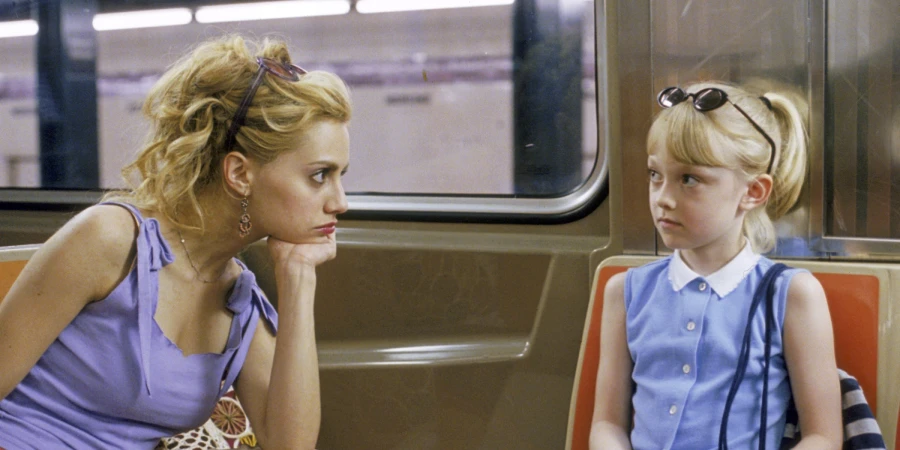

Brittany Murphy plays a broke heiress who can barely boil water, and somehow that premise produces one of the more quietly affecting coming-of-age stories of the early 2000s. Uptown Girls arrived in 2003 with modest expectations and a bubblegum marketing campaign that buried what the film actually does well: it puts two emotionally stunted people in a room together and lets them teach each other how to grow up. Critics panned it on release, but it has since been reappraised as a 2000s cult favorite, and Murphy’s performance deserved a wider conversation than it received at the time.
Detailed Summary
Molly Gunn’s Financial Freefall
We meet Molly Gunn (Brittany Murphy) living off the trust fund left by her rock-star father, Tommy Gunn, who died in a plane crash along with her mother when she was a child. She floats through Manhattan without a single adult responsibility. At her birthday party, thrown by her best friends Huey and Ingrid, she falls for a singer named Neal Fox.
Then she learns that her father’s accountant has embezzled her money, leaving her penniless and homeless. She moves in with Ingrid, on the condition that she finds a job.
Enter Ray Schleine
Lorraine “Ray” Schleine (Dakota Fanning) is the eight-year-old girl Molly ends up nannying. Ray is the polar opposite of Molly: rigidly disciplined, obsessively neat, a hypochondriac, and emotionally armored in a way no child should be. She refuses to act her age and carries herself like a tiny CEO.
Ray’s mother, Roma Schleine (Heather Locklear), is a wealthy music executive who is almost entirely uninvolved in her daughter’s life. Ray’s father is in a coma after a stroke and is cared for at home by a private nurse. Ray avoids him, repressing her feelings behind a strict regimen of order.
Chaos Meets Control
Molly does not move in with the Schleines. She stays with Ingrid and, after the two fall out, with Huey. The clash between Molly’s chaos and Ray’s control produces most of the film’s comedy.
Ray already loves ballet, but only by the rules. She refuses to freestyle and likes to quote Baryshnikov. Molly keeps trying to show her how to have fun, and the friction between them slowly becomes something warmer.
Molly and Neal
Neal Fox (Jesse Spencer) is a singer-songwriter, not a band member. After a few intense days with Molly he leaves abruptly, saying he cannot be part of her disordered life. Molly keeps his lucky jacket in the hope of seeing him again, damages it in a kitchen fire, and redesigns it to hide the damage. When Neal sees it, he breaks things off for good, saying he needs to focus on his music.
He soon lands a record deal with Roma and scores a hit music video with a song Molly inspired, wearing the jacket she remade. Later, after spending a night at the Schleine apartment, Molly discovers that Neal has slept with Roma.
Ray’s Control and Its Source
Ray’s rigidity is grief wearing a business suit. She cannot face her father’s condition, so she controls everything else instead. Molly, who never processed her own parents’ deaths, recognizes the pattern.
Molly takes Ray to Coney Island and tells her that after her parents died she ran there and rode the teacups. She encourages Ray to talk to her comatose father and promises it will help him.
The Break and the Fallout
Ray’s father dies the next day. Furious that Molly raised her hopes, Ray tells her mother to fire Molly. Before leaving, Molly confronts Roma in her office about her emotional neglect of Ray.
On her way out she runs into Neal, who begs for another chance and calls her his muse. Molly turns him down, telling him he only cares about her when it is convenient.



Movie Ending
Ray runs away from home, and Roma begs Molly to find her. Molly finds her at Coney Island, riding the teacups. Ray lashes out at her and then collapses into her arms, finally crying. It is the emotional payoff the whole film has been building toward.
Molly then takes charge of her own life. Following Ray’s advice, she auctions her father’s guitar collection to an anonymous buyer, which lets her afford her own apartment. At the wake for Ray’s father, several musicians who saw Neal’s jacket in his video ask her to design clothes for them. She makes up with Ingrid, apologizes to Ray, promises to stay her friend, and enrolls in design school.
In the final scene, Molly arrives late to Ray’s recital and sees Ray wearing a tutu Molly designed. Ray dances freestyle while Neal sings “Molly Smiles,” the song Tommy Gunn wrote for his daughter, on Tommy’s acoustic guitar. The other ballerinas dance with the rest of the collection, which suggests the Schleines were the anonymous buyers.
Molly and Neal do not clearly get back together. The ending is hopeful because Molly has found a direction and Ray has learned to let go, not because of the romance.
Are There Post-Credits Scenes?
Uptown Girls has no post-credits scene. You can leave when the credits start rolling.
Type of Movie
Uptown Girls is a comedy-drama. It plays as a fish-out-of-water comedy in its first act and a grief drama by its third. That tonal range is both its strength and the reason some viewers feel whiplashed.
Cast
- Brittany Murphy – Molly Gunn
- Dakota Fanning – Lorraine “Ray” Schleine
- Heather Locklear – Roma Schleine
- Jesse Spencer – Neal Fox
- Donald Faison – Huey
- Marley Shelton – Ingrid
- Austin Pendleton – Mr. McConkey
- Marceline Hugot – Nurse
Film Music and Composer
Joel McNeely composed the score. The soundtrack album, Uptown Girls (Music from and Inspired by the Motion Picture), was released by Nettwerk on August 5, 2003. It includes songs by Jesse Spencer, Leigh Nash, Chantal Kreviazuk and Toby Lightman, among others.


Filming Locations
The film is set in Manhattan and makes prominent use of New York City, including Coney Island, which serves as the emotional anchor for both Molly and Ray.
Awards and Nominations
Uptown Girls did not receive major awards attention. IMDb lists two nominations for the film.
Reception and Box Office
- Released in the U.S. on August 15, 2003; running time 92 minutes.
- Opened at number five with about $11.3 million and grossed about $44.6 million worldwide.
- Critics were harsh: 14% on Rotten Tomatoes and 33 on Metacritic. Audiences were warmer, giving it an A– CinemaScore.
- Roger Ebert was a notable exception, giving it three stars out of four and comparing Murphy to Lucille Ball.
Behind the Scenes Insights
- Director Boaz Yakin had mostly made grittier dramas before this project, so the film was a notable change of register for him.
- The film was produced by John Penotti, Fisher Stevens and Allison Jacobs, and shot by cinematographer Michael Ballhaus.
- After Murphy’s death in 2009, Fanning said she cherished their time together on the film. In 2020 she recalled that Murphy made every day on set special.
Inspirations and References
The script uses the classic odd-couple structure, pairing a hyper-responsible child with an irresponsible adult. Molly’s backstory as the daughter of a dead rock legend connects to a long tradition of stories about children who inherit fame and loss in equal measure.
Alternate Endings and Deleted Scenes
No alternate ending is documented, but deleted scenes do exist. The 2004 special edition DVD includes thirteen deleted scenes, along with two featurettes (“The Lowdown on Uptown” and “Rockin’ Style”) and Chantal Kreviazuk’s “Time” music video.


Book Adaptations and Differences
Uptown Girls is not based on a book. The screenplay by Julia Dahl, Mo Ogrodnik and Lisa Davidowitz was developed from an original story by Allison Jacobs.
Memorable Scenes and Quotes
Key Scenes
- Molly telling Ray about the teacups at Coney Island.
- Ray on the teacups after her father’s death, hitting out at Molly and then breaking down in her arms.
- Molly confronting Roma about neglecting her daughter.
- Molly turning Neal down when he asks for another chance.
- The recital finale, with Ray dancing freestyle to “Molly Smiles.”
Iconic Quotes
- “Fundamentals are the building blocks of fun.” Ray’s favorite maxim, which she attributes to Mikhail Baryshnikov.
Easter Eggs and Hidden Details
- The funeral scene features celebrity cameos, including Nas, Carmen Electra, Mark McGrath, Dave Navarro and Duncan Sheik.
- Producer Fisher Stevens appears on screen as a funeral guest.
- The guitars the ballerinas dance with at the recital are Tommy Gunn’s auctioned collection, which quietly reveals who bought them.
Trivia
- Dakota Fanning, born in 1994, was nine when the film was released and plays an eight-year-old.
- The film opened in mid-August 2003 behind Freaky Friday, Open Range, S.W.A.T. and Freddy vs. Jason.
- Jesse Spencer performs his own songs on the soundtrack. He later became known for long-running TV roles in House and Chicago Fire.
- The film came out on DVD and VHS on January 6, 2004, and on Blu-ray in 2016.
Why Watch?
Murphy’s physical comedy in the first act is reason enough to start watching, but Fanning’s slow, precise dismantling of Ray’s armor is the real reason to stay. What looks like a glossy Manhattan confection turns out to have a bruised, genuine heart underneath it all.
Director’s Other Movies
- Fresh (1994)
- A Price Above Rubies (1998)
- Remember the Titans (2000)
Recommended Films for Fans
- Big (1988)
- Harriet the Spy (1996)
- Little Miss Sunshine (2006)
- 13 Going on 30 (2004)
- Riding in Cars with Boys (2001)