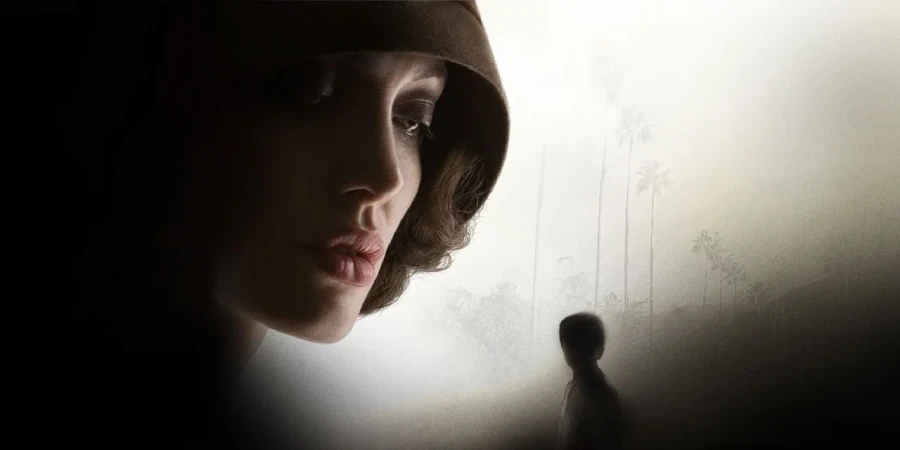

Clint Eastwood’s 2008 film puts a mother’s worst nightmare on screen and then keeps making it worse. Christine Collins gets her son back, except it isn’t her son, and the Los Angeles Police Department insists she is simply wrong. What follows is a legal, psychological, and criminal horror story based on real events from 1928 Los Angeles, a period when the LAPD was notoriously corrupt and women had almost no institutional recourse. Angelina Jolie carries nearly every scene on her shoulders, and the film never lets her, or the audience, off easy.
Detailed Summary
Christine Collins and Her Son Walter
Christine Collins, played by Angelina Jolie, is a single mother and telephone operator supervisor living in Los Angeles in 1928. She raises her son Walter Collins alone and their relationship feels warm and specific, not just functional backstory.
One afternoon, Christine is called into work unexpectedly. She leaves Walter at home alone, promising to return soon. When she comes back, Walter is gone.
The Disappearance and the Long Search
Christine reports Walter missing to the LAPD. Sergeant J.J. Jones, played by Jeffrey Donovan, takes the report but offers little urgency. Christine spends months searching on her own.
Five months later, police captain J.J. Jones contacts her with good news: a boy matching Walter’s description has been found in Illinois. Christine prepares to reunite with her son at a public, media-covered arrival at a Los Angeles train station.
The Wrong Boy
When the boy steps off the train, Christine immediately knows something is wrong. She tells Jones plainly: this is not her son. Jones pressures her to take the child home anyway, framing it as temporary while they investigate.
At home, the differences pile up fast. The boy is three inches shorter than Walter. His teeth are different. A circumcision mark does not match Walter’s medical records. Christine brings these facts to the police, and Jones dismisses every single one.
His teacher confirms the boy is not Walter. Christine’s own doctor confirms it. Jones responds by suggesting that time apart and trauma have made Christine misremember her own child. This is the film’s cruelest and most precise observation: institutional power can gaslight one woman into doubting her own motherhood.
Captain Jones and the LAPD’s Corruption
Jones represents a pattern, not just a bad apple. The LAPD under Chief James Davis, played by Colm Feore, operates as a political machine. Silencing Christine protects the department’s carefully staged good-news story about finding a missing child.
Captain Gustav Briegleb, a Presbyterian minister and radio broadcaster played by John Malkovich, has been publicly criticizing the LAPD for years. He becomes Christine’s most vocal ally.
Christine Committed to a Psychiatric Ward
When Christine refuses to stop insisting the boy is not Walter, Jones has her committed to the Los Angeles County Hospital psychiatric ward. He uses a procedural tool called a “Code 12,” which allowed police to institutionalize people without a judicial order.
Inside the ward, Christine meets Carol Dexter, played by Amy Ryan, a woman who was also committed after speaking out against a corrupt officer. Carol becomes a crucial guide, explaining how the ward operates and how women end up trapped there.
Dr. Jonathan Steele runs the ward and functions as an extension of LAPD authority. Christine’s presence there is a punishment, not a diagnosis.
The Northcott Ranch
Parallel to Christine’s ordeal, a Canadian teenager named Sanford Clark escapes from a chicken farm in Wineville, California, and goes to police. He tells detectives about his uncle, Gordon Northcott, played by Jason Butler Harner.
Northcott had abducted and murdered multiple young boys at his ranch. Police find human remains on the property. Walter Collins may have been one of Northcott’s victims.
Jason Butler Harner’s performance as Northcott is genuinely disturbing. He plays the character with twitching, nervous energy and a child-like need for attention that makes the violence feel even more wrong.
Christine Fights Back
Attorney S.S. Hahn, working with Briegleb, launches a legal challenge. A judge orders Christine released from the psychiatric ward. Her release is a significant legal moment: it marks the first successful challenge to the LAPD’s use of Code 12 against citizens.
Christine then files a civil lawsuit against Captain Jones personally. She wins, and Jones is fired. The courtroom sequence is satisfying but the film keeps its focus on Christine’s grief rather than the legal victory, which is the right call.
Gordon Northcott’s Trial and Execution
Northcott is arrested in Canada after fleeing the United States. His trial focuses on the ranch murders. He is convicted and sentenced to death.
Before his execution, Christine visits Northcott in prison. She asks him directly whether he killed Walter. Northcott toys with her, offering partial hints and then retracting them. He is executed without ever giving her a clear answer.
This scene is quietly devastating. Jolie sits across from Harner in a small room and does almost nothing except listen, and the restraint makes the moment hit harder than any dramatic outburst would.
The Impostor Boy
The boy who came off the train eventually admits he is Arthur Hutchins, a runaway from Iowa who had been pretending to be Walter to get a free ride to California and meet a movie star. His admission does not help Christine legally or emotionally, it only confirms what she already knew.

Movie Ending
In 1930, one of Northcott’s ranch hands, a boy named Sanford Clark, tells police that he witnessed Walter Collins alive at the ranch after the date Northcott claimed to have killed him. A search of a second property turns up evidence that some boys may have escaped. Police find a boy who survived the ranch, and he confirms Walter was there and that Walter ran.
Christine receives this information and, in the film’s final scene, she allows herself a small, cautious moment of hope. She does not know if Walter is alive. She does not know where he might be. Eastwood and screenwriter J. Michael Straczynski resist giving her, or the audience, a clean resolution.
Jolie delivers the film’s most precise acting choice here. When told there is still hope, she does not smile broadly. A tiny, almost reluctant softening crosses her face, the expression of a woman who has learned to be careful about hope. It is the best moment in the film.
In real life, Walter Collins was never found. Eastwood holds a title card over the final image confirming this. Christine Collins continued searching for Walter for the rest of her life. That real-life fact, placed on screen after the credits, does more work than any scripted line could.
Are There Post-Credits Scenes?
No. Changeling has no post-credits scenes. The film ends with title cards explaining what happened to the real people involved, and that is the appropriate final note for a true story with no comfortable ending.
Type of Movie
Changeling is a crime drama with strong elements of a legal thriller and a psychological drama. It is also, in stretches, a horror film, though one that never relies on genre mechanics to generate dread.
Tonally, the film is slow and deliberate. Eastwood’s pacing is patient to a fault at times, but that patience mirrors Christine’s situation: she must wait, endure, and repeat herself while the world refuses to listen.
Cast
- Angelina Jolie – Christine Collins
- John Malkovich – Reverend Gustav Briegleb
- Jeffrey Donovan – Captain J.J. Jones
- Colm Feore – Chief James Davis
- Jason Butler Harner – Gordon Northcott
- Amy Ryan – Carol Dexter
- Michael Kelly – Detective Lester Ybarra
- Gattlin Griffith – Walter Collins
- Eddie Alderson – Sanford Clark
- Devon Conti – Arthur Hutchins (the impostor boy)
- Denis O’Hare – Dr. Jonathan Steele
Film Music and Composer
Clint Eastwood composed the score himself, as he frequently does. His musical approach here is spare and mournful, leaning on piano and strings rather than swelling orchestration.
The main theme is delicate and keeps a kind of restrained sadness throughout the film. Eastwood the composer understands the material the same way Eastwood the director does: neither indulges in sentimentality, both trust silence when silence serves better than sound.
This is one of the most underrated elements of the film. Critics focus on Jolie’s performance, but Eastwood’s musical choices actively shape how measured the emotional experience feels from start to finish.



Filming Locations
Principal photography took place primarily in and around Los Angeles, California. The production worked to recreate late 1920s Los Angeles, relying heavily on period-appropriate architecture still standing in the city.
The Los Angeles Times Building and other historic downtown structures appear in the film. Universal Studios backlot sets supplemented location work to fill in street scenes that required period dressing.
Location matters enormously to this story. Los Angeles in 1928 was a city actively constructing its own mythology, and the film’s production design uses that context well, showing a city that looks aspirational on the surface but runs on corruption underneath.
Awards and Nominations
Angelina Jolie received an Academy Award nomination for Best Actress for her performance. The film also received nominations at the Cannes Film Festival, where it competed for the Palme d’Or.
Jolie won several critics circle awards for the role. The film received additional nominations at the Golden Globes and BAFTA, though it did not win in the major categories at either ceremony.
Behind the Scenes Insights
- Screenwriter J. Michael Straczynski wrote the first draft of the script in eleven days after researching the real case extensively in Los Angeles city archives.
- Straczynski found actual transcripts from the court hearings, which informed much of the dialogue in the legal sequences.
- Eastwood shot the film on a tight schedule, consistent with his well-known preference for minimal takes and fast production.
- Jolie has described the emotional weight of playing Christine as particularly heavy given that she was a mother herself at the time of filming.
- The production design team spent considerable effort sourcing period-accurate telephone switchboard equipment for the scenes at Christine’s workplace.
- Eastwood reportedly kept the tone on set quiet and controlled, discouraging excessive rehearsal and preferring actors to arrive fresh to emotional scenes.
Inspirations and References
The film is based directly on the real Wineville Chicken Coop Murders and the Christine Collins case from 1928 Los Angeles. Straczynski drew from court documents, newspaper archives, and LAPD records.
The town of Wineville, California, changed its name to Mira Loma after the murders because residents wanted to escape the association. That detail speaks to how deeply the case scarred the community.
No single book served as the primary source. Straczynski’s research was archival rather than literary, which gives the screenplay an unusual quality: it reads like a case file that gradually reveals something unbearable.
Alternate Endings and Deleted Scenes
No officially released alternate ending exists for Changeling. Eastwood’s productions are not known for extensive alternate cut material being made publicly available.
Some scenes involving the psychiatric ward were reportedly longer in early cuts, providing more detail about the other women committed there. Trimming these scenes kept the pacing tighter, though some of that material might have deepened Carol Dexter’s character further.
Book Adaptations and Differences
Changeling is not based on a book. The screenplay draws directly from historical records and court documents related to the real Christine Collins case and the Northcott murders.
Some dramatic compressions and composite moments exist in the script, as Straczynski shaped the timeline for narrative clarity. Nothing in the film fundamentally distorts the historical record, though certain conversations and private interactions are necessarily reconstructed.



Memorable Scenes and Quotes
Key Scenes
- The train station arrival: Christine walks toward the boy on the platform, and her pace slows almost imperceptibly the moment she sees his face. No one else notices. The camera stays on her eyes.
- The psychiatric ward introduction: Dr. Steele explains the ward’s rules to Christine while she stands in a hospital gown, stripped of everything that marks her as a functioning adult.
- Christine confronting Northcott in prison: The two sit across a table, and Harner’s Northcott folds and unfolds his hands constantly while Jolie’s Christine sits perfectly still. The contrast does the work.
- Christine’s release from the ward: She walks out in her own clothes and the film does not punctuate the moment with music. The silence is the point.
- The final scene: Christine hears that Walter may have escaped. She processes the information alone, and Jolie’s face moves through five emotions in about four seconds without a single word.
Iconic Quotes
- “I will never stop looking for my son.” Christine Collins, to Captain Jones.
- “Never start a fight. But always finish it.” Christine to Walter, early in the film, a line that echoes back at the end.
- “You know what LAPD stands for? ‘Lions, apes, and dogs patrol.'” Reverend Briegleb on his radio broadcast.
Easter Eggs and Hidden Details
- The film’s color palette shifts subtly as Christine’s situation deteriorates. Early scenes use warmer amber tones; the psychiatric ward sequences are cooler and more desaturated, a deliberate choice by cinematographer Tom Stern.
- Christine’s uniform at the telephone exchange mirrors, in cut and color, the uniforms worn by nurses in the psychiatric ward, a visual suggestion that both environments control and confine women.
- The boy who claims to be Walter repeatedly glances at Christine with a slight calculation in his eyes that Eastwood keeps in frame long enough for attentive viewers to catch before any dialogue confirms the deception.
- Briegleb’s radio station call letters and broadcast details are historically accurate, grounding his character firmly in documented record rather than dramatic invention.
Trivia
- The real Christine Collins reportedly never fully accepted that Walter was dead, and continued hoping he had escaped from the Northcott ranch.
- Gordon Northcott’s actual trial was a sensational media event in 1920s Los Angeles, drawing crowds to the courthouse.
- Straczynski pitched the script to Eastwood, who committed to direct it quickly after reading it.
- The film was in competition at Cannes in 2008, an unusual placement for a Hollywood studio production of its scale.
- Jolie wore period-specific costumes designed to emphasize Christine’s vulnerability: fitted but not glamorous, always a shade or two duller than you might expect for a lead actress.
- The real Arthur Hutchins, the impostor boy, reportedly did it largely to get to Hollywood and meet his favorite celebrities, exactly as depicted in the film.
- Eastwood was in his late seventies during production and directed the film with the same compressed efficiency he has maintained throughout his directorial career.
Why Watch?
Watch it for Angelina Jolie’s hands. Specifically, watch how she grips a doorframe, clutches a handbag, or simply goes still when Christine is pushed past what any person should have to absorb. Jolie built Christine from physical restraint outward, and the result is a performance far more controlled and specific than the Academy conversation around it suggested.
Director’s Other Movies
- Unforgiven (1992)
- Mystic River (2003)
- Million Dollar Baby (2004)
- Letters from Iwo Jima (2006)
- Gran Torino (2008)
- Invictus (2009)
- J. Edgar (2011)
- American Sniper (2014)
- Sully (2016)
- Richard Jewell (2019)