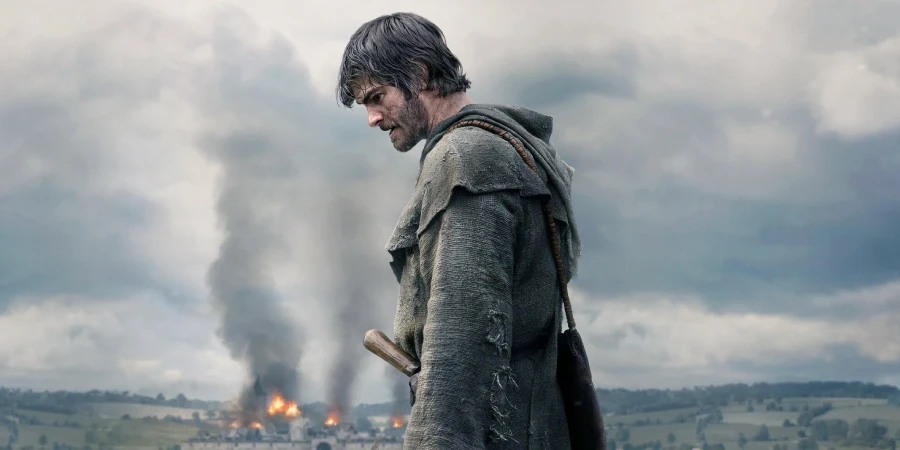
Six centuries ago, England’s poorest people marched on London and forced a teenage king to bargain with them. Paul Greengrass’s The Uprising drops Andrew Garfield into that 1381 revolt as a grieving farmer known only as Ploughman. Brace yourself, because we are spoiling every betrayal, every beheading, and that divisive Robin Hood finale.
Table of Contents
Detailed Summary
England in 1381: A Kingdom Broken by Plague
In 1381, England is still reeling from the Black Death, which wiped out half the population. Fourteen-year-old King Richard II cannot rule alone, and nightmares of demonic mobs haunt his sleep.
His council needs money, yet taxing the Church or the merchant class seems politically impossible. Instead, they squeeze the peasants.
A Ploughman Pushed Too Far
Ploughman survived the plague, but it took his wife and two children. Seven years on, he struggles to work his land alone.
At tax time, the collector demands death taxes for his family all over again, since Ploughman lacks paperwork proving they died. Meanwhile, soldiers subject young women to invasive inspections to decide whether they count as taxable adults.
Ploughman finally snaps. He attacks the tax collector and kills a soldier who tries to arrest him.
The Revolt Spreads: Tyler, Ball, and Alyce
His act of defiance sparks peasant revolts across England. Soon, Ploughman shares leadership with Wat Tyler, a veteran who served the king’s late father, and John Ball, a radical priest the rebels free from prison.
At first, Ploughman resists the role. A village priest guilts him into fighting, insisting his dead family will only find rest if he acts.
Alyce, a fierce young woman who has suffered the Church’s corruption firsthand, joins the cause and stays at Ploughman’s side. Ploughman’s own faith is fraying; in one exchange, he tells Ball that God abandoned his fields long ago.
A Snub on the Thames and the Sack of London
The rebels march on London to petition Richard, believing their king is just but held hostage by corrupt advisers. On his council’s advice, the king sails down the River Thames and shows himself only from a distance.
He never hears their petition. In response, the furious rebels storm London and sack it.
With royal armies still days away, fighting in Scotland and France, the council hatches a plan. Richard will grant the rebels’ demands and then let his soldiers slaughter them when they least expect it.
The King’s Promise and a Night of Blood
Richard meets the rebels and promises self-rule and pardons at the Priory of St. John the next day. Face to face, Ploughman tells the boy that the dead torment his dreams, and Richard vows that torment will end.
Richard even lets the rebels punish his council as traitors. Before long, a mob drags out the councilors and beheads them in the streets.
The night spirals into looting, and the mob starts beheading merchants, including immigrants blamed for stealing local jobs. Horrified, Ploughman, Tyler, and Ball struggle to control the crowd they unleashed.
Movie Ending
Smithfield should have been the rebels’ victory lap. Instead, Mayor William Walworth strikes down Wat Tyler, with the young king secretly behind the killing.
Richard then steps forward, urges the crowd to lay down their weapons, and promises Tyler will meet them at the priory. Sadly, thousands obey.
At the priory, Richard presents Tyler’s severed head. Moments later, royal archers open fire on the unarmed crowd.
Who Survives the Massacre?
Ploughman uncovers the king’s treachery but cannot warn the rebels in time. John Ball refuses to flee and dies alongside the people who followed him.
Ploughman, Alyce, and a handful of survivors escape into the woods. Afterward, the crown burns the charters that promised the people self-governance.
Burying the Farmer
Ploughman returns to his burned village and weeps at his family’s graves. He smears their grave soil across his face and pulls on a hood and a mask.
Symbolically, the farmer dies right there. What rises in his place is something closer to a legend.
One Year Later: Ambush in Sherwood Forest
A year later, King Richard travels through Sherwood Forest when a band of archers ambushes his party. A storm of arrows takes out his guards.
Their leader is Ploughman, now dressed in a green hood. He kills Walworth in single combat, finally avenging Tyler.
Next, he pins Richard to the ground while the boy’s mother begs for his life. He shows the king his own sealed charter, the empty promise that got thousands killed.
Why Does Ploughman Spare King Richard?
Ultimately, Ploughman decides that killing the king would solve nothing. Another king would simply take his place, and a murdered boy would hand the crown a martyr.
Rather than strike, he declares that his people now live beyond the king’s rule. Their defiance, he promises, will torment Richard forever.
Greengrass told IGN he never wanted his hero to die, preferring to end him as a mythic, never-named outlaw. Tellingly, the choice pays off that earlier scene where both men admitted the dead keep them awake.
The Final Image
In the last scene, Richard’s palace sits beneath a thundering sky while the king screams wildly inside. Fittingly, Richard opened the film dreaming of hooded devils; now a hooded man truly haunts him.
Is Ploughman Really Robin Hood?
Not officially. The film never uses the name, yet its epilogue clearly frames Ploughman as the leader of green-clad, bow-wielding forest outlaws.
Greengrass originally titled the project The Hood because of that outlaw ending. In the production notes, he described the original Hood as a simple outlaw, which made the transformation feel right for Ploughman.
Critics, however, stayed divided. The Wrap’s William Bibbiani felt the epilogue ruined an otherwise powerful film, while CBR’s Rachel Leishman wanted even more Robin Hood. In short, Ploughman is Robin Hood in spirit, not in name.
Are There Post-Credits Scenes?
No post-credits scene has been reported for The Uprising. Richard’s screaming nightmare serves as the true final beat, so you can head out once the credits roll.
Type of Movie
Officially, The Uprising is an action period drama about the 1381 Peasants’ Revolt. In practice, it plays like a gritty war epic filtered through Greengrass’s documentary instincts.
Greengrass shoots with what he calls an “unknowing camera,” a restless, handheld vérité style rooted in his journalism background. Admittedly, that shaky approach divided critics.
Tonally, the film is grim, muddy, and furious. Its R rating and 128-minute runtime signal a heavy sit.
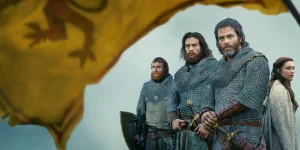
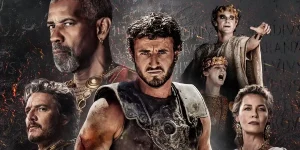
Garfield placed it in the lineage of Gladiator and Braveheart. That said, its political subtext is impossible to miss, from wealth inequality to a post-pandemic mood.
Faith runs through it as well. Garfield told the National Catholic Reporter that Ploughman clings by a thread to his belief in a loving God.
Cast
Garfield leads a stacked ensemble, with Jamie Bell, Cosmo Jarvis, and Thomasin McKenzie at his side.
- Andrew Garfield – Ploughman
- Jamie Bell – John Ball
- Cosmo Jarvis – Wat Tyler
- Thomasin McKenzie – Alyce
- Woody Norman – King Richard II
- Katherine Waterston – Joan of Kent
- Jonny Lee Miller – William Walworth
- Stephen Dillane – Simon Sudbury
- Tom Hollander – Sir Robert Hales
- Stanley Townsend – Robert Bealknap
- Gerald Tyler – Thomas Beauchamp, 12th Earl of Warwick
- Simon Kunz – Sir John Newton
- Sky Yang – The Scribe
- Jamie Maclachlan – Walworth’s Lieutenant
- Dónal Finn – Village Priest
Fun fact: the film never names Richard’s mother on screen. She is simply “The Countess.”
Film Music and Composer
Oscar winner Volker Bertelmann composed the score. Many know him as the pianist Hauschka, and he won his Academy Award for All Quiet on the Western Front. His other credits include Conclave, Lion, and A House of Dynamite.
Bertelmann gives the medieval world a distinctly modern unease, mixing distorted cello textures with bagpipe-like tones. JoBlo’s Chris Bumbray called the score hard-driving.
Back Lot Music released the 28-track album digitally on September 11, 2026. Standout cues include:
- “Uprising Ouverture”: the opening statement of rebellion.
- “Petitions”: the album’s longest track, running over five minutes.
- “The Trap”: a title that points straight at the Smithfield betrayal.
- “The Duel”: a cue whose name matches Ploughman’s showdown with Walworth.
- “No Kings” and “Freeman”: the closing pair, echoing the film’s final message.
In addition, Greengrass shaped the music in an unusual way. He even wrote lyrics for the rebels’ marching songs.
Filming Locations
Although the story unfolds in England, Greengrass shot the film in Germany, mainly across Upper Bavaria and Franconia. Principal photography ran through autumn 2025 with up to 5,000 extras.
Much of the work happened at Penzing Studios, a former airfield about 20 miles outside Munich. In fact, the crew turned a nearby field into a sprawling rebel camp, complete with tents, animal pens, and churned mud.
For London Bridge, the team built one section with two faces, a “French reverse” trick that turns one set into two. Visual effects extended it into the full bridge.
In Nuremberg, the ancient St. Sebaldus Church pulled quadruple duty as Canterbury Cathedral, Windsor Castle, the king’s bedchamber, and a scriptorium. Crews also shot at St. Egidien, around the Rathausplatz and Pellerhaus, and at the Brückkanal in Feucht.
At the Franconian Open-Air Museum in Bad Windsheim, historic buildings became English peasant villages filled with 200 performers. Lichtenau Fortress near Ansbach rounded out the key locations.
Why Germany? Its preserved medieval streets, churches, and fortresses give 1381 a lived-in texture that soundstages rarely match.
Garfield called the extras the film’s secret weapon. He praised the passionate, soulful performances filling every corner of the frame.
Awards and Nominations
So far, The Uprising has not earned any major awards or nominations. Its mixed reviews and quiet box office make a big awards push unlikely.
Behind the Scenes Insights
- The project began in 2022 as The Hood, with Benedict Cumberbatch attached to star.
- By 2025 it had become The Rage with Matthew McConaughey in the lead.
- Eventually, McConaughey departed, and Garfield took over the role.
- Jason Blum came aboard through Blumhouse, and Focus Features landed U.S. distribution.
- Greengrass started writing during the COVID-19 lockdown, drawing on historian Dan Jones‘s work on the revolt.
- Jones briefed every extra on set, and each lead actor had a dedicated core group of background performers for the whole shoot.
- Before Captain Phillips, Matt Damon warned Tom Hanks that first rehearsals with Greengrass feel like total chaos.
- To prepare, Garfield watched Robin Hood movies, the 2010 horror film Black Death, and Ridley Scott’s The Last Duel.
- Greengrass promised “a rip-roaring adventure” rather than a history lecture.
- Critic Tom Shone joined the shoot as an extra, and Greengrass had him improvise a speech begging for pardons.
- Shone’s scene was eventually cut, but Greengrass says it survives among the home release’s deleted scenes.
- Three weeks before release, Focus rebranded the film as The Uprising: The Rise of Robin Hood. By contrast, the U.K. distributor publicly insisted it was not a Robin Hood movie.
Inspirations and References
The backbone is history: the 1381 Peasants’ Revolt, which had never received a film adaptation before.
Greengrass drew on William Langland’s 1377 poem Piers Plowman, which captures a common farmer’s hopes and fears. Interestingly, it contains the first printed mention of Robin Hood.
Historian Dan Jones’s writing on the revolt shaped the script, and Jones served as historical adviser. Greengrass described his hero as “a moderate man in immoderate times.”
He has compared the crowd dynamics to events like Bloody Sunday, where radicals and moderates pull against each other. For Greengrass, the material simply feels urgently contemporary.
Book Adaptations and Differences
No. Greengrass wrote The Uprising as an original screenplay based on real events, not on a novel. Since history is the source, here is how the film compares with the record:
- Ploughman and Alyce: Both are invented. Ploughman stands in for the ordinary, unrecorded people who rose up.
- Tyler’s death: Walworth really did cut down Tyler at Smithfield, and the wounded rebel lost his head soon after.
- The priory trap: Pure invention. The real Richard told the crowd their leader was dead and let them disperse with promises of pardon.
- John Ball: Royal forces hunted down and executed the real Ball after the revolt. Greengrass has him die during the massacre.
- London’s violence: The breach of the Tower, the archbishop’s beheading, and attacks on Flemish merchants all really happened.
- The betrayal: Richard truly reversed his concessions and launched a brutal crackdown, so the film’s spirit matches the record.
- The epilogue: The Sherwood ambush is entirely fictional.
- The Robin Hood timeline: Critics flagged the anachronism, since Piers Plowman already mentions Robin Hood and most adaptations set his story in the late 12th century.
Memorable Scenes and Quotes
Key Scenes
- Tax day: Ploughman attacks the tax collector after soldiers humiliate local women.
- Royal snub: Richard floats past on the Thames without hearing a single petition.
- Face to face: Ploughman and the boy king briefly bond over their sleepless grief.
- Night of heads: the mob beheads councilors and merchants as the leaders lose control.
- Smithfield: Tyler’s severed head, followed by a storm of royal arrows.
- Grave soil: Ploughman paints his face with earth from his family’s graves.
- Sherwood ambush: green-hooded archers strike, and Ploughman kills Walworth in single combat.
- Final haunting: a thunderstorm over the palace and a screaming king.
Iconic Quotes
- “I am what I do.” Ploughman’s blunt self-introduction.
- Describing his ruined world, Ploughman says: “The land is broken.”
- To John Ball, with his faith fraying: “God left my fields long ago.”
- Facing the young king, through gritted teeth: “No kings.”
- Summing up the whole film, the tagline reads: “Rise or die.”
Easter Eggs and Hidden Details
- Ploughman’s name nods to Piers Plowman, the poem containing the first printed reference to Robin Hood.
- Richard opens the film plagued by visions of hooded devils, and a hooded man fulfills that nightmare at the end.
- The score’s second-to-last track is titled “No Kings,” matching Ploughman’s defiant words to the king.
- Similarly, critics linked that “No kings” line to the slogan of recent real-world protests.
- Most characters go by their jobs rather than names, from Ploughman to The Scribe.
- One Nuremberg church plays four different English locations, including Windsor Castle.
- Film critic Tom Shone appears as an extra in a deleted scene.
Trivia
- The film carried two earlier titles: The Hood and The Rage.
- Its U.S. release moved up a day to September 10, 2026.
- Its U.K. release slipped to October 9, 2026.
- It opened in eighth place with $3.3 million.
- Worldwide grosses reached about $6.5 million against a reported $20 million budget.
- Reviews landed at 55% on Rotten Tomatoes and 57 on Metacritic, and audiences gave it a B-minus CinemaScore.
- Focus Features reportedly paid around $11 million for domestic rights.
- According to Time Out, Greengrass shot it in roughly 50 days.
- Consequently, it reached digital platforms less than three weeks after opening.
- A Limited Edition SteelBook features “Rise or Die” printed across the top.
- Garfield surprised fans at a “Lectures on Tap” history event promoting the film.
Why Watch?
Few films dare to make a peasant revolt this raw, this angry, or this relevant. Garfield anchors Greengrass’s chaotic, mud-caked epic with real heart, while the supporting cast keeps the history crackling. Come for the rebellion, and stay to argue about that Robin Hood ending.
Paul Greengrass’s Other Movies
- Bloody Sunday (2002)
- The Bourne Supremacy (2004)
- United 93 (2006)
- Green Zone (2010)
- Captain Phillips (2013)
- Jason Bourne (2016)
- News of the World (2020)
- The Lost Bus (2025)