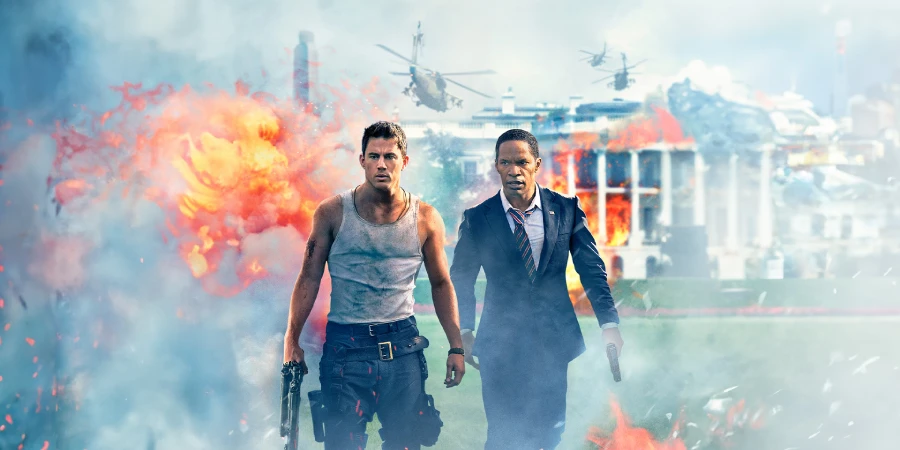

Channing Tatum spends half this movie running through the White House in socks because his dress shoes get lost in a shootout. That detail alone tells you everything about the tone Roland Emmerich is going for here: big, dumb, loud, and weirdly sweet about it. This is a movie where the Capitol Dome practically winks at the camera before things blow up, and somehow that works.
Detailed Summary
John Cale’s Job Interview Goes Nowhere
John Cale (Channing Tatum), a Capitol Police officer with a habit of missing his daughter’s big moments, applies for a Secret Service job on the presidential detail. His old college buddy Carol Finnerty (Maggie Gyllenhaal) shoots him down fast, unimpressed by his job history.
Cale brought his daughter Emily along for the interview because she is obsessed with the White House and the president. That decision turns out to matter a lot once the building starts exploding around them.
The Tour Turns Into a Nightmare
While Cale sulks after his rejection, he takes Emily on a public tour of the White House anyway. Minutes later, a paramilitary group posing as a maintenance crew detonates a bomb in the Capitol and storms the executive mansion.
The attack is fast and brutal. Secret Service agents drop one by one, and the building gets sealed off from the outside world before anyone in the government fully understands what is happening.
Cale and the President Team Up
President James Sawyer (Jamie Foxx) ends up alone with Cale as the only line of defense. What follows is a mismatched buddy pairing that shouldn’t work on paper but clicks because Foxx plays the president as tired and sarcastic rather than heroic on principle.
Foxx and Tatum bounce off each other with genuine chemistry, trading jabs about rocket launchers and Jordans while dodging gunfire. It is the best relationship in the film by a wide margin.
Emily Becomes an Accidental Hero
Separated from her father, Emily hides but eventually gets captured. She livestreams footage of the attackers using her phone, which becomes crucial evidence proving the White House itself has been overrun rather than just facing a random terror threat.
Her subplot could have been unbearable in lesser hands, but the young actress playing her keeps it grounded instead of syrupy.
The Real Villain Reveals Himself
The mercenaries are led by Emil Stenz (Jason Clarke), but the true architect is Walker (James Woods), the outgoing head of the presidential detail. Walker’s motive traces back to grief over his son, a soldier killed in a conflict he blames on the administration’s foreign policy.
Woods plays him with a quiet, wounded bitterness rather than mustache twirling villainy, which makes the betrayal sting more since Cale trusted him minutes earlier.
A Conspiracy Inside the Government
Vice President Alvin Hammond (Michael Murphy) and Speaker Raphelson (Richard Jenkins) get pulled into the chaos too, and the film uses the mess to poke at defense contractors and warmongering politicians. Raphelson’s arc in particular pushes the story’s cynical view of Washington power plays.
The plot’s political commentary is not subtle, but Emmerich has never been a subtle filmmaker, so it fits the movie’s brashness rather than undercutting it.


Movie Ending
Cale and Sawyer spend the back half of the film clawing their way through tunnels, the Situation Room, and eventually the White House lawn while the military hovers outside, unsure who is even in charge anymore. Stenz’s crew tries to trigger a full scale conflict by launching a missile strike using stolen access codes, aiming to provoke a war that benefits the contractors funding Walker’s operation.
Cale manages to get Sawyer’s authentication working just in time to abort the strike, a sequence that plays out with the kind of last second tension Emmerich clearly enjoys staging. Walker gets his hands on Emily as leverage, forcing a final confrontation on the White House lawn in front of news cameras and a crowd of onlookers.
Cale takes down Walker in a scuffle that ends with a flag pole and a nasty fall, closing out the villain without dragging the moment into overlong sentiment. Sawyer, who spends the entire back half proving he is not just a politician in a suit, gets his own hero beat by manning a rocket launcher against an armored vehicle, a scene that is ridiculous and completely earns its laugh.
The ending ties Cale’s arc back to his daughter and to Finnerty, who watches his actions from outside and clearly reconsiders that Secret Service rejection. It is a tidy, crowd pleasing wrap up that never pretends to be anything deeper than a popcorn payoff, and honestly, that restraint from over explaining the politics afterward is the smartest choice in the whole third act.
Are There Post-Credits Scenes?
No. White House Down ends when the credits start, with nothing extra tucked in afterward.
Type of Movie
This is an action thriller with disaster movie DNA, built for popcorn and loud speakers. The tone leans into comedy far more than most White House siege movies, treating the mayhem with a wink rather than grim seriousness.
Cast
- Channing Tatum – John Cale
- Jamie Foxx – President James Sawyer
- Maggie Gyllenhaal – Carol Finnerty
- Jason Clarke – Emil Stenz
- James Woods – Walker
- Richard Jenkins – Speaker Raphelson
- Joey King – Emily Cale
- Michael Murphy – Vice President Alvin Hammond
- Jimmi Simpson – Tyler
Film Music and Composer
The score comes from Harald Kloser and Thomas Wander, longtime Emmerich collaborators who understand exactly what he needs: brass heavy swells for the patriotic beats and pounding percussion for the action. Nothing here reinvents the disaster movie sound, but it hits its marks with the reliability of a metronome.

Filming Locations
Production shot largely in Montreal, with soundstages standing in for the White House interiors and exteriors built to match the real building’s scale. Using Canadian studios kept the production practical while allowing the crew to blow up a full scale White House replica without touching an inch of Washington DC.
Awards and Nominations
The film did not pick up major awards attention and largely flew under the radar during awards season. Its ambitions were always box office and popcorn thrills rather than trophies.
Behind the Scenes Insights
- Roland Emmerich reportedly wanted to inject humor into the disaster genre after years of playing similar destruction fairly straight in films like 2012.
- Channing Tatum has spoken about enjoying the buddy dynamic with Jamie Foxx, pushing improvisation into some of their banter on set.
- The production built extensive sets replicating White House rooms to allow for the level of destruction the script demanded.
- The film arrived in theaters just months after Olympus Has Fallen, another White House siege movie, which hurt its box office performance considerably.
Inspirations and References
The screenplay draws on classic siege thriller structure, echoing Die Hard in its lone hero trapped in a building premise. James Vanderbilt’s script also folds in post 9/11 anxieties about homeland security and distrust of institutional power, though it wears those themes lightly.
Alternate Endings and Deleted Scenes
Home video releases include extended and deleted scenes that flesh out some of the political subplot involving Raphelson and the vice president. None of the alternate material substantially changes the ending, and the theatrical cut remains the tightest version of the story.
Book Adaptations and Differences
This film is not based on a book. James Vanderbilt wrote an original screenplay for the project.



Memorable Scenes and Quotes
Key Scenes
- The Capitol bombing that kicks off the siege, staged with a scale that makes clear Emmerich is not holding back his budget.
- Cale driving the presidential limo across the White House lawn while dangling out the window under gunfire.
- Sawyer firing a rocket launcher from the back of a moving vehicle, the film’s most gleefully absurd action beat.
- Emily waving the American flag out a window as proof of life, a moment that could have been cheesy but lands thanks to Joey King’s sincerity.
Iconic Quotes
- Sawyer telling Cale to get his “Jordans” ready before a chase sequence.
- Cale’s repeated promises to his daughter that he will make it to her events, a running line that pays off in the final scene.
Easter Eggs and Hidden Details
- Emmerich sneaks in his trademark love of monument destruction, this time restrained to mostly the White House itself rather than global landmarks.
- Cale’s Roosevelt Room banter references real historical decor details, a small nod to the production’s research into the actual building’s layout.
- Eagle eyed viewers will spot news ticker graphics referencing other fictional events from Emmerich’s other disaster films, a fun bit of self reference for fans who catch it.
Trivia
- The film released in the same year as Olympus Has Fallen, leading to constant comparisons between the two similarly themed White House thrillers.
- Jamie Foxx based some of his performance on the physical demeanor of real presidents rather than any single individual.
- Channing Tatum did a portion of his own stunt work, particularly during the limo chase sequence.
- Roland Emmerich has cited this film as one of his personal favorites among his own filmography because of its humor.
Why Watch?
Watch it for Jamie Foxx turning the president into a genuinely funny action partner instead of a stiff figurehead who gets rescued. Tatum’s sock footed sprint through the halls sells the movie’s refusal to take itself seriously, and that choice makes ninety minutes of explosions go down easy instead of feeling exhausting.
Director’s Other Movies
- Independence Day (1996)
- Godzilla (1998)
- The Day After Tomorrow (2004)
- 2012 (2009)
- Independence Day: Resurgence (2016)
- Midway (2019)
- Moonfall (2022)
Recommended Films for Fans
- Olympus Has Fallen (2013)
- Die Hard (1988)
- Air Force One (1997)
- London Has Fallen (2016)
- 2012 (2009)