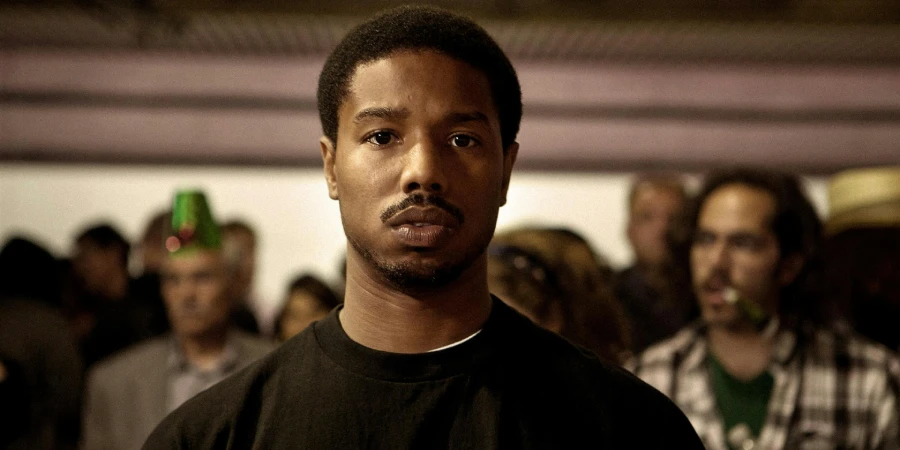

Ryan Coogler made his feature debut with a film built around a real death, a real name, and real footage shot on a real platform. Fruitvale Station opens with actual cell phone video of Oscar Grant’s shooting on New Year’s Day 2009, and that choice sets the entire film’s terms. You already know the ending before the first scene plays out. Coogler dares you to care anyway, and the film makes that dare feel effortless.
Detailed Summary
The Opening Footage
Before any dramatized scene begins, the film plays real, shaky cell phone footage from Fruitvale Station in Oakland. Bystanders recorded BART police officer Johannes Mehserle shooting Oscar Grant in the back while Grant lay face-down on the platform. Coogler puts this in front of everything, refusing to let the audience forget this is not fiction.
New Year’s Eve Morning
We meet Oscar Grant III on what will be the last day of his life, December 31, 2008. He wakes up next to his girlfriend Sophina and they argue, because she has found evidence he was unfaithful. Oscar is 22, charming, and visibly trying to be better than his recent past.
He has recently lost his job at a grocery store after showing up late too many times. In a pivotal scene, he drives to the store to beg his manager for his job back. His manager refuses, and Oscar sits alone in the parking lot, burning the bag of marijuana he had planned to sell.
The Dog
Walking along the street, Oscar witnesses a dog get struck by a car. He rushes to the animal, tries to comfort it, and watches it die at the roadside. Coogler inserts this moment quietly, without score swelling beneath it. It works as a pure character beat, showing Oscar’s instinct toward tenderness before the film shows anything more complicated about him.
Time with His Daughter and Mother
Oscar picks up his young daughter Tatiana and spends the afternoon with her. These scenes are warm and unhurried. Michael B. Jordan plays Oscar’s playfulness with Tatiana without any sentimentality laid on top.
Later, Oscar visits his mother Wanda, played by Octavia Spencer, for a birthday dinner. Family members crowd the kitchen. Oscar helps with the fish, asking his mother for cooking tips over the phone in a scene that feels genuinely lived-in rather than performed.
A Prison Flashback
A brief flashback shows Oscar during a prior prison stint. Wanda visits and tells him she will not come back if he keeps fighting inside. The scene gives the relationship between mother and son its full weight. It also frames Oscar’s effort to change as something concrete, not abstract.
New Year’s Eve Night
Oscar and Sophina, along with friends, decide to take the BART train into San Francisco to watch the fireworks and avoid drunk driving. It is a responsible choice. Coogler frames it with quiet irony, never stating it outright.
On the train, Oscar reconnects with a woman he knows, which gives Sophina a moment of fresh jealousy. The group is loud and celebratory. Oscar moves between conversations, mediating, laughing, keeping the mood up.
The Fight on the Platform
On the return trip, a fight breaks out on the train involving Oscar and a man he had previously clashed with in prison. BART police pull several young Black men off the train at Fruitvale Station and force them to sit against the wall on the platform. Oscar is among them.
The situation escalates. Officers struggle with Oscar. One officer, Johannes Mehserle, draws his weapon and shoots Oscar in the back. Mehserle would later claim he intended to draw his taser. Oscar is left bleeding on the platform while Sophina screams from inside the train.


Movie Ending
Oscar is transported to Highland Hospital in Oakland. Sophina, Wanda, and friends wait through the night. The waiting room scenes are punishing in the best way. Coogler holds on faces rather than cutting to medical action. Wanda prays. Sophina barely speaks. Jordan, through earlier scenes, has made Oscar so present that his absence now registers as a physical thing.
Oscar dies from his injuries early in the morning on New Year’s Day 2009. Wanda collapses. The grief in the room is not performed for the camera. Spencer gives her character’s breakdown a rawness that the film earns honestly because Coogler spent 85 minutes making you believe in this family.
A title card tells us Mehserle was convicted of involuntary manslaughter, not murder. He served 11 months. Another card notes that Oscar’s daughter Tatiana was 4 years old when her father was killed. That detail lands harder than any formal dramatic conclusion could.
The film ends with home video footage of the real Oscar Grant, smiling, alive. It is a small and devastating gesture. Coogler returns Oscar’s humanity in the exact form the film opened by taking it away: actual footage, no mediation, no performance. The symmetry is precise and purposeful.
Are There Post-Credits Scenes?
No. Fruitvale Station has no post-credits scenes. Given the film’s subject matter and tone, anything after the home video epilogue would be completely out of place.
Type of Movie
Fruitvale Station operates as a biographical drama with elements of a day-in-the-life narrative. Its tone is intimate, restrained, and quietly devastating. It shares texture with social realist cinema more than with prestige Hollywood biopics.
Coogler never sensationalizes the subject. He builds dread through ordinariness, which is a far more difficult task than building dread through spectacle.
Cast
- Michael B. Jordan – Oscar Grant III
- Octavia Spencer – Wanda Johnson (Oscar’s mother)
- Melonie Diaz – Sophina Mesa (Oscar’s girlfriend)
- Ariana Neal – Tatiana Grant (Oscar’s daughter)
- Kevin Durand – Officer Caruso
- Chad Michael Murray – Officer Ingram
- Ahna O’Reilly – Katie
- Destiny Ekaragha – Chantelle
Film Music and Composer
Ludwig Goransson composed the score for Fruitvale Station. His work here is deliberately understated. He avoids telegraphing emotion, letting silence and ambient sound carry large portions of the film.
Goransson would go on to score several of Coogler’s later films, establishing a consistent creative partnership. His score for this film does not announce itself. That restraint is one of the most underrated elements of the entire production.
Filming Locations
Coogler shot on location in Oakland, California, including at the actual Fruitvale BART Station. Using the real location was a deliberate act of specificity. This is not a stand-in for a city. This is the exact place where Oscar Grant died.
Scenes at Highland Hospital were also shot at or near the actual facility. Grounding the film geographically in real Oakland gives every neighborhood scene a documentary weight that studio sets simply cannot replicate.
Awards and Nominations
Fruitvale Station won the Grand Jury Prize and the Audience Award in the U.S. Dramatic Competition at the Sundance Film Festival in 2013. It also won the Prize of the Future at the Cannes Film Festival that same year.
Octavia Spencer received significant awards attention for her supporting performance. Michael B. Jordan earned wide critical recognition that helped cement his trajectory as a leading dramatic actor.
Behind the Scenes Insights
- Ryan Coogler grew up in the Bay Area and knew the BART system personally. That familiarity shaped every location choice in the film.
- Michael B. Jordan spent time in Oakland neighborhoods to prepare for the role, meeting people who knew Oscar Grant.
- Coogler wrote the screenplay himself and pursued the project before he had any major industry backing.
- The production shot on location at Fruitvale Station, which required coordination with BART authorities and carried obvious emotional weight for the cast and crew.
- Coogler was in his mid-twenties during production, making the film’s control and composure even more striking.
- Oscar Grant’s family gave their support to the project. That relationship informed the film’s approach to depicting private family moments.
Inspirations and References
The film draws directly from documented events surrounding Oscar Grant’s death. News reports, witness testimony, and the cell phone footage shot by bystanders all informed the screenplay. Coogler conducted research and spoke with people who knew Grant personally.
The social realist tradition in cinema, particularly films focused on a single day in a character’s life, clearly shapes the film’s structure. Works like Rosetta by the Dardenne brothers share this interest in ordinary time as dramatic material, though Coogler came to this form through a distinctly American lens.
Alternate Endings and Deleted Scenes
No officially released alternate endings or significant deleted scenes have been made publicly available for Fruitvale Station. Given how precisely the film’s structure serves its purpose, it is hard to imagine a substantially different cut existing.
Coogler has discussed that shaping the chronology, specifically the decision to open with the real footage, was a key editorial choice that defined everything that followed.
Book Adaptations and Differences
Fruitvale Station is not based on a book. Ryan Coogler wrote an original screenplay based on his own research into Oscar Grant’s life and the events of December 31, 2008, into January 1, 2009.

Memorable Scenes and Quotes
Key Scenes
- Oscar burns the marijuana: Sitting alone in the parking lot of the grocery store where he just got rejected, Oscar takes a bag of weed from his car and sets it on fire. Jordan does almost nothing physically, yet the scene communicates everything about a man at a crossroads.
- The dog scene: Oscar crouches over a dying dog on the roadside, stroking its fur, looking helpless. There is no dramatic music. The moment lasts long enough to feel real.
- The cooking phone call: Oscar calls his mother from the grocery store to ask how to cook fish for a customer. Coogler uses this mundane exchange to show the intimacy between Oscar and Wanda. Spencer, on the other end of the line, gives the scene its warmth.
- The hospital waiting room: Wanda, Sophina, and family members fill a waiting room while Oscar is in surgery. Coogler keeps the camera at ground level. Nobody speaks much. The silence is where the grief lives.
- The shooting: Shot partly from bystander perspectives, the sequence on the platform is chaotic without being exploitative. Oscar is pinned down. A gun fires. Then the film goes quiet.
Iconic Quotes
- “I love you, Mom.” Oscar says this to Wanda during a phone call, casually, the way people say things they mean but do not flag as significant. Given the context, it destroys you.
- “Happy New Year.” Oscar says this on the train platform before everything falls apart. Three words that the film uses to mark the exact moment where ordinary time ends.
Easter Eggs and Hidden Details
- The film includes a scene where Oscar interacts with a white woman named Katie at the grocery store, helping her pick fish. This encounter is not confirmed as historically documented and functions as a scripted grace note, but Coogler places it without fanfare, letting it breathe as a small act of human connection.
- The colors in Oscar’s final hours lean warm: his jacket, the lights of the celebration, the fireworks. Once the platform sequence begins, the palette shifts to harsher artificial light. The shift is subtle enough that most viewers feel it before they notice it.
- Coogler frames Tatiana in several scenes in ways that echo the framing of Oscar, placing them in matching visual compositions to underscore their bond without using dialogue to state it.
- The real cell phone footage at the opening is not edited or stylized. Coogler presents it as a document, not as cinema, and that distinction makes everything that follows feel like a reconstruction of something that actually happened.
Trivia
- Fruitvale Station was Ryan Coogler’s feature film debut.
- Michael B. Jordan and Ryan Coogler had worked together previously on the television series Parenthood, which helped establish their collaborative shorthand before production began.
- The film premiered at Sundance in January 2013 and won two major prizes, generating immediate awards momentum and distributor interest.
- Coogler and Jordan would collaborate again on Creed and Black Panther, making Fruitvale Station the starting point of one of the more significant director-actor partnerships in recent American cinema.
- Oscar Grant’s mother, Wanda Johnson, has been a public advocate for justice in her son’s case. Her involvement and approval mattered deeply to the filmmakers.
- The film runs at a tight length that mirrors its single-day structure. Coogler does not pad it with subplot. Every scene earns its place.
Why Watch?
Michael B. Jordan burns the bag of marijuana alone in a parking lot and does not cry, does not monologue, barely moves, and you feel an entire life’s worth of frustrated good intentions in about forty seconds of screen time. That is what this film offers: a performance so physically precise that it makes a real person feel fully present rather than symbolically mourned. Coogler trusts his actors and his locations over every conventional biopic instinct, and that trust produces something closer to grief than to cinema.
Director’s Other Movies
Recommended Films for Fans
- Do the Right Thing (1989)
- Beasts of the Southern Wild (2012)
- Short Term 12 (2013)
- The Florida Project (2017)
- Moonlight (2016)
- Just Mercy (2019)
- Detroit (2017)