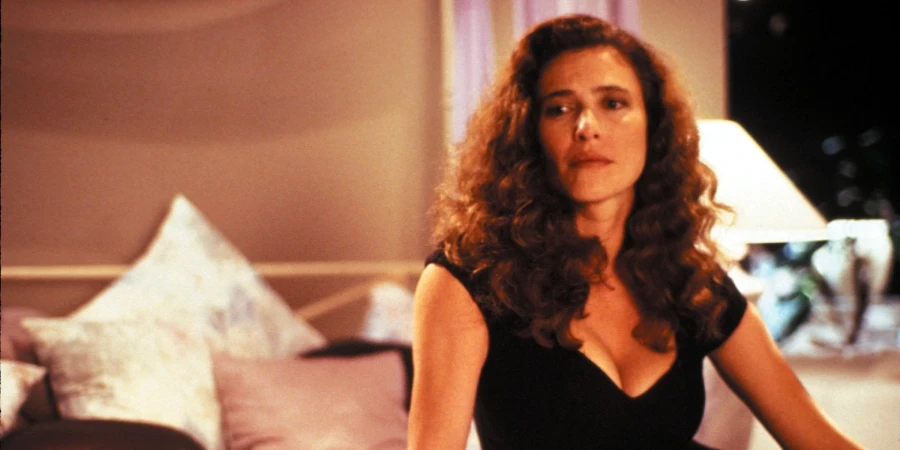

Michael Tolkin wrote and directed The Rapture in 1991, and he made a film that genuinely commits to its premise in a way that should terrify comfortable audiences: God is real, the apocalypse arrives on schedule, and the protagonist still refuses to love Him.
Mimi Rogers plays Sharon, a phone operator who swaps swinging hedonism for evangelical Christianity, baptizes her daughter, and eventually pulls a trigger in the desert. What follows is not a faith-affirming drama but something far thornier, a film that takes theology seriously enough to indict it.
Detailed Summary
Sharon’s Empty Life of Pleasure
Sharon works a monotonous job as a telephone operator in Los Angeles. She fills her nights with strangers, cycling through partners with her boyfriend Vic in organized group encounters that leave her visibly hollow.
Rogers plays Sharon’s vacancy with precision. She goes through physical motions with zero expression, her face a flat register of someone who has checked out of her own body.
The Pearl and the Conversion
Sharon starts overhearing coworkers talk about “the pearl,” a recurring symbol in a Christian evangelical community circulating through her workplace. She dismisses it at first, then becomes obsessed.
After a suicide attempt scare and a one-night encounter with a young man named Randy who belongs to the group, Sharon breaks. She falls to the floor of her apartment and converts, loudly and completely, to evangelical Christianity.
Tolkin shoots her conversion without irony. Sharon’s weeping on the floor feels desperate and genuine, not satirical, and that choice shapes everything that follows.
Marriage, Motherhood, and Randy
Sharon reconnects with Randy and they marry. She has a daughter named Mary. Their domestic life is calm, sober, and sincere.
Randy genuinely believes. His faith is uncomplicated and warm, a stark contrast to Sharon’s more volatile, searching spirituality. His death later in the film hits hard partly because Tolkin establishes him as the most emotionally stable person in the story.
Randy’s Murder and the Collapse
A disgruntled man shoots Randy at a campground. His death is abrupt and senseless, a random act of violence that arrives with no dramatic preparation.
Sharon’s world collapses. She becomes consumed by apocalyptic expectation, pulling young Mary into an increasingly intense prayer vigil. She drives them both into the Mojave desert to wait for the Rapture, which she is certain is imminent.
Sharon Kills Mary
Waiting in the desert with no food and dwindling water, Sharon believes God is telling her to send Mary to heaven ahead of the Rapture so Mary will not have to suffer the tribulation. She shoots her daughter.
This is the film’s most devastating scene. Rogers sits in the dirt, voice steady, explaining to a confused child what she is about to do, and the camera does not look away. It is an act of genuine horror rooted in sincere faith, and Tolkin refuses to frame it as simple madness.
Sharon cannot bring herself to shoot herself afterward. A deputy arrests her and she goes to prison.
The Rapture Actually Happens
While Sharon sits in a jail cell, the sky tears open. Trumpets sound. Mary appears to her mother, glowing and peaceful, beckoning Sharon to come with her into God’s kingdom.
Sharon refuses. She tells God she will not love Him on demand, not after everything He allowed to happen. Mary ascends without her.

Movie Ending
Sharon walks out of what appears to be a crumbling reality as the end times fully arrive. She finds herself in a gray, featureless limbo, a landscape of absolute nothing. Foster, a detective who had been circling her story and who converted partly because of her, finds her there.
He has accepted God’s grace and moves toward light. Sharon will not move. She stands in the gray void, and the film ends with her refusing to repent, refusing to submit, trapped in a self-chosen purgatory that is not quite heaven and not quite hell.
Tolkin’s conclusion is genuinely radical. God exists in this film. The Rapture is real. Mary is in heaven. Sharon knows all of this firsthand, and she still says no. Her refusal is not portrayed as heroic in any clean way, but it is portrayed as human, and the film treats it with complete seriousness.
What haunts viewers is the ambiguity of Sharon’s moral position. She murdered her child out of love and faith, lost that faith through grief and divine silence, and then watched God confirm everything she had believed. Her rage is coherent. Her damnation, if that is what it is, feels earned by both her actions and God’s indifference to her suffering.
Foster’s presence in that limbo underlines the contrast. Two people faced the same evidence. One submitted, one did not. Tolkin gives neither character an easy verdict.
Are There Post-Credits Scenes?
The Rapture has no post-credits scenes. When the film ends, it ends completely. Given the tone, a post-credits tag would have been absurd anyway.
Type of Movie
The Rapture is a religious drama with strong elements of psychological thriller and apocalyptic fiction. Its first act plays almost like a character study of addiction and emptiness. By the final act, it has become something closer to theological horror.
Tone shifts are deliberate and jarring. Tolkin never lets the film settle into one register, and that restlessness is part of what makes it uncomfortable.
Cast
- Mimi Rogers – Sharon
- David Duchovny – Randy
- Darwyn Carson – Mary
- Patrick Bauchau – Victor
- Will Patton – Foster
- James LeGros – Tommy
- Stephanie Menuez – Paula
Film Music and Composer
Thomas Newman composed the score for The Rapture. Newman was relatively early in his film career at the time, and his work here leans into sparse, unsettling textures rather than conventional dramatic swells.
His score avoids the warm choral sounds you might expect from a film involving Christianity. Instead, it sits uneasily under scenes, which reinforces Tolkin’s refusal to offer emotional comfort. Newman would go on to score films like American Beauty and The Shawshank Redemption, but his work here is notably bleaker than either of those.

Filming Locations
Production shot primarily in and around Los Angeles. The urban phone-operator sequences use the flat, fluorescent anonymity of office environments to underscore Sharon’s spiritual emptiness before her conversion.
The Mojave desert sequences are the film’s visual anchor. That vast, featureless landscape does exactly what Tolkin needs it to do: it strips away all context and leaves Sharon, Mary, and their faith with nothing external to lean on.
Choosing the actual desert rather than a studio set matters enormously. The heat, dust, and physical discomfort visible on Rogers’ face in those scenes is real, and it gives her performance extra weight.
Awards and Nominations
The Rapture did not receive major awards attention upon release, which is a genuine critical failure by the industry considering Rogers’ performance is one of the most committed lead turns of that decade. It circulated in critical circles and built its reputation over years rather than through awards recognition.
Behind the Scenes Insights
- Michael Tolkin adapted the screenplay from his own novel of the same name, which gave him complete creative control over the theological arguments in the film.
- Mimi Rogers was a practicing Scientologist at the time of filming, which adds an interesting biographical layer to her portrayal of a woman seeking spiritual certainty.
- David Duchovny’s role as Randy predates his breakout on The X-Files; his warmth and low-key sincerity in the part make Randy’s death land much harder than it might have with a more mannered actor.
- Tolkin has spoken in interviews about wanting to make a film that took religious belief seriously rather than mocking it, while still interrogating its darkest implications.
- Fine Line Features released the film, and it received an NC-17 rating initially due to explicit sexual content in the early sequences; an R-rated version was prepared for wider distribution.
Inspirations and References
Tolkin drew directly from his own novel The Rapture, which he published before adapting it for the screen. His interest in religious extremism and the Book of Revelation shapes every structural choice in the story.
The film engages seriously with evangelical Christian theology of the late 1980s and early 1990s, particularly the widespread cultural obsession with end-times prophecy during that period. Hal Lindsey’s The Late, Great Planet Earth and similar texts informed the cultural atmosphere Tolkin was capturing.
Philosophically, the ending borrows from the tradition of characters who defy God on His own terms, a lineage running through existentialist literature. Sharon’s final refusal echoes figures in Camus and Dostoevsky who reject divine authority even when confronted with its reality.
Alternate Endings and Deleted Scenes
No widely documented alternate ending exists for The Rapture. Tolkin’s vision appears to have remained consistent from script to screen, which tracks with his level of authorial control over the material.
No significant deleted scenes have entered public record. Given the film’s lean, purposeful structure, it is difficult to imagine where substantial cuts would have been made.
Book Adaptations and Differences
Tolkin wrote the source novel himself before writing the screenplay, so the adaptation process was unusually direct. He functioned as his own adapter, which minimized the tension between source fidelity and cinematic practicality.
Readers familiar with the novel generally note that the film compresses certain elements of Sharon’s pre-conversion life. The core theological argument, including the ending’s refusal of grace, carries over intact from page to screen.

Memorable Scenes and Quotes
Key Scenes
- Sharon’s conversion on her apartment floor, her body folded and shaking, shot in close-up without score for several seconds, is the film’s emotional hinge point.
- Sharon explaining to young Mary why she is about to shoot her, her voice calm and her eyes dry, is one of the most genuinely disturbing scenes in 1990s American cinema.
- Mary ascending during Sharon’s jail cell vision, a child in pale light reaching back toward her mother, only for Sharon to turn away.
- The gray limbo finale, Sharon standing immovable in a featureless void while Foster moves toward light, shot with almost no camera movement, letting Rogers carry the entire weight through stillness.
- Randy’s sudden murder at the campground, staged with no telegraphing and no score swell, just a gunshot and a body.
Iconic Quotes
- “I won’t give him my love just because he has the power to give or take away.” Sharon’s refusal in the limbo sequence is the film’s thesis delivered as dialogue.
- Sharon to Mary before the shooting: a quiet, matter-of-fact explanation of heaven that Tolkin writes without melodrama, which is precisely why it destroys you.
Easter Eggs and Hidden Details
- The pearl symbol that draws Sharon into the evangelical community recurs visually in costume and prop details throughout the film, most noticeably as jewelry worn by women in the congregation.
- Sharon’s telephone operator job places her literally at the center of a network of voices she cannot connect with meaningfully, a visual metaphor Tolkin builds into the production design rather than stating outright.
- The gray limbo at the film’s end uses the same flat, colorless lighting palette as Sharon’s office in the opening sequences, suggesting her spiritual emptiness has become her permanent address.
- Mary’s name carries obvious religious resonance, and her role in the story as an innocent who ascends while the mother remains behind deliberately inverts conventional martyr imagery.
Trivia
- Michael Tolkin would later receive an Academy Award nomination for his screenplay for The Player, which Robert Altman directed the same year The Rapture was released.
- David Duchovny has cited the film as an important early role in interviews, noting that working with Rogers and Tolkin pushed him in directions his television work later drew on.
- Mimi Rogers had been married to Tom Cruise during the late 1980s, and tabloid attention on her personal life partly overshadowed critical appreciation of her work in this film upon release.
- Fine Line Features, the distributor, was a subsidiary of New Line Cinema and specialized in films considered too challenging or uncommercial for major studio release.
- Despite its small theatrical footprint, the film developed a significant cult following through home video and later became a touchstone in academic discussions of religion in American cinema.
Why Watch?
Rogers’ performance in the desert sequence alone justifies sitting through this film. She plays a woman committing an act of monstrous love with total conviction, no scenery-chewing, just a quiet certainty that is far more disturbing than hysteria would be. Tolkin then has the audacity to make God show up and prove her faith was correct all along, which turns the film from a tragedy into something far more philosophically unsettling.
Director’s Other Movies
- The New Age (1994)
Recommended Films for Fans
- Rosemary’s Baby (1968)
- Carrie (1976)
- Safe (1995)
- Inherit the Wind (1960)
- Crimes and Misdemeanors (1989)
- First Reformed (2017)
- Take Shelter (2011)