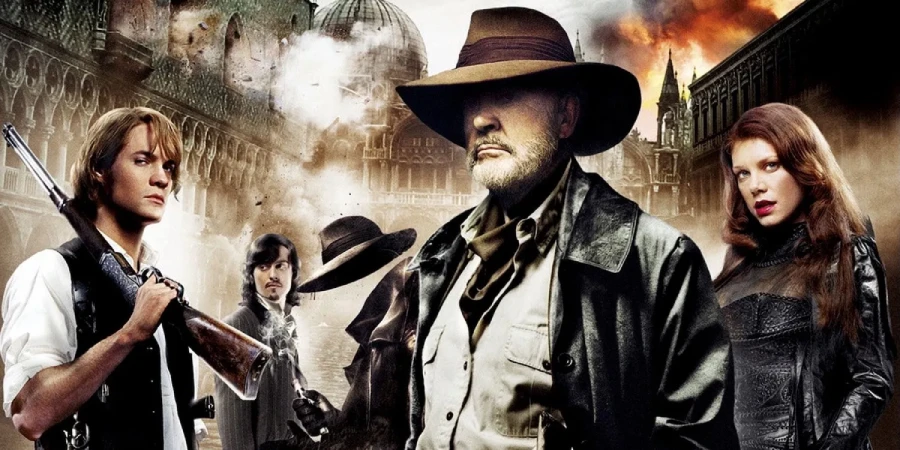

The League of Extraordinary Gentlemen arrived in 2003 with one of the most tantalizing premises in superhero cinema: gather the greatest fictional characters of the Victorian era and let them fight a global conspiracy. It sounds brilliant on paper. In practice, it became one of Hollywood’s most famously troubled productions and a film that drove its own star, Sean Connery, into permanent retirement. This is a movie worth dissecting, disaster and all.
Detailed Summary
A World Under Threat
The film opens in 1899, with a heavily armored attack on a British bank in London and a subsequent assault on a German military facility. Both attacks involve advanced, anachronistic weaponry. Someone is deliberately engineering a war between Britain and Germany.
British intelligence quickly determines that a mysterious figure known as the Fantom is responsible. However, the Fantom’s true identity remains hidden behind an ornate mask. A secret British organization called M begins assembling a team to stop him.
Recruiting Allan Quatermain
We meet Allan Quatermain (Sean Connery), a retired hunter and adventurer living in Kenya, drowning his sorrows in a colonial club. He has lost his son and retreated from the world entirely. A British agent named Sanderson Reed arrives to recruit him.
After the club suffers an attack by heavily armed men sent to kill or capture Quatermain, he reluctantly agrees to return to London. His entrance into the story sets the film’s tone: gruff, world-weary, but ultimately heroic. Connery essentially plays himself at this point, and nobody minds.
Assembling the League
Back in London, Quatermain meets the mysterious M (Richard Roxburgh), who presents the assembled team. Each member represents a famous fictional figure. The concept is genuinely thrilling, even if the execution wobbles.
Mina Harker (Peta Wilson), a vampire with supernatural abilities, has already joined. So has the invisible thief Rodney Skinner (Tony Curran), who replaced the original Invisible Man, Hawley Griffin, for rights reasons. In addition, Dorian Gray (Stuart Townsend) joins as an immortal aesthete.
Captain Nemo (Naseeruddin Shah) arrives with his submarine, the Nautilus, and serves as the team’s primary mode of transport. Meanwhile, American agent Tom Sawyer (Shane West) joins as a nod to American audiences, a decision that frustrated fans of the source material considerably. Finally, Mr. Hyde and his alter ego Dr. Jekyll (Jason Flemyng) round out the roster.
Venice and the Fantom’s Plan
The league travels to Venice aboard the Nautilus. Intelligence suggests the Fantom plans to attack a peace conference of world leaders there. Bombs planted beneath the city’s ancient foundations threaten to sink entire districts into the lagoon.
Tom Sawyer drives a car at reckless speed through Venice’s narrow streets, which is historically and geographically absurd but undeniably fun. The team successfully prevents the largest explosion, though not without significant destruction. Consequently, the mission reveals a deeper problem: there is a traitor within the League.
The Traitor Revealed
During the Venice mission, the Fantom steals samples of the League members’ unique abilities. Specifically, he takes Mina’s blood, Jekyll’s formula, and Skinner’s invisibility coating. This theft feels methodical and deliberate.
Dorian Gray reveals himself as the traitor, working for the Fantom all along. His immortality makes him essentially impossible to kill through conventional means, and he escapes easily. Furthermore, it turns out that M himself is the Fantom, unmasked as Professor James Moriarty, the villain from the Sherlock Holmes stories.
Moriarty’s True Scheme
Moriarty’s endgame is breathtaking in its cynicism. He plans to sell the stolen abilities as weapons technology to the world’s warring nations. By auctioning supercharged soldiers and invisibility formulas, he will profit from the very war he engineered.
His base of operations sits in the frozen wastes of Mongolia, inside an enormous industrial fortress. The League must regroup, deal with Dorian Gray’s betrayal, and mount a final assault on Moriarty’s stronghold. On the other hand, the team’s trust is shattered, which makes cooperation genuinely difficult.
Movie Ending
Moriarty’s Mongolian fortress becomes the site of an all-out battle that throws every character’s abilities into maximum overdrive. Mr. Hyde transforms and rampages through the facility, tearing apart Moriarty’s army of manufactured super-soldiers with brutal efficiency. Nemo’s men fight alongside, and Tom Sawyer proves himself in open combat.
Mina confronts Dorian Gray in the film’s most visually inventive sequence. Dorian’s immortality has always protected him from seeing his own corrupted portrait, and Mina exploits this weakness by forcing him to look at it. His centuries of sin catch up with him instantly, and he crumbles to dust in spectacular fashion.
Quatermain pursues Moriarty through the fortress. Their confrontation is personal, with Moriarty shooting Quatermain before escaping. Quatermain’s wound proves fatal, and he dies in Tom Sawyer’s arms, passing the torch of adventure to the younger man. It is a genuinely affecting moment in an otherwise chaotic film.
Moriarty himself falls through the ice into a freezing river below the fortress. His fate is left slightly ambiguous, though the implication is clear: he drowns in the frozen water. No sequel ever revisited this, so Moriarty’s end remains permanently unresolved in cinematic terms.
Quatermain receives a burial in Africa, at a site he had requested. A witch doctor performs a ceremony over his grave. Suddenly, the earth cracks and something stirs beneath the surface, strongly suggesting that Africa itself, the continent Quatermain loved, refuses to let him die. This moment sets up a sequel that never materialized, leaving audiences with an evocative but permanently dangling thread.
Are There Post-Credits Scenes?
There are no post-credits scenes in The League of Extraordinary Gentlemen. However, the burial scene at the very end of the film functions almost like a tease, hinting at Quatermain’s resurrection. It sits within the main narrative rather than after the credits, so it qualifies as a finale beat rather than a proper post-credits sequence.
Type of Movie
The League of Extraordinary Gentlemen is a steampunk action-adventure film with strong fantasy elements. It blends Victorian-era science fiction with superhero team dynamics, roughly two decades before that formula became Hollywood’s dominant export. The tone aims for swashbuckling fun but frequently tips into bombastic excess.
There are genuine thriller elements in the first act, and the traitor subplot adds a brief flash of intrigue. Nonetheless, the film prioritizes spectacle over character, making it a popcorn blockbuster rather than a thoughtful genre piece. It sits comfortably alongside early 2000s action-fantasy films like Van Helsing and The Mummy Returns.
Cast
- Sean Connery – Allan Quatermain
- Naseeruddin Shah – Captain Nemo
- Peta Wilson – Mina Harker
- Tony Curran – Rodney Skinner (The Invisible Man)
- Stuart Townsend – Dorian Gray
- Shane West – Tom Sawyer
- Jason Flemyng – Dr. Henry Jekyll and Mr. Hyde
- Richard Roxburgh – M / Professor Moriarty
Film Music and Composer
Trevor Jones composed the film’s score. Jones brought considerable experience to the project, having previously scored films like Excalibur and The Last of the Mohicans. His work on this film leans heavily into orchestral bombast, matching the film’s maximalist visual style.
Notable tracks include the main theme, which carries a suitably grand Victorian adventure feel. The score largely serves the action rather than the characters, which is a missed opportunity given how rich each League member’s background is. Still, Jones delivers functional, well-crafted genre music throughout.

Filming Locations
Principal photography took place primarily in Prague, Czech Republic, which doubled for London and various European settings. Prague’s architecture provided convincing late-Victorian atmosphere at a fraction of the cost of shooting in the actual cities. The production also used studios and backlots extensively for interior sequences.
Malta served as the stand-in for Venice, with its historic harbor and waterways providing the necessary Mediterranean aesthetic. Shooting in Venice itself would have been logistically prohibitive. For the Mongolian fortress sequences, the production relied on large-scale set construction rather than any genuine on-location work.
The Kenyan opening sequence, where we first meet Quatermain, used locations designed to evoke colonial Africa convincingly. The choice of Prague as a central hub was a practical decision that ultimately served the film’s visual ambitions well, even if purists noticed the occasional architectural anachronism.
Awards and Nominations
The League of Extraordinary Gentlemen did not receive notable awards recognition. It was nominated for a Razzie Award in several categories, reflecting its poor critical reception upon release.
Behind the Scenes Insights
- Sean Connery had a famously difficult relationship with director Stephen Norrington throughout production, with the two reportedly clashing repeatedly on set.
- Norrington and Connery’s conflict became so severe that it contributed to Norrington effectively withdrawing from Hollywood filmmaking afterward.
- Connery publicly stated after the film’s release that the experience was so unpleasant it convinced him to retire from acting entirely.
- Connery reportedly struggled to understand certain aspects of the script and found the production process chaotic and poorly managed.
- Shooting in Prague presented significant logistical challenges, particularly for the large-scale action sequences that required coordinating large numbers of extras and complex practical effects.
- The Nautilus set was one of the largest and most expensive built for the production, designed to convey Nemo’s blend of opulence and engineering genius.
- Shane West’s addition as Tom Sawyer was a studio-driven decision intended to give American audiences a relatable entry point, a choice that drew criticism from fans of the source comic.
- Peta Wilson prepared extensively for her role as Mina Harker, drawing on Bram Stoker’s original Dracula as a character reference rather than relying solely on the script.
Inspirations and References
The film adapts The League of Extraordinary Gentlemen, the comic book series created by writer Alan Moore and artist Kevin O’Neill, published by America’s Best Comics beginning in 1999. Moore’s comic drew on a vast tradition of Victorian and Edwardian popular fiction, assembling characters from H.G. Wells, Jules Verne, Bram Stoker, and others.
Each character in the League originates in a specific literary work. Quatermain comes from H. Rider Haggard’s adventure novels, Captain Nemo from Jules Verne’s Twenty Thousand Leagues Under the Sea, Mina Harker from Bram Stoker’s Dracula, and Hyde from Robert Louis Stevenson’s Strange Case of Dr Jekyll and Mr Hyde. Dorian Gray originates in Oscar Wilde’s The Picture of Dorian Gray.
Professor Moriarty, meanwhile, comes directly from Arthur Conan Doyle’s Sherlock Holmes canon, where he serves as Holmes’s greatest nemesis. The film smartly uses Moriarty as a villain precisely because his reputation for intellectual evil is already pre-loaded in the audience’s cultural memory.
Alternate Endings and Deleted Scenes
No officially released alternate ending exists for The League of Extraordinary Gentlemen. However, the troubled production almost certainly involved script revisions and reshoots that altered the film’s shape during post-production. Specific details about deleted scenes have not been comprehensively documented in publicly available sources.
The resurrection tease at Quatermain’s grave reportedly reflected studio interest in launching a franchise. It suggests the ending went through at least one deliberate revision to accommodate sequel possibilities that ultimately never materialized.
Book Adaptations and Differences
Alan Moore’s original comic series differs from the film in significant ways. Moore’s version is far darker, morally complex, and deeply literary, treating its Victorian characters with both reverence and subversion. In contrast, the film strips away much of this complexity in favor of straightforward blockbuster action.
Tom Sawyer does not appear in Moore’s original story, and his addition represents the most glaring departure from the source material. Moore’s League also features Hawley Griffin, the original invisible man from H.G. Wells’s novel, rather than the invented replacement character Rodney Skinner used in the film due to rights issues.
Moore himself disowned the film and had his name removed from it, consistent with his well-documented practice of distancing himself from Hollywood adaptations of his work. His disapproval was emphatic and has colored how the film is discussed ever since.


Memorable Scenes and Quotes
Key Scenes
- Quatermain’s colonial club in Kenya coming under attack, showcasing Connery’s effortless physicality even in his late sixties.
- Tom Sawyer’s car chase through Venice, an absurdist but energetic sequence that encapsulates the film’s gleeful disregard for historical plausibility.
- Dorian Gray’s death, where Mina forces him to confront his portrait and centuries of corruption consume him in an instant.
- Mr. Hyde’s rampage through Moriarty’s Mongolian fortress, a visceral showcase of Jason Flemyng’s physical performance under heavy prosthetics.
- Quatermain’s death in Tom Sawyer’s arms, a quieter moment that lands with unexpected emotional weight amid the surrounding chaos.
- The Fantom’s unmasking as M, revealing Richard Roxburgh’s Moriarty as the architect of the entire conspiracy.
Iconic Quotes
- “I may have done many things in my time, but I’ve never started a war.” (Quatermain)
- “Do you have any idea how loud it is inside my head?” (Mr. Hyde)
- “I’ve lived long enough to see the future become history.” (Dorian Gray)
- “This is the Nautilus. Nothing is beyond her.” (Captain Nemo)
Easter Eggs and Hidden Details
- The name M is used as a deliberate echo of the James Bond series, itself a descendant of Victorian adventure fiction, adding a winking meta-layer to Moriarty’s cover identity.
- Nemo’s Nautilus interior features design details drawn directly from Jules Verne’s original descriptions, rewarding readers of the source novel with visual callbacks.
- Mina Harker’s vampiric powers include the ability to command bats, a subtle nod to her transformation in Bram Stoker’s Dracula that the film never explicitly explains.
- The Dorian Gray portrait, glimpsed briefly in his quarters aboard the Nautilus, shows visible rot and decay even in early scenes, foreshadowing his eventual fate.
- Moriarty’s disguise as M places him in a position of authority over British intelligence, which mirrors his role in the Holmes canon as a criminal who operates invisibly within respectable society.
- Skinner’s character name, Rodney Skinner, was invented specifically to sidestep the copyright situation surrounding H.G. Wells’s Griffin character, a behind-the-scenes necessity that became a lore detail.
Trivia
- This was Sean Connery’s final theatrical film appearance, making it the last time the legendary actor appeared in a cinema release before his retirement.
- Alan Moore has repeatedly cited the film as an example of Hollywood’s failure to understand his work, and he declined any involvement in the adaptation process.
- Director Stephen Norrington has not directed another major studio film since, making this production effectively the end of his mainstream Hollywood career.
- The film’s budget was reportedly around 78 million dollars, and it grossed approximately 179 million dollars worldwide, making it technically profitable despite its poor critical reception.
- The Nautilus as depicted in the film is substantially larger than any version described in Verne’s original novel, scaled up to function as a mobile headquarters for the entire team.
- Shane West performed many of his own driving stunts during the Venice car chase sequence.
- Jason Flemyng wore extensive prosthetic makeup and padding to portray Mr. Hyde, spending hours in the makeup chair before each day of filming as the creature.
- The production used a predominantly European crew, which contributed to some communication difficulties between the American studio and the on-the-ground filmmaking team.
Why Watch?
Despite its well-documented flaws, this film offers a genuinely unique spectacle: Sean Connery in his final role, leading a team of Victorian literary icons through an insane steampunk adventure. Its ambition outpaces its execution at every turn, which makes it fascinating rather than boring. For fans of early 2000s blockbuster excess, it remains essential, gloriously imperfect viewing.
Director’s Other Movies
Recommended Films for Fans
- Van Helsing (2004)
- The Mummy (1999)
- From Hell (2001)
- Sherlock Holmes (2009)
- The Time Machine (2002)
- Dracula Untold (2014)