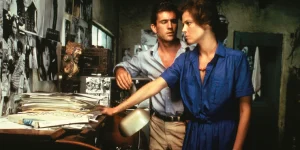

Grief can make a person capable of almost anything, and In the Fade takes that truth to its most devastating conclusion. Director Fatih Akin delivers a film that refuses to let you get comfortable, following a German woman named Katja as she loses her husband and son to a nail bomb and then watches the justice system fail her completely. It is raw, precise, and utterly unforgiving.
Detailed Summary
Katja’s Life Before the Bombing
Katja Sekerci, played by Diane Kruger, lives in Hamburg with her Kurdish-German husband Nuri and their young son Rocco. Nuri runs a small tax consultancy, and despite his past conviction for drug offenses, the family lives a warm, ordinary life together.
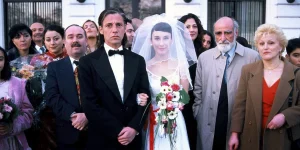
Akin establishes their relationship quickly but with real tenderness. A brief flashback shows Katja and Nuri marrying in prison, which signals both their unconventional history and the depth of their bond.
The Bombing and Its Immediate Aftermath
One afternoon, Katja drops Rocco off at Nuri’s office. She plans to return shortly, but a nail bomb planted outside the building explodes while she is gone, killing both Nuri and Rocco instantly.
Katja’s world collapses in a single moment. She arrives to find a crime scene where her entire family once stood, and Kruger’s performance in these scenes is almost unbearable to watch. Akin does not soften the violence or its consequences.
In the days that follow, Katja struggles to function. She briefly relapses into drug use, a coping mechanism that also hands the prosecution a convenient narrative about her character later in the film.
The Investigation and Suspects
Police investigators initially consider Nuri’s criminal past as a possible motive, suggesting organized crime or a personal dispute. Katja firmly rejects this line of thinking. She notices a bicycle left near the scene before the explosion and reports it.
Surveillance footage and witness accounts eventually lead investigators to a young Neo-Nazi couple: Edda Moller and her husband Andre Moller. Katja had seen Edda near the office beforehand and identifies her to police. However, the evidence against the couple is largely circumstantial at first.
The Trial
The second act of the film shifts into courtroom territory. Katja’s lawyer, Daniyar, builds a case against the Mollers, presenting forensic evidence and witness testimony to link them to the bombing.
The defense, meanwhile, attacks Katja’s credibility relentlessly. Her drug use, her emotional state, and her background all come under scrutiny. The courtroom becomes a second arena of violence, just dressed in suits and legal procedure.
Edda’s mother provides a false alibi, claiming the couple was at her home during the attack. A key witness recants under pressure. As a result, the judge ultimately acquits both defendants due to insufficient evidence, citing reasonable doubt.
Katja’s Breaking Point
After the acquittal, Katja falls apart completely. She attempts suicide by overdose in her car. A passerby finds her in time, and she survives physically, but emotionally she is somewhere beyond rescue.
Her lawyer Daniyar informs her that the couple has relocated to Greece. Consequently, Katja makes a decision that the film has been quietly building toward from its opening frames: she will take justice into her own hands.


Movie Ending
Katja travels to Greece, tracks down the Mollers at their seaside holiday rental, and methodically prepares to kill them. She constructs a bomb using materials she has acquired, mirroring the exact method the couple used to destroy her family. The parallel is deliberate and devastating.
She sends a final video message to her own mother, says goodbye, and walks to the Mollers’ beach house wearing the explosive device. Katja detonates the bomb, killing herself, Edda, and Andre in one act of absolute finality.
Akin frames this ending with striking calm. There is no dramatic score swelling, no slow-motion heroics. Moreover, the film cuts to black almost immediately after the explosion, refusing to aestheticize or moralize the act. Audiences are left to sit with what they have just witnessed.
The ending raises questions the film deliberately leaves open. Was this justice, or was it simply more violence feeding the same cycle? Notably, Akin never positions Katja’s choice as triumphant. Her death is a tragedy layered onto a tragedy, not a resolution.
For many viewers, the most haunting element is how In the Fade implicates the legal system in her death. If the courts had convicted the Mollers, Katja would have had no reason to go to Greece. In contrast to typical revenge thrillers, this film places the institutional failure front and center as the true engine of destruction.
Are There Post-Credits Scenes?
In the Fade contains no post-credits scenes. Akin ends the film abruptly and intentionally, and nothing follows the credits. Sit with the silence; it is part of the experience.
Type of Movie
In the Fade operates primarily as a drama thriller with strong elements of a legal procedural and a revenge film. Its tone is somber, restrained, and relentlessly focused on emotional realism rather than genre spectacle.
Akin structures the film in three distinct acts, almost like a triptych: grief, justice, and retribution. Furthermore, the film carries a pointed political dimension, addressing right-wing extremism and xenophobia in contemporary Germany.
Cast
- Diane Kruger – Katja Sekerci
- Denis Moschitto – Daniyar, Katja’s lawyer
- Johannes Krisch – Andre Moller
- Hanna Hilsdorf – Edda Moller
- Numan Acar – Nuri Sekerci
- Ulrich Brandhoff – supporter of the Mollers
- Rafael Santana – Rocco Sekerci
Film Music and Composer
Josh Homme, frontman of Queens of the Stone Age, composed the score for In the Fade. His contribution is deliberately sparse, using guitar-driven textures that feel rawer and more unsettling than a conventional orchestral score would.
Homme had no prior film scoring credits before this project, which made the collaboration an unusual creative risk. However, his instinct for tension and mood translated remarkably well to cinema. The music never tells you how to feel; it simply intensifies the atmosphere that is already present.
The film also features the song In the Fade by Queens of the Stone Age from their album Rated R, which inspired both the film’s title and some of its emotional texture.



Filming Locations
Principal photography took place in Hamburg, Germany. Hamburg is not just a backdrop here; it functions as a character in itself, its busy urban streets and harbor providing a sense of ordinary life disrupted by ideological hatred.
The courtroom scenes ground the film in a recognizable institutional setting, reinforcing the sense that this story could happen in any modern European city. For the final act, production moved to Greece, specifically coastal locations that contrast sharply with Hamburg’s gray urban texture.
That visual shift from overcast German streets to sun-drenched Mediterranean shores is deeply unsettling. It makes Katja’s mission feel even more surreal and final, as if she has stepped out of her old life entirely.
Awards and Nominations
Diane Kruger won the Best Actress award at the Cannes Film Festival in 2017 for her performance, which remains one of the most celebrated individual acting achievements of that year. In the Fade also won the Golden Globe for Best Foreign Language Film in 2018.
Additionally, the film received a nomination for the Academy Award for Best Foreign Language Film at the 90th Academy Awards, representing Germany’s official submission.
Behind the Scenes Insights
- Fatih Akin developed the script in response to the real-life crimes of the NSU (Nationalsozialistischer Untergrund), a German Neo-Nazi terrorist cell responsible for a series of murders targeting people with immigrant backgrounds.
- Diane Kruger, who is German but had built most of her career in English-language films, performed entirely in German for this role, a deliberate and personally significant choice.
- Kruger has spoken about drawing on deeply personal emotional reserves for the grief sequences rather than relying purely on technical acting methods.
- Josh Homme recorded the score while dealing with personal difficulties of his own, which Akin has suggested added an unexpected authenticity to the music’s emotional register.
- Akin structured the film’s three acts to mirror the stages of grief, though he deliberately avoided making that structure feel schematic or tidy.
Inspirations and References
The primary inspiration for In the Fade is the real activity of the NSU, the far-right terrorist network that operated in Germany for years largely undetected by intelligence services. Their crimes disproportionately targeted people of Turkish and Kurdish origin, and the subsequent investigations and trials raised serious questions about institutional failure and systemic bias.
Akin drew on the experiences of the victims’ families, particularly the sense of abandonment they reported feeling during the legal proceedings. In contrast to a standard revenge thriller, the film treats political reality as the foundation rather than the backdrop.
Greek tragedy also informs the film’s structure and mood. Akin has cited classical tragic forms as a reference point for Katja’s arc, specifically the idea of a protagonist whose destruction stems from a world that has already failed her.
Alternate Endings and Deleted Scenes
No officially confirmed alternate endings or significant deleted scenes have been made public for In the Fade. Akin has spoken about the ending being essential to the film’s honesty; changing it would have undermined everything preceding it.
Some early discussions during script development apparently considered leaving Katja’s fate more ambiguous, but Akin committed to the definitive conclusion that appears in the final cut.
Book Adaptations and Differences
In the Fade is not based on a book. Fatih Akin wrote the original screenplay himself, drawing on real-world events and personal research rather than adapting an existing literary source.



Memorable Scenes and Quotes
Key Scenes
- Katja arriving at the bomb site and being physically restrained from crossing the police barrier, her screams completely wordless.
- The prison wedding flashback, which recontextualizes Nuri and Katja’s relationship and makes the loss hit even harder retroactively.
- Katja’s overdose attempt in her car after the acquittal, filmed with quiet, almost clinical stillness.
- Edda Moller’s mother delivering her false alibi on the witness stand while Katja watches from the gallery.
- Katja walking toward the Mollers’ beach house in the final sequence, the camera holding on her back as she moves away from the world she once knew.
Iconic Quotes
- “My husband was not a criminal. He was my husband.” – Katja, pushing back against the defense’s attempts to reframe Nuri’s identity.
- “There is no justice. There is only what you do.” – Katja, in her final video message, articulating the film’s central and most troubling thesis.
Easter Eggs and Hidden Details
- The bicycle left near the bomb site before the explosion mirrors documented details from NSU-related attacks, grounding the fiction in specific historical reality.
- Katja’s final beach walk is filmed so that the Mediterranean light washes out the image slightly, visually suggesting she is already moving into a realm beyond the ordinary world.
- Nuri’s office is shown briefly early in the film from Katja’s point of view, establishing the exact geography that later becomes the site of destruction, making the audience unconsciously memorize a place before it is destroyed.
- Akin includes small details in the courtroom set design that reflect actual German federal court aesthetics, reinforcing that this is not a heightened fictional space but a recognizable institution.
Trivia
- Diane Kruger became the first German actress to win Best Actress at Cannes since Hanna Schygulla in 1981.
- Fatih Akin is himself of Turkish-German heritage, which gives the film’s themes of identity and discrimination a deeply personal dimension.
- In the Fade was selected as Germany’s official entry for the Academy Award for Best Foreign Language Film, a significant institutional endorsement for a film so critical of German institutions.
- Josh Homme had never composed a film score before this project; Akin approached him after being a long-time fan of his music.
- The film’s German title is Aus dem Nichts, which translates literally as Out of Nothing, a phrase that captures the sudden, senseless nature of the bombing far more bluntly than the English title.
Why Watch?
Diane Kruger delivers one of the great screen performances of the 2010s, and Fatih Akin builds around her a film that is both politically urgent and emotionally devastating. In the Fade treats its difficult subject with unflinching honesty and refuses easy catharsis. Consequently, it stays with you long after the credits roll.
Director’s Other Movies
- Head-On (2004)
- The Edge of Heaven (2007)
- Soul Kitchen (2009)
- The Cut (2014)