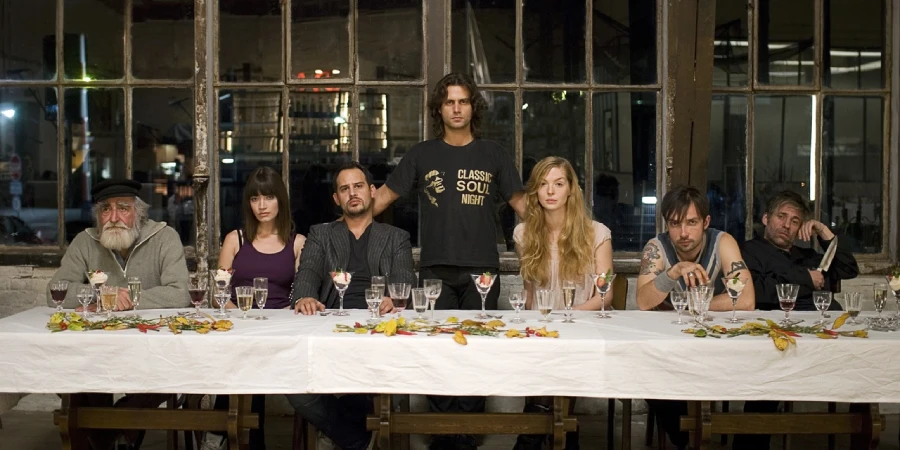

Fatih Akin’s Soul Kitchen operates like a perfectly cooked meal: chaotic in preparation, deeply satisfying by the end. This 2009 German comedy follows Zinos Kazantzakis, a Hamburg restaurant owner whose life unravels in spectacularly funny ways, all while celebrating food, friendship, and stubbornness in equal measure. Akin shot the film in his hometown of Hamburg with genuine affection for its gritty, working-class energy. What results is one of the most purely enjoyable European comedies of its decade.
Detailed Summary
Introducing Zinos and His Crumbling World
Zinos Kazantzakis (Adam Bousdoukos) runs Soul Kitchen, a shabby but beloved restaurant in a rundown Hamburg warehouse district. His cooking is uninspired, his clientele loyal but undemanding, and his life held together by nothing but routine.
His girlfriend, Nadine, has moved to Shanghai for work. Zinos desperately wants to follow her, which immediately puts pressure on everything he has built in Hamburg.
The Chef Who Changes Everything
Zinos hires Shayn Weiss (Birol Unel), an eccentric, volatile, and supremely talented chef who transforms the Soul Kitchen menu overnight. Shayn refuses to serve mediocre food and clashes with regulars who just want their comfort meals.
However, Shayn’s cooking slowly turns the restaurant into a genuine culinary destination. Customers who complained at first come back hungry for more. This shift sets the entire second act in motion.
Zinos and His Bad Back
Throughout all of this, Zinos suffers from a serious back injury. His pain becomes a recurring physical comedy element, but it also grounds the film in something real: a man literally breaking down under pressure.
His back problem forces him to delegate, which he does poorly. Consequently, things keep slipping out of his control at the worst possible moments.
The Brother Arrives
Illias (Moritz Bleibtreu), Zinos’s brother, enters the story fresh from prison on a day-release scheme. Zinos gives him a job at the restaurant, hoping to keep him out of trouble. This proves to be an optimistic miscalculation.
Illias is charming, impulsive, and fundamentally allergic to honest work. He immediately starts gambling and running schemes on the side, dragging the restaurant into his orbit of bad decisions.
The Real Estate Threat
Neumann, a slick property developer played by Wotan Wilke Mohring, has his eye on the building where Soul Kitchen operates. He wants to redevelop the entire area into something profitable and modern.
Neumann begins pressuring Zinos to sell. Moreover, Illias secretly makes contact with Neumann, seeing a personal opportunity in his brother’s misfortune.
Zinos Loses the Restaurant
Illias, in an act of staggering betrayal, manipulates legal documents and effectively signs over the restaurant to Neumann while Zinos is distracted and away dealing with personal crises. Zinos loses his business through his own brother’s scheming.
This is the film’s emotional gut punch. In addition, Zinos’s trip to Shanghai to visit Nadine goes badly, and he returns to Hamburg with nothing waiting for him.
Love, Loss, and a New Beginning
Meanwhile, a genuine romantic connection develops between Zinos and Lucia (Dorka Gryllus), a waitress at the restaurant. She is warm, grounded, and clearly a better fit for Zinos than his absent Shanghai girlfriend ever was.
Zinos slowly recognizes this. His emotional journey mirrors the restaurant’s journey: both need to be rebuilt from scratch on a better foundation.



Movie Ending
Zinos fights back legally and with sheer persistence. He exposes Illias’s fraudulent document manipulation and, with help from his loyal circle, reclaims ownership of Soul Kitchen. Neumann’s scheme collapses, and the slick developer walks away empty-handed.
Illias faces real consequences for his betrayal, but the film handles this with typical Akin warmth rather than harsh judgment. Brothers remain brothers, even after spectacular failures of loyalty.
Soul Kitchen reopens, now fully realized as the vibrant, chaotic, joyful space it always had the potential to be. Shayn returns to the kitchen. The food is extraordinary. The music is loud and the crowd is alive.
Zinos and Lucia end up together, which feels entirely earned by this point. Their relationship represents the life Zinos was building without realizing it, right there in Hamburg, while he was chasing someone in Shanghai.
The ending argues that home is where you make something with your hands, whether that is a restaurant, a relationship, or a community. Akin closes on a note of genuine warmth without tipping into sentimentality.
Are There Post-Credits Scenes?
Soul Kitchen does not include any post-credits scenes. Once the film ends, it ends. No hidden content waits for patient viewers.
Type of Movie
Soul Kitchen is a comedy-drama, firmly rooted in the tradition of warm European slice-of-life cinema. Its tone sits comfortably between screwball comedy and heartfelt character study.
Akin keeps things light without ever letting the drama feel weightless. For instance, the real estate subplot and the brotherly betrayal carry genuine emotional stakes despite the film’s consistently playful energy.
Cast
- Adam Bousdoukos – Zinos Kazantzakis
- Moritz Bleibtreu – Illias Kazantzakis
- Birol Unel – Shayn Weiss
- Dorka Gryllus – Lucia
- Wotan Wilke Mohring – Neumann
- Phline Roggan – Trish
- Anna Bederke – Nadine
- Catrin Striebeck – Thomas’s mother
Film Music and Composer
Music sits at the absolute heart of Soul Kitchen. Akin, who previously made the music documentary Crossing the Bridge: The Sound of Istanbul, treats the soundtrack with the same seriousness he gives the script.
The film draws heavily on soul, funk, and R&B tracks that match the restaurant’s name and spirit. Songs pulse through nearly every scene, shaping the mood as much as any piece of dialogue.
Akin collaborated with Klaus Maeck on music supervision for the project. The sonic texture of the film reinforces its central theme: that joy is something you feel in your body before you understand it in your head.


Filming Locations
Soul Kitchen was shot almost entirely in Hamburg, Germany, specifically in the Wilhelmsburg district. Wilhelmsburg is a working-class island neighborhood with a multicultural identity, and Akin has deep personal roots there.
Choosing this location was not simply logistical. The neighborhood itself becomes a character, representing communities that face gentrification and erasure at the hands of developers exactly like Neumann.
Hamburg’s industrial architecture, its waterways, and its gritty textures give the film a visual authenticity that no studio build could replicate. On the other hand, a more polished setting would have completely undermined the story’s emotional argument.
Awards and Nominations
Soul Kitchen won the Special Jury Prize at the Venice Film Festival in 2009, which represented a significant recognition for a comedy at a festival that typically celebrates weightier fare. The film also performed strongly at the German Film Awards.
Behind the Scenes Insights
- Fatih Akin wrote the script specifically with Adam Bousdoukos in mind; the two are longtime friends and previous collaborators.
- Bousdoukos himself has a background in the restaurant industry, which informed his performance with genuine physical familiarity.
- Akin deliberately kept the production rooted in Wilhelmsburg to draw attention to the real gentrification pressures facing the neighborhood at the time.
- Birol Unel, who previously starred in Akin’s Head-On, brought an intense, method-like commitment to the role of the uncompromising chef Shayn.
- Akin described the film as his most personal comedy, a deliberate attempt to make audiences laugh after the emotional weight of his previous work.
- Several scenes involving food preparation required actual cooking skills from the cast, and rehearsals included time in a working kitchen.
Inspirations and References
Akin drew loosely on classic screwball comedies and the tradition of European films that treat food as a metaphor for life and identity. The DNA of films like Big Night (1996) runs through Soul Kitchen‘s celebration of culinary passion.
Personally, Akin referenced his own experiences growing up in Hamburg’s multicultural working-class communities. The Greek-German identity of the Kazantzakis brothers reflects broader themes of immigrant identity that recur across his filmography.
Alternate Endings and Deleted Scenes
No officially documented alternate endings or significant deleted scenes from Soul Kitchen have entered public record. Akin has not discussed substantial material being cut from the final film in major interviews.
Book Adaptations and Differences
Soul Kitchen is not based on any book or pre-existing literary work. Fatih Akin and Adam Bousdoukos wrote the original screenplay together. No source novel or adaptation comparison applies here.



Memorable Scenes and Quotes
Key Scenes
- Shayn’s first service: the chef terrorizes the kitchen and reinvents the menu in a single chaotic night, transforming the restaurant’s identity in real time.
- Zinos’s back collapse: his injury hits at the most inconvenient moment possible, reducing him to helplessness while everything he owns teeters on the edge.
- Illias and the forged documents: the betrayal lands with surprising emotional force for a comedy, because Akin has built enough genuine warmth between the brothers to make it sting.
- The reopening party: Soul Kitchen at full capacity, music blazing, food flying out of the kitchen, functioning exactly as Zinos always dreamed it could.
- Zinos and Lucia’s quiet moment: amid all the noise and chaos, their understated romantic connection becomes the emotional anchor of the entire film.
Iconic Quotes
- “You don’t eat to live. You live to eat.” Shayn’s culinary philosophy in a single line, delivered with complete conviction.
- Zinos, on his restaurant: “This place is mine. It’s not much, but it’s mine.” Simple, direct, and entirely the point.
Easter Eggs and Hidden Details
- Akin includes visual nods to Hamburg’s Wilhelmsburg neighborhood’s real community spaces, grounding the fictional restaurant in an authentic geographic and social context.
- Several background characters in the restaurant scenes appear to be real local residents rather than professional extras, adding documentary texture to the crowd scenes.
- Shayn’s cooking philosophy mirrors arguments Akin has made in interviews about filmmaking: namely, that craft without compromise produces something worth experiencing.
- Neumann’s polished wardrobe deliberately contrasts with every other character’s casual dress, visually coding him as an outsider invader from the first scene he appears in.
- Music choices in specific scenes often comment ironically on the on-screen action, a technique Akin uses throughout his career as a kind of authorial wink.
Trivia
- Fatih Akin and Adam Bousdoukos grew up together in Hamburg; their friendship directly shaped the warm, lived-in chemistry between Zinos and every character he interacts with.
- Soul Kitchen marked a deliberate tonal shift for Akin, who wanted to prove he could work effectively in pure comedy after acclaimed but emotionally heavy earlier films.
- Hamburg’s Wilhelmsburg district has faced ongoing gentrification debates for years; Akin’s film effectively used fiction to make a real political point about community and displacement.
- Moritz Bleibtreu, one of Germany’s most recognizable actors internationally, took the role of the scheming brother Illias in a noticeably looser and more comedic register than his usual work.
- Birol Unel’s performance as Shayn draws on similar volcanic energy to his career-defining role in Akin’s Head-On, though here it is played for comedy rather than tragedy.
- At the Venice Film Festival, Soul Kitchen competed in the main competition, which was a notable placement for a German-language comedy.
Why Watch?
Soul Kitchen is funny, warm, and energetically alive in ways that most comedies never manage. Akin fills every frame with genuine affection for his characters and his city. Furthermore, it makes a persuasive case that good food, good music, and stubborn loyalty to your own small piece of the world are more than enough to build a life around.
Director’s Other Movies
- Short Sharp Shock (1998)
- In July (2000)
- Head-On (2004)
- Crossing the Bridge: The Sound of Istanbul (2005)
- The Edge of Heaven (2007)
- The Cut (2014)
- In the Fade (2017)
Recommended Films for Fans
- Big Night (1996)
- Head-On (2004)
- The Edge of Heaven (2007)
- Bon Appetit (2010)
- Chef (2014)
- Mostly Martha (2001)
- In July (2000)