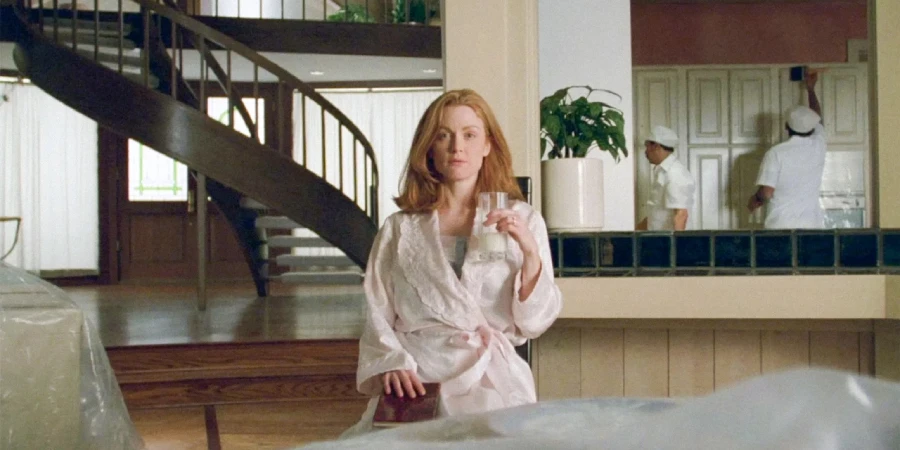

A woman becomes allergic to her own life, and director Todd Haynes refuses to let you look away. Safe (1995) follows suburban housewife Carol White as she develops a mysterious, debilitating sensitivity to the modern world around her, and the film never offers a comforting diagnosis or a tidy resolution. It is one of the most quietly devastating films of the 1990s, operating more like a slow-burn psychological study than a conventional drama. Haynes weaponizes stillness, distance, and domestic mundanity to make the audience feel just as suffocated as Carol does.
Detailed Summary
Carol’s Comfortable, Hollow Life
We meet Carol White (played by Julianne Moore) living a picture-perfect existence in the San Fernando Valley. Her days consist of aerobics classes, furniture shopping, and quiet dinner conversations that never quite connect. She is married to Greg White (Xander Berkeley), a reasonably kind but emotionally absent husband, and she has a stepson she never truly bonds with.
Haynes frames Carol as a ghost in her own home. Wide shots keep her small within large, pristine spaces, signaling her lack of agency before anything has gone wrong. She drifts through privilege without hunger, curiosity, or self-knowledge.
The First Signs of Illness
Carol begins experiencing unexplained symptoms: nosebleeds, a persistent cough, and a violent reaction to car exhaust fumes. A new sofa delivery triggers a sudden, shocking nosebleed. Doctors find nothing wrong with her, attributing her symptoms to stress or vague psychosomatic causes.
Her symptoms escalate with alarming speed. She has a seizure at the dry cleaner and collapses in her garage. However, the medical establishment continues to dismiss her, and her husband grows visibly frustrated by her increasing incapacitation.
Discovering Environmental Illness
Carol stumbles across a pamphlet for Environmental Illness (also called Multiple Chemical Sensitivity), and something clicks. She attends a support group where sufferers describe reactions to everyday chemicals, pesticides, and synthetic materials. For the first time, Carol finds language for her experience.
This section of the film is deliberately ambiguous. Haynes never confirms whether Carol’s illness is physiological, psychological, or something socially constructed. In contrast to most illness narratives, the film refuses to validate or debunk her condition; it simply watches.
Wrenwood and the Retreat
Carol decides to leave her family and travel to Wrenwood, a New Age wellness retreat in New Mexico run by a charismatic, HIV-positive leader named Peter Dunning (Peter Friedman). Wrenwood promises a safe, chemical-free environment and a community of fellow sufferers. Carol moves into a primitive, porcelain-lined “safe house” on the property.
Peter’s philosophy centers on self-love as the cure for illness. He preaches that negative thinking and unresolved emotional pain cause physical disease. His influence over the community is total and, notably, troubling.
Life at Wrenwood
Carol embraces Wrenwood’s rituals with desperate sincerity. She attends group sessions, repeats affirmations, and isolates herself further from the outside world. Meanwhile, her health does not visibly improve; it may actually worsen.
Haynes draws a pointed parallel between Wrenwood and a cult. Peter’s teachings, however gentle in tone, shift blame for illness onto the patient. Carol, already lacking selfhood, absorbs this framework completely and begins turning her fragile sense of identity entirely over to Peter’s ideology.

Movie Ending
Carol’s condition continues deteriorating at Wrenwood until she moves into an even more isolated, sparse igloo-like structure on the edge of the property, effectively quarantining herself from everything, including human warmth. Her husband Greg visits with her stepson, and the reunion is stilted and sad; Carol seems more at home in her sterile pod than with her family. Greg eventually leaves, and Carol watches his departure without apparent grief.
On her birthday, the Wrenwood community gathers to celebrate her. Peter leads her through an affirmation exercise in front of the group. Carol stands at the microphone, stumbles through words of self-love, and breaks down. Consequently, what should feel like a breakthrough registers as collapse.
In the film’s final image, Carol returns alone to her igloo. She looks into a small mirror and softly says, “I love you. I really love you.” Her face is gaunt, her expression hollow, her voice barely a whisper. She is speaking to herself, but there is no self left to receive the message.
Haynes offers no cure, no escape, and no catharsis. Carol has traded one suffocating environment (suburban conformity) for another (ideological dependence on Peter’s community). Furthermore, she has not found herself; she has simply found a new container to disappear into. The film’s final shot lingers long enough to make the viewer feel the full weight of that tragedy.
Audiences often ask whether Carol actually has a real physical illness or whether the film diagnoses her with something psychosomatic. Haynes refuses both answers. The ambiguity is the point: the film implicates modern life, medical dismissal, spiritual exploitation, and Carol’s own inability to claim a self as equally complicit in her unraveling.
Are There Post-Credits Scenes?
Safe contains no post-credits scenes. The film ends on its devastating final image, and Haynes allows no buffer, no relief, and no additional content after the credits roll.
Type of Movie
Safe operates primarily as a psychological drama with elements of body horror and social satire. Its tone is cold, clinical, and deeply unsettling without relying on conventional horror mechanics. Haynes keeps emotion at arm’s length, making the film feel more like an observation than a story.
In contrast to mainstream 1990s drama, Safe withholds judgment and withholds comfort in equal measure. It is deliberately slow, deliberately distancing, and rewards patient viewers willing to sit with ambiguity.
Cast
- Julianne Moore – Carol White
- Xander Berkeley – Greg White
- Peter Friedman – Peter Dunning
- Susan Norman – Linda
- Kate McGregor-Stewart – Claire
- Mary Carver – Nell
- Steven Gilborn – Dr. Hubbard
- Ronnie Farer – Barbara
Film Music and Composer
Ed Tomney composed the score for Safe. His work here is spare, ambient, and deliberately uneasy, favoring long, droning tones over melodic warmth. Music in this film functions less as emotional guidance and more as a source of low-grade dread.
Tomney’s score mirrors Haynes’s visual strategy perfectly. It never swells at emotional peaks or softens during painful moments. As a result, the audience receives no musical permission to feel relieved, making the viewing experience consistently unsettling.



Filming Locations
Principal photography took place in the San Fernando Valley in California, which provides Carol’s immaculate, sun-bleached suburban home environment. Haynes chose these locations specifically for their aesthetic of affluent emptiness: wide streets, manicured lawns, and interiors that look more like showrooms than lived-in homes.
Wrenwood scenes were shot in New Mexico, using the arid landscape to create a sense of false sanctuary. The stark, open terrain looks freeing at first glance but gradually reads as desolate. Both locations work together to show Carol moving from one kind of trap to another, with geography reinforcing theme at every turn.
Awards and Nominations
Safe received significant critical acclaim but limited major awards recognition upon release. Julianne Moore earned considerable praise for her performance, and the film appeared on numerous critics’ year-end lists. It has since been reassessed as a landmark work, though major awards bodies largely overlooked it at the time of release.
Behind the Scenes Insights
- Todd Haynes conceived the film partly as a response to the AIDS crisis, using Environmental Illness as a metaphor for how society treats people with stigmatized or misunderstood conditions.
- Julianne Moore has described the role as one of the most challenging of her career, requiring her to portray a character with almost no interiority while still generating empathy.
- Haynes deliberately kept Moore’s character thin and physically diminished throughout production to visually reinforce Carol’s disappearing sense of self.
- The film operated on a very modest budget, which directly influenced the minimalist visual approach and sparse production design.
- Haynes and his team researched Multiple Chemical Sensitivity extensively, interviewing people who identified as sufferers to inform the community scenes at Wrenwood.
- The wide-angle, distancing cinematography by Alex Nepomniaschy was a deliberate choice to deny the audience the intimacy of close-ups during emotional moments.
Inspirations and References
Haynes cited the work of filmmaker Chantal Akerman, particularly Jeanne Dielman, 23 quai du Commerce, 1080 Bruxelles, as an influence on his use of domestic space and female passivity. Both films use mundane routine as a form of existential horror. Haynes admired how Akerman made housework look like slow suffocation.
The film also draws on broader anxieties about New Age wellness culture and its capacity to exploit vulnerable people under the guise of healing. Peter Dunning’s community at Wrenwood reflects real movements of the era that blended legitimate self-help with manipulative group dynamics. Haynes was similarly influenced by the cultural moment of the late 1980s and early 1990s, when environmental illness support communities were a genuine social phenomenon in the United States.
Alternate Endings and Deleted Scenes
No officially documented alternate endings or notable deleted scenes for Safe have been confirmed in publicly available production records or interviews. Haynes has spoken about the film’s ending as always being essential to its meaning. Consequently, no significant variations appear to have been seriously considered during production.
Book Adaptations and Differences
Safe is not based on a book, novel, or pre-existing source material. Todd Haynes wrote the original screenplay himself. The story, characters, and thematic framework all originated with Haynes directly.


Memorable Scenes and Quotes
Key Scenes
- Carol’s first nosebleed during the sofa delivery, arriving without warning in a scene of cheerful domestic mundanity, signals that something in her world has fundamentally broken.
- Her collapse in the dry cleaner’s shop, which Haynes films with quiet, almost clinical detachment, is one of the film’s most viscerally uncomfortable moments.
- Carol’s seizure in the garage, surrounded by fumes, marks the point at which her illness can no longer be socially managed or explained away.
- Peter Dunning’s group sessions at Wrenwood, in which he redirects the language of healing into thinly veiled blame, grow more sinister on each viewing.
- The birthday celebration scene, in which Carol attempts to speak affirmations and crumbles, functions as the film’s emotional climax and its most heartbreaking moment.
- The final mirror scene, in which Carol addresses her own reflection with hollow words of self-love, is one of the most chilling endings in American independent cinema.
Iconic Quotes
- “I love you. I really love you.” – Carol White, to her own reflection, in the film’s devastating final line.
- “Are you safe? I’m not safe.” – Carol, during a phone call, encapsulating the film’s central anxiety in a single exchange.
- Peter Dunning, to his community: “The only person who can make you sick is you.” A line that sounds like empowerment but functions as accusation.
Easter Eggs and Hidden Details
- Haynes consistently positions Carol in the far corner or edge of the frame, a visual choice that emphasizes her marginalization within her own story from the very first scene.
- Carol’s home is decorated almost entirely in white and beige, colors that signify purity and blankness simultaneously, foreshadowing the sterile “safe” environments she will later inhabit.
- A television in the background of one early scene plays news coverage that subtly references public health anxieties of the era, grounding Carol’s private crisis in a broader cultural moment.
- Peter Dunning’s own visible physical deterioration from HIV progresses quietly in the background of Wrenwood scenes, drawing a parallel between his condition and Carol’s without the film ever stating it directly.
- Carol’s aerobics class at the film’s opening features synchronized, robotic movement that prefigures the group conformity she will later submit to at Wrenwood.
- The igloo-like structure Carol retreats to at Wrenwood visually resembles a womb, though it provides no comfort or regeneration, only further isolation.
Trivia
- Safe was produced by Christine Vachon, one of the most important producers in American independent cinema, who also collaborated with Haynes on several of his other films.
- Julianne Moore reportedly lost weight for the role to make Carol’s physical decline more visually convincing as the film progresses.
- Critics and scholars have frequently read the film as an AIDS allegory, with Carol’s stigmatized, misunderstood illness mirroring the social experience of people living with HIV in the early 1990s.
- Film critic Roger Ebert gave the film a strong review and highlighted Moore’s performance as exceptionally controlled and quietly devastating.
- Safe premiered at the Sundance Film Festival in 1995, where it generated significant critical attention within the independent film community.
- Many film scholars cite Safe as one of the defining American films of the 1990s, and its reputation has grown considerably in the decades since its release.
- Haynes has discussed the film in the context of feminist theory, describing Carol as a woman who has been so thoroughly shaped by external expectations that she has no autonomous self to fall back on when crisis arrives.
Why Watch?
Safe rewards anyone willing to accept a film that refuses easy answers and comfortable emotions. Julianne Moore delivers one of the great screen performances of the 1990s, communicating an entire interior collapse through posture, breath, and stillness. Moreover, Haynes’s critique of wellness culture, medical dismissal, and suburban alienation feels more relevant today than ever. This film will get under your skin and stay there.
Director’s Other Movies
- Poison (1991)
- Velvet Goldmine (1998)
- Far from Heaven (2002)
- I’m Not There (2007)
- Mildred Pierce (2011)
- Carol (2015)
- Wonderstruck (2017)
- Dark Waters (2019)
- May December (2023)
Recommended Films for Fans
- Jeanne Dielman, 23 quai du Commerce, 1080 Bruxelles (1975)
- The Hours (2002)
- Happiness (1998)
- A Woman Under the Influence (1974)
- Far from Heaven (2002)
- The Wolf Hour (2019)
- Ordinary People (1980)
- The Virgin Suicides (1999)
- Antichrist (2009)
- Martha Marcy May Marlene (2011)