
Michael Haneke does not make films for passive viewers. Code Unknown opens with a silent game of charades that no one can decode, and that image sets the tone for everything that follows: a world full of people speaking without being heard. Released in 2000, this French-language film fractures its narrative into disconnected episodes with no transitions, no closure, and no apology. It is one of the most quietly devastating portraits of urban alienation ever committed to film.
Detailed Summary
The Inciting Incident on the Street
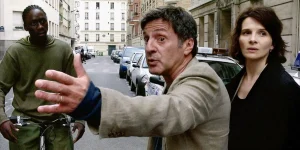
Everything begins on a Paris street with a small act of thoughtlessness. Jean (Alexandre Hamidi), a young farm boy visiting his brother Georges, tosses a crumpled paper bag into the lap of Maria (Luminita Gheorghiu), a Romanian beggar woman sitting on the pavement. Amadou (Ona Lu Yenke), a young Black man of West African descent, confronts Jean about the disrespect and demands he apologize.
Jean refuses. The confrontation escalates, and police arrive. Consequently, both Amadou and Maria end up detained, while Jean walks away with minimal consequences. This opening sequence is not presented as a dramatic catalyst; it is deliberately mundane, which makes it far more unsettling.
Anne Laurent and Her World
Georges’s girlfriend, Anne Laurent (Juliette Binoche), witnesses the street incident. She is an actress living in Paris, navigating a relationship with a photojournalist partner who is frequently absent. Her storyline unfolds in fragments, shifting between her professional life and her private loneliness.
Anne works on a film set, where we see her performing scenes. In one striking sequence, she records a voice-over for a thriller, reading lines that carry an eerie tension mirroring her real emotional state. However, her personal life is equally strained: Georges travels to Kosovo for war photography assignments, leaving Anne alone for extended stretches.
Georges and the Weight of Witness
Georges Laurent (Thierry Neuvic) spends significant time away in conflict zones. His work forces him to document suffering without intervening, a moral position that quietly corrodes him. Back in Paris, he struggles to reconnect with Anne after each return.
Their relationship carries a persistent tension rooted in absence and emotional unavailability. Georges cannot fully re-enter domestic life after witnessing atrocities abroad. Furthermore, his younger brother Jean’s naivety and recklessness contrast sharply with Georges’s world-weary detachment.
Maria’s Deportation and Return
Maria, the Romanian woman caught up in the street incident, faces serious consequences from that brief confrontation. French authorities deport her back to Romania. Her storyline then shifts geographically, showing her life in a rural Romanian village with her family.
Back in Romania, Maria’s world is marked by poverty and resignation. Nevertheless, she eventually returns to Paris to resume begging, completing a circular journey that underscores how little the system actually changes for people in her position. Her arc is presented without melodrama, which makes it all the more affecting.
Amadou’s Family and the Cycle of Anger
Amadou’s life after the street incident involves his father, a strict and authoritative figure who represents a more traditional generational worldview. Their dynamic highlights the pressure Amadou faces between his French-raised identity and his father’s expectations. In addition, Amadou’s work with deaf children at a school provides a counterpoint to the film’s recurring theme of failed communication.
His relationship with Francine (Seydou Boro’s character’s girlfriend) is touched upon but not heavily developed. Amadou is a man trying to do the right thing, only to find that good intentions produce messy results in a structurally indifferent society.
Anne’s Harassment on the Metro
One of the film’s most tension-soaked sequences follows Anne on a Paris Metro train. A group of young men begin harassing her verbally and physically. Other passengers watch but do not intervene. As a result, Anne endures the entire episode in frightening isolation despite being surrounded by people.
This scene crystallizes Code Unknown‘s central preoccupation. Proximity does not create community. Haneke holds the camera on Anne’s face for an uncomfortably long time, forcing viewers to sit inside her fear rather than observe it from a safe distance.
Jean’s Disappearance and the Farm
Jean, whose careless act triggered the entire chain of events, eventually disappears from the narrative without resolution. He had gone to Paris hoping to escape farm life and join the army. His failure to apologize to Maria, that single small refusal, sets multiple lives in motion.
Georges’s father on the farm represents an older, rural France increasingly disconnected from the urban multicultural world his sons inhabit. Jean’s storyline ends without conclusion, which is entirely deliberate. Haneke refuses to give him, or viewers, a tidy arc.
The Recurring Deaf Children and Silent Communication
Throughout the film, Amadou works with children who are deaf, teaching them through sign language and physical communication. These scenes directly echo the opening charades game. Silent communication becomes a kind of metaphor running through the entire film: even people who cannot hear each other find more genuine connection than those who technically can.
Haneke returns to these children at key structural moments, using them as a quiet counterpoint to the failures of verbal and social communication depicted everywhere else.

Movie Ending
Anne returns to the apartment she shares with Georges and tries to enter with her key. It does not work. Someone has changed the lock. She knocks, but no one answers. She stands in the hallway, locked out of her own home and her own relationship, and the film cuts away without explanation.
This moment carries enormous weight. Haneke never clarifies whether Georges changed the lock, whether there was a break-in, or whether something more sinister occurred. The ambiguity is not lazy; it is the point. In contrast to conventional thriller logic, the film refuses to resolve what it has raised.
Simultaneously, the final images return to the deaf children performing their silent communication exercises. They clap, gesture, and reach toward each other across a gymnasium. The film ends on this image, which functions as a kind of muted, fragile hope. These children, unable to hear, still try harder to connect than the hearing adults throughout the film.
Moreover, the circular structure is significant. Code Unknown does not arc toward resolution; it loops back toward its own beginning. Maria is back in Paris begging. Communication has still failed. Lives have been altered by a single moment of thoughtlessness that nobody fully processed or learned from. Haneke’s conclusion is not nihilistic, but it is unflinching: the codes that govern how we treat each other remain, frustratingly, unknown.
Are There Post-Credits Scenes?
Code Unknown contains no post-credits scenes. Haneke’s filmmaking philosophy is entirely incompatible with that kind of audience appeasement. Once the film ends, it ends completely.
Type of Movie
Code Unknown is a drama with strong elements of social realism and political cinema. Its tone is austere, restrained, and deliberately uncomfortable. Haneke leans into long takes and minimal musical intervention to create a documentary-like texture.
In terms of genre mood, the film sits closer to Haneke’s broader body of work than to any conventional dramatic label. It is cerebral, fragmented, and challenges viewers to fill in the gaps it deliberately leaves open.
Cast
- Juliette Binoche – Anne Laurent
- Thierry Neuvic – Georges Laurent
- Seydou Boro – Amadou
- Ona Lu Yenke – Amadou (some sources attribute this role differently; Seydou Boro plays Amadou)
- Alexandre Hamidi – Jean
- Luminita Gheorghiu – Maria
- Heloise Godet – Francine
- Maimouna Helene Diarra – Aminate
Film Music and Composer
Code Unknown uses music very sparingly, which is consistent with Haneke’s approach across his career. He tends to distrust non-diegetic music as a tool for emotional manipulation. As a result, silence itself becomes a compositional element throughout the film.
There is no conventional film score by a single composer. Instead, Haneke incorporates fragments of music that arise naturally within scenes, maintaining the film’s documentary-like restraint. This absence of a traditional score forces viewers to engage without the emotional cues a conventional soundtrack would provide.


Filming Locations
Principal photography took place in Paris, France, with key scenes shot in real Metro stations and on actual city streets. Haneke chose authentic urban environments rather than controlled sets, which gives the film its gritty, immediate texture. The city’s density and anonymity are central to the film’s themes.
Additional footage was shot in Romania for Maria’s sequences, and brief material was captured in Kosovo to contextualize Georges’s war photography work. These location shifts reflect the film’s interest in how geography and national borders shape people’s fates. Furthermore, moving between Paris and rural Romania underscores the vast inequality separating Maria’s two worlds.
Awards and Nominations
Code Unknown competed in the main competition at the 2000 Cannes Film Festival, one of cinema’s most prestigious platforms. While it did not win the Palme d’Or that year, its presence in competition significantly raised its international profile.
Juliette Binoche’s performance received considerable critical recognition across European film circles, though specific individual awards varied by organization. The film’s reputation has grown substantially in critical reassessments since its initial release.
Behind the Scenes Insights
- Haneke structured the film as a series of long, unbroken takes with no conventional transitions between scenes; each segment begins and ends abruptly, reinforcing the theme of incomplete communication.
- Juliette Binoche had already worked with Haneke prior to this film and trusted his unconventional methods enough to commit fully to the project’s unusual structure.
- The Metro harassment sequence required careful coordination to shoot in a real train carriage while maintaining the claustrophobic, unpredictable energy Haneke wanted.
- Haneke reportedly cast non-professional actors alongside professionals in certain sequences to blur the line between scripted drama and documentary-style realism.
- The opening charades scene with deaf children was shot to set up the film’s core thematic question immediately: what does it mean to communicate without shared codes?
Inspirations and References
Haneke drew heavily on his ongoing preoccupation with media, violence, and urban alienation. His earlier Austrian films, particularly Benny’s Video and 71 Fragments of a Chronology of Chance, established the fragmented narrative approach he refined in Code Unknown.
The film also reflects broader European anxieties about immigration, racism, and the limits of liberal tolerance in multicultural cities. Sociological writing on urban anonymity and structural inequality informed Haneke’s thematic framework, even if no single text serves as a direct source.
Additionally, the French New Wave’s interest in location shooting and naturalistic performance clearly left a mark on Haneke’s aesthetic choices here.
Alternate Endings and Deleted Scenes
No publicly documented alternate endings or formally released deleted scenes exist for Code Unknown. Haneke is known for his precise, pre-planned approach to filmmaking; he does not typically generate large volumes of extraneous material. What ended up in the film reflects his deliberate editorial vision.
Book Adaptations and Differences
Code Unknown is not based on a book, novel, or pre-existing source material. Haneke wrote the original screenplay himself. The film is entirely an original work.

Memorable Scenes and Quotes
Key Scenes
- The opening street confrontation: Jean discards his bag into Maria’s lap; Amadou intervenes; police arrive and take the wrong people. A mundane moment with cascading consequences.
- Anne’s Metro harassment: A slow, suffocating sequence in which Anne is tormented by young men while surrounding passengers refuse to intervene. Haneke holds on her face without cutting.
- Maria in Romania: Her return to her village strips away any romanticization of “home.” Poverty and resignation define her domestic world as much as Paris ever did.
- Anne locked out of her apartment: The film’s final act for her character; she stands in a hallway, key useless, as the film offers no explanation and cuts away.
- The deaf children’s gymnasium scene: Silent communication performed with genuine effort and warmth, providing the film’s final image and its most quietly hopeful note.
- Georges’s inability to reconnect: His return from Kosovo plays out in stilted, awkward domestic scenes that reveal how trauma and emotional absence hollowed out the relationship.
Iconic Quotes
- “You can’t just throw things at people.” (Amadou, confronting Jean; the simplest moral statement in the film, and the one that costs him most.)
- Anne’s voice-over recordings during her acting work carry lines about fear and captivity that resonate far beyond the thriller film she is recording them for.
Easter Eggs and Hidden Details
- The title Code Unknown refers directly to the opening charades game, where children must guess what another child is miming without any verbal code; the film never gives viewers a key to decode it either.
- Haneke uses black screens between scenes rather than conventional cuts or fades, creating a deliberate rhythm of interruption that mimics the experience of incomplete information.
- Anne’s acting work within the film includes a scene where she appears to be trapped and afraid; this directly mirrors her real emotional state and her later experience on the Metro.
- Maria’s circular journey (Paris, deportation, Romania, back to Paris) is structured symmetrically in the film’s episode order, though viewers must track it carefully given the non-linear presentation.
- The recurring presence of deaf children is not incidental; Haneke uses them to show that people who lack hearing work harder at connection than those who have every communicative tool available.
- Georges’s photographic work in Kosovo echoes Haneke’s recurring interest in mediated violence: images of suffering observed through a lens rather than confronted directly.
Trivia
- The full title in French is Code inconnu: Récit incomplet de divers voyages, which translates roughly to “Code Unknown: Incomplete Tale of Various Journeys,” a title that is itself a direct warning about the film’s narrative approach.
- Haneke shot the film in a French-language production, marking one of his first major works outside his native Austria and German-language filmmaking context.
- Juliette Binoche is one of France’s most internationally recognized actresses, and her presence gave the film significant commercial and awards-circuit visibility that a more obscure cast might not have provided.
- Each episode in the film was designed to be self-contained enough that its beginning and ending are withheld from the viewer, reinforcing the sense of catching fragments of lives mid-stream.
- Haneke has cited his frustration with Hollywood narrative conventions as a motivating force behind the film’s refusal to provide traditional story resolution.
- Luminita Gheorghiu, who plays Maria, later appeared in the acclaimed Romanian New Wave film The Death of Mr. Lazarescu, demonstrating the cross-pollination between Eastern European art cinema and Haneke’s milieu.
Why Watch?
Code Unknown is essential viewing for anyone serious about what cinema can do that no other art form can replicate. Haneke weaponizes form itself, making the film’s structure inseparable from its meaning. Consequently, walking away unchanged requires a level of detachment most viewers will not manage. Few films of its era capture urban alienation with such precision and such refusal to comfort.
Director’s Other Movies
- The Seventh Continent (1989)
- Benny’s Video (1992)
- 71 Fragments of a Chronology of Chance (1994)
- Funny Games (1997)
- The Piano Teacher (2001)
- Time of the Wolf (2003)
- Cache (2005)
- Funny Games (2007)
- The White Ribbon (2009)
- Amour (2012)
- Happy End (2017)
Recommended Films for Fans
- Cache (2005)
- Babel (2006)
- Short Cuts (1993)
- Magnolia (1999)
- Certified Copy (2010)
- The Death of Mr. Lazarescu (2005)
- Elephant (2003)
- 4 Months, 3 Weeks and 2 Days (2007)
- Amores Perros (2000)