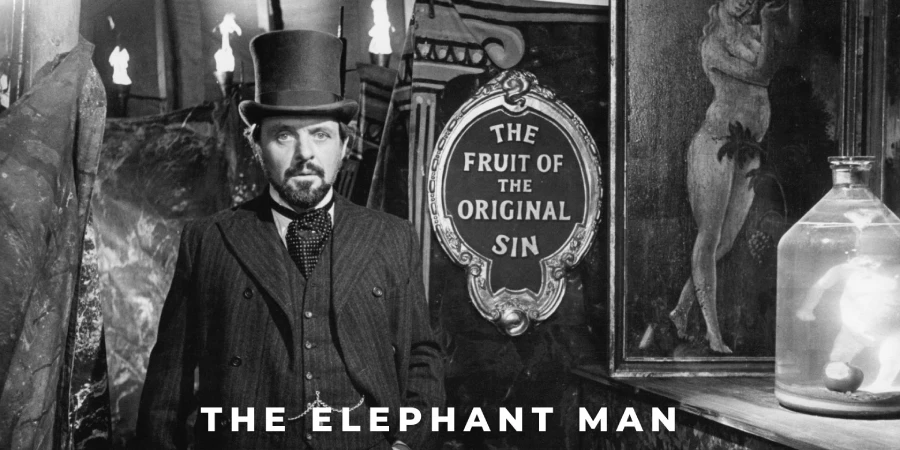

David Lynch shot The Elephant Man in luminous black and white, and that single choice tells you everything about how he saw Joseph Merrick’s world: a place of stark contrasts, beauty pressed hard against cruelty, light barely holding back the dark.
Anthony Hopkins plays Frederick Treves, the surgeon who pulls Merrick from a Victorian freak show, and John Hurt disappears so completely under layers of prosthetic makeup that you forget there is a face underneath at all. What Lynch delivers is not a straightforward biopic but something closer to a nightmare with a conscience.
Detailed Summary
The Freak Show and First Encounter
Frederick Treves, a surgeon at the London Hospital in 1884, pays a street showman named Bytes to view his prize exhibit: John Merrick, a severely deformed man kept in squalid conditions and displayed like an animal. Treves finds Merrick crouched in a dark, damp booth, covered in rags and a hood. Merrick’s body is grotesquely misshapen, with a massive bony growth on his skull, a twisted spine, and a right arm so enlarged it is nearly useless.
Treves brings Merrick to the hospital for examination and photographs him for a medical lecture. He believes, at first, that Merrick is severely intellectually disabled. He quietly returns him to Bytes afterward, which is one of the film’s early moral discomforts: Treves cannot yet justify keeping him.
Discovery of Intelligence and Rescue
Merrick collapses on the street and police bring him back to the hospital. Treves secures him a room there permanently. During their conversations, Treves makes a startling discovery: Merrick can speak, has memorized the 23rd Psalm, and possesses a gentle, articulate intelligence. Bytes had deliberately cultivated the impression of mental incapacity.
This reveal lands hard. Merrick recites scripture in a halting, emotional voice, and Hurt plays the moment with shaking hands and wet eyes, as though Merrick himself cannot quite believe someone is listening.
Merrick’s Life at the Hospital
Merrick settles into a room at the London Hospital. Treves introduces him to polite society, including the hospital’s matron and eventually London’s social elite. Merrick begins building an intricate model of a cathedral from a picture he can see through his window. He forms a genuine friendship with a celebrated actress named Mrs. Kendal, who visits him and reads Romeo and Juliet with him.
Treves grows conflicted. He wonders aloud in a key scene whether he has simply replaced Bytes with a more comfortable cage, trading one kind of exhibition for another. It is the film’s sharpest question, and Lynch does not let Treves off the hook easily.
The Night Porter and the Mob
A night porter named Silcock secretly charges other workers and members of the public to gawk at Merrick after hours. He even brings a group of drunken men into the room one night, and the scene is genuinely disturbing: leering faces pushed into Merrick’s space while he sits terrified and helpless. Bytes eventually reappears and bribes his way into the hospital, reclaims Merrick, and drags him back onto the European freak show circuit.
This section of the film is deliberately ugly. Lynch shoots the mob scenes with low, crawling camera angles and deep shadows, making the cruelty feel physical and suffocating.
Return and Final Days
Merrick escapes from the continental shows with help from fellow performers and makes his way back to London. He arrives at Liverpool Street Station and is chased by a mob of children mocking his appearance. He is cornered in a lavatory, collapses, and cries out his most famous line. Police take him back to the hospital.
Back under Treves’s care, Merrick enjoys a period of genuine warmth. Mrs. Kendal arranges a visit to the theatre, and the entire cast onstage acknowledges Merrick from the stage while the audience applauds him. Merrick weeps with happiness. It is the film’s emotional high point and Hurt plays it with total stillness, tears running down the prosthetic face.

Movie Ending
Merrick has always slept sitting up, because lying flat would likely suffocate him given the weight of his head. On his final night, after returning from the theatre and completing his cathedral model, he chooses to lie down in his bed like a normal person. He looks at a picture of his mother on the wall. He arranges his pillows. Then he lies back.
He dies in his sleep. The cause is almost certainly positional asphyxia, though the film frames it as a conscious choice rather than an accident. Merrick knows the risk. He does it anyway.
Lynch then cuts to an extraordinary sequence. Merrick’s dead body dissolves into a starfield, and the film shows images of his mother’s face floating in darkness while a soft voice reads lines from Invictus by W.E. Henley. The sequence is abstract, spiritual, and deliberately unresolved. Lynch refuses to explain it or make it tidy.
What makes this ending so precise is what it refuses to do. It does not present Merrick’s death as tragedy or as relief. Merrick gets exactly one night of choosing how his body exists in space, and Lynch treats that single act of self-determination as the closest thing to freedom the film offers. The final images feel less like a conventional closing and more like Lynch releasing Merrick from the film’s own scrutiny.
Are There Post-Credits Scenes?
No. The Elephant Man contains no post-credits scenes. Lynch cuts to black after the final cosmic sequence, and the credits roll in silence over that darkness. Sitting through them expecting a scene would be its own kind of sad joke given the film’s subject matter.
Type of Movie
The Elephant Man is a biographical drama with strong elements of horror and surrealism. Lynch keeps one foot in the period drama tradition and the other in the nightmare imagery that defined his earlier work, Eraserhead. The tone is mournful and oppressive for most of its running time, breaking only occasionally into something warmer.
Do not mistake it for a feel-good Victorian story. Lynch is making something uncomfortable even in its tender moments.
Cast
- Anthony Hopkins – Frederick Treves
- John Hurt – John Merrick
- Anne Bancroft – Mrs. Kendal
- John Gielgud – Carr Gomm
- Wendy Hiller – Mothershead (Matron)
- Freddie Jones – Bytes
- Michael Elphick – Night Porter
- Hannah Gordon – Anne Treves
Film Music and Composer
John Morris composed the score. Morris was a frequent collaborator with Mel Brooks, which makes his work here a fascinating detour; he brings a genuine melancholy to the orchestral arrangements without sliding into sentimentality. The main theme uses strings with a low, searching quality that suits Lynch’s imagery perfectly.
Samuel Barber’s Adagio for Strings appears in the film and carries enormous emotional weight in the theatre scene. Lynch’s use of pre-existing classical music alongside Morris’s original score gives the film a layered sonic texture. The industrial noise and steam sounds that open the film, bleeding into the score’s opening passages, are a signature Lynchian touch.
Filming Locations
Principal photography took place in England. The production used locations around London and studio work at Lee International Studios in Wembley. The Victorian street scenes and hospital interiors were largely built on set, giving Lynch precise control over the lighting and the oppressive, enclosed atmosphere he wanted.
Shooting in black and white let the production design do heavy lifting. The grimy industrial backdrops, the steaming streets, the cramped hospital corridors all read as period-accurate without requiring the full color spectacle of a traditional costume drama. That restraint was a deliberate choice that pays off in almost every scene.
Awards and Nominations
The Elephant Man received eight Academy Award nominations, including Best Picture, Best Director, Best Actor for John Hurt, Best Adapted Screenplay, Best Film Editing, Best Art Direction, Best Costume Design, and Best Original Score. It won none of them; that year’s ceremony heavily favored Ordinary People and Raging Bull.
John Hurt received a BAFTA Award for Best Actor. The film also received Golden Globe nominations. Its Academy shutout remains one of the more debated results of that era, particularly given the craft on display in Hurt’s physical performance.
Behind the Scenes Insights
- John Hurt spent roughly seven hours in the makeup chair each day to be transformed into Merrick. The prosthetics were designed by Christopher Tucker.
- Lynch was brought onto the project by producer Mel Brooks, who kept his own name off the credits as producer to avoid audiences expecting a comedy.
- Anthony Hopkins has spoken about how moved he was by Hurt’s performance, describing it as one of the finest pieces of acting he had ever witnessed on set.
- Lynch insisted on shooting in black and white despite studio pressure to shoot in color. The choice was non-negotiable for him.
- The film was based on a script originally developed by Christopher De Vore and Eric Bergren, which Lynch rewrote extensively.
- Freddie Jones reportedly drew on his knowledge of fairground showmen to build the character of Bytes, making the abuse feel mundane rather than theatrical.
Inspirations and References
The film draws from two main sources: The Elephant Man and Other Reminiscences by Sir Frederick Treves, published in 1923, and The Elephant Man: A Study in Human Dignity by Ashley Montagu. Treves’s own account provided the film’s basic structure and many of its key scenes.
The real Joseph Merrick lived from 1862 to 1890. Later scholarship has complicated Treves’s own account, suggesting his memoir romanticized his role in Merrick’s life. Lynch and his screenwriters worked primarily from the sympathetic Treves version rather than any revisionist reading.
Lynch also drew visually from his own earlier surrealist work and from the tradition of early horror cinema, particularly the atmospheric black-and-white films of the 1930s.
Alternate Endings and Deleted Scenes
No widely documented alternate ending exists for The Elephant Man. Lynch has not publicly discussed filming a different conclusion. The cosmic, abstract finale with the starfield and the mother’s voice appears to have been his intention from early in the production.
Some scenes were reportedly trimmed during editing, but no significant deleted scene package has been officially released or extensively detailed in interviews. What Lynch cut has largely stayed cut.
Book Adaptations and Differences
The film is loosely adapted from Treves’s memoir and Montagu’s study rather than a single definitive source text. Treves’s account presents him as Merrick’s devoted rescuer, and the film mostly preserves that flattering self-portrait, though Lynch’s screenplay does introduce the subplot about Treves questioning his own motives.
That self-questioning by Treves does not appear prominently in Treves’s original memoir. It is a screenwriting addition that gives Hopkins a genuine dramatic arc and prevents the film from becoming a straightforward saint-and-victim story. That addition is, arguably, the smartest structural choice the script makes.


Memorable Scenes and Quotes
Key Scenes
- Treves’s first sight of Merrick in the dark booth, lit by a single lamp; Lynch holds the shot long enough that it becomes genuinely unsettling before becoming heartbreaking.
- Merrick reciting the 23rd Psalm to prove his intelligence, with Hurt’s voice barely controlled and Hopkins visibly shaken beside him.
- The night porter’s mob scene, shot from low angles with lurching handheld movement, making the viewer feel complicit in the intrusion.
- Merrick at the theatre, watching the pantomime while the cast acknowledges him from the stage; the audience applauds, and Merrick covers his face with his hands.
- Merrick arranging his pillows, looking at his mother’s portrait, and lying down for the final time; Lynch keeps the camera still and lets silence do the work.
Iconic Quotes
- “I am not an animal! I am a human being!” spoken by Merrick in the Liverpool Street Station lavatory, surrounded by a jeering crowd.
- “I am not sure I agree with you, Frederick. We are all what we are, aren’t we?” spoken by Carr Gomm, gently deflecting Treves’s self-doubt.
- “I have such friends. I have such friends.” Merrick’s quiet declaration near the film’s end, which Hurt delivers with a trembling simplicity that is almost unbearable to watch.
Easter Eggs and Hidden Details
- The opening sequence, showing abstract images of a woman surrounded by stampeding elephants, references the story Treves heard that Merrick’s deformity was caused by his mother being frightened by an elephant during pregnancy. Lynch presents it as myth rather than fact, deliberately blurring the dream and the reality.
- The cathedral model Merrick builds throughout the film mirrors the view from his hospital window. When he completes it near the end, Lynch holds a close shot of both the model and the real building visible through the glass, letting the parallel speak for itself.
- Freddie Jones as Bytes wears clothing that subtly echoes the respectable gentleman, making the visual point that exploitation and respectability share a costume.
- Lynch cameos as a voice on a gramophone record that plays in a background scene, though he is not visible on screen.
Trivia
- John Hurt said the role was the most physically demanding of his career and that the hours in the makeup chair required a form of almost meditative endurance.
- Mel Brooks reportedly told Lynch he had complete creative control and kept that promise throughout production, never interfering with the black-and-white decision or the surrealist sequences.
- The film marked Lynch’s transition from cult midnight cinema into mainstream awards contention, though Lynch himself seemed largely indifferent to the commercial category.
- John Gielgud, playing Carr Gomm, was in his mid-seventies during production and reportedly found the prosthetic and makeup work done on Hurt deeply affecting on set.
- The real John Merrick’s skeleton is held at the Royal London Hospital and has been the subject of ongoing medical study regarding the precise nature of his condition.
- Lynch has cited the industrial landscapes of his own childhood in America as influencing the visual texture of Victorian London in the film, a distinctly anachronistic but effective creative decision.
Why Watch?
Watch it for John Hurt’s face, or rather for what Hurt does with a face you cannot see. He communicates grief, humor, and dignity through posture alone, through the angle of a shoulder or the stillness of a hand, and it remains one of cinema’s great physical performances. Lynch’s black-and-white photography turns cruelty into something almost beautiful and then makes you uncomfortable for finding it beautiful. That tension is what keeps this film working forty-plus years after its release.
Director’s Other Movies
- Eraserhead (1977)
- Dune (1984)
- Blue Velvet (1986)
- Wild at Heart (1990)
- Twin Peaks: Fire Walk with Me (1992)
- Lost Highway (1997)
- The Straight Story (1999)
- Mulholland Drive (2001)
- Inland Empire (2006)