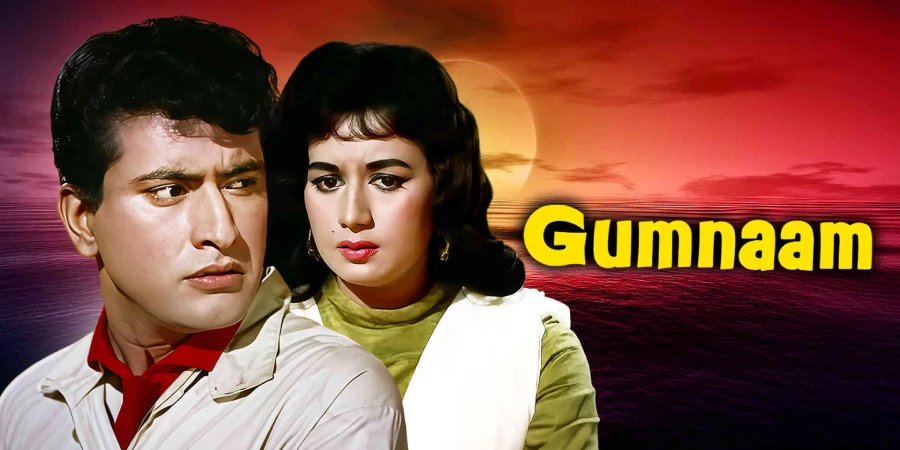

Gumnaam is the film that proved Bollywood could do Agatha Christie just as well as Hollywood, possibly better, and with far superior dance numbers. Released in 1965, this Hindi thriller drops eight strangers on a remote island and methodically murders them one by one. Director Raja Nawathe wrapped genuine dread inside glossy entertainment, creating a film that still holds up as one of Hindi cinema’s finest whodunits.
Detailed Summary
The Lottery Winners and Their Fateful Journey
Eight people win a lottery and travel together to a foreign destination. However, their aircraft faces a serious emergency, forcing an unplanned landing on a remote, seemingly deserted island.
Among the survivors are Anand (played by Manoj Kumar), the story’s moral compass, and Asha (played by Nanda), who becomes central to the mystery. In addition, the group includes a glamorous dancer named Sunita, played by Helen, whose provocative energy contrasts sharply with the island’s growing terror.
The Mysterious Bungalow and the Servant
Stranded and desperate, the group stumbles upon a fully stocked bungalow. Inside, they find food, beds, and every comfort, but no visible owner.
Only one figure inhabits the place: a mute, eerily cheerful servant named Ramu, portrayed with scene-stealing comedic brilliance by Mehmood. Ramu cannot speak, which conveniently prevents him from answering any of the group’s increasingly urgent questions.
The Anonymous Letters and the First Deaths
A nursery rhyme begins circulating among the survivors, listing each of them by name. Consequently, paranoia sets in fast, because the rhyme predicts their deaths in sequence.
One by one, members of the group are killed under mysterious circumstances. Each death follows the rhyme’s specific prediction, suggesting a killer with intimate knowledge of the group’s secrets.
Secrets, Suspects, and Hidden Motives
As the body count rises, the surviving characters reveal uncomfortable truths about their pasts. Several of them, it emerges, were involved in a shady business scheme that ruined an innocent person.
Anand pushes to investigate while others dissolve into fear or suspicion. Meanwhile, a romance develops between Anand and Asha, providing emotional warmth against the story’s cold backdrop of murder.
The Killer’s Identity Closes In
Suspicion falls on multiple characters throughout the film. Mr. Dharamdas, a seemingly respectable older gentleman, and others each carry enough guilt to qualify as the murderer.
Anand begins piecing together the connection between the victims’ shared past and the killings. For instance, the lottery itself seems too convenient, suggesting the survivors were deliberately assembled on the island rather than randomly selected.



Movie Ending
Anand finally identifies the killer as Mr. Dharamdas, played by Manmohan, who orchestrated the entire scheme to avenge a devastating wrong done to his family. Dharamdas engineered the lottery, arranged the stranding, and executed each murder methodically, using his apparent frailty as cover.
His motive centers on the group’s collective role in destroying someone close to him through fraud and betrayal. In contrast to the victims’ self-serving rationalizations, Dharamdas views himself purely as an instrument of justice.
Ramu, the mute servant, turns out to have been Dharamdas’s loyal accomplice throughout. His comic buffoonery masked active participation in the plan, making his earlier scenes land very differently on a second viewing.
Dharamdas is ultimately stopped before he can kill the remaining survivors, including Anand and Asha. His confession lays bare not just the crimes of the evening but the original sin that set everything in motion years earlier.
Rescue finally arrives, and the survivors who remain alive escape the island. The film ends on a bittersweet note: justice of a personal kind was achieved, but the cost in lives was devastating.
Are There Post-Credits Scenes?
Gumnaam has no post-credits scene. Films of this era in Hindi cinema did not employ that convention, so viewers can leave once the credits roll without missing anything.
Type of Movie
Gumnaam is a mystery thriller with strong elements of dark comedy and musical entertainment. Its tone is a genuinely unusual blend, alternating between suspenseful murder sequences and lively song-and-dance numbers without either element undermining the other.
Notably, the film owes a clear structural debt to the locked-room mystery tradition. It belongs to a select group of Bollywood films that treat genre conventions with genuine seriousness rather than using them as mere backdrop.
Cast
- Manoj Kumar – Anand
- Nanda – Asha
- Helen – Sunita
- Mehmood – Ramu
- Pran – Rakesh
- Manmohan – Mr. Dharamdas
- Madan Puri – Mr. Soni
- Tarun Bose – Mr. Bannerjee
- Lekh Tandon – Mr. Khanna
Film Music and Composer
Shankar-Jaikishan composed the score, and their work here ranks among their finest contributions to Hindi cinema. The duo understood how to use music as tonal counterpoint, placing upbeat numbers inside a story dripping with dread.
The opening title track, Gumnaam Hai Koi, sung by Lata Mangeshkar, is one of Hindi cinema’s most iconic thriller pieces. Its eerie, hypnotic melody sets the film’s mood immediately and lodges itself in the listener’s memory for days.
Similarly, Jaan Pehechaan Ho, also sung by Mohammed Rafi, became a cultural phenomenon far beyond the film’s original audience. Western audiences encountered it memorably in the opening sequence of the 1988 film Ghost World, introducing an entirely new generation to its infectious energy.


Filming Locations
Gumnaam was primarily shot at studio locations in Mumbai, with the island setting created largely through set design and controlled studio environments. This approach gave the production tight control over atmosphere and lighting, which proved essential for building claustrophobic tension.
Some outdoor sequences used locations around Mumbai to suggest the remote island geography. The confined, artificial quality of the bungalow interiors, moreover, reinforces the story’s psychological trap: these characters have nowhere to run.
Awards and Nominations
Gumnaam achieved strong commercial success and critical appreciation in India, though detailed records of specific award wins and nominations from this period are not comprehensively documented in widely verified sources. Its cultural legacy has far outpaced any formal recognition it may or may not have received at the time.
Behind the Scenes Insights
- Director Raja Nawathe was known for working efficiently within studio-era Bollywood constraints, and Gumnaam reflected that disciplined, production-focused approach.
- Mehmood reportedly brought significant improvisational energy to the role of Ramu, making the character funnier and more unsettling than the script alone might have achieved.
- Helen‘s performance of Jaan Pehechaan Ho required elaborate choreography and became one of her most celebrated screen moments, cementing her reputation as Bollywood’s definitive cabaret dancer of the era.
- The film’s nursery rhyme device, used to predict each murder, required careful scripting to ensure internal consistency throughout all the kill sequences.
- Pran, typically cast as a villain in films of this period, played a morally ambiguous role here, which added an extra layer of audience suspicion to his character.
Inspirations and References
Gumnaam draws direct inspiration from Agatha Christie‘s novel And Then There Were None, published in 1939. Christie’s premise of strangers trapped together and killed one by one according to a predetermined list forms the structural backbone of the film.
However, the filmmakers did not pursue a strict adaptation. They transplanted Christie’s concept into a distinctly Bollywood framework, adding songs, comic relief, and a romantic subplot that Christie’s source material never contained.
Consequently, Gumnaam occupies an interesting space between homage and original creation. It borrows Christie’s architecture while building an entirely different kind of house on top of it.
Alternate Endings and Deleted Scenes
No confirmed information exists in widely verified sources regarding alternate endings or deleted scenes for Gumnaam. Given standard Bollywood production practices of the mid-1960s, extensive alternate versions were not common practice at most studios.
Book Adaptations and Differences
Gumnaam is not a direct book adaptation in the formal sense. It takes its central concept from Christie’s And Then There Were None but represents an unofficial, uncredited reworking rather than a licensed adaptation.
In Christie’s novel, no character survives the island. Gumnaam, in contrast, preserves its romantic leads and delivers a more conventionally satisfying resolution, reflecting Bollywood’s audience expectations of the period.
Furthermore, Christie’s source has no musical numbers, no comic servant subplot, and no Bollywood-style romance. These additions fundamentally change the emotional texture of the story, making the film a genuinely distinct experience from its inspiration.



Memorable Scenes and Quotes
Key Scenes
- Helen’s electrifying performance of Jaan Pehechaan Ho in the opening cabaret sequence, which introduces the film’s wildly confident tonal mix.
- The first discovery of the anonymous rhyme, where the group realizes each of their names appears alongside a predicted manner of death.
- Ramu’s repeated comic interruptions during moments of high tension, which provide relief while subtly concealing his true role in the killings.
- The sequence in which Anand first openly accuses a fellow survivor, cracking the group’s fragile pretense of cooperation.
- Dharamdas’s final confession, which reframes every earlier scene and forces both the characters and the audience to reconsider who the real victims are.
Iconic Quotes
- “Gumnaam hai koi, badnaam hai koi”: the haunting refrain from the title song that functions almost as the film’s philosophical statement about anonymous guilt.
- Dharamdas’s confession speech, in which he explains his motive with chilling calm, arguing that the law failed where his own justice succeeded.
Easter Eggs and Hidden Details
- Ramu’s exaggerated cheerfulness in early scenes, played purely for laughs, takes on a sinister new dimension once his complicity is revealed, rewarding attentive repeat viewers.
- The nursery rhyme’s predictions are specific enough that a careful viewer can cross-reference each death against the verse, confirming Dharamdas planned every detail in advance.
- Pran’s character displays subtle behavioral tells throughout that, in retrospect, suggest he knows more than he admits, though not in the way audiences initially suspect.
- The bungalow’s suspiciously perfect preparation, full pantry, made beds, and all, functions as an early clue that the group’s arrival was anticipated rather than accidental.
Trivia
- Jaan Pehechaan Ho gained massive international recognition after its use in the 2001 film Ghost World, directed by Terry Zwigoff.
- This was one of several films of the 1960s that drew on Christie’s works without formal licensing, reflecting looser international copyright enforcement of the era.
- Shankar-Jaikishan composed music for a large number of major Hindi films throughout the 1950s and 1960s, making them among the most prolific and celebrated composers in Bollywood history.
- Mehmood was one of the biggest comedy stars in Hindi cinema during this period, and his casting added guaranteed box-office appeal beyond the thriller elements alone.
- Gumnaam remains a foundational text for anyone studying the mystery thriller genre within Indian popular cinema.
- Helen, a performer of mixed European and Burmese heritage, became iconic precisely through roles like this one, where her outsider glamour amplified every scene she inhabited.
Why Watch?
Gumnaam delivers something genuinely rare: a tightly plotted murder mystery that also functions as a full-blooded musical entertainment. Moreover, it stands as proof that genre filmmaking and mass-market Bollywood storytelling can coexist without compromise. Few films from any era juggle suspense, comedy, romance, and showstopping music this confidently.
Director’s Other Movies
- Naughty Boy (1962)
- Ek Dil Sau Afsane (1963)
Recommended Films for Fans
- Woh Kaun Thi? (1964)
- Mera Saaya (1966)
- Jewel Thief (1967)
- Ittefaq (1969)
- And Then There Were None (1945)
- Teesri Manzil (1966)