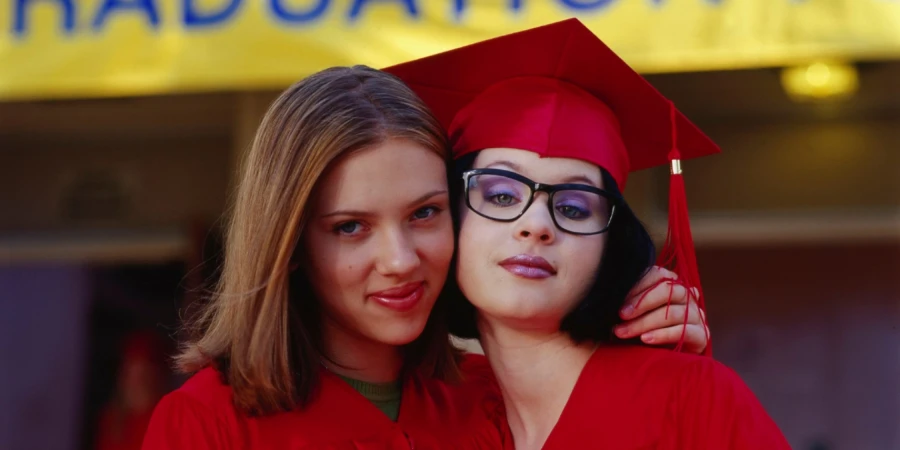

Ghost World is a film about alienation so precise it almost feels like surveillance footage of your own adolescence. Director Terry Zwigoff adapts Daniel Clowes’s graphic novel into something sharp, melancholy, and quietly devastating. Two misfit girls graduate high school and immediately start drifting apart, and the film refuses to make that process comfortable or neat. It is one of the rare coming-of-age stories that actually respects how painful coming of age can be.
Detailed Summary
Graduation and the Beginning of the Drift
Enid and Rebecca graduate high school doing exactly what you would expect from them: mocking everyone around them. They are best friends bound together by their shared contempt for mainstream culture. However, that contempt is already starting to function differently for each of them.
Rebecca has a practical streak underneath her cynicism. She wants a real apartment and a real life. Enid, in contrast, seems genuinely uninterested in any future that looks like what adults have built around her.
The Prank That Changes Everything
Enid and Rebecca pull a cruel prank on a lonely man named Seymour, responding to his personal ad in the newspaper as a joke. They follow him to a diner to watch his humiliation when his date never shows. Enid, however, finds herself genuinely fascinated by him rather than contemptuous.
Seymour is a middle-aged record collector, socially awkward and completely out of step with the world around him. Enid recognizes something in him immediately. He is, in his own way, exactly what she fears she might become.
Enid Gets to Know Seymour
Enid befriends Seymour and starts spending real time with him. She listens to his records, talks with him about art and culture, and finds his particular brand of isolation oddly comforting. Meanwhile, her friendship with Rebecca continues to fray around the edges.
Seymour’s collection becomes a kind of window into his character. He is passionate, knowledgeable, and completely incapable of connecting with people his own age. Enid, for her part, seems energized by someone who takes niche interests as seriously as she does.
Summer School and the Art Class Conflict
Enid failed an art class and must retake it over the summer in order to receive her diploma. Her teacher, Roberta, represents everything Enid despises about institutional validation. Roberta pushes trendy, politically correct art while showing no interest in genuine creative vision.
Enid submits a found piece of vintage racist advertising imagery as commentary. Roberta initially praises it. Later, when the piece causes controversy in a public show, Roberta turns on Enid without hesitation, prioritizing her own position over any artistic integrity.
Enid Pushes Seymour Toward Romance
Enid develops a quasi-obsessive interest in getting Seymour a girlfriend. She helps him post a new personal ad and coaches him on how to connect with women. Her motives are layered: she genuinely wants to help him, but she also seems to be testing something about human connection itself.
Seymour eventually connects with a woman named Dana. Their relationship develops, and Seymour seems happier in a conventional sense. Enid, on the other hand, starts to look more isolated as the people around her move forward.
The Relationship Between Enid and Seymour Deepens
After a night of drinking, Enid and Seymour sleep together. It is a moment neither of them fully pursues with clear intention. Afterward, the dynamic between them becomes uncomfortable and unresolved.
Seymour continues seeing Dana. Enid says nothing about what happened between them. The incident hangs over the rest of the film without any tidy resolution, which is entirely the point.
Rebecca Moves On
Rebecca finds an apartment and starts building the ordinary life she always wanted, at least in a modest sense. She takes a job at a coffee shop. Enid, however, refuses to commit to any version of a shared future with her.
Their friendship does not end in a dramatic fight. Instead, it dissolves through Enid’s inability to show up. Rebecca eventually stops waiting for her. Consequently, Enid’s last real anchor to her previous life disappears quietly.
Enid’s Art School Scholarship Is Revoked
Enid had won an art scholarship, which offered her a potential path forward. After the controversy around her art class submission, that scholarship is revoked. She is now without a plan, without a future, and increasingly without anyone who knows how to help her.
Her father, well-meaning but ineffective, cannot reach her. His girlfriend Maxine adds to the domestic tension. Enid feels utterly stranded inside a life she did not choose and cannot escape through conventional means.


Movie Ending
Enid finds herself completely unmoored in the film’s final act. She has no scholarship, no apartment with Rebecca, no clear relationship with Seymour, and no plan. She keeps returning to a bus stop that, according to everyone around her, is no longer in service.
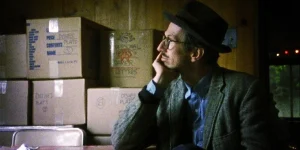
An old man named Norman sits at that bus stop every day waiting for a bus that does not come. Enid has watched him throughout the film, treating him as a kind of eccentric local fixture. Late in the story, a bus actually stops for him and takes him away. Nobody can explain it.
In the final scene, Enid packs a bag and sits at that same bus stop. A bus arrives, she boards it, and it carries her away into an unknown destination. The moment deliberately echoes Norman’s impossible departure. Zwigoff does not explain where she goes.
Most viewers read this as a metaphorical escape rather than a literal one. Enid is leaving behind everything: her town, her stalled life, her unresolved relationships. Whether that departure represents hope, defeat, or simply change is something the film leaves entirely open.
Notably, the graphic novel handles Enid’s ending with similar ambiguity, which gives the film’s choice real weight rather than feeling like a dodge. Zwigoff trusted the audience to sit with uncertainty. For a film so committed to honesty about alienation, a tidy resolution would have been a betrayal.
Are There Post-Credits Scenes?
Ghost World contains no post-credits scenes. Once Enid’s bus disappears, the film is finished. There is nothing hidden after the credits roll.
Type of Movie
Ghost World operates primarily as a coming-of-age drama with a strong thread of dark comedy running through it. It fits comfortably alongside indie character studies of the early 2000s. However, its tone is distinctly its own: sardonic but sincere, funny but genuinely sad.
It does not follow the arc of a conventional teen film. Nobody learns a lesson that solves their problems. In contrast to most films in its category, it refuses to redeem the world Enid inhabits.
Cast
- Thora Birch – Enid
- Scarlett Johansson – Rebecca
- Steve Buscemi – Seymour
- Brad Renfro – Josh
- Illeana Douglas – Roberta
- Bob Balaban – Enid’s father
- Stacey Travis – Dana
- David Cross – a nerdy record store regular
- Tom McGowan – Norman
Film Music and Composer
David Kitay composed the film’s score. His work here is understated and largely stays out of the way of the performances. That restraint suits the film’s sensibility perfectly.
Beyond the original score, the film features a memorable use of vintage blues and early American roots music drawn from Seymour’s record collection. A 1928 recording by Skip James, specifically “Devil Got My Woman,” appears early in the film and anchors Seymour’s character immediately. In addition, an Indian film song sequence opens the movie, with Enid dancing along to a Bollywood number, which signals her attraction to anything outside the mainstream.

Filming Locations
Ghost World was filmed primarily in Los Angeles, California. Zwigoff and his team chose locations that felt deliberately generic and slightly unreal. Strip malls, chain restaurants, and suburban sprawl dominate the visual landscape.
That aesthetic choice is central to the film’s argument. Enid’s world looks like nowhere in particular, which reinforces her feeling that she belongs nowhere in particular. The locations are not just backdrops; they function as a commentary on American consumer culture.
Awards and Nominations
Ghost World received an Academy Award nomination for Best Adapted Screenplay, shared by Terry Zwigoff and Daniel Clowes. Furthermore, it earned significant attention from independent film critics and organizations throughout the awards season following its release.
Thora Birch received considerable praise for her performance, earning nominations from several critics circles. The film also received a BAFTA nomination for Best Adapted Screenplay.
Behind the Scenes Insights
- Terry Zwigoff had a pre-existing friendship with Daniel Clowes, which gave him unusual access to the source material and a genuine understanding of its tone.
- Thora Birch was deeply committed to the role and worked closely with Zwigoff to shape Enid’s specific mannerisms and look, including her green-dyed hair.
- Steve Buscemi reportedly connected strongly with Seymour’s character, describing him as someone whose passions isolate him rather than connect him to others.
- Zwigoff pushed for the film to avoid any conventional resolution, resisting studio pressure to soften Enid’s arc.
- The Bollywood opening sequence was a deliberate choice to signal Enid’s personality before she speaks a single word.
- Scarlett Johansson was relatively early in her career during production, and the role helped establish her range beyond straightforward ingenue parts.
Inspirations and References
The film draws directly from Daniel Clowes’s graphic novel of the same name, serialized in his comic series Eightball during the 1990s. Clowes co-wrote the screenplay, which means the adaptation carries genuine authorial weight rather than being a licensed reinterpretation.
Clowes has cited his own feelings of social alienation and his interest in American vernacular culture as driving forces behind the original comic. His deep knowledge of outsider art, vintage Americana, and the specific misery of suburban sameness all feed directly into the film.
Moreover, the film carries echoes of R. Crumb’s underground comics, an influence that makes sense given Zwigoff’s prior documentary work on Crumb himself. Both Crumb and Clowes share a fascination with social misfits and American cultural detritus.
Alternate Endings and Deleted Scenes
No widely documented alternate ending exists for Ghost World in the public record. Zwigoff has spoken about the collaborative process of shaping the film’s conclusion, but no specific cut version with a different ending appears to have circulated.
Some scenes from the graphic novel did not make it into the film, including certain subplots involving secondary characters that Clowes developed across the comic’s original run. Adapting a serialized comic into a single film required significant compression, and some of Enid’s peripheral encounters from the source material fell away in the process.
Book Adaptations and Differences
Ghost World is based directly on Daniel Clowes’s graphic novel of the same name. Several notable differences exist between the source material and the film.
Seymour does not appear in the original comic in the same significant way. His character was substantially expanded for the film, giving the story a stronger emotional anchor and a more developed secondary relationship for Enid. In the graphic novel, Enid’s arc feels even more fragmented and episodic.
Rebecca’s role also shifts considerably. The comic gives her more screen time in relative terms, while the film increasingly sidelines her as Enid’s focus moves toward Seymour. Additionally, the Bollywood opening sequence is a cinematic invention with no direct equivalent in the source material.


Memorable Scenes and Quotes
Key Scenes
- The opening Bollywood dance: Enid dances alone to an Indian film number, immediately establishing her as someone who operates on her own frequency.
- The diner stakeout: Enid and Rebecca watch Seymour wait for a date who never arrives, and Enid’s laughter slowly shifts into something more complicated.
- The “Coon Chicken Inn” art class moment: Enid presents vintage racist advertising as found art, provoking the film’s sharpest examination of institutional hypocrisy.
- Enid and Seymour listening to records: A quiet scene that captures why these two people recognize each other across a generational gap.
- Norman’s bus arrives: An inexplicable, slightly magical moment that the film uses to set up its final image.
- The final bus departure: Enid boards a bus and disappears, leaving everything behind without explanation or farewell.
Iconic Quotes
- “I don’t want to meet someone who shares my interests. I hate my interests.” – Seymour, crystallizing his self-aware misery.
- “We need to find some total loser that we can make fun of.” – Enid, before the prank that changes everything.
- “You always act like you’re so much better than everyone.” – Rebecca, finally naming the core tension in their friendship.
- “I don’t know what I want. I just know it’s not this.” – Enid, stating the film’s central problem in one sentence.
Easter Eggs and Hidden Details
- The vintage Bollywood film playing at the start is from Gumnaam (1965), a detail that rewards viewers familiar with Indian cinema.
- Seymour’s record collection includes authentic pre-war blues and early jazz recordings, all carefully sourced to reflect his character’s specific obsessions.
- Many background locations deliberately feature businesses that appear half-empty or slightly off, reinforcing the film’s vision of a dying commercial culture.
- Enid’s room contains various vintage and kitsch objects that mirror Seymour’s collecting habits, visually suggesting their kinship before the film states it explicitly.
- The bus line that picks up Norman runs a route number that, according to some viewers, does not correspond to any actual Los Angeles bus route, underlining its unreality.
Trivia
- Daniel Clowes co-wrote the screenplay, making Ghost World one of the more author-faithful comic adaptations of its era.
- The Academy Award nomination for Best Adapted Screenplay was a significant milestone for a small independent film with no major studio backing.
- Terry Zwigoff had previously directed the acclaimed documentary Crumb (1994), which examined underground cartoonist Robert Crumb. His background in that world shaped his sensitivity to Clowes’s material.
- Thora Birch dyed her hair green for the role, committing to Enid’s visual identity from the graphic novel.
- The film’s budget was modest by Hollywood standards, which gave Zwigoff significant creative freedom over casting and tone.
- Scarlett Johansson and Thora Birch were both teenagers during filming, which adds a layer of authenticity to their dynamic.
- The “Coon Chicken Inn” imagery Enid uses in her art class submission was a real American restaurant chain from the mid-20th century, making the scene’s discomfort historically grounded.
Why Watch?
Ghost World captures the specific agony of feeling like you exist slightly outside the world everyone else inhabits, and it does so without condescending to that feeling or resolving it cheaply. Birch’s performance alone justifies the runtime. Moreover, the film remains one of the most honest portraits of female friendship and its quiet dissolution in American independent cinema.
Director’s Other Movies
- Crumb (1994)
- Bad Santa (2003)
- Art School Confidential (2006)
Recommended Films for Fans
- Crumb (1994)
- Welcome to the Dollhouse (1995)
- Rushmore (1998)
- American Splendor (2003)
- Napoleon Dynamite (2004)
- Juno (2007)
- Submarine (2010)
- The Perks of Being a Wallflower (2012)