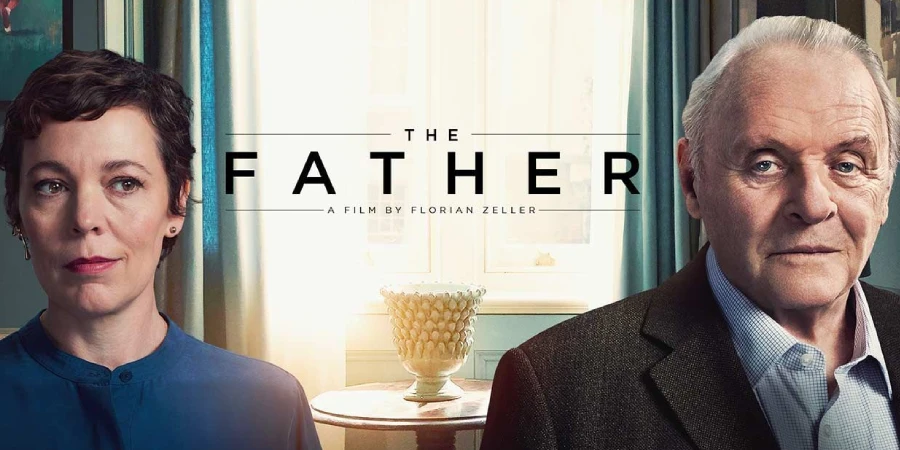

Anthony Hopkins sits in a sun-drenched London flat, cheerfully insisting to his daughter Anne that he doesn’t need a carer, while the audience has absolutely no idea yet that they’re about to have the floor pulled out from under them.
The Father (2020), directed by Floatin Zeller and adapted from his own stage play, puts you inside the fractured mind of a man with dementia rather than observing him from a safe, sympathetic distance. You don’t watch Anthony deteriorate; you deteriorate alongside him. That choice alone makes this one of the most disorienting and genuinely upsetting films in recent memory.
Detailed Summary
Anthony Meets Yet Another Carer
We open in Anthony’s spacious London flat. His daughter Anne arrives and tells him she’s hired a new carer, a young woman named Laura. Anthony is chipper, sharp-tongued, and dismissive, insisting he manages perfectly on his own.
Anthony claims the previous carer stole his watch. Whether she actually stole it or whether Anthony misplaced it himself is left deliberately unresolved. That ambiguity is the film’s first trap, and it works perfectly.
The Flat Begins to Shift
Strange things start happening with the apartment itself. Furniture moves. Paintings vanish. Rooms reconfigure. A man Anthony doesn’t recognize is suddenly sitting in the living room, calmly claiming to be Anne’s husband Paul.
Anthony is confused and so are we. Has he been living in Anne’s flat all along, rather than his own? Or has Paul moved in? Every scene resets without warning, and Zeller refuses to plant clear chronological markers.
Anne’s Plans and Paul’s Resentment
We learn Anne is planning to move to Paris to be with a new romantic partner. This creates enormous guilt for her and visible frustration in Anthony, who seems to understand what it means, even through the fog.
Paul, played by Mark Gatiss in one version of reality and Rufus Sewell in another, barely conceals his contempt for Anthony. Sewell’s Paul is cold, clipped, and quietly menacing, and Zeller uses him to represent everything Anthony fears: being unwanted, being a burden, being erased.
The Missing Watch and Shifting Identities
Anthony’s watch becomes a recurring obsession. He hides it, forgets he hid it, accuses carers of theft, and then finds it somewhere inexplicable. It’s a mundane object carrying enormous psychological freight.
Characters also shift identities in deeply unsettling ways. A new carer named Catherine seems to remind Anthony of his other daughter, Lucy, who we learn died at some point before the film’s events. Imogen Poots plays Catherine with warmth, and her scenes with Hopkins crackle with fragile hope.
The Violence and the Unraveling
In one of the film’s most disturbing sequences, Paul strikes Anthony across the face, hard, after Anthony makes an unkind remark about Anne. It’s sudden and brutal. Hopkins plays the aftermath with a shaken, animal vulnerability that lands harder than any speech could.
Anne arrives moments later. Paul denies everything. Anthony can’t be certain what happened, and neither can we. That uncertainty is precisely the point, and it’s the most effective scene in the film.
The Nursing Home Reality Emerges
Gradually, a terrible truth assembles itself. Anthony is not in his own flat. He has been living in a care home for some time. Anne has already left for Paris. Everything we’ve seen, the flat, Paul, the shifting furniture, has been Anthony’s mind constructing and reconstructing a familiar world over an unfamiliar one.
A nurse named Catherine (the same actress Poots, in a quiet, devastating piece of doubling) confirms the reality of the care home setting. Anne visits, but Anthony asks for his mother, which is the film’s gut-punch confirmation that he has regressed to childhood.


Movie Ending
Anthony sits in a care home garden in the film’s final minutes. He weeps, not with dramatic grief but with the small, helpless crying of a frightened child. He tells the nurse he feels as though he’s losing all his leaves, that he doesn’t know where he is, that he wants his mummy.
Hopkins plays this entirely without vanity. No actorly technique shields him here; he just cries, quietly and completely. It’s an actor letting something real happen on camera, and it’s the reason the film exists.
Anne is not there. She is in Paris. A phone call earlier in the film showed her choosing her own life, with guilt but also with necessity. Zeller doesn’t punish her for that choice. She is not a villain; she is a person doing her best inside an impossible situation.
What the ending argues is that dementia ultimately strips away every constructed self until only the earliest, most foundational self remains. Anthony the proud, independent, sometimes cruel man dissolves entirely. What’s left is a child who wants his mother. That regression is the film’s thesis, delivered without sentimentality.
Most audiences find the ending devastating rather than hopeless, and that distinction matters. Zeller gives Anthony a moment of genuine presence in those tears, a raw expression of the self that still exists, even as everything else falls away.
Are There Post-Credits Scenes?
No. The Father has no post-credits scene of any kind. After the final image of the garden and Anthony’s tears, the film simply ends. Sit with it.
Type of Movie
The Father is a psychological drama with strong elements of the unreliable-narrator thriller. Its tone is somber, intimate, and quietly harrowing. There’s no genre comfort here; no mystery that resolves cleanly, no villain to blame.
It plays closest to chamber drama, confined almost entirely to interior spaces, driven entirely by performance and spatial disorientation rather than plot mechanics.
Cast
- Anthony Hopkins – Anthony
- Olivia Colman – Anne
- Mark Gatiss – Paul (first appearance)
- Rufus Sewell – Paul (second appearance)
- Imogen Poots – Laura / Catherine
- Olivia Williams – Woman (the nurse/carer)
- Ayesha Dharker – Dr. Sarai
Film Music and Composer
Ludovico Einaudi composed the score, and his sparse, piano-led pieces suit the film’s quiet devastation perfectly. Einaudi is an Italian composer known for minimalist classical work; his pieces appear in the film like fragments of memory, beautiful but incomplete.
Pieces from Einaudi’s existing catalog appear alongside original material. The music never announces itself; it surfaces and retreats, mirroring exactly how Anthony’s lucid moments work.
Opera also plays a significant role. Anthony loves opera, and arias appear at several points as both comfort and counterpoint. The contrast between those grand, certain musical structures and Anthony’s disintegrating world is one of the film’s smartest tonal choices.

Filming Locations
The Father was shot almost entirely on sets built at Ealing Studios in London. Zeller and his production designer Peter Francis constructed the flat and care home environments on a single interconnected stage, allowing rooms to be subtly altered between setups.
That studio-bound approach was a deliberate creative decision, not a budget limitation. Shooting on location would have anchored the space too firmly in external reality. By controlling every inch of the environment, Zeller could shift details, lighting temperatures, and furniture arrangements without the audience initially registering what changed.
London is named but barely glimpsed. One brief outdoor scene in the care home garden is the only moment of exterior space, and its openness makes it feel strangely unfamiliar after so much interiority.
Awards and Nominations
The Father received widespread awards recognition. Anthony Hopkins won the Academy Award for Best Actor, and Florian Zeller and Christopher Hampton won the Academy Award for Best Adapted Screenplay. Hopkins’s win was famously unexpected on the night, as many predicted the award would go to Chadwick Boseman posthumously.
Olivia Colman received an Academy Award nomination for Best Supporting Actress. The film also received Best Picture and Best Film Editing nominations at the Oscars. At the BAFTAs, Hopkins won Best Actor, and the film picked up additional nominations across multiple categories.
Behind the Scenes Insights
- Florian Zeller wrote the original stage play, also titled Le Pere, in French. He specifically wanted to direct the film adaptation himself rather than hand it to another filmmaker.
- Hopkins reportedly did not meet Zeller until shortly before production began, yet the collaboration was immediately fluid and trusting.
- Olivia Colman described filming the phone call scene, in which Anne weeps alone after making the decision to move to Paris, as one of the most emotionally demanding days of her career.
- The production deliberately shot scenes in a non-linear order to help Hopkins inhabit Anthony’s disorientation from the inside rather than mapping it intellectually.
- Peter Francis’s production design team kept a meticulous chart of which specific objects appeared in which scenes, so that continuity errors could be introduced precisely and intentionally.
- Zeller chose to cast two different actors as Paul partly to disorient the audience and partly to show how Anthony’s perception of Anne’s husband shifts depending on his emotional state.
Inspirations and References
Zeller’s source play Le Pere drew on his own observations of relatives experiencing cognitive decline. He has described wanting to break theatrical convention by refusing to allow the audience a stable point of view from which to observe the protagonist safely.
Samuel Beckett’s influence is visible throughout, particularly the way familiar environments become strange and threatening. The circular, repetitive dialogue also echoes Beckett’s interest in characters trapped in patterns they cannot perceive or escape.
Virginia Woolf’s interior-narrative techniques, particularly the way perception and reality blur in her prose, also feel relevant, though Zeller has not explicitly cited her as a direct influence.
Alternate Endings and Deleted Scenes
No officially confirmed alternate endings or significant deleted scenes have been made public for The Father. Zeller has spoken about the film being very close to the shooting script, with relatively little material cut in post-production.
Given how tightly constructed the film is, an alternate ending would likely have undone the entire structural logic. The garden scene, and specifically Anthony asking for his mother, seems to have been the fixed endpoint from the earliest drafts.
Book Adaptations and Differences
The Father is adapted from Florian Zeller’s stage play Le Pere, first performed in France in 2012. Christopher Hampton translated the play into English and co-wrote the screenplay with Zeller.
The stage play uses a similarly fractured structure, but film allows for more precise environmental manipulation than theatre can achieve. On stage, audiences share a fixed perspective with the house; on film, camera placement and editing make the viewer complicit in Anthony’s subjective experience in a way theatre cannot fully replicate.
The core characters and their arcs remain faithful to the source material. Zeller did not significantly expand the story outward; he deepened it inward.

Memorable Scenes and Quotes
Key Scenes
- The slap: Paul strikes Anthony without warning; the sudden violence in an otherwise restrained film hits like a physical shock, and Hopkins’s small, stunned reaction afterward is more affecting than any theatrical response could be.
- The watch accusation: Anthony angrily accuses the carer of stealing his watch, then finds it himself moments later; the scene is filmed without score, in flat light, making it feel mundane and therefore more cruel.
- Anthony confusing Catherine for Lucy: When Anthony looks at Imogen Poots’s character with that soft, uncertain recognition, Hopkins’s face does something almost impossible to describe; he seems to access genuine grief through confusion rather than memory.
- The phone call: Anne sits alone and weeps after agreeing to move to Paris; Colman films it with her body turned slightly away from camera, as if ashamed of her own relief, and it’s the most underrated moment in the film.
- The garden ending: Anthony cries like a child in the care home garden, asking for his mother; the shot is wide enough to show how small he has become inside the space around him.
Iconic Quotes
- “I feel as if I’m losing all my leaves.” Anthony, in the final sequence, describing his experience of dementia in the film’s most quietly devastating line.
- “I don’t need anyone’s help. I’m managing perfectly well on my own.” Anthony, in the opening scenes, establishing the defiant self-image that will be systematically dismantled.
- “Who are you? What are you doing in my flat?” Anthony, to Paul, a line that recurs in variations throughout the film and carries more weight each time.
Easter Eggs and Hidden Details
- The watch Anthony obsesses over appears in the background of scenes where he doesn’t notice it, visible on a shelf or side table, suggesting it was never stolen and always present.
- The flat’s color temperature shifts subtly between scenes: warmer, yellower light accompanies Anthony’s more lucid or happier moments; cooler, flatter light accompanies confusion and fear.
- Two different actors playing Paul are dressed in almost identical clothing across their respective scenes, making it harder for first-time viewers to register the swap immediately.
- A framed photograph of a young girl appears and disappears from the mantelpiece between scenes; this is presumably Lucy, Anthony’s deceased daughter.
- The care home nurse is played by the same actress as the carer Laura and Catherine, tying together three versions of a nurturing female figure that Anthony repeatedly conflates with his daughter and, ultimately, with his mother.
- Floorplan continuity in the flat is quietly inconsistent across scenes, with doorways appearing in positions that don’t match earlier establishing shots; most viewers don’t notice consciously, but the wrongness registers.
Trivia
- Hopkins was 82 years old when he won the Academy Award for Best Actor for this role, making him the oldest winner in that category’s history.
- The film marks Hopkins’s second Oscar win for Best Actor; he previously won for The Silence of the Lambs in 1992.
- Florian Zeller made his feature directorial debut with this film, having previously worked exclusively in theatre.
- Christopher Hampton, who co-wrote the screenplay, previously won an Oscar for adapting Dangerous Liaisons in 1989.
- Hopkins did not attend the Academy Awards ceremony in person; he was in Wales when his win was announced, and his surprise and emotion in the acceptance video were widely considered genuine.
- Olivia Colman and Hopkins had no prior working relationship before this film; Colman has described Hopkins as both generous and slightly terrifying to act alongside.
- Zeller deliberately avoided using conventional dementia-film signifiers like frantic music cues, voiceover narration, or flashback sequences that are clearly labeled as memories.
Why Watch?
Hopkins’s performance in the final garden scene alone earns two hours of your time; watching a man of his stature cry with the unguarded helplessness of a four-year-old is something that doesn’t leave you quickly. Zeller’s structural decision to place you inside Anthony’s perception rather than outside it turns a sad story into a genuinely disorienting experience. You come out of it understanding dementia as a feeling rather than a condition.
Director’s Other Movies
Recommended Films for Fans
- Away from Her (2006)
- Still Alice (2014)
- Amour (2012)
- Nebraska (2013)
- A Beautiful Mind (2001)
- Iris (2001)