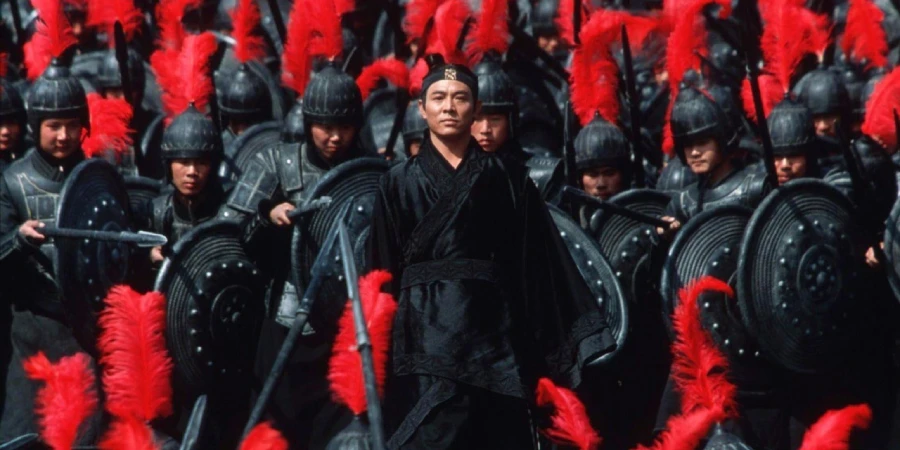
Zhang Yimou made a film where the hero dies on purpose, the villain wins with tears in his eyes, and the entire story gets told three times over in three different colors. Hero opens with a nameless assassin walking into the palace of the King of Qin, and every frame that follows is a calculated act of visual seduction.
Jet Li barely blinks throughout the whole thing, which sounds like a criticism until you realize the stillness is the point. This film arrived in 2002 and spent years being discussed primarily as a spectacle, which undersells how ruthlessly clever the script actually is.
Detailed Summary
The Nameless Warrior Arrives at the Palace
A royal guard named Nameless requests an audience with the King of Qin, claiming he has killed three notorious assassins: Broken Sword, Flying Snow, and Sky. As reward, he earns the right to sit closer and closer to the king with each confirmed kill. He recounts the story of each defeat over a formal banquet ceremony.
Right away, Zhang Yimou signals that structure and color will carry meaning. Each version of the story gets its own dominant hue, and each hue carries an emotional temperature. Red is passion and deception. Blue is longing and doubt. White is truth stripped bare.
The Red Version: Nameless Plays the King
Nameless tells the king that he defeated Sky in a chess house by exploiting his arrogance. He claims to have turned Broken Sword and Flying Snow against each other by seducing Flying Snow, sending Broken Sword into a jealous rage. According to this account, Broken Sword kills Flying Snow, and Nameless finishes Broken Sword himself.
This version plays out in scorching reds. Flying Snow wears red robes. Autumn leaves cascade in red torrents during sword fights. It all looks gorgeous and feels completely false, which is exactly the point.
The king listens, then calmly dismantles every piece of the story. He has studied Broken Sword and Flying Snow for years. He knows their devotion to each other. He tells Nameless the red version is a lie.
The Blue Version: The King’s Counter-Narrative
Now the king offers his own reading of events, dressed in cool blues. In this version, Broken Sword and Flying Snow sacrificed themselves willingly so that Nameless could gain access to the palace. Sky also deliberately lost his fight. The entire plan was orchestrated so Nameless could get close enough to assassinate the king.
Blue suits this version perfectly. It carries the weight of strategy, grief, and long-cultivated purpose. Broken Sword and Flying Snow are lovers who chose death together as an offering to a larger goal.
The king tells Nameless directly: you are here to kill me. Nameless confirms it.
The White Version: What Actually Happened
A third telling follows, this one in white and pale tones. Broken Sword, after gaining access to Qin’s calligraphy inside the palace years earlier, had a revelation. He saw the king’s vision of a unified China and chose not to kill him. He spent years trying to convince Flying Snow of the same conclusion, but she refused.
Broken Sword left a message for Nameless written in two characters on a sword scabbard: “Our Land.” He wanted Nameless to understand that one man’s death, even a tyrant’s, would not buy peace for a fractured world. Only unification could do that.
Flying Snow remained devoted to revenge. She and Broken Sword fought over his decision, and she fatally wounded him. He died forgiving her. She followed him in death.
Movie Ending
Nameless stands close enough to kill the king. He draws his sword. The king waits without flinching, because he has read the calligraphy too and believes Nameless has already reached the same conclusion as Broken Sword.
Nameless holds the sword at the king’s throat for a long, airless moment. Then he lowers it. He has chosen the same path as Broken Sword: the life of one man, even a cruel conquering one, cannot outweigh the possibility of ending centuries of war between the warring states.
What follows is the film’s most quietly devastating choice. The king’s ministers demand Nameless be executed for entering the palace with intent to kill. The king is legally obligated to order it. He does. Nameless walks out into the courtyard where the royal archers stand in formation. He does not run. A storm of arrows kills him.
Zhang Yimou then shows the funeral. Broken Sword and Flying Snow are buried together. Nameless receives a hero’s burial by order of the king himself. A closing title card tells us the King of Qin did eventually unify China and became the First Emperor.
That title card is the most morally loaded moment in the whole film. Zhang Yimou refuses to editorialize. He presents the unification as historical fact and lets the audience sit with the discomfort of having just watched three people die so that a famous authoritarian could build an empire. Whether that makes Nameless a hero or a victim depends entirely on the politics you walk in with.
Are There Post-Credits Scenes?
Hero has no post-credits scenes. Once the credits roll, the film is finished. Nothing waits for you at the end.
Type of Movie
Hero is a wuxia martial arts epic with heavy political and philosophical dimensions. Its tone is solemn and ceremonial, far closer to a Greek tragedy than an action film.
Audiences expecting wall-to-wall combat will find long stretches of dialogue-driven drama. Fight sequences exist, but they serve the thematic argument rather than providing visceral thrills for their own sake.
Cast
- Jet Li – Nameless
- Tony Leung Chiu-wai – Broken Sword
- Maggie Cheung – Flying Snow
- Zhang Ziyi – Moon, Broken Sword’s apprentice
- Donnie Yen – Sky
- Chen Daoming – King of Qin
Film Music and Composer
Tan Dun composed the score, and it ranks among the best work of his career. He blends traditional Chinese instruments, particularly the erhu and percussion, with sweeping orchestral passages.
Tan Dun had already collaborated with Zhang Yimou’s peer Ang Lee on Crouching Tiger, Hidden Dragon, which gave him fluency in this specific emotional register. His work on Hero feels more austere and less romantic than that earlier score, which suits the film’s colder philosophical stance.
Yo-Yo Ma performed cello solos on the soundtrack. His contributions give several key scenes a mournful, almost elegiac texture that simple percussion could not have achieved.
Filming Locations
Production shot across multiple regions of China. Jiuzhaigou Valley in Sichuan province provided the multicolored lake sequences where Nameless and Sky fight on the water’s surface. Those lakes exist due to unique mineral deposits, and their naturally vivid blues and greens gave the production a visual gift no set designer could manufacture.
The Gobi Desert served as the location for sweeping battle scenes and the calligraphy school sequences. Its emptiness amplifies the film’s sense of historical vastness.
Interior palace sequences were shot on elaborate constructed sets. Zhang Yimou and cinematographer Christopher Doyle designed each interior around the dominant color of whichever version of the story was being told, so location and production design worked as a single coordinated system.
Awards and Nominations
Hero received an Academy Award nomination for Best Foreign Language Film at the 76th Academy Awards. It did not win, losing to The Barbarian Invasions.
Tan Dun won a Grammy Award for his score. The film also earned nominations at the Hong Kong Film Awards and the BAFTAs, and Christopher Doyle’s cinematography attracted significant industry recognition across multiple award bodies.
Behind the Scenes Insights
- Zhang Yimou spent considerable time studying the historical record of the Warring States period before writing the screenplay, though the story is largely fictional.
- Jet Li performed many of his own stunts, but wire work and choreography from Ching Siu-tung shaped the fight sequences significantly.
- Christopher Doyle was a deliberate and somewhat unconventional choice as cinematographer; his background in Wong Kar-wai films brought an intimacy that contrasted productively with the epic scale.
- The red autumn leaf sequence required enormous quantities of artificial leaves combined with real location shooting; the sheer logistics of maintaining color consistency across outdoor takes was a notable production challenge.
- Maggie Cheung and Tony Leung had previously starred together in Wong Kar-wai’s In the Mood for Love, and their already-established on-screen chemistry informed how Zhang Yimou framed their relationship in this film.
- Zhang Ziyi’s role as Moon was physically demanding; she trained extensively for the film’s fight choreography despite having less martial arts background than some of her co-stars.
Inspirations and References
Zhang Yimou drew on the real historical figure of Qin Shi Huang, the king who unified the warring Chinese states and became the first emperor of a unified China around 221 BCE. Multiple historical assassination attempts on Qin Shi Huang are documented, and the film plays with that historical anxiety.
The concept of Jing Ke, a famous historical assassin who attempted to kill the King of Qin and failed, clearly influenced the Nameless character’s arc. Zhang Yimou reframes the assassination attempt as a philosophical renunciation rather than a practical failure.
The film engages directly with classical Chinese calligraphy traditions and the idea that mastery of the brush and mastery of the sword share a common spiritual root. That parallel is not decoration; it drives Broken Sword’s entire arc.
Alternate Endings and Deleted Scenes
No officially released alternate ending exists for Hero. Zhang Yimou has not released a director’s cut with substantially different content.
Some extended and deleted scenes have circulated in various regional releases and supplementary materials, but nothing that fundamentally alters the plot or its conclusions has entered the public record with confirmation from the filmmakers.
Book Adaptations and Differences
Hero is not based on a novel or pre-existing literary source. Zhang Yimou wrote the screenplay as an original work drawing from historical records and classical Chinese cultural traditions rather than adapting any single text.
Memorable Scenes and Quotes
Key Scenes
- Nameless vs. Sky on the lake: The two fighters face each other on the glassy surface of Jiuzhaigou and conduct their entire battle in their imaginations while sitting completely still. It is the film’s most formally daring sequence, and it works because both actors hold total physical composure while the camera and score do the heavy lifting.
- The red leaf battle between Flying Snow and Moon: Crimson leaves tornado around two women in red robes. Maggie Cheung moves with an almost predatory slowness, which makes every acceleration into speed feel violent by contrast.
- Broken Sword’s calligraphy under arrow fire: The king sends his archers to fill the sky with arrows while Broken Sword practices calligraphy in a courtyard. He deflects every arrow with his brush strokes, turning writing into swordsmanship in a single fluid sequence. It is the clearest visual argument the film makes about the unity of art and combat.
- Nameless in the courtyard at the end: He walks out, faces the assembled archers, and makes no move to flee. Jet Li’s face carries no visible emotion, but his feet plant deliberately into the ground. It reads as choice, not resignation.
- Broken Sword’s death and Flying Snow’s grief: She holds him, then kills herself with his blade. Tony Leung and Maggie Cheung play it with enormous restraint, which makes it hit harder than any theatrical weeping could.
Iconic Quotes
- “Our Land” (the two-character message Broken Sword leaves for Nameless, the conceptual center of the entire film)
- “The most dangerous move in swordsmanship is not killing, but sparing.”
- “Under Heaven, all is one.” (the king’s governing philosophy, and the phrase that Broken Sword ultimately adopted)
Easter Eggs and Hidden Details
- Each color scheme in the film’s three versions corresponds to a specific emotional state in classical Chinese poetic tradition, not just a visual style choice by Zhang Yimou.
- The calligraphy Broken Sword examines in the king’s chamber is visually consistent with Qin-era script styles, reflecting research into actual historical writing forms from the period.
- Sky’s chess house setting in the red version contains game pieces arranged in a formation that mirrors a real historical battle strategy from the Warring States period.
- Broken Sword’s name in Chinese, Cangjian, carries a secondary meaning related to the act of hiding or sheathing a weapon, which foreshadows his decision to put away his murderous purpose.
- The arrows fired at Nameless at the film’s end darken the sky in a shot that deliberately recalls ancient accounts of Qin military power, where massed archers were described as blotting out the sun.
Trivia
- Hero was one of the highest-grossing Chinese films of its era and played a significant role in opening Western markets to Chinese-language cinema.
- Quentin Tarantino personally championed the film’s North American release, serving as its presenter for Miramax’s distribution push in 2004, two years after its original Chinese release.
- The film’s color-coded narrative structure directly influenced discussions about visual storytelling in screenwriting circles throughout the mid-2000s.
- Donnie Yen’s role as Sky is relatively brief, but his fight sequence with Jet Li was considered a career highlight for both actors at the time of release.
- Zhang Yimou cast Chen Daoming as the King of Qin partly because of the actor’s ability to project authority through absolute physical stillness, a quality the role demanded above all others.
- Christopher Doyle shot the film using a combination of approaches, moving between handheld intimacy during close dialogue scenes and locked-off, formally composed wide shots for the battle sequences.
Why Watch?
Watch this film because Tony Leung and Maggie Cheung deliver two of the most controlled, devastating performances in any martial arts film ever made, almost entirely through posture and eye contact. Zhang Yimou uses color the way a composer uses key changes: each shift reframes everything you thought you understood. No other film in the genre asks its audience to actively distrust what they are watching, then rewards that distrust so completely.
Director’s Other Movies
- Red Sorghum (1987)
- Ju Dou (1990)
- Raise the Red Lantern (1991)
- The Story of Qiu Ju (1992)
- To Live (1994)
- Shanghai Triad (1995)
- Not One Less (1999)
- House of Flying Daggers (2004)
- Curse of the Golden Flower (2006)
- Shadow (2018)
Recommended Films for Fans
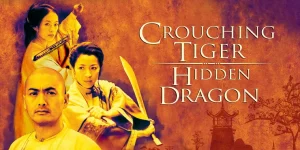
- Crouching Tiger, Hidden Dragon (2000)
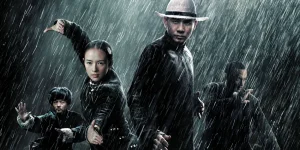
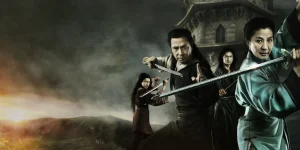
- Crouching Tiger, Hidden Dragon: Sword of Destiny (2016)
- House of Flying Daggers (2004)
- Raise the Red Lantern (1991)
- In the Mood for Love (2000)
- The Assassin (2015)
- Curse of the Golden Flower (2006)
- Ran (1985)
- Shadow (2018)
- Ashes of Time (1994)