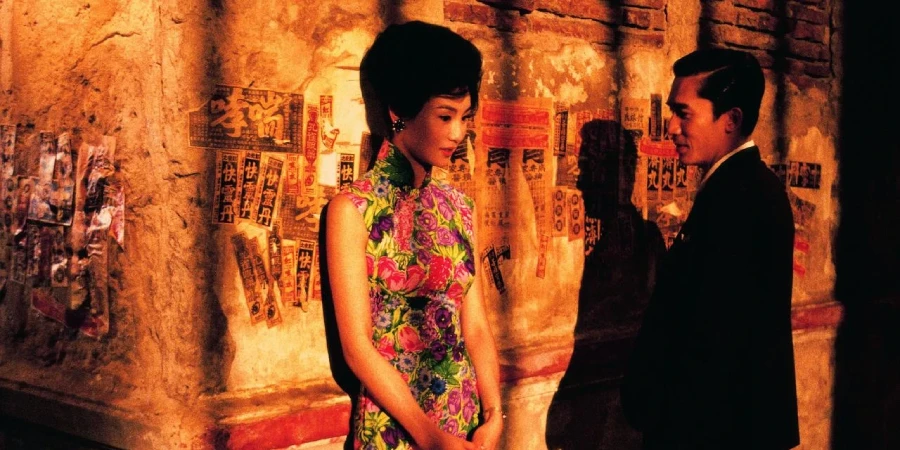

Two people fall in love without ever confessing it out loud, and somehow that restraint makes In the Mood for Love one of the most devastating romantic films ever made. Director Wong Kar-wai built an entire world from slow-motion corridors, rain-soaked noodle runs, and the unbearable weight of a glance held one second too long. This is a film where nothing happens and everything happens simultaneously. It rewards patience, punishes distraction, and leaves a mark that lingers for days.
Detailed Summary
Two Neighbors, Two Secrets
In 1962 Hong Kong, Chow Mo-wan (played by Tony Leung) and Su Li-zhen (played by Maggie Cheung) move into adjacent rooms in the same crowded Shanghai-expatriate apartment building on the same day. Their spouses are largely absent, always conveniently out of frame. Almost immediately, a quiet unease settles in.
Both characters notice small, damning details. Su Li-zhen recognizes her husband’s tie on Chow’s wife. Chow notices Su’s husband carrying the same unusual handbag his wife recently acquired. The conclusion arrives slowly but brutally: their respective spouses are having an affair with each other.
A Friendship Built on Shared Pain
Rather than confront their spouses directly, Chow and Su gravitate toward each other. They share meals at the local noodle shop, walking narrow staircases and rain-slicked alleys in those hypnotic slow-motion sequences that define the film’s visual grammar. Their connection deepens through proximity and mutual humiliation.
They begin a strange, almost therapeutic ritual: they role-play their spouses’ affair, rehearsing how it might have started, what words were exchanged. It is equal parts painful and oddly intimate. In doing so, they inadvertently create their own emotional entanglement.
Room 2046 and the Almost-Affair
Chow rents a room in a hotel, number 2046, ostensibly to write his martial arts serial in peace. Su visits him there. Their time together in that room is charged and tender, yet they repeatedly pull back from physically crossing the line their spouses crossed without hesitation.
Chow writes a wuxia story during these sessions, but he also begins writing something more personal: a story about a man burying a secret in a hole in a tree. That detail resurfaces at the film’s end in a way that reframes everything. Meanwhile, their feelings become impossible to deny or contain.
The Decision to Stay Apart
Su asks Chow if he would have gone further if she had offered more. He says yes. She weeps quietly. That single exchange is the closest the film gets to a declaration of love, and it arrives wrapped in regret rather than joy.
Chow eventually tells Su he plans to leave Hong Kong for Singapore. He invites her to go with him. She arrives at his door, pauses, and turns away without knocking. He leaves alone. Their window of possibility closes, and neither reaches through it in time.
Movie Ending
Years pass. Su returns to the building and rents the very room Chow once occupied, finding in that small act of return something she cannot quite name. Chow visits Hong Kong later, unaware she is there. They miss each other by margins so thin they feel almost cruel.
In 1966, Chow travels to Angkor Wat in Cambodia, following a news crew covering Charles de Gaulle’s visit. He finds a crumbling stone wall with a small hole in it. He whispers his secret into the hole and seals it with grass, enacting the ritual from his old story: a man who buries what he cannot say.
Consequently, the film’s final act functions as elegy rather than resolution. There is no reunion, no confrontation, no closure. What Chow whispers remains inaudible to us, and that silence is entirely intentional. Wong Kar-wai refuses to let the audience consume the secret; instead, he asks us to sit with the same unresolved longing his characters carry.
The ending is devastating precisely because it honors the logic of the entire film. These two people chose dignity and restraint over desire, and that choice cost them everything. However, the film never frames that as a mistake; it simply observes, without judgment, how time and hesitation conspire against love.
Are There Post-Credits Scenes?
In the Mood for Love contains no post-credits scenes whatsoever. Wong Kar-wai’s filmmaking sensibility is deeply contemplative, not franchise-oriented. You can leave when the credits roll, but staying to absorb the final images is absolutely worth the extra minutes.
Type of Movie
This is a romantic drama with strong elements of melodrama and art-house formalism. Its tone sits somewhere between ache and beauty, never tipping into sentimentality. In contrast to conventional romance films, it withholds the catharsis audiences typically expect.
Pacing is deliberately slow and hypnotic. Wong Kar-wai treats time itself as a malleable, emotional substance rather than a neutral container for plot. The result feels closer to a sustained mood or a sustained memory than a conventional narrative.
Cast
- Tony Leung Chiu-wai – Chow Mo-wan
- Maggie Cheung Man-yuk – Su Li-zhen (Mrs. Chan)
Film Music and Composer
The score is one of cinema’s great emotional instruments. Michael Galasso composed original pieces for the film, contributing delicate, melancholy guitar and string works that feel suspended in time. His compositions match the film’s visual tempo perfectly.
Equally central is Shigeru Umebayashi’s recurring piece Yumeji’s Theme, originally written for a different Japanese film. Wong Kar-wai repurposed it here, and it became so associated with this film that many viewers assume it was composed specifically for it. That slow, circling waltz accompanies nearly every slow-motion corridor sequence.
Wong Kar-wai also incorporated Nat King Cole songs performed in Spanish, including Quizas, Quizas, Quizas and Aquellos Ojos Verdes. Those choices feel deliberately disorienting in a 1960s Hong Kong setting, and that disorientation is very much the point. They add a layer of romantic longing that transcends cultural specificity.

Filming Locations
Principal photography took place primarily in Hong Kong, with key sequences filmed in narrow, claustrophobic corridor sets built to evoke the cramped, intimate apartment buildings of 1960s Shanghainese expatriate communities. The tightness of those spaces forces physical closeness between characters in a way that carries enormous emotional charge.
Some sequences were also shot in Bangkok, Thailand, which doubled for certain exterior environments. The final sequences at Angkor Wat were filmed on location in Cambodia. That shift to ancient stone ruins gives the ending a timeless, elegiac quality entirely distinct from the urban intimacy of the Hong Kong sections.
Awards and Nominations
At the 2000 Cannes Film Festival, Tony Leung won the Best Actor award, a deeply deserved recognition for one of cinema’s most internalized and controlled performances. The film also received the Technical Grand Prize at Cannes for its extraordinary cinematography by Christopher Doyle and Mark Lee Ping-bing.
Moreover, the film appeared on numerous critics’ year-end lists and has since accumulated consistent recognition in retrospective polls. In the Mood for Love ranked fifth in the 2022 Sight and Sound Greatest Films poll, placing it among the most critically acclaimed works in cinema history.
Behind the Scenes Insights
- Wong Kar-wai famously worked without a completed script. He developed the story organically during production, a method that extended the shoot considerably.
- Maggie Cheung wore a different cheongsam (form-fitting dress) in virtually every scene. The costume department created over 20 distinct designs, each carefully chosen to reflect Su Li-zhen’s emotional state.
- The spouses of Chow and Su are deliberately kept off-screen or shown only in fragments. Wong Kar-wai made a conscious choice never to fully reveal their faces.
- Cinematographer Christopher Doyle and Mark Lee Ping-bing used slow-motion photography extensively to create the film’s signature hypnotic visual rhythm.
- Wong Kar-wai reportedly shot enormous amounts of footage. His editing process was intensive, and the final cut represents only a fraction of what was captured.
- The production took approximately 15 months to complete, an unusually long shoot driven by Wong Kar-wai’s improvisational approach.
- Tony Leung has described the experience as emotionally exhausting, largely because of the sustained tension required to convey so much while doing so little outwardly.
Inspirations and References
Wong Kar-wai drew loosely from a short story by Liu Yi-chang, a Hong Kong writer whose novella Tete-Beche (also known as Intersection) explored the near-miss encounters of two strangers in 1960s Hong Kong. The film does not adapt that story directly, but it shares its structural preoccupation with parallel lives and missed connections.
The obsessive attention to the textures of 1960s Hong Kong, including fashion, music, food, and social codes of propriety, reflects Wong Kar-wai’s broader project of excavating a vanished world. His own childhood memories of Shanghai expatriate culture in Hong Kong informed the film’s specific social milieu. That autobiographical layer gives the nostalgia an unusual personal weight.
Alternate Endings and Deleted Scenes
Given Wong Kar-wai’s improvisational production method, substantial footage was shot and ultimately discarded. Some accounts indicate that scenes depicting more explicit emotional confrontations between Chow and Su were filmed but cut, preserving the film’s commitment to restraint and suggestion.
The spouses’ affair, largely implied in the final cut, was apparently depicted more directly in some footage. Wong Kar-wai chose to remove that material entirely, which proves to be one of the most creatively significant decisions in the film’s construction. Showing less made everything feel more.
No officially released alternate version of the film exists. However, Wong Kar-wai has acknowledged that the edit could have taken several different directions, and the version audiences know reflects his final instinct about what the film needed to withhold.
Book Adaptations and Differences
In the Mood for Love is not a direct adaptation of any single book or story. As noted in the inspirations section, Liu Yi-chang’s work provided a loose conceptual framework, but Wong Kar-wai constructed his own original screenplay (such as it was, given his improvisational method).
Consequently, there is no source text to compare against the film. It stands entirely as an original cinematic work rooted in personal memory, cultural nostalgia, and directorial intuition rather than literary adaptation.

Memorable Scenes and Quotes
Key Scenes
- Su Li-zhen descending the narrow staircase in slow motion to buy noodles, her cheongsam catching the light, Yumeji’s Theme swelling around her.
- Chow and Su rehearsing their spouses’ imagined first conversation about the affair, sliding between performance and genuine feeling in real time.
- Su arriving at Chow’s door in the hotel, pressing her hand against it, and then walking away without knocking. The hallway swallows her silence.
- Chow whispering his secret into the ancient stone wall at Angkor Wat and sealing it with grass, enacting the story he wrote in Room 2046.
- The final, lingering shot of the Angkor Wat ruins, empty of people, full of everything unspoken.
Iconic Quotes
- “He remembers those vanished years. As though looking through a dusty window pane, the past is something he could see, but not touch.”
- “Feelings can creep up just like that. I thought I was in control.”
- “It is a restless moment. She has kept her head lowered, to give him a chance to come closer. But he could not, for lack of courage.”
Easter Eggs and Hidden Details
- Room 2046 in the hotel directly foreshadows Wong Kar-wai’s follow-up film, also titled 2046, in which Chow Mo-wan returns as a central character.
- The spouses are never shown with clear, full facial visibility. This is a deliberate formal choice: their identities remain as peripheral to us as they are to the emotional core of the story.
- Nat King Cole’s Spanish-language recordings were enormously popular in Southeast Asia during the 1960s, making their inclusion historically accurate as well as emotionally resonant.
- Su’s rotating wardrobe of cheongsam dresses functions as a visual timeline. Attentive viewers can track shifts in her emotional state through changes in color and pattern across scenes.
- The landlady’s mahjong games in the background serve as both social texture and symbolic counterpoint: a world of noise and community surrounding two people in profound, private isolation.
- Wong Kar-wai frames many shots through doorways, windows, and curtains, consistently placing physical barriers between the audience and the characters, mirroring the emotional barriers the characters place between themselves.
Trivia
- The film’s English title comes from a Nat King Cole song, though the original Cantonese title, Fa Yeung Nin Wa, translates more literally as “The Age of Blossoms” or “Flowery Years.”
- Wong Kar-wai wore his trademark sunglasses throughout the shoot, even on enclosed sets, a personal habit his collaborators have commented on repeatedly.
- Tony Leung and Maggie Cheung had worked together previously, but both have cited this film as among the most demanding experiences of their careers.
- The film operates as a loose companion piece or prequel to Wong Kar-wai’s later film 2046, which continues Chow Mo-wan’s story after the events depicted here.
- Christopher Doyle, one of the film’s cinematographers, left the production before it was fully complete. Mark Lee Ping-bing completed the remaining cinematography work.
- The film’s running time is approximately 98 minutes, remarkably brief given how much emotional territory it covers and how deliberately slow its pacing feels.
Why Watch?
In the Mood for Love is proof that cinema can communicate what language cannot. It captures the specific, unbearable texture of love that never gets to become itself, and it does so with a visual and musical precision that is genuinely rare. Furthermore, few films have made restraint feel this powerful or this heartbreaking. Watch it once, and some part of it never quite leaves you.
Director’s Other Movies
- As Tears Go By (1988)
- Days of Being Wild (1990)
- Chungking Express (1994)
- Fallen Angels (1995)
- Happy Together (1997)
- 2046 (2004)
- My Blueberry Nights (2007)
- The Grandmaster (2013)
Recommended Films for Fans
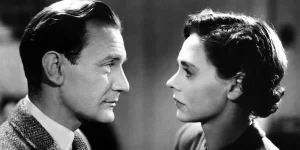
- Brief Encounter (1945)
- Chungking Express (1994)
- Certified Copy (2010)
- Lost in Translation (2003)
- Memoirs of a Geisha (2005)
- The Remains of the Day (1993)
- A Separation (2011)
- Carol (2015)
- Past Lives (2023)