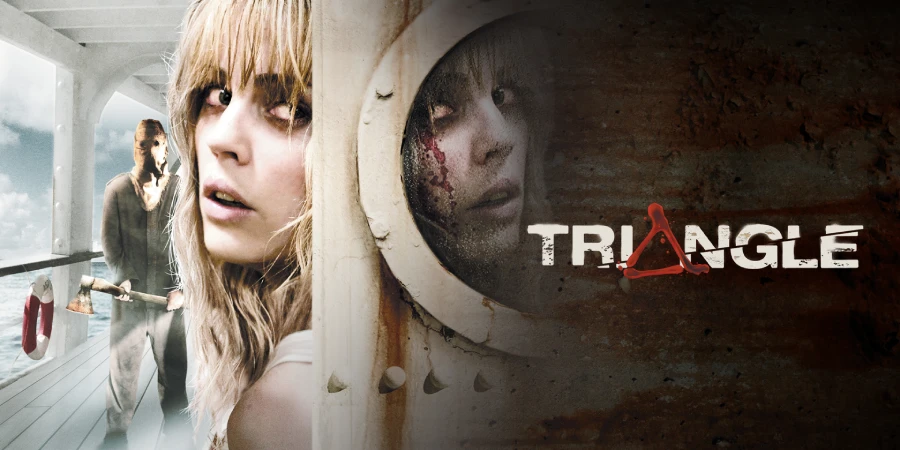
Triangle (2009) is a British-Australian psychological thriller written and directed by Christopher Smith. It’s one of those rare films that you finish watching—and immediately want to rewatch—because you realize you’ve missed something huge. A blend of psychological horror, time loop mystery, and Greek mythology, Triangle is a film that challenges your perception of time, guilt, and reality itself.
Detailed Summary
The Beginning: A Normal Day That Isn’t So Normal
The film opens with Jess (Melissa George) preparing for a sailing trip with her friend Greg and his acquaintances—Sally, Downey, Victor, and Heather. Jess seems distracted, uneasy, and slightly disoriented. She leaves her home after taking care of her autistic son, Tommy. Something feels off, but the movie doesn’t tell us why—yet.
The Storm and the Abandoned Ship
Once aboard Greg’s yacht, the group sets sail. The mood is lighthearted until a strange storm suddenly hits, capsizing the boat. The group manages to climb onto the overturned hull and spot an enormous ocean liner named Aeolus—which conveniently appears out of the mist. They board the ship, relieved but confused, because it seems completely deserted.
The Mysterious Loop Begins
As they explore, Jess begins to experience déjà vu. She sees familiar items and feels as if she’s been there before. Things escalate when a masked figure starts hunting and killing the group one by one. Jess eventually fights back and kills the masked attacker—only to discover that the killer is another version of herself. Then, the loop resets.
Jess finds herself back on the yacht with the group, realizing she’s trapped in a repeating cycle where the same events keep happening over and over. Each time, she tries to change the outcome—but the result is always the same: everyone dies, and the cycle restarts.
The Truth Behind the Aeolus
The ship’s name, Aeolus, isn’t random. In Greek mythology, Aeolus is the god of winds who helps Odysseus—another man trapped in an endless cycle. Jess realizes she’s caught in her own version of hell. The ship becomes a purgatorial symbol—a punishment tied to her actions in the real world.
The Real-World Revelation
Eventually, Jess escapes the ship and washes up onshore, believing she’s free. She rushes home—only to find her own self there, scolding her son. This is the key moment: Jess realizes that she’s been dead (or at least caught in a punishment loop) since the beginning.
In a shocking twist, she kills her “other self” in front of her son, stuffs the body into her car, and drives off to dispose of it. However, a seagull hits her windshield. When she stops to clear it, she notices a pile of dead seagulls at the same spot—indicating she’s repeated this act countless times. Moments later, a fatal car crash occurs, killing her son and herself.
Jess, however, stands by the wreck unharmed, watching her own dead body being pulled from the car. A taxi driver arrives and offers her a ride—to the harbor. Jess agrees, getting back on the yacht to “start over,” completing the loop.
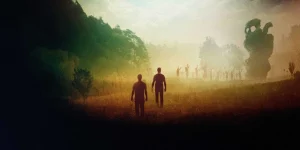
Movie Ending
Jess is trapped in an eternal time loop, forced to relive the same events endlessly as punishment for killing her son in a fit of rage. The cruise ship acts as her personal purgatory, with every loop representing her failed attempt to atone or change fate.
Each time she thinks she can “fix” things, she only repeats the same mistakes, symbolizing the myth of Sisyphus, who is condemned to push a boulder up a hill for eternity. The taxi driver’s cryptic promise to “wait” hints that he could be Death, always ready to escort Jess back to her doomed cycle.
In essence, Jess never escapes—she’s trapped in an infinite punishment of guilt and denial.
Are There Post-Credits Scenes?
No, Triangle does not have a post-credits scene. The film ends abruptly after Jess steps back onto the yacht, emphasizing the endless nature of her torment. The silence of the credits serves as a chilling punctuation mark to the cyclical narrative.
Type of Movie
Triangle is a psychological thriller with strong elements of horror, mystery, and time-loop sci-fi. It combines atmospheric dread with philosophical undertones, exploring guilt, fate, and the illusion of control.
Cast
- Melissa George as Jess
- Michael Dorman as Greg
- Rachael Carpani as Sally
- Henry Nixon as Downey
- Emma Lung as Heather
- Liam Hemsworth as Victor
Film Music and Composer
The eerie and minimalistic score was composed by Christian Henson, enhancing the unsettling tone and the sense of disorientation that permeates the film. The soundtrack plays a crucial role in creating the claustrophobic atmosphere aboard the Aeolus.
Filming Locations
The movie was filmed primarily in Queensland, Australia, and on sets designed to replicate the interior of an ocean liner. The maritime setting contributes to the film’s oppressive mood—isolated, timeless, and surrounded by endless ocean, perfectly mirroring Jess’s inescapable loop.
Awards and Nominations
While Triangle didn’t sweep major awards, it gained strong recognition in horror and independent film circles. It was praised for its clever script and Melissa George’s performance, earning nominations at genre festivals like Sitges Film Festival and FrightFest.
Behind the Scenes Insights
- Director Christopher Smith described the film as “a nightmare that loops on guilt.”
- The Aeolus ship’s set was built partially on land and partially on water to simulate realistic flooding scenes.
- Melissa George shot nearly every scene herself; the physical and emotional demands were so intense that she reportedly lost sleep for days during filming.
- The film’s structure was planned using a mathematical chart to keep the time loops logically consistent.
Inspirations and References
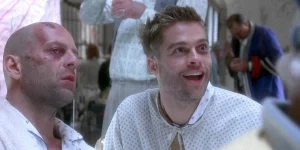
The film draws heavy inspiration from Greek mythology, particularly the myth of Sisyphus and Aeolus, and from classic time-loop stories like Groundhog Day and Memento. Philosophically, it mirrors themes from Jacob’s Ladder and Donnie Darko, exploring death, guilt, and repetition.
Alternate Endings and Deleted Scenes
There are no official alternate endings, but an early draft reportedly featured a more explicit depiction of the afterlife, showing Jess realizing her own death sooner. The final version wisely leaves it ambiguous, allowing the audience to interpret the cycle in their own way.
Book Adaptations and Differences
Triangle is not directly based on a book, but its title and narrative structure borrow from mythological and philosophical literature, particularly Albert Camus’s concept of the eternal return and guilt-based punishment.
Memorable Scenes and Quotes
Key Scenes
- The moment Jess realizes there are multiple versions of herself on the ship.
- Jess killing the masked figure, only to discover it’s another her.
- The car crash scene, revealing the true nature of her guilt and loop.
Iconic Quotes
- Jess: “It’s different this time.”
- Greg: “You’ve been here before, haven’t you?”
- Taxi Driver: “You’ll be back. They always come back.”
Easter Eggs and Hidden Details
- The ship’s name “Aeolus” directly ties to Greek mythology.
- The number of seagulls at the crash site changes subtly each time—a visual cue of repeated loops.
- The storm always occurs at the same exact time, hinting that Jess’s death anchors the start of each cycle.
- The “Triangle” title symbolizes not just the Bermuda Triangle but also the cyclical triangle between guilt, denial, and punishment.
Trivia
- The film’s timeline can be mapped as a Mobius strip—a never-ending loop with no beginning or end.
- Liam Hemsworth’s role, though small, was one of his earliest screen appearances.
- The ship’s corridors were designed to subtly change layout between loops, disorienting both Jess and the viewer.
Why Watch?
Watch Triangle if you love mind-bending thrillers that challenge your sense of time and morality. It’s the perfect film for fans who enjoy dissecting clues, theories, and alternate interpretations. Plus, Melissa George delivers one of the best performances in modern psychological horror.
Director’s Other Movies
- Creep (2004)
- Severance (2006)
- Black Death (2010)
- Detour (2016)