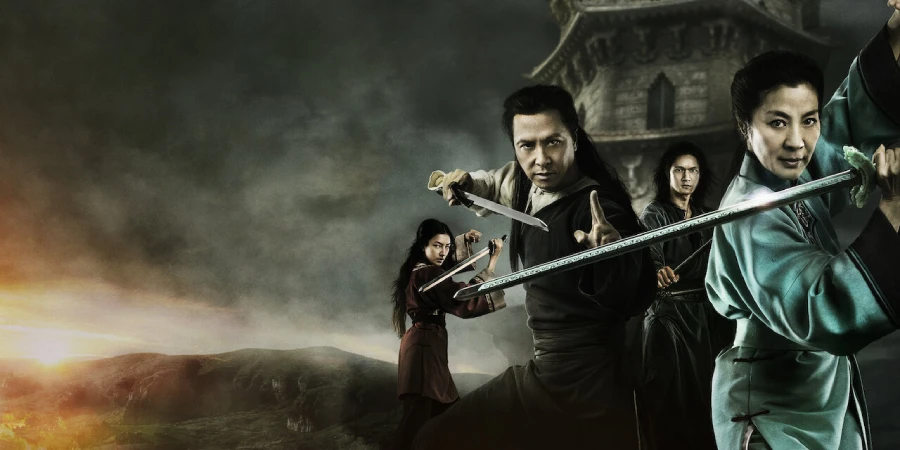

Netflix dropped this sequel sixteen years after Ang Lee’s original, handed the director’s chair to Yuen Woo-ping, shot the whole thing in English, and somehow still produced a film worth arguing about. Michelle Yeoh returns as Yu Shu Lien, older and considerably more guarded, carrying grief like a second weapon. Sword of Destiny is not the film purists wanted, but it has sharp action choreography, a genuine emotional core, and at least one scene that earns its place in the franchise’s memory. Calling it a disappointment requires ignoring what it actually does well.
Detailed Summary
Yu Shu Lien Returns to Peking
Yu Shu Lien travels to Peking to pay respects at the grave of Sir Te and to safeguard the legendary sword Green Destiny. She has withdrawn from the martial arts world since Li Mu Bai’s death. Returning to the estate, she finds herself thrust back into conflict almost immediately.
A gang of thieves infiltrates the compound to steal the Green Destiny. Shu Lien fights them off with breathtaking precision, wielding a chain whip in tight quarters. This opening battle reintroduces her not as a relic but as a fully active force.
Hades Dai and the Iron Way
Hades Dai, a warlord of frightening ambition, commands a criminal army called the Iron Way. He wants the Green Destiny to consolidate his power over the martial arts underworld. His presence organizes the film’s threat from scattered robbery into something genuinely menacing.
Hades Dai sends his followers to acquire the sword through any means necessary. His ruthlessness gets established early when he punishes failure without hesitation. The film takes care to make him a credible villain rather than a cartoon.
Wei Fang and Snow Vase
A young thief named Wei Fang is captured during the estate raid. Shu Lien discovers he has real martial arts talent hiding under his rough exterior. She decides, somewhat against her better judgment, to keep him close rather than hand him over to the authorities.
A young woman named Snow Vase arrives at the estate claiming to be a student seeking training. She carries a secret: she is actually the ward of the legendary warrior Silent Wolf. Her backstory ties the film’s romantic subplot directly to its action mechanics.
Silent Wolf Arrives
Silent Wolf, played by Donnie Yen, is revealed to be an old companion of Li Mu Bai. He arrives to help protect the Green Destiny and to reconnect with Shu Lien. Their shared history gives the film its most emotionally loaded scenes.
Shu Lien and Silent Wolf share an unspoken bond forged over years of parallel loss. Donnie Yen plays these quieter moments with real restraint, letting his stillness do the talking. It is, honestly, his best work in the film.
Training and Loyalty
Wei Fang initially serves as a spy for Hades Dai inside the estate. His loyalty begins to shift as Snow Vase and he grow closer. This dynamic plays out as a smaller, younger echo of the Shu Lien and Li Mu Bai relationship from the original film.
Shu Lien takes Wei Fang through rigorous training sequences. She spots the same reckless potential in him that defined earlier generations of warriors. These scenes give Michelle Yeoh room to perform mentorship rather than just combat.
The Iron Way Attacks
Hades Dai launches a full assault on the estate. His warriors include several named fighters, each with a distinct combat style, and the film deploys them in rapid succession. The battle is large-scale and choreographed with Yuen Woo-ping’s trademark spatial clarity.
Wei Fang’s double-agent role gets exposed during the chaos. He must choose a side, and the film makes that choice feel genuinely costly rather than inevitable. Snow Vase’s own fighting ability surfaces fully during this sequence.
Snow Vase’s Secret and the Green Destiny
Snow Vase reveals she has actually trained with the Green Destiny before, under Silent Wolf’s guidance. Her skill with the sword surprises everyone, including Hades Dai’s lieutenants. Silent Wolf had prepared her specifically for a moment like this.
Hades Dai eventually seizes the Green Destiny during the battle’s most chaotic stretch. Possessing the sword grants him a terrifying advantage. The film uses this moment to raise genuine stakes around an object that could easily become mere MacGuffin.
Final Confrontation
Shu Lien, Silent Wolf, Snow Vase, and Wei Fang regroup for a final assault on Hades Dai’s stronghold. Each character brings a different emotional reason to fight. Yuen Woo-ping stages the climax across multiple simultaneous duels rather than a single showdown.
Silent Wolf faces Hades Dai directly. Their fight is the film’s longest and most technically demanding confrontation. Donnie Yen moves with controlled ferocity while Harry Shum Jr. plays Hades Dai’s physicality as something close to dance.
Movie Ending
Silent Wolf defeats Hades Dai and reclaims the Green Destiny, but the victory costs him dearly. He suffers a fatal wound during the final duel and dies shortly after. His death closes a loop: another generation of legendary warrior lost, another sword changing hands in grief.
Snow Vase takes the Green Destiny to Wudang Mountain and drops it into a deep chasm, echoing Jen Yu’s leap at the end of the original film. This is the film’s most deliberate callback, and it mostly earns its weight. She steps away from the sword rather than being destroyed by it, which reads as a more hopeful resolution than Jen Yu ever received.
Wei Fang survives and chooses to leave the criminal world. His arc completes as a straightforward redemption, less ambiguous than the film probably needed, but satisfying on its own terms. Shu Lien watches both young people find their paths and remains standing, as she always does, alone but unbroken.
What the ending actually argues is that the Green Destiny’s story should end. Every character who carried it paid a price. Shu Lien’s survival feels like the film’s quiet thesis: some people outlast legend not through glory but through endurance.
Are There Post-Credits Scenes?
No. Crouching Tiger, Hidden Dragon: Sword of Destiny contains no post-credits scene. Once the credits begin, the film is finished. You can close the Netflix tab without missing anything.
Type of Movie
This is a wuxia action film with strong romantic and melodramatic undertones. The tone sits somewhere between classical martial arts epic and accessible Netflix adventure. It is more emotionally grounded than many wuxia entries but lighter in philosophical weight than the original.
Expect wire-fu combat, sweeping landscapes, and storylines built on honor, sacrifice, and romantic longing. The pacing is brisk rather than contemplative. Audiences who prefer the original’s slower, more lyrical rhythm may find this version a bit lean.
Cast
- Michelle Yeoh – Yu Shu Lien
- Donnie Yen – Silent Wolf
- Harry Shum Jr. – Hades Dai
- Natasha Liu Bordizzo – Snow Vase
- Chris Pang – Wei Fang
- Juju Chan – Mantis
- Veronica Ngo – Zasalamel (credited as Flying Blade)
- Jason Scott Lee – Turtle
- Roger Yuan – Silver Dart Shi
Film Music and Composer
Stephen Edwards composed the score for Sword of Destiny. His work deliberately echoes Tan Dun’s Oscar-winning score from the original, leaning on cello, erhu, and traditional Chinese instrumentation. This creates tonal continuity across the two films.
The score functions best during the quieter emotional scenes between Shu Lien and Silent Wolf. It wisely pulls back during combat rather than overwhelming the choreography. Edwards understood that Yuen Woo-ping’s fight sequences are their own kind of music.

Filming Locations
Principal photography took place in New Zealand. The production used New Zealand’s dramatic landscapes to stand in for classical China’s mountains and valleys. The Wudang Mountain sequences, in particular, benefit from the country’s genuinely imposing natural scenery.
Shooting in New Zealand rather than China was partly a practical decision tied to the Netflix production infrastructure. Purists noticed the geographic substitution, and some of the wider landscape shots do feel slightly generic. That said, Yuen Woo-ping’s interior and mid-range compositions mostly disguise the location.
Awards and Nominations
Sword of Destiny received a nomination at the Hong Kong Film Awards for Best Action Choreography, recognizing Yuen Woo-ping’s work. It did not make a significant impression at major Western awards ceremonies. The film’s Netflix release format likely limited its awards-circuit visibility.
Behind the Scenes Insights
- Yuen Woo-ping served as both director and action choreographer, a combination that gave him unusually tight control over how the fights were staged and shot.
- Michelle Yeoh underwent intensive physical preparation to reprise her role, working closely with the choreography team to adapt her fighting style to an older, more defensive Shu Lien.
- Donnie Yen insisted on performing his own stunts throughout production, consistent with his approach across his career.
- Natasha Liu Bordizzo was a relative newcomer to film before this role and trained extensively in wire-work and martial arts choreography for the production.
- The film was shot primarily in English, a deliberate choice by Netflix to broaden its international appeal, which caused significant debate among fans of the original Mandarin-language film.
- Chris Pang, who plays Wei Fang, trained in martial arts prior to casting, which reportedly helped accelerate his choreography preparation on set.
Inspirations and References
The film draws from Iron Knight, Silver Vase, a novel by Wang Dulu, which also served as part of the source material for Ang Lee’s original. Wang Dulu wrote a five-book series of wuxia novels, and the films mine different sections of that saga.
Yuen Woo-ping drew on the classical wuxia tradition in Chinese literature and cinema more broadly. Films like Come Drink with Me and the broader Shaw Brothers catalog inform the combat aesthetic. His own choreography history on the original film created a self-referential layer in the sequel’s fight design.
Alternate Endings and Deleted Scenes
No officially confirmed alternate endings or deleted scenes have been released for Sword of Destiny. Netflix has not published extended cuts or behind-the-scenes footage revealing significant cut material. Any claims about alternate versions remain unverified.
Book Adaptations and Differences
Wang Dulu’s novel series provides the narrative foundation, but the film takes considerable creative liberties. Silent Wolf and Snow Vase’s relationship, as presented here, diverges from the source material’s structure. The screenplay adapts tone and character archetypes rather than following the novels closely.
Readers who know the Wang Dulu novels will notice that character names and relationships have been adjusted for Western audiences and for narrative compression. Treating the film as a loose adaptation rather than a faithful translation is the most accurate framing.

Memorable Scenes and Quotes
Key Scenes
- Yu Shu Lien’s opening chain-whip defense of the Green Destiny estate: the camera stays close to her body, tracking each strike in real time rather than cutting away, and the fight feels genuinely earned rather than flashy.
- Silent Wolf and Shu Lien’s quiet conversation in the courtyard, where two people who clearly love each other say almost nothing of consequence; the performances carry everything the dialogue refuses to state.
- Snow Vase wielding the Green Destiny for the first time: Harry Shum Jr.’s Hades Dai takes one step back, and that single physical beat communicates exactly what the sword means.
- The multi-front final battle inside Hades Dai’s stronghold, where Yuen Woo-ping cuts between four simultaneous fights without losing spatial logic.
- Snow Vase releasing the Green Destiny into the chasm at Wudang Mountain: she watches it fall without reaching for it, which is the whole film in one image.
Iconic Quotes
- “A sword by itself rules nothing. It only comes alive in skilled hands.” – Silent Wolf
- “I have lived too long in the shadow of the sword.” – Yu Shu Lien
- “Loyalty isn’t given. It’s chosen, every single day.” – Silent Wolf to Wei Fang
Easter Eggs and Hidden Details
- Snow Vase’s leap at Wudang directly mirrors Jen Yu’s closing leap in Crouching Tiger, Hidden Dragon, right down to the composition of the shot and the direction of the fall.
- The Green Destiny sword is handled with the same ritualistic care as in the original film, always presented in close-up before a major combat beat, reinforcing its status as a character rather than a prop.
- Silent Wolf’s name functions as a deliberate thematic echo of Li Mu Bai: both are warriors defined by what they cannot bring themselves to say to the woman they love.
- Shu Lien’s fighting style in this film has visibly shifted toward defense and redirection compared to the original, a subtle physical storytelling choice that reflects her age and her grief.
- Yuen Woo-ping choreographed fights for the original 2000 film and effectively references his own visual vocabulary throughout this sequel, particularly in the airborne dueling sequences.
Trivia
- This is the first and currently only official sequel to Crouching Tiger, Hidden Dragon.
- Netflix acquired the project as part of its early push into international prestige content, releasing the film globally in February 2016.
- Donnie Yen replaced an earlier casting choice for Silent Wolf after production decisions shifted.
- Michelle Yeoh is the only actor from the original 2000 film to reprise her role in the sequel.
- The decision to film in English rather than Mandarin drew sharp criticism from fans, many of whom felt it violated the spirit of the original.
- Yuen Woo-ping had choreographed the fight sequences in Ang Lee’s original film before taking over as director for this sequel, making him one of the few people with deep institutional knowledge of both productions.
- Natasha Liu Bordizzo had minimal professional film credits before landing the role of Snow Vase.
Why Watch?
Watch it for Michelle Yeoh, who treats every frame like a master class in physical acting without a single wasted gesture. Her chain-whip opening fight sequence alone justifies pressing play. Donnie Yen’s quiet, grief-soaked performance as Silent Wolf is the most underrated element in the entire film, far more interesting than the showy villain work surrounding him.
Director’s Other Movies
- Iron Monkey (1993)
- Wing Chun (1994)
- Tai Chi Master (1993)
- The Grandmaster of Kung Fu (1992)
Recommended Films for Fans
- Crouching Tiger, Hidden Dragon (2000)
- Hero (2002)
- House of Flying Daggers (2004)
- Ip Man (2008)
- The Grandmaster (2013)
- Come Drink with Me (1966)
- Kung Fu Hustle (2004)