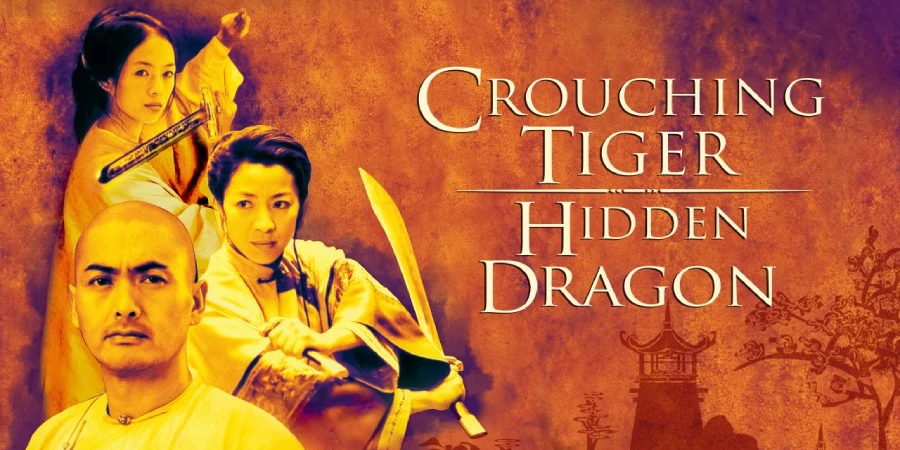

Few films shatter genre conventions as spectacularly as Crouching Tiger, Hidden Dragon. Ang Lee’s 2000 masterpiece fuses breathtaking martial arts choreography with a deeply emotional love story, all wrapped in the visual poetry of ancient China. It arrived in Western cinemas like a revelation, introducing millions of viewers to wuxia storytelling for the first time. More importantly, it proved that subtitled foreign-language films could conquer the global box office on pure cinematic merit.
Detailed Summary
Li Mu Bai Retires and a Sword Goes Missing
Legendary warrior Li Mu Bai, played by Chow Yun-fat, decides to retire from the martial arts world. He entrusts his famous sword, the Green Destiny, to his closest companion, Yu Shu Lien, played by Michelle Yeoh, asking her to deliver it to their friend Sir Te in Beijing.
Yu Shu Lien and Li Mu Bai share a deep, unspoken romantic love. However, their bond remains unconsummated out of loyalty to Yu Shu Lien’s deceased fiance, who was Li Mu Bai’s sworn brother. This emotional restraint drives much of the film’s melancholy.
Jen Yu and the Theft of the Green Destiny
In Beijing, Yu Shu Lien meets Jen Yu, the aristocratic daughter of a governor, played brilliantly by Zhang Ziyi. Jen appears refined and admiring, but she secretly harbors extraordinary martial arts skills and a fierce desire for freedom.
That night, a masked thief steals the Green Destiny from Sir Te’s compound. Yu Shu Lien pursues the thief across rooftops in a stunning chase sequence. She cannot catch the thief, and the Green Destiny vanishes.
The Arrival of Jade Fox
Li Mu Bai arrives in Beijing and recognizes the fighting style of the thief as belonging to his nemesis, Jade Fox, played by Cheng Pei-pei. Jade Fox had murdered his master years earlier and then disappeared. Consequently, Li Mu Bai senses an opportunity for long-delayed revenge.
Jade Fox, we learn, had stolen a Wudang manual to teach herself its secrets. She could read only the pictures, not the text. In contrast, her young pupil Jen had secretly read the manual and learned far more than her teacher ever could.
Jen’s Hidden Life and Lo the Desert Bandit
A lengthy and vivid flashback reveals Jen’s past. In the Xinjiang desert, a bandit named Lo, also called Dark Cloud and played by Chang Chen, stole her comb and kidnapped her. Rather than terrifying her, this encounter thrilled her completely.
Jen and Lo fell passionately in love in the desert. Their relationship represented everything her arranged aristocratic life denied her: freedom, passion, and raw authenticity. She eventually returned to her family, leaving Lo heartbroken in the desert.
Confrontations and Revelations
Yu Shu Lien deduces that Jen is the masked thief. She confronts her privately, hoping to guide the young woman toward a better path. Jen refuses to listen, too intoxicated by her own skill and independence to accept counsel.
Li Mu Bai encounters Jen and recognizes her extraordinary potential. He offers to take her as his disciple at Wudang, an offer of immense prestige. Jen rejects him repeatedly, unwilling to submit to any authority.
Meanwhile, Jade Fox moves in the shadows, manipulating events. She resents Jen deeply for secretly surpassing her. As a result, their partnership has rotted into something dangerous and volatile.
The Famous Inn Fight
Jen, armed with the Green Destiny, provokes a spectacular brawl at a roadside inn. She defeats every martial artist present with contemptuous ease. This scene functions as both a showcase of her power and a portrait of her recklessness.
Yu Shu Lien confronts Jen again after the inn fight, this time in combat. Yu Shu Lien cycles through weapon after weapon, each one shattered by the Green Destiny. Ultimately, Jen wins the physical fight but cannot escape Yu Shu Lien’s moral authority over her.
The Green Destiny Returns, Briefly
Li Mu Bai disarms Jen and retrieves the Green Destiny with elegant ease. He tries once more to draw her toward Wudang, this time as a genuine mentor reaching out to a lost student. Jen escapes again by diving into a river, slipping away like water.
Movie Ending
Jade Fox poisons Jen with a dart intended for Li Mu Bai. Li Mu Bai kills Jade Fox in the ensuing confrontation. However, he takes a poisoned dart himself during the fight, and the venom moves fast.
Yu Shu Lien rushes to find an antidote, but time runs out. Li Mu Bai uses his final moments not to meditate toward enlightenment, as Wudang tradition would demand, but to confess his love to Yu Shu Lien at last. He dies in her arms, and the love they spent a lifetime suppressing finally surfaces only when it is too late to matter.
This is the film’s most devastating blow. Two people who chose duty and restraint over love pay the ultimate price for that choice. Ang Lee refuses to reward their nobility with anything resembling comfort.
In the final scene, Jen reunites briefly with Lo at Wudang Mountain. She asks him to make a wish, recalling a legend that a person who jumps from the mountain will have their deepest wish granted. Lo wishes to return to their days together in the desert.
Jen steps off the mountain and falls into the mist below. Many viewers interpret this as suicide, a final escape from her impossible life. Others read it as a transcendent act, a leap into freedom consistent with the film’s wuxia mythology where the truly gifted can fly. Ang Lee has never firmly closed the door on either reading, and that ambiguity is entirely intentional.
Jen’s leap represents the film’s central argument: that a life of pure freedom, however briefly lived, may matter more to certain souls than a long life of quiet compromise. For a character who suffocated in gilded cages her entire life, the leap is not defeat. It is, in its own way, a kind of triumph.
Are There Post-Credits Scenes?
Crouching Tiger, Hidden Dragon contains no post-credits scenes whatsoever. Once the credits roll, the film is complete. You can leave the theater, or in this case the streaming platform, without missing anything.
Type of Movie
This film belongs firmly to the wuxia genre, a Chinese tradition of stories featuring wandering martial artists bound by a code of honor. Ang Lee layers it with elements of romance, tragedy, and philosophical drama. The tone balances visual spectacle with quiet emotional devastation.
Western audiences often shelved it alongside action films, but that undersells it considerably. At its core, this is a film about repressed desire, female agency, and the cost of living inside social expectations. The action serves the emotion, never the other way around.
Cast
- Chow Yun-fat – Li Mu Bai
- Michelle Yeoh – Yu Shu Lien
- Zhang Ziyi – Jen Yu (Yu Jiaolong)
- Chang Chen – Lo (Dark Cloud)
- Cheng Pei-pei – Jade Fox
- Lung Sihung – Sir Te
- Li Fazeng – Governor Yu
- Gao Xian – Bo
Film Music and Composer
Tan Dun composed the score, blending Eastern and Western instrumentation in ways that felt genuinely new. He incorporated traditional Chinese instruments alongside a full Western orchestra, creating something that belonged entirely to neither world. The result perfectly mirrored the film’s own cultural hybridity.
Cellist Yo-Yo Ma performed the cello solos that anchor the most emotionally charged moments. His playing gives the score its aching, melancholic spine. Singer Coco Lee performed the end-title song A Love Before Time, which received significant awards attention.
Tan Dun won the Academy Award for Best Original Score for this work. His approach treated silence and space as musical tools, matching Ang Lee’s restrained visual style precisely.
Filming Locations
Principal photography took place across multiple regions of China, including Beijing, the Gobi Desert, and the bamboo forests of Anji in Zhejiang province. Each location carries specific narrative weight within the story. The desert sequences feel lonely and boundless, perfectly capturing the freedom of Jen and Lo’s romance.
The bamboo forest fight between Li Mu Bai and Jen stands as one of cinema’s most visually inventive sequences. Shooting among actual bamboo in Anji created an organic, swaying quality that no studio set could replicate. Furthermore, the forest’s natural instability forced the performers to develop genuinely extraordinary wire-work techniques.
Wudang Mountain, a real location sacred in Chinese martial arts tradition, provides the setting for the film’s final scene. Using it grounded Jen’s leap in authentic cultural mythology. It was not merely a pretty backdrop; it was a place loaded with meaning for Chinese audiences.
Awards and Nominations
Crouching Tiger, Hidden Dragon received ten Academy Award nominations and won four: Best Foreign Language Film, Best Cinematography (Peter Pau), Best Original Score (Tan Dun), and Best Art Direction. It remains one of the most decorated foreign-language films in Oscar history.
At the BAFTAs, it won Best Film Not in the English Language. It also swept numerous critics’ circles awards globally. Moreover, Zhang Ziyi’s performance launched her into international stardom almost overnight.
Behind the Scenes Insights
- Ang Lee did not speak Mandarin as his first language, which created some communication challenges on set with his largely Mandarin-speaking cast.
- Michelle Yeoh performed many of her own stunts, drawing on her background in action cinema and her extensive training for this production.
- Zhang Ziyi had very limited martial arts experience before production. She trained intensively for months and reportedly pushed through significant physical pain during filming.
- Choreographer Yuen Woo-ping designed the fight sequences. He approached each fight as a character-driven scene rather than pure spectacle, tailoring the style of combat to each fighter’s personality.
- Chow Yun-fat had to learn Mandarin for the role, as he primarily speaks Cantonese. He worked with a dialect coach throughout production.
- Ang Lee has described the film as his most personal work, despite it being set in a world far removed from his own experience, because it dealt so directly with the suppression of desire and feeling.
- The bamboo forest sequence required performers to balance on the tips of actual bamboo stalks using wire rigs, demanding extraordinary core strength and coordination.
Inspirations and References
The film adapts the fourth novel in a five-part wuxia series by novelist Wang Dulu, written in the 1940s. Wang Dulu’s series was called the Crane-Iron Pentalogy, and the source novel for this film was titled Crouching Tiger, Hidden Dragon in direct translation. His writing blended martial arts action with melodramatic romance in ways that were quite unusual for the genre at the time.
Ang Lee and his screenwriting collaborators, including James Schamus, drew on the broader wuxia literary tradition as well. They also studied classical Chinese painting and poetry to inform the film’s visual language. In addition, Lee cited Taiwanese filmmaker King Hu as a direct cinematic inspiration, particularly Hu’s 1971 film A Touch of Zen.
Alternate Endings and Deleted Scenes
No widely documented alternate endings or significant deleted scenes have entered the public record for this film. Ang Lee has discussed the intentional ambiguity of Jen’s final leap in interviews, suggesting he always conceived multiple interpretations as part of the design. He did not shoot a version that definitively resolved her fate one way or another.
Some early script drafts apparently handled the emotional confrontations between Li Mu Bai and Jen differently, with a sharper emphasis on the mentor-student dynamic. However, specific details of those early drafts remain largely undocumented in reliable sources.
Book Adaptations and Differences
Wang Dulu’s source novel is considerably more sprawling than the film. It gives Lo’s desert storyline much greater page time and develops secondary characters more fully. The film compresses and streamlines these threads to sharpen its emotional focus.
Notably, the novel handles Jen’s ending differently, with less ambiguity about her fate. Ang Lee and his screenwriters deliberately introduced the mythological ambiguity of the mountain leap. In doing so, they elevated the ending from melodrama into something approaching poetry.
The film also sharpens the theme of female repression more pointedly than the novel does. Wang Dulu’s original work is romantic and tragic, but the film adds a layer of feminist critique that feels very much like Ang Lee’s own contribution.
Memorable Scenes and Quotes
Key Scenes
- The rooftop chase: Yu Shu Lien pursues the masked thief across Beijing’s rooftops in the film’s first major action set piece, establishing the film’s gravity-defying visual rules immediately.
- The inn brawl: Jen single-handedly dismantles every fighter in a roadside inn, wielding the Green Destiny with terrifying ease and barely concealed joy.
- The bamboo forest duel: Li Mu Bai and Jen fight among swaying bamboo treetops in a sequence that many critics consider one of the most beautiful action scenes ever put on film.
- Li Mu Bai’s confession: Dying from poison, Li Mu Bai finally tells Yu Shu Lien he loves her. He wastes his last breath not on enlightenment but on honesty, making it one of cinema’s most heartbreaking moments.
- Jen’s leap: Standing at the edge of Wudang Mountain, Jen closes her eyes and steps into the mist, leaving her fate beautifully unresolved.
- The desert flashback: Jen and Lo’s entire desert romance, shot in sweeping golden light, functions almost as a short film within the film and establishes everything we need to understand about Jen’s longing.
Iconic Quotes
- “I would rather be a ghost, drifting by your side, as a condemned soul, than enter heaven without you.” – Li Mu Bai to Yu Shu Lien
- “No growth without resistance. No action without reaction. No desire without restraint.” – Li Mu Bai
- “Whatever path you take in this life, be true to yourself.” – Yu Shu Lien to Jen
Easter Eggs and Hidden Details
- Cheng Pei-pei, who plays Jade Fox, was herself a major star of 1960s Hong Kong wuxia cinema. Her casting is a direct homage to the genre’s own history, layering the film with self-aware reverence.
- Peter Pau’s cinematography frequently frames characters against vast, empty landscapes to emphasize their emotional isolation. The visual strategy is consistent and deliberate throughout the film.
- Yuen Woo-ping’s choreography assigns each major character a distinct fighting style that reflects their personality: Li Mu Bai fights with economy and restraint, Jen with wild brilliance, Yu Shu Lien with disciplined pragmatism.
- Wudang Mountain appears in the film’s final frames as a location already mythologized in Chinese martial arts culture as the home of internal martial arts. Audiences familiar with that context read Jen’s leap as even more resonant.
- Wang Dulu’s source novels were largely out of print and somewhat forgotten by the time Ang Lee adapted them. The film’s success prompted a significant revival of interest in the entire series.
Trivia
- Crouching Tiger, Hidden Dragon became the highest-grossing foreign-language film in American box office history at the time of its release.
- Ang Lee initially struggled to secure financing for the project, as studios were skeptical that a Mandarin-language martial arts film could attract a broad international audience.
- The film was a co-production involving companies from Taiwan, Hong Kong, mainland China, and the United States, making it genuinely multinational in its financing structure.
- Zhang Ziyi was only 19 years old during filming. Crouching Tiger, Hidden Dragon was one of her first major film roles.
- Yo-Yo Ma recorded his cello parts after seeing early footage of the film, allowing him to shape his performance directly in response to the imagery.
- Despite winning the Oscar for Best Foreign Language Film, the film was submitted by Taiwan rather than mainland China or Hong Kong, reflecting the complex politics of its co-production status.
- Sony Pictures Classics handled the North American distribution and mounted an unusually wide release strategy for a subtitled film, which contributed significantly to its crossover success.
Why Watch?
Crouching Tiger, Hidden Dragon offers something genuinely rare: action choreography so beautiful it functions as visual poetry, wrapped around a love story that quietly destroys you. It handles themes of freedom, desire, and sacrifice with uncommon maturity and grace. For anyone who believes subtitles are a barrier, this film is the perfect argument against that idea entirely.
Director’s Other Movies
- Pushing Hands (1992)
- The Wedding Banquet (1993)
- Eat Drink Man Woman (1994)
- Sense and Sensibility (1995)
- The Ice Storm (1997)
- Ride with the Devil (1999)
- Hulk (2003)
- Brokeback Mountain (2005)
- Lust, Caution (2007)
- Taking Woodstock (2009)
- Life of Pi (2012)
- Billy Lynn’s Long Halftime Walk (2016)
- Gemini Man (2019)
Recommended Films for Fans
- Crouching Tiger, Hidden Dragon: Sword of Destiny (2016)
- Hero (2002)
- House of Flying Daggers (2004)
- A Touch of Zen (1971)
- The Grandmaster (2013)
- Come Drink with Me (1966)
- The Grandmaster (2013)
- Raise the Red Lantern (1991)
- In the Mood for Love (2000)
- Memoirs of a Geisha (2005)
- Curse of the Golden Flower (2006)