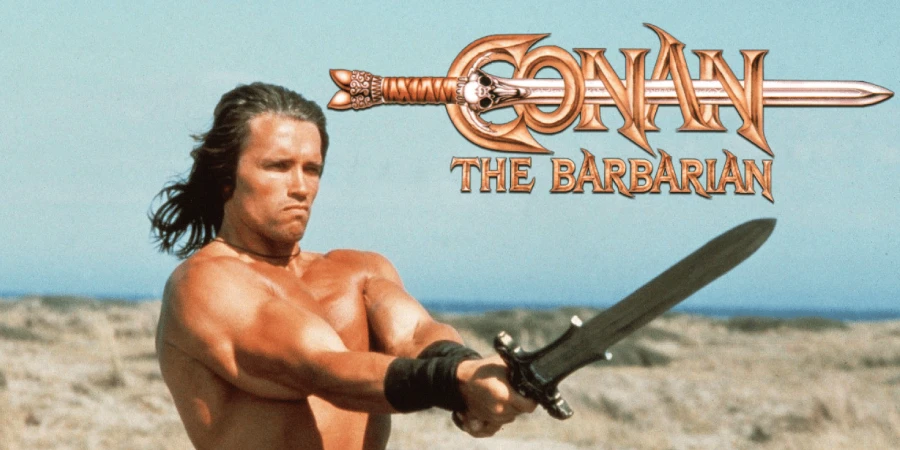

Few sword-and-sorcery films carry the raw, mythic weight of Conan the Barbarian. John Milius took Robert E. Howard’s pulp hero and forged something genuinely primal from him, a brooding revenge epic soaked in blood, philosophy, and Basil Poledouris’s thunderous score. Arnold Schwarzenegger barely spoke, yet he commanded every single frame. This film did not just launch a franchise; it redefined what a fantasy action movie could be.
Detailed Summary
The Forge of Grief: Conan’s Origins
The film opens with a father teaching his young son the Riddle of Steel. Quality of iron matters less than the hand that wields it, or so the lesson begins. This philosophical thread runs through the entire story.
Warlord Thulsa Doom and his serpent cult raid the Cimmerian village, slaughtering adults and enslaving children. Conan watches his father get torn apart by Doom’s war dogs. His mother faces Doom directly, and Doom decapitates her with Conan’s own father’s sword.
Young Conan is chained and forced to push the Wheel of Pain for years. This grinding, circular labor strips away his childhood but builds his extraordinary physique. He grows from a frightened boy into a mountain of muscle.
The Pit Fighter and the Eastern Scholar
Conan’s owner eventually enters him into pit fights, where he proves devastatingly effective. His master sends him east to train under skilled warriors and scholars. Consequently, Conan learns swordsmanship, philosophy, and even how to read.
After years of service, his master releases him. Conan wanders freely for the first time in his adult life, driven purely by instinct and a burning, unresolved rage against Thulsa Doom.
The Serpent Tomb and Subotai
Conan encounters Subotai, a Hyrkanian thief and archer, after freeing him from chains in the wilderness. The two form an immediate, unspoken bond built on mutual respect. In addition, they share a healthy appetite for mischief.
Together they raid a Snake Cult temple, stealing jewels including the Eye of the Serpent. Conan kills a massive snake inside the idol. This scene establishes Conan as a fighter unafraid of supernatural threats.
Valeria and the Tower of the Serpent
Conan and Subotai meet Valeria, a fierce and skilled thief, in a tavern. She agrees to join their raid on the Tower of Set, where Thulsa Doom’s cult operates. Climbing the tower, fighting guards, and stealing a priceless jewel, the trio prove themselves a formidable team.
Valeria and Conan fall deeply in love during this sequence. Their relationship feels earned rather than decorative. She matches him physically and intellectually, which makes her importance to the ending deeply painful.
Captured and Crucified
King Osric hires Conan and his companions to retrieve his daughter, who has joined Doom’s cult willingly. Guards loyal to Doom, however, capture Conan before the mission can properly begin. They crucify him on the Tree of Woe and leave him to die.
Subotai refuses to abandon him. He performs a desperate shamanistic ritual to fight off death spirits claiming Conan’s soul. The wizard Akiro assists, and together they pull Conan back from the edge of death in a genuinely eerie sequence.
The Cult Orgy and the Princess
Recovered and furious, Conan infiltrates Doom’s mountain stronghold disguised as a cult priest. He witnesses the cult’s grotesque feasts and drug-fueled rituals. Moreover, he observes firsthand how completely Doom controls his followers.
Conan finds Osric’s daughter and attempts to bring her back. She resists and bites him, fully committed to her cult master. Conan subdues her and escapes with Subotai and Valeria, but Doom retaliates swiftly.
Valeria’s Death
Doom shoots a snake arrow from an enormous distance, striking Valeria fatally. She dies in Conan’s arms, and the film does not soften this moment at all. Her death transforms the story from adventure into genuine tragedy.
Akiro prepares her funeral pyre. Conan burns her body with full warrior honors. Her loss sharpens his resolve into something absolute and cold.
Movie Ending
Conan sets a brutal trap for Doom’s forces at an ancient battlefield, using Akiro’s knowledge of the terrain and Subotai’s archery to devastating effect. The battle is vicious and almost costs Conan his life multiple times. For instance, Conan fights while severely wounded, relying on preparation and rage rather than clean strength.
Valeria returns as a warrior spirit, briefly manifesting to save Conan from a killing blow during the fight. This moment honors their bond without undermining the tragedy of her death. She vanishes immediately after, leaving Conan alive but utterly alone in his grief.
Conan pursues the surviving Doom to his mountain sanctuary, a place of torches and kneeling worshippers. Doom tries his most chilling weapon: his voice. He demonstrates his absolute hold over his followers by calmly ordering one to leap to her death, and she obeys without hesitation.
Conan does not flinch. He advances on Doom, and the two confront each other directly for the first time since Conan’s childhood. Doom attempts to mesmerize Conan as he has mesmerized countless others, but Conan resists and decapitates him with his father’s sword.
This moment resolves the Riddle of Steel philosophically. Doom once told young Conan that flesh is stronger than steel, that will and belief conquer all. However, Conan’s answer is simple and final: a sword, wielded by a man with genuine purpose, ends the argument permanently.
Conan then smashes the altar and frees the remaining cult followers from Doom’s grip. Osric’s daughter, no longer under Doom’s influence, is returned home. Akiro narrates in closing that Conan eventually became a king, though the film ends before showing that throne.
Are There Post-Credits Scenes?
Conan the Barbarian contains no post-credits scene of any kind. The film ends with Akiro’s narration and a final image of Conan seated alone on a rocky throne at dusk. After that, credits roll against Poledouris’s score without any additional footage.
Type of Movie
Conan the Barbarian is a sword-and-sorcery fantasy action film with strong elements of tragedy and mythological epic. Its tone is serious, even somber at times, far removed from campy fantasy fare of its era. Director John Milius treated the material with the gravity of classical myth.
Violence is frequent and brutal without glorifying gore for its own sake. Themes of grief, identity, philosophy, and power elevate it well beyond standard action fare. In contrast to many contemporaries, this film actually has something to say.
Cast
- Arnold Schwarzenegger – Conan
- James Earl Jones – Thulsa Doom
- Sandahl Bergman – Valeria
- Gerry Lopez – Subotai
- Max von Sydow – King Osric
- Mako – Akiro the Wizard (narrator)
- Ben Davidson – Rexor
- Cassandra Gava – The Witch
- William Smith – Conan’s Father
Film Music and Composer
Basil Poledouris composed one of the most celebrated fantasy scores in cinema history for this film. His music blends orchestral bombast with choral grandeur, creating something that feels genuinely ancient. Notably, the score was recorded before filming completed, which is highly unusual.
Key tracks include “Anvil of Crom,” which opens the film with thunderous brass and sets the mythic tone immediately. “The Riddle of Steel / Riders of Doom” accompanies the village massacre with devastating emotional force. The score does not merely accompany the story; it narrates it.
Poledouris was a close friend of director John Milius, having studied film together at USC. Their creative shorthand allowed unusually deep collaboration. As a result, the music and the film feel inseparable in a way rare for the genre.
Filming Locations
Principal photography took place across Spain, primarily in the landscapes around Almeria and various locations in and around Madrid. Spain’s rugged, arid terrain provided a convincing ancient world without requiring expensive set construction. Furthermore, Spanish locations had a long history of sword-and-sandal productions, meaning infrastructure was already in place.
The Almeria desert doubled as Cimmeria and the various wastelands Conan traverses. Rocky outcroppings and ancient ruins provided natural set dressing that no studio could replicate cheaply. On the other hand, interior scenes and specific set pieces were built on constructed stages.
The Tower of Set sequence used real architectural structures combined with built sets. Shooting in practical locations grounded the fantasy in physical reality. This approach gave the film its distinctive gritty, tactile quality.
Awards and Nominations
Conan the Barbarian did not receive major awards recognition from mainstream bodies like the Academy Awards. Basil Poledouris’s score, however, earned widespread critical praise and later recognition as one of cinema’s great fantasy compositions.
Behind the Scenes Insights
- Arnold Schwarzenegger trained intensively for over a year before production, studying swordsmanship, horseback riding, and various martial disciplines.
- Director John Milius drew heavily from his personal philosophy and admiration for warrior cultures, including Samurai tradition and Nietzschean ideas, when shaping the script.
- Sandahl Bergman was primarily a dancer and choreographer before this film; her physical grace came directly from that background.
- Schwarzenegger injured himself during production multiple times, including a shoulder injury from intensive sword training.
- James Earl Jones reportedly found the role of Thulsa Doom genuinely unsettling to perform because of how easily Doom manipulates others.
- Milius originally envisioned a much larger budget production; financial constraints forced creative solutions that often improved the film.
- The snake used in the Snake Cult temple scene was a real boa constrictor, and handling it required careful coordination with animal wranglers on set.
- Mako was cast partly because Milius wanted a narrator with an otherworldly, slightly alien vocal quality.
Inspirations and References
Robert E. Howard created Conan the Cimmerian in the early 1930s for Weird Tales magazine. Howard’s stories established the entire sword-and-sorcery genre as a distinct category separate from high fantasy. Milius and co-writer Oliver Stone drew from multiple Howard stories rather than adapting a single narrative.
Friedrich Nietzsche’s writings, particularly ideas about will, power, and the nature of strength, deeply influenced the script. The Riddle of Steel functions as the film’s philosophical backbone, a question Nietzsche might have appreciated. Milius also cited Akira Kurosawa as a visual and structural influence.
Joseph Campbell’s work on mythology and the hero’s journey shaped the film’s narrative arc consciously. Conan moves through archetypal stages: loss, slavery, transformation, descent, and ultimate vengeance. In addition, Norse mythology and ancient warrior cultures informed the visual design throughout.
Alternate Endings and Deleted Scenes
Several scenes shot during production did not make the final cut, primarily to control pacing and runtime. Some of these extended Conan’s travels in the east and deepened his scholarly education. Their removal kept the story leaner but sacrificed some character texture.
An alternate, slightly extended version of the Tree of Woe rescue sequence existed in early cuts. It included more of the shamanistic ritual and the death spirits attacking. Milius trimmed it because prolonging Conan’s vulnerability too long risked undercutting his mythic stature.
No radically different alternate ending exists in any confirmed form. The core climax, specifically Conan confronting and beheading Doom, remained consistent from script through final cut. Milius considered the ending philosophically essential and refused to soften it.
Book Adaptations and Differences
Conan the Barbarian draws from Robert E. Howard’s Conan stories but does not adapt any single story directly. Milius and Stone constructed an original narrative using Howard’s world, characters, and mythology as raw material. Howard’s Conan was never a slave or pit fighter; those elements are original to the screenplay.
Howard’s Thulsa Doom actually appeared in stories featuring Kull of Atlantis, not Conan. Milius transferred the villain to Conan’s universe and reimagined him entirely as a serpent cult leader. Howard’s Doom was a very different kind of antagonist.
Howard’s Conan was also notably more talkative, cunning, and quick-witted in prose. Schwarzenegger’s largely silent portrayal suited the film’s mythic approach but differs significantly from the literary character. Nonetheless, the spirit of Howard’s barbaric outsider survives in the adaptation.
Memorable Scenes and Quotes
Key Scenes
- The village massacre: Doom’s riders slaughter Conan’s people as a child watches, establishing the film’s emotional stakes in brutal, efficient terms.
- The Wheel of Pain montage: Years of slavery compress into a single powerful sequence showing a boy become a man through pure suffering.
- The Tower of Set heist: Conan, Valeria, and Subotai work together in near silence, creating genuine tension without a single wasted moment.
- Valeria’s death: Doom’s snake arrow strikes from impossibly far away, and Valeria dies quietly in Conan’s arms, giving the climax its emotional weight.
- Doom commands his follower to jump: The film’s most chilling moment, where a kneeling cultist leaps to her death without hesitation on a single word from Doom.
- Conan decapitates Doom: Short, brutal, and final, the revenge the entire film has built toward arrives with zero ceremony.
Iconic Quotes
- “Crush your enemies, see them driven before you, and hear the lamentations of their women.” – Conan, answering what is best in life
- “Steel isn’t strong, boy. Flesh is stronger.” – Thulsa Doom
- “Fire and wind come from the sky, from the gods of the sky. But Crom is your god, Crom and he lives in the earth.” – Conan’s Father
- “Contemplate this on the Tree of Woe.” – Thulsa Doom
- “Conan, what is best in life?” – Mongol General
Easter Eggs and Hidden Details
- The snake cult’s visual iconography draws directly from real ancient serpent worship traditions across multiple cultures, giving Doom’s religion an unsettling plausibility.
- Conan’s father’s speech about steel echoes Nietzsche’s “what does not kill me makes me stronger,” a theme Milius seeded deliberately throughout.
- The Wheel of Pain has no specific historical parallel but visually echoes ancient grain mills and torture devices, blending function with punishment.
- Akiro’s narration frames the story as a legend retold centuries later, which subtly suggests Conan’s tale has already passed into myth by the time we hear it.
- Thulsa Doom’s ability to transform into a serpent is shown only briefly, keeping his supernatural nature ambiguous for most of the film.
- The opening forge sequence over the credits mirrors the film’s closing image of Conan on a throne, creating a visual bracket around the entire story.
- James Earl Jones delivered some of Doom’s lines in a deliberately slow, hypnotic cadence, a conscious performance choice meant to mirror cult leader manipulation techniques.
Trivia
- Arnold Schwarzenegger has said that Conan the Barbarian was a more physically demanding production than any other film in his career.
- Oliver Stone wrote an earlier, far darker draft of the screenplay that Milius substantially rewrote before production began.
- Sandahl Bergman won a Saturn Award for Best Actress for her performance as Valeria.
- The film’s budget was approximately $20 million, which was considered substantial for a fantasy film at that time.
- Milius drew on the tradition of Samurai cinema for the film’s approach to violence, treating combat as both brutal and ceremonial.
- Producer Dino De Laurentiis had attempted to develop a Conan film for years before this version finally reached production.
- Basil Poledouris conducted the score with a full orchestra; the recording sessions reportedly moved crew members to tears.
- Schwarzenegger’s limited English dialogue was partly a practical script decision, but it also aligned perfectly with Milius’s vision of Conan as an elemental, pre-verbal force.
Why Watch?
Conan the Barbarian offers something genuinely rare in fantasy cinema: a film that takes its world, its hero, and its themes completely seriously. Poledouris’s score alone justifies the runtime. Moreover, Schwarzenegger and Jones deliver performances that anchor pulp material in real emotional weight, making the revenge arc land with surprising force.
Director’s Other Movies
- Dillinger (1973)
- The Wind and the Lion (1975)
- Big Wednesday (1978)
- Red Dawn (1984)
- Farewell to the King (1989)
- Flight of the Intruder (1991)
Recommended Films for Fans
- Excalibur (1981)
- The Beastmaster (1982)
- Willow (1988)
- Red Sonja (1985)
- Masters of the Universe (2026)
- Krull (1983)
- Masters of the Universe (1987)
- Kull the Conqueror (1997)
- The 13th Warrior (1999)
- Flesh + Blood (1985)