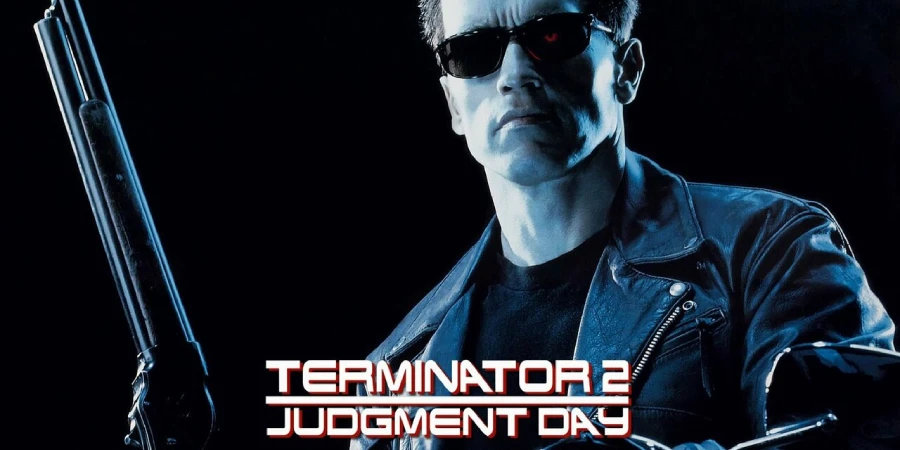

A machine sent back in time to kill a child walks into a biker bar, and somehow that is the least remarkable thing Terminator 2: Judgment Day does in its first twenty minutes. James Cameron’s 1991 sequel does not just raise the stakes of its predecessor; it obliterates them, delivering a film that redefined blockbuster filmmaking, special effects, and what a sequel could aspire to be.
Detailed Summary
The Future War and the Setup
Terminator 2 opens with a chilling vision of Los Angeles in 2029, scorched and ruled by machines. Humanity’s resistance, led by John Connor, fights back against the tyrannical artificial intelligence known as Skynet. Two machines travel back to 1995: one to protect John, one to kill him.
Skynet sends the T-1000, a terrifying new liquid-metal Terminator capable of mimicking any person or object it touches. In contrast, the Resistance reprograms a older-model T-800 and sends it to protect the young John. Both arrive in Los Angeles, naked and disoriented, ready to begin their hunt.
Finding John Connor
Young John Connor, played by Edward Furlong, lives with foster parents in Reseda. He is a rebellious, streetwise kid who has been raised to survive but currently resents his absent mother. His biological mother, Sarah Connor, sits locked in Pescadero State Hospital, branded delusional for her warnings about Skynet.
Both Terminators converge on John at a shopping mall arcade. For a tense few minutes, the audience genuinely does not know which machine is the protector. Cameron brilliantly withholds that reveal, letting dread build before the T-800 saves John and the two escape on a motorcycle.
Sarah Connor in Pescadero
Meanwhile, Sarah Connor endures brutal conditions at Pescadero under the care of Dr. Silberman. She has not abandoned her mission; she works out obsessively in her cell and manipulates staff with calculated precision. When she learns through a dream that Judgment Day is still coming, she engineers a violent escape.
Her escape attempt is harrowing. She overpowers guards, takes Silberman hostage, and nearly makes it out before running directly into the T-1000, which has infiltrated the hospital. In a remarkable reversal, the T-800 arrives and rescues her, forcing Sarah to accept that a Terminator is now her son’s protector.
On the Run and Building Trust
Sarah struggles to trust the T-800, understandably so given what a similar machine did to her in the first film. John, however, bonds with it quickly, teaching it slang and testing the boundaries of its programming. He famously orders it never to kill anyone, and it complies.
John begins to see the T-800 as the father figure he never had. This emotional core gives the film its unexpected warmth and depth. Cameron never lets the action overshadow the relationship developing between a lonely boy and a reprogrammed killing machine.
Targeting Miles Dyson
Sarah learns that Miles Dyson, a Cyberdyne Systems engineer, will create the technology that eventually becomes Skynet. She decides to take matters into her own hands. In a deeply unsettling sequence, she arms herself and drives to Dyson’s home to assassinate him.
She opens fire on Dyson at his house, wounding him. However, she cannot finish the job when she sees his wife and child. John and the T-800 arrive and stop her. Consequently, instead of killing Dyson, they explain everything, and a shaken Dyson agrees to help them destroy his own work.
Raiding Cyberdyne Systems
The group breaks into Cyberdyne headquarters to destroy the CPU and the arm from the original Terminator, both of which Cyberdyne has been reverse-engineering to accelerate its research. They blow up the lab, setting back the development of Skynet significantly. Police surround the building as the explosion tears through it.
Dyson stays behind to trigger the explosion manually after being shot, giving his life to help stop Judgment Day. His sacrifice is quiet and devastating. Furthermore, it reframes the film’s moral complexity: the villain of this subplot dies a hero.
The T-1000 Closes In
Police chase the group in a spectacular freeway sequence. A truck crash sends the T-1000 tumbling but does not stop it. Nothing stops it for long. Its liquid-metal body reforms after every injury, making it one of cinema’s most relentless antagonists.
Robert Patrick’s physical performance as the T-1000 is essential to why it works. He moves with an eerie, inhuman precision, running at impossible speed and fixing the camera with a blank, predatory stare. In contrast to Schwarzenegger’s hulking T-800, the T-1000 is all economy and cold efficiency.


Movie Ending
At a steel mill, the final confrontation erupts in spectacular and emotionally brutal fashion. The T-1000 corners Sarah, mimicking her voice and stabbing her through the shoulder. John watches in horror. The T-800 arrives and unloads everything it has into the T-1000, blasting it apart repeatedly, only for the liquid metal to keep reassembling.
A damaged T-800, arm destroyed and eye blackened, finally uses a grenade launcher to send the T-1000 into a vat of molten steel. On impact, the liquid metal thrashes through a series of anguished, morphing forms before dissolving permanently. It is a visually astonishing death for a visually astonishing villain.
Then comes the gut punch. John and Sarah realize the T-800 itself must also be destroyed, because its CPU and physical structure represent future technology that could still lead to Skynet’s creation. The T-800, now capable of something resembling understanding, agrees. It cannot self-terminate, so it asks Sarah to lower it into the molten steel.
John begs it not to go. He grabs it, crying, refusing to let go. Arnold Schwarzenegger’s performance in these final minutes is genuinely moving, precisely because Cameron trusts the audience to feel the loss of a machine that learned what it means to care. The T-800 gives John a thumbs-up as it sinks below the surface.
Sarah’s final voiceover reflects on an uncertain but hopeful future. She no longer knows exactly what will happen, but for the first time, she believes Judgment Day might be avoided. Cameron closes on a road stretching into darkness, open and unresolved, a rare piece of restraint from a filmmaker who rarely does restraint.
Audiences often ask whether the ending truly prevents Judgment Day. Within the film’s own logic, it does, at least partially. Subsequent films and the television series complicated this, but within T2 itself, the ending feels earned and complete. It answers the film’s central question: can fate be changed? Sarah’s answer, for the first time, is yes.
Are There Post-Credits Scenes?
Terminator 2: Judgment Day contains no post-credits scenes. After the emotional conclusion, the credits roll and that is that. Cameron and his team let the film breathe rather than tease a sequel. Given the story’s resolution, a post-credits sting would have undercut the ending’s weight considerably.
Type of Movie
Terminator 2 is a science fiction action thriller with surprisingly strong dramatic and emotional underpinnings. It operates primarily as a chase film but weaves in genuine character development, moral philosophy, and family dynamics. Cameron rarely lets it feel like just an action movie.
Tonally, the film walks a careful line. It is intense and violent but never gratuitously so. Moments of dark humor, particularly those involving the T-800’s attempts to learn human behavior, prevent the relentless tension from becoming exhausting.
Cast
- Arnold Schwarzenegger – The T-800 / Terminator
- Linda Hamilton – Sarah Connor
- Edward Furlong – John Connor
- Robert Patrick – The T-1000
- Joe Morton – Miles Dyson
- Earl Boen – Dr. Silberman
- Jenette Goldstein – Janelle Voight (John’s foster mother)
- Xander Berkeley – Todd Voight (John’s foster father)
- S. Epatha Merkerson – Tarissa Dyson
Film Music and Composer
Brad Fiedel composed the score for Terminator 2, returning from the original film. His work blends industrial percussion with sweeping orchestral passages, perfectly mirroring the film’s tension between cold machinery and human emotion. Notably, the main theme remains one of the most recognizable in action cinema history.
Fiedel’s approach treats the score as something almost mechanical. Metallic rhythms and synthesizer textures give the music a feeling of relentless forward motion. However, he also layers in quieter, more vulnerable cues during the emotional scenes between John and the T-800, giving those moments genuine resonance.



Filming Locations
Principal photography took place across Los Angeles and surrounding areas. The Galleria mall in Sherman Oaks hosted the iconic arcade chase. Freeway sequences used the then-unfinished stretch of the Elysian Park area, providing the wide, empty lanes that made the truck pursuit so visually striking.
Pescadero State Hospital scenes filmed at an actual facility in Simi Valley. Cyberdyne headquarters used a real office building in Fremont, California. These real locations ground the film’s futuristic premise in recognizable, everyday spaces, which amplifies the sense of danger considerably.
The steel mill climax filmed at a Kaiser Steel facility in Fontana, California. Cameron chose a real, operational-feeling industrial space rather than a studio set. As a result, the final battle carries a gritty, visceral authenticity that a constructed set might have lacked.
Awards and Nominations
Terminator 2 won four Academy Awards at the 1992 ceremony, taking home trophies for Best Visual Effects, Best Sound, Best Sound Editing, and Best Makeup. These wins were thoroughly deserved given the film’s groundbreaking use of CGI, particularly for the T-1000. The film also received nominations across additional technical categories.
Beyond the Oscars, the film swept most major technical awards that year. Its impact on the visual effects industry specifically was so significant that the Academy effectively restructured how it evaluated digital effects in subsequent years.
Behind the Scenes Insights
- Linda Hamilton underwent intense physical training to transform Sarah Connor into the hardened, muscular survivor seen in the film. She trained for months with a personal trainer and a former Israeli commando.
- Robert Patrick trained as a sprinter specifically to achieve the T-1000’s unsettling, relentless running style. Cameron wanted the machine to look like it never tires.
- The liquid-metal effects for the T-1000 cost enormous resources and required Industrial Light and Magic to develop entirely new software. Many of the techniques pioneered here became industry standards.
- Arnold Schwarzenegger was paid approximately $15 million for the role, which at the time made him one of the highest-paid actors in Hollywood history.
- Cameron wrote the script with William Wisher Jr., and the two completed much of the screenplay while literally faxing pages back and forth overnight.
- The budget for T2 was approximately $102 million, making it the most expensive film ever made at the time of its release.
- Hamilton’s twin sister, Leslie Hamilton Gearren, appeared in the film as a body double for scenes requiring two Sarah Connors simultaneously.
- Schwarzenegger actually learned to use a real shotgun one-handed for several sequences, though the weapon’s recoil required significant physical management.
Inspirations and References
James Cameron drew heavily from his own original film as a foundation, but T2 consciously inverted its predecessor’s premise. Making the Terminator the protector rather than the hunter was a deliberate creative pivot. Cameron wanted to explore what it might mean for a killing machine to develop something resembling empathy.
Philosophically, the film engages with technological determinism, the idea that once certain technologies exist, their destructive applications become inevitable. Sarah Connor’s mission to stop Skynet at its source reflects genuine anxieties about artificial intelligence and nuclear warfare that were very much alive in the early 1990s.
Cameron also cited classic chase films and road movies as structural influences. The middle section of T2 functions almost like a family road trip, albeit one involving pipe bombs and a shape-shifting assassin. In addition, the father-son dynamic between John and the T-800 draws on traditional Western tropes about reluctant protectors and the men who shape young boys.
Alternate Endings and Deleted Scenes
Cameron shot an alternate ending that appeared on some home video releases and later on the Special Edition cut. In this version, the film jumps forward to a peaceful 2029, showing an elderly Sarah Connor watching children play while Judgment Day never occurs. Cameron ultimately found it too sentimental and cut it from the theatrical release.
Several deleted scenes appeared in the Special Edition, most notably a sequence where Sarah and the T-800 open its skull and briefly switch it to “read-write” mode, allowing John to fiddle with its learning capabilities. This scene explains why the T-800 becomes progressively more human-like as the film progresses. Cameron felt it slowed momentum in the theatrical cut.
Another deleted scene extended the Pescadero escape, giving Sarah a more drawn-out confrontation with the T-1000 in the hospital corridors. Some fans consider the Special Edition the superior version because these additions deepen the character work significantly.
Book Adaptations and Differences
Terminator 2: Judgment Day is not based on a book. It is an original screenplay by James Cameron and William Wisher Jr. A novelization by Randall Frakes was published to coincide with the film’s release, adapting the screenplay into prose form.
Frakes’s novelization follows the film closely and includes some additional character interiority, particularly for Sarah Connor. However, it offers no significant plot divergences. Readers looking for an expanded version of the story will find the Special Edition director’s cut a more rewarding experience than the novelization.



Memorable Scenes and Quotes
Key Scenes
- The T-800 walking into the biker bar and systematically acquiring clothing, sunglasses, and a motorcycle with cold, methodical efficiency.
- The shopping mall chase, where both Terminators converge on John and the audience finally learns which machine is the protector.
- Sarah Connor’s nightmare sequence showing the nuclear destruction of a Los Angeles playground, one of the most haunting images in 1990s cinema.
- Sarah’s brutal escape attempt at Pescadero, showcasing Hamilton’s physical transformation and Sarah’s terrifying competence.
- The T-1000 mimicking a police officer and walking through prison bars, the film’s first true showcase of its liquid-metal effects.
- John ordering the T-800 not to kill anyone, and the T-800’s compliance, establishing the film’s moral stakes early.
- The Cyberdyne raid and explosion, a sequence that balances large-scale action with the personal cost of Dyson’s sacrifice.
- The steel mill finale, culminating in the T-800’s slow descent into molten metal and the thumbs-up that became one of cinema’s most emotional gestures.
Iconic Quotes
- “I need your clothes, your boots, and your motorcycle.” – The T-800
- “hasta la vista, baby.” – The T-800
- “No fate but what we make for ourselves.” – John Connor
- “The unknown future rolls toward us. I face it, for the first time, with a sense of hope.” – Sarah Connor
- “I know now why you cry. But it’s something I can never do.” – The T-800
- “Come with me if you want to live.” – The T-800 to John Connor
Easter Eggs and Hidden Details
- The biker bar the T-800 enters is called The Corral, and a Guns N’ Roses song plays on the jukebox, a deliberate period detail grounding the film in early 1990s Los Angeles culture.
- When the T-1000 scans John’s room at his foster home, a calendar on the wall shows August 1994, which conflicts slightly with other timeline references in the film.
- The Cyberdyne building exterior features a subtle architectural choice: its glass facade reflects the sky, symbolically suggesting the company mirrors and ultimately threatens the natural world above it.
- John Connor’s initials, J.C., are a deliberate reference to Jesus Christ, a messianic figure who sacrifices himself for humanity. Cameron has acknowledged this parallel was intentional.
- During the hospital escape, one of the orderlies the T-1000 impersonates wears a uniform number consistent with an inside joke among the crew about a specific crew member’s locker number.
- The thumbs-up gesture the T-800 gives as it descends into the steel mill was actually shot with Schwarzenegger physically lowering himself into a crane harness, with the thumbs-up added as a genuine improvised farewell on set.
- A miniature toy truck on John’s desk in his foster home foreshadows the massive truck used by the T-1000 in the freeway chase sequence.
Trivia
- Edward Furlong was discovered in a youth center in Pasadena, California, and T2 was his film debut.
- Robert Patrick was cast partly because Cameron wanted someone who looked like no living human body could stop him despite being physically lean, creating a contrast with Schwarzenegger’s mass.
- The liquid-metal morphing effects required Industrial Light and Magic to create over 40 entirely new computer-generated shots, each taking weeks to render on hardware that would be considered laughably primitive today.
- Schwarzenegger reportedly damaged his wrist during production while operating the shotgun one-handed, though he continued filming without significant delay.
- Cameron placed a strict rule on set: no one was allowed to refer to the T-800 as a “robot.” It was always to be called a Terminator, preserving the character’s specific identity.
- At the time of release, T2 grossed over $500 million worldwide, making it the highest-grossing film of 1991.
- The film’s famous “No fate” line originated in the first Terminator film as a message Kyle Reese carried from the future; Cameron brought it forward and expanded it here into the film’s central thesis.
- Hamilton wore contact lenses to convey Sarah’s hardened, flat affect in certain scenes, subtly distinguishing the post-Pescadero Sarah from the terrified waitress of the original film.
Why Watch?
Terminator 2 is not simply a great action film; it is a masterclass in how sequels should work, deepening every character while expanding the world in logical, emotionally satisfying ways. Cameron delivers breathtaking set pieces alongside genuine pathos, and the result holds up better than almost any blockbuster of its era. Few films have earned their tearjerker endings quite as honestly as this one does.
Director’s Other Movies
- Piranha II: The Spawning (1982)
- The Terminator (1984)
- Aliens (1986)
- The Abyss (1989)
- True Lies (1994)
- Titanic (1997)
- Avatar (2009)
- Avatar: The Way of Water (2022)