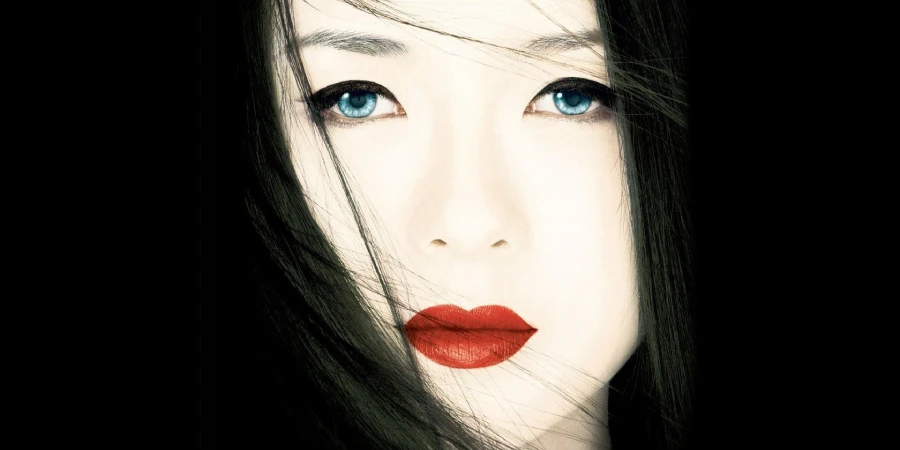

Few films carry the weight of a child sold into servitude and still manage to frame it as something achingly beautiful. Memoirs of a Geisha (2005) does exactly that, pulling viewers into a world of silk, sacrifice, and survival set against pre-war and wartime Japan. Director Rob Marshall adapts Arthur Golden’s bestselling novel with visual grandeur and emotional ambition. It is a film that courts controversy as readily as it courts admiration.
Detailed Summary
A Young Girl Sold and Separated
We open in a poor fishing village in 1929, where a young girl named Chiyo Sakamoto lives with her ailing mother and aging father. Her striking grey-blue eyes set her apart immediately, and her father, sensing he cannot care for his daughters, makes a heartbreaking decision. He sells both Chiyo and her older sister, Satsu, to a broker.
Chiyo arrives at the renowned okiya (geisha house) in Kyoto’s Gion district, run by a businesswoman known as Mother. Her sister, however, ends up in a brothel rather than a geisha house. Chiyo holds onto the hope of reunion, but that hope fractures quickly.
Life Inside the Okiya
Chiyo works as a servant inside the okiya, enduring harsh conditions under the jealous reign of Hatsumomo, the house’s reigning geisha. Hatsumomo is both magnificent and vicious, recognizing in Chiyo a future threat to her own dominance. She systematically undermines the girl at every turn.
Meanwhile, Chiyo befriends another girl named Pumpkin, who shares her servant status. Their bond offers the only warmth in an otherwise cold and transactional world. Chiyo attempts to run away with Satsu, but Satsu escapes alone, leaving Chiyo stranded and demoted to permanent servant status as punishment.
The Chairman and a Moment of Kindness
On a particularly low day, a young Chiyo sits weeping on a bridge. A wealthy, kind businessman known as the Chairman stops and offers her sympathy, sweets, and a few coins. This small act of human decency reshapes everything. Chiyo decides then and there that she wants to become a geisha, specifically to move within the Chairman’s world.
This moment functions as the film’s emotional engine. Every sacrifice Chiyo endures afterward connects back to this single encounter on that bridge. It is not a dramatic vow, but it is absolutely a defining one.
Mameha Takes Chiyo Under Her Wing
Years pass, and Chiyo remains trapped in servant life until the celebrated geisha Mameha strikes an unusual deal with Mother. Mameha agrees to train Chiyo, betting that the girl will become profitable enough to repay her debts within a set timeframe. Mother accepts, and Chiyo’s transformation begins.
Chiyo receives a new name: Sayuri. Her grey eyes, once a source of otherness, become her most prized asset in Gion. Mameha is a shrewd teacher, guiding Sayuri through the complex social rituals, performances, and politics of the geisha world.
The Rivalry With Hatsumomo
Hatsumomo views Sayuri’s rise as a direct assault on her own position. She spreads rumors, sabotages Sayuri’s reputation, and attempts to destroy Mameha’s standing as well. In contrast, Mameha plays a longer, more strategic game. She positions Sayuri carefully against Hatsumomo’s attacks.
Hatsumomo’s downfall arrives when Mother catches her smuggling her secret lover into the okiya. Mother, ever the pragmatist, expels Hatsumomo rather than tolerate the disruption. Hatsumomo exits the story in disgrace, and Sayuri inherits her room in the okiya.
The Mizuage Auction
One of the film’s most controversial sequences involves the auction of Sayuri’s mizuage, the ceremonial bidding on a young geisha’s virginity. Mameha engineers a competition between two wealthy men: Nobu, a loyal business associate of the Chairman, and Dr. Crab, a collector of first experiences. Dr. Crab wins, paying a record sum.
This sequence makes no attempt to romanticize the transaction. It is cold, clinical, and deeply uncomfortable, which is precisely the point. Sayuri endures it as another cost of survival in this world.
Sayuri Becomes a Celebrated Geisha
Sayuri’s career flourishes after her mizuage. Her beauty, grace, and intelligence attract powerful patrons. She moves closer to the Chairman’s social circle, though he remains at an agonizing distance. Nobu becomes a devoted admirer and advocate for Sayuri.
Pumpkin, meanwhile, becomes Hatsumomo’s apprentice and later shifts her loyalties in ways that will matter deeply later. Their friendship strains under the pressures of ambition and survival. The world of Gion does not reward sentiment.
War Changes Everything
World War II disrupts the geisha world entirely. Gion effectively shuts down, and Sayuri faces genuine poverty and danger. Nobu arranges for her and Mameha to find safety working at a kimono factory in the countryside. Sayuri survives, but the life she built dissolves around her.
After the war, Nobu hopes to revive his business with the help of American occupation authorities. He asks Sayuri to help entertain a visiting American general, recognizing her charm as a useful asset. Sayuri agrees, sensing an opportunity to finally reach the Chairman.
The Betrayal by Pumpkin
Sayuri hatches a plan to push Nobu away so she can pursue the Chairman freely. She arranges for Nobu to find her in a compromising situation with the American general, hoping to disgust him into abandoning her. She asks Pumpkin to bring Nobu to witness the scene.
Pumpkin, however, brings the Chairman instead. It is an act of deliberate revenge, a settling of old scores for years of perceived favoritism toward Sayuri. The Chairman witnesses something that looks like betrayal, and Sayuri is devastated.

Movie Ending
Sayuri finds the Chairman alone and attempts to explain herself. She confesses everything: the scheme, the intention, and the truth of her feelings. She tells him that everything she ever did, every sacrifice she made as a geisha, connected back to him and that single afternoon on the bridge decades ago.
The Chairman listens. He then reveals something that reframes the entire story: he had noticed her on that bridge all those years ago, and he had asked Mameha to take her on as an apprentice precisely because of that encounter. He had been quietly orchestrating her path from a distance, never declaring himself because of his close friendship with Nobu.
Nobu’s feelings for Sayuri had complicated everything. The Chairman would not betray a loyal friend by pursuing the woman Nobu admired. Consequently, he kept his distance for years, allowing Sayuri to orbit him without ever reaching him. His restraint was not indifference; it was loyalty.
With the truth finally on the table, the Chairman and Sayuri connect as equals. He becomes her danna (patron), and she later moves to New York, where he establishes a tea house for her. They spend their lives together. Sayuri narrates the ending from the perspective of an older woman, reflecting on how her life, for all its pain, delivered her to the one moment she always wanted.
What makes the ending resonate is the symmetry. A child’s accidental encounter with a kind man sets a life in motion. That life endures war, exploitation, loneliness, and betrayal. Yet the film argues, quietly and without apology, that a single act of human decency can function as a compass for an entire existence. Whether that argument is comforting or troubling depends entirely on the viewer.
Are There Post-Credits Scenes?
Memoirs of a Geisha contains no post-credits scenes whatsoever. Once the film ends and the credits roll, the story is complete. You are free to leave the theater, or, more likely, sit quietly and process what you just watched.
Type of Movie
This is a historical romantic drama with strong elements of melodrama and literary adaptation. Its tone balances lush romanticism with sobering realism, especially in sequences dealing with the transactional nature of a geisha’s existence.
Pacing is deliberate and sometimes slow, favoring atmosphere and character interiority over plot momentum. In contrast to typical Hollywood romances, this film withholds its romantic payoff until the very final act, testing the viewer’s patience in ways that ultimately reward commitment.
Cast
- Ziyi Zhang – Sayuri (adult Chiyo)
- Ken Watanabe – the Chairman
- Michelle Yeoh – Mameha
- Gong Li – Hatsumomo
- Koji Yakusho – Nobu
- Youki Kudoh – Pumpkin
- Kaori Momoi – Mother
- Mako – the Baron
- Suzuka Ohgo – young Chiyo
Film Music and Composer
John Williams composed the score, delivering one of the more quietly stunning achievements of his later career. His work here trades heroic brass for something far more delicate: strings, solo cello, and subtle Eastern-influenced melodic lines that feel organic rather than decorative.
The standout piece, Sayuri’s Theme, features Itzhak Perlman on violin and Yo-Yo Ma on cello, two of the most celebrated instrumentalists in the world performing together on a single film cue. That combination alone elevates the score into special territory. Williams won the Academy Award for Best Original Score for this film.


Filming Locations
Despite being set in Kyoto’s Gion district, much of the film was actually shot in California, primarily on studio sets and locations around Los Angeles. Some exterior scenes used locations in the Owens Valley and other California landscapes doubled as Japanese countryside.
Certain sequences were filmed on location in Japan, capturing authentic architectural details that sets alone could not replicate. The decision to rely heavily on studio work generated criticism, particularly from Japanese viewers who noticed the artificiality. However, Rob Marshall and his production team prioritized a stylized, heightened visual aesthetic over strict documentary realism.
Awards and Nominations
Memoirs of a Geisha received six Academy Award nominations and won three. Its wins came in Best Cinematography (Dion Beebe), Best Art Direction, and Best Costume Design (Colleen Atwood). John Williams’s score nomination also converted into a win, giving the film four Oscar victories overall.
The film also earned nominations at the Golden Globes and won multiple BAFTA awards in craft categories. Colleen Atwood’s costume work earned particular recognition across multiple ceremonies, and justifiably so; the kimono designs are extraordinary.
Behind the Scenes Insights
- Director Rob Marshall conducted extensive research into geisha culture, consulting historians and practitioners before production began.
- The casting of Chinese actresses, specifically Ziyi Zhang, Gong Li, and Michelle Yeoh, in roles depicting Japanese women generated significant controversy in both Japan and China.
- Gong Li reportedly learned her dialogue phonetically in Japanese, as she does not speak the language fluently.
- Ziyi Zhang trained intensively in traditional Japanese dance and the shamisen to perform her own sequences authentically.
- Production designer John Myhre and his team constructed highly detailed Gion streetscapes on studio lots, incorporating authentic materials sourced from Japan.
- Steven Spielberg originally held the rights to the novel and was attached as director before passing the project to Marshall.
- Colleen Atwood’s costume department created hundreds of hand-crafted kimono for the production, each reflecting the social status and emotional state of the wearer.
Inspirations and References
The film adapts Arthur Golden’s 1997 novel of the same name, which itself claims inspiration from Golden’s conversations with Mineko Iwasaki, a retired geisha. Iwasaki later sued Golden for breach of confidentiality and settled out of court, also publishing her own memoir, Geisha of Gion, as a corrective account.
Golden’s novel drew on Japanese history, the social structure of Gion’s hanamachi districts, and the broader cultural context of Japan transitioning through pre-war prosperity into wartime austerity. The film inherits all of this, for better and occasionally for worse.
Alternate Endings and Deleted Scenes
No officially released alternate ending exists for Memoirs of a Geisha. Rob Marshall followed Golden’s novel fairly closely in resolving Sayuri’s story, and no significantly different version has surfaced in home video releases.
Some scenes present in the theatrical cut feel trimmed for pacing, particularly sequences developing Pumpkin’s interiority and backstory. Extended character development for Pumpkin would have made her eventual act of revenge land with considerably more weight. No confirmed deleted scene reel addressing this gap has been officially released.
Book Adaptations and Differences
Memoirs of a Geisha adapts Arthur Golden’s novel closely in its broad story structure but compresses and simplifies several subplots. The novel spends considerably more time on Sayuri’s training, her observation of geisha politics, and the internal economics of the okiya. Much of this texture disappears in the film’s two-hour runtime.
The character of Nobu is more fully developed in the novel, making his feelings for Sayuri more genuinely sympathetic and therefore more painful when the scheme unfolds. In addition, the novel explores Sayuri’s interiority through first-person narration in ways that a visual medium can only partially replicate. The film compensates with imagery but loses some emotional granularity in the trade.
Memorable Scenes and Quotes
Key Scenes
- Young Chiyo weeping on a bridge while the Chairman offers her kindness and a coin for her emotions, establishing the film’s entire emotional architecture.
- Sayuri’s electrifying audition dance in the snow, performed for Mameha and a panel of evaluators, showcasing Ziyi Zhang’s physical commitment to the role.
- The mizuage bidding sequence, cold and transactional, making the audience deeply uncomfortable by design.
- Hatsumomo’s expulsion from the okiya, a satisfying but strangely melancholy moment as a magnificent villain exits the story.
- Pumpkin delivering the Chairman rather than Nobu to witness Sayuri’s staged betrayal, a single act that reframes their entire friendship.
- Sayuri’s final confession to the Chairman on the bridge, mirroring the film’s opening emotional geography.
Iconic Quotes
- “A story like mine should never be told.” (Sayuri, opening narration)
- “We do not become geisha to pursue our own destiny. We become geisha because we have no other choice.” (Mameha)
- “Whatever our struggles and triumphs, however we may suffer them, all too soon they bleed into a wash, just like watery ink on paper.” (Sayuri)
- “I am not a piece of clay to be molded.” (Chiyo, early in her training)
Easter Eggs and Hidden Details
- The color blue appears repeatedly in connection with Sayuri, from her iconic grey-blue eyes to costume choices, reinforcing her status as someone rare and out of place in the world she inhabits.
- Hatsumomo’s costumes grow progressively darker in color as her moral descent accelerates, a deliberate choice by costume designer Colleen Atwood.
- The bridge where young Chiyo meets the Chairman reappears visually in the film’s final act, creating a conscious architectural echo that ties the ending to the beginning.
- Background extras in Gion street scenes include historically accurate props and signage reflecting pre-war Kyoto commercial culture, details most viewers will miss entirely.
- Mameha’s apartment decor subtly reflects Western influence creeping into Japanese culture during the 1930s, a visual detail that speaks to the historical moment without a single line of dialogue.
Trivia
- Arthur Golden’s novel spent over two years on the New York Times bestseller list before the film adaptation entered production.
- Mineko Iwasaki, whose life partially inspired the novel, publicly criticized both the book and the film for what she called inaccuracies and misrepresentations of geisha culture.
- Rob Marshall’s previous film was Chicago (2002), which won the Academy Award for Best Picture, giving him significant leverage to mount this ambitious project.
- The film’s opening scenes depicting the fishing village were among the most technically complex to shoot, requiring the recreation of a period-accurate coastal Japanese community.
- Ziyi Zhang performed many of her own dance sequences after months of intensive training, a commitment that production staff widely praised.
- John Williams composed the score before filming completed, allowing Marshall to play the music on set to influence the emotional atmosphere during certain takes.
- The film grossed over 160 million dollars worldwide against a production budget of approximately 85 million dollars.
Why Watch?
Memoirs of a Geisha offers a rare combination of visual opulence, genuine emotional stakes, and a central performance from Ziyi Zhang that demands your full attention. Moreover, the film’s unflinching look at the economics of beauty and survival gives it more substance than its gorgeous surface suggests. John Williams’s score alone justifies two hours of your evening.
Director’s Other Movies
- Chicago (2002)
- Nine (2009)
- Pirates of the Caribbean: On Stranger Tides (2011)
- Into the Woods (2014)
- Mary Poppins Returns (2018)
- The Little Mermaid (2023)
Recommended Films for Fans
- The Last Samurai (2003)
- Raise the Red Lantern (1991)
- In the Mood for Love (2000)
- Anna and the King (1999)
- Crouching Tiger, Hidden Dragon (2000)
- The Pillow Book (1996)
- Empire of the Sun (1987)