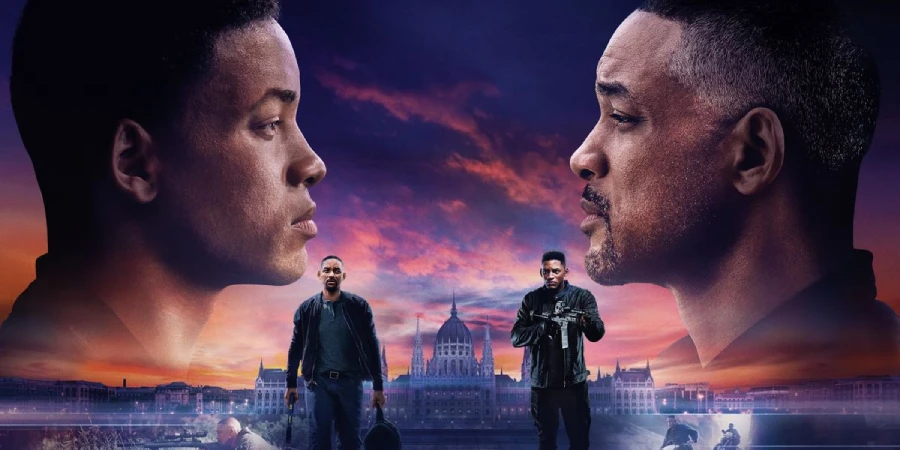

Imagine coming face to face with a younger, faster, deadlier version of yourself. Gemini Man (2019) puts that nightmare front and center, pitting a retiring assassin against a cloned duplicate engineered to replace him. Director Ang Lee wrapped this high-concept thriller in cutting-edge visual technology, sparking more conversation about frame rates than feelings. It is a film that promised everything and delivered something far more complicated.
Detailed Summary
Henry Brogan Pulls One Last Trigger
Henry Brogan, played by Will Smith, opens the film executing a target from an absurd distance while the man sits aboard a moving train in Belgium. Henry threads the bullet between two innocent passengers to eliminate his mark. It is a bravura sequence designed to establish him as the world’s greatest assassin.
However, Henry immediately begins doubting himself. He worries the shot nearly hit a civilian, and that nagging guilt signals that his edge is dulling. Consequently, he decides to retire.
A Retirement That Nobody Wants Him to Have
Henry retreats to Savannah, Georgia, where he meets Danny Zakarewski, played by Mary Elizabeth Winstead. She is a Defense Intelligence Agency operative assigned to surveil him, though she is clearly attracted to him almost immediately. Henry, sharp as ever, figures out her cover within their first conversation.
Meanwhile, Henry’s old contact Jack Willis reveals something troubling: the target Henry just killed was not a terrorist at all. He was a scientist who had discovered something dangerous about a program called Gemini. Shortly after sharing this information, Jack turns up dead.
The Hunt Begins in Budapest
Henry and Danny flee to Europe after a team of operatives attempts to kill them. They link up with Henry’s old friend Baron, played by Benedict Wong, who helps them navigate Budapest while government forces close in. Baron becomes a reliable and entertaining ally throughout the second act.
In Budapest, Henry faces his clone for the first time. Junior, also played by Will Smith via de-aging digital effects, attacks Henry in a stunning motorcycle chase through narrow European streets. The sequence is visceral and disorienting because Henry is essentially fighting his own reflexes.
Cartagena and the Clone Revealed
Henry and Danny track the conspiracy to Clay Verris, played by Clive Owen, the director of the private Gemini Project. Verris raised Junior as his own son, shielding the young clone from the truth of his origins. In contrast, Henry always knew something felt off about his own past, though he never suspected a clone existed.
The story moves to Cartagena, Colombia, where a confrontation in a catacombs sequence further develops the bond between Henry and Junior. Henry begins to recognize Junior’s pain. He chooses to speak to Junior rather than kill him, planting the first seed of doubt in the clone’s mind about his father figure, Verris.
Junior Learns the Truth
Verris eventually tells Junior the full truth: Junior is a clone of Henry, grown and trained to become the perfect soldier without Henry’s emotional baggage. For instance, Verris specifically engineered Junior to lack Henry’s trauma, guilt, and capacity for doubt. Junior, understandably, does not take this well.
Junior begins questioning everything Verris told him. His loyalty to his surrogate father starts to fracture. Henry, moreover, presses the advantage by showing Junior compassion instead of aggression.
A Second Clone and the Final Confrontation
Verris reveals a third layer to his scheme: he has created a new, even more advanced clone, this one designed to feel no pain and no empathy at all. This clone, wearing tactical gear and a mask, represents the endpoint of the Gemini Project, a soldier stripped of every human weakness. Henry, Danny, Baron, and Junior all join forces to stop Verris and neutralize this new threat.
The climax takes place at a facility where the fully combat-capable second clone attacks Henry ferociously. Junior ultimately kills the second clone himself, an act of self-determination that signals his break from Verris’s control entirely.


Movie Ending
Verris dies during the final confrontation; Junior shoots him after Verris makes one last attempt to manipulate him by insisting Junior exists only to serve a purpose. It is a moment of liberation dressed up as a tragedy. Junior pulls the trigger not in anger but in clarity, which carries real emotional weight.
Henry chooses not to hand Junior over to government custody. Instead, he advocates for Junior to live a normal life. A DIA official agrees to give Junior a clean identity, with the implication that Henry will mentor him going forward.
In the final scene, Junior enrolls at a college under a new name. Henry watches from a distance, clearly proud. Danny and Baron are present too, suggesting the group has formed an unlikely surrogate family. It is a warm, arguably too tidy conclusion for a film that spent most of its runtime in moral murkiness.
Audiences most often ask whether Junior survives, and the answer is yes, unambiguously. Furthermore, many wonder whether Junior and Henry will remain connected, and the film answers that question with a quiet smile rather than a dramatic declaration. It resolves things gently, which some viewers find satisfying and others find frustratingly soft for an action thriller.
Are There Post-Credits Scenes?
Gemini Man contains no post-credits scenes. Once the film ends, it ends cleanly. You can safely leave when the credits roll.
Type of Movie
This is an action thriller with science fiction undertones rooted in speculative bioethics. Its tone oscillates between slick blockbuster energy and quieter, more contemplative moments about identity and purpose. On the other hand, it never fully commits to being a serious philosophical drama, which leaves it straddling two modes throughout.
Ang Lee’s technical presentation at 120 frames per second in select theaters pushed the film into conversation about the future of cinema technology as much as storytelling. Genre-wise, it sits closest to the Bourne series in its grounded spy mechanics, with a science fiction concept borrowed from ethical debates about human cloning.
Cast
- Will Smith – Henry Brogan / Junior
- Mary Elizabeth Winstead – Danny Zakarewski
- Clive Owen – Clay Verris
- Benedict Wong – Baron
Film Music and Composer
Lorne Balfe composed the score for Gemini Man. Balfe is a prolific film and television composer known for his work on Mission: Impossible – Fallout and Black Hawk Down (as an additional music contributor). His work here leans into percussive tension and electronic textures suited to the action sequences.
Notably, the score supports the film’s identity themes without overplaying them. Balfe uses subtle melodic mirroring in sequences involving both Henrys, a compositional choice that reinforces their shared DNA without stating it bluntly.

Filming Locations
Production filmed primarily in Savannah, Georgia, which serves as Henry’s retirement haven and establishes a sense of quiet before everything explodes. Savannah’s Spanish moss, waterways, and Southern Gothic atmosphere give the film a distinctly American mood in its opening act.
Significant sequences also filmed in Cartagena, Colombia, and Budapest, Hungary. Cartagena’s dense architecture and colorful streets provide a vibrant backdrop for the underground confrontations. Budapest, in contrast, supplies the brooding European textures perfect for a chase through narrow city streets at night.
Additionally, scenes filmed at Tbilisi, Georgia (the country), lending further international scope to the globe-trotting narrative.
Awards and Nominations
Gemini Man received a Visual Effects Society nomination recognizing the digital de-aging work used to create Junior. The film’s primary awards attention centered on its technical achievements rather than its performances or screenplay.
Behind the Scenes Insights
- The project spent roughly 20 years in development hell before Ang Lee finally brought it to production, cycling through numerous directors and scripts.
- Ang Lee shot the film at 120 frames per second in 4K 3D for select theaters, continuing his interest in high frame rate filmmaking after Billy Lynn’s Long Halftime Walk.
- Creating Junior required an entirely new digital pipeline; the team at Weta Digital built a photoreal digital human face based on Will Smith’s younger likeness from archival footage and reference material.
- Will Smith stated in interviews that he found acting opposite himself deeply strange and that the dual performance demanded unusual concentration.
- The Budapest motorcycle chase involved genuine stunt work combined with digital enhancement, and Ang Lee reportedly spent significant time choreographing it as a kind of mirror-image ballet.
- Production faced the challenge that no cinema technology infrastructure existed to fully support 120fps projection at scale, limiting the immersive experience to a very small number of theaters worldwide.
Inspirations and References
Screenwriter Darko Lundy originally conceived the script in the late 1990s, drawing on then-current anxieties about human cloning following the famous cloning of Dolly the sheep in 1996. The film taps into a broader science fiction tradition of identity horror rooted in doubles and doppelgangers.
Thematically, Gemini Man echoes older philosophical questions about nature versus nurture, specifically whether a person’s moral character results from genetics or lived experience. In addition, it references the military-industrial complex’s appetite for optimizing the human soldier, a theme present across many Cold War-era espionage narratives.
Alternate Endings and Deleted Scenes
No officially confirmed alternate endings or notable deleted scenes have been publicly released for Gemini Man. Ang Lee and the production team have not released a director’s cut or extended version as of this writing. Consequently, the theatrical cut remains the only widely available version of the film.
Book Adaptations and Differences
Gemini Man is not based on a book, novel, or pre-existing intellectual property. Its screenplay originated as an original spec script. Therefore, no source material comparison applies here.


Memorable Scenes and Quotes
Key Scenes
- The Opening Train Kill: Henry eliminates a target from over a kilometer away while the train moves, threading the shot past civilians in a display of almost supernatural precision.
- The Budapest Motorcycle Chase: Junior pursues Henry through narrow streets, and the fight escalates to close-quarters combat where Henry realizes he is fighting someone who anticipates his every instinct.
- The Catacombs Confrontation in Cartagena: Henry chooses to speak to Junior rather than kill him, a pivotal scene where the film shifts from pure action into its core emotional argument.
- Junior Kills the Masked Clone: A brutal and fast fight sequence that doubles as Junior’s symbolic rejection of everything Verris built him to be.
- Junior Shoots Verris: A quiet, devastating beat where Junior ends his relationship with his surrogate father by pulling the trigger, acting entirely on his own terms for the first time.
Iconic Quotes
- “I know every move you’re gonna make before you make it.” (Junior to Henry, reflecting their shared instincts)
- “He doesn’t have your pain. He doesn’t have your memories. He’s you, but without the things that made you weak.” (Verris to Henry, explaining the logic behind Junior)
- “You deserve a life.” (Henry to Junior, the emotional thesis of the entire film in four words)
Easter Eggs and Hidden Details
- The project’s name, Gemini, directly references the zodiac twins, a subtle thematic label that frames Henry and Junior as two halves of a whole rather than original and copy.
- Henry’s retirement location in Savannah mirrors the real-world tendency of intelligence operatives to favor Southern coastal towns, a small but grounded nod to genuine tradecraft culture.
- Junior’s combat style in the motorcycle chase mirrors Henry’s exactly but executes at higher speed, a visual cue reinforcing that Junior was engineered to be a faster, fresher version without any hesitation built up from years of guilt.
- Baron’s base of operations has photographs and trinkets on the walls suggesting a long career in off-books military work, quietly fleshing out his backstory without a single line of expository dialogue.
- Verris wears consistently muted, institutional colors throughout the film, a costuming choice that subtly aligns him with bureaucratic coldness rather than personal menace.
Trivia
- The script circulated in Hollywood for roughly two decades, attracting interest from directors including Tony Scott and Curtis Hanson at various points before Ang Lee took it on.
- Will Smith plays two roles in the film, requiring him to essentially act against himself in post-production for many key scenes.
- Weta Digital, the visual effects company behind the Lord of the Rings trilogy, handled the digital de-aging and photoreal face work for Junior.
- At its widest release, only a handful of theaters globally could project the film at its full 120fps 4K 3D specification, meaning most audiences saw a standard version that missed Ang Lee’s intended visual experience.
- The film grossed approximately 173 million dollars worldwide against a production budget reported at around 138 million dollars, making it a modest commercial disappointment when accounting for marketing costs.
- Ang Lee described the digital human work on Junior as the single most complex visual effects challenge he had ever undertaken as a director.
Why Watch?
Gemini Man offers a genuinely striking central performance from Will Smith, who brings warmth and melancholy to both versions of his character. Its action sequences are crisp and inventive, and the cloning premise generates real emotional stakes rather than just plot mechanics. For fans of high-concept thrillers willing to forgive an overly tidy ending, it rewards patient viewing.
Director’s Other Movies
- Sense and Sensibility (1995)
- The Ice Storm (1997)
- Crouching Tiger, Hidden Dragon (2000)
- Hulk (2003)
- Brokeback Mountain (2005)
- Life of Pi (2012)
- Billy Lynn’s Long Halftime Walk (2016)