Akira Kurosawa’s High and Low pulls off something genuinely audacious: it splits itself in half, transforms its own genre midway through, and still lands as one of the most gripping crime films ever made. A wealthy industrialist must decide whether to sacrifice his entire fortune to save a child he has no obligation to protect. That moral gut-punch arrives in the first act, and the film never lets you breathe after it. Kurosawa treats suspense not as a genre trick but as a philosophical weapon.
Detailed Summary
A Kidnapping Gone Wrong
High and Low opens inside the lavish hilltop home of Kingo Gondo, a senior executive at National Shoes. He is in the middle of a bold financial play, secretly borrowing money to buy a controlling stake in the company before his rivals can push him out.
Then the phone rings. A kidnapper claims to have snatched Gondo’s young son and demands a ransom of 30 million yen. Moments later, Gondo’s son walks in from the garden, completely unharmed. However, the kidnapper’s plan went wrong: he accidentally took Shinichi, the son of Gondo’s chauffeur, instead.
The Impossible Moral Choice
Gondo faces a brutal dilemma. Paying the ransom would destroy him financially, wiping out his leveraged investment and his career. Meanwhile, the child at risk is not even his own.
Police detectives, led by Inspector Tokura, gather in Gondo’s home and urge him to cooperate with their investigation. Gondo initially refuses to pay, reasoning that the kidnapper made his own mistake. His position is cold and logical, yet the film makes sure you understand exactly what it costs him to hold it.
Consequently, the moral pressure in that single room becomes almost unbearable. Gondo’s wife pleads with him. His chauffeur says nothing but stares. In the end, Gondo relents and agrees to pay the full ransom.
The Ransom Handoff on the Bullet Train
The delivery sequence ranks among the most technically inventive set pieces in Kurosawa’s filmography. Gondo must throw two briefcases of cash from a moving express train at a precise moment, while detectives observe and photograph everything they can.
Kurosawa shoots the sequence with multiple cameras and suffocating precision. The briefcases tumble out, the kidnapper’s contact retrieves them below, and the police gather fragments of evidence without making an arrest. Shinichi returns home safely after the drop.
Gondo’s Ruin and the Investigation Begins
With the ransom paid, Gondo loses everything. His rivals complete their takeover of National Shoes, and he faces the prospect of starting from zero. For a brief stretch, High and Low almost feels like a tragedy about a man destroyed by his own decency.
Then the film pivots sharply. The second half belongs entirely to the police. Inspector Tokura and his team pick apart every clue from the train sequence and begin a meticulous, procedural hunt for the kidnapper.
Tracking the Kidnapper Through Yokohama’s Underworld
Detectives trace a distinctive smell on the child’s clothes to a rare compound found in Yokohama’s red-light district. This clue pulls the investigation down from Gondo’s hilltop mansion into the city’s sweltering, neon-lit streets below.
The contrast is stark and intentional. Kurosawa shoots the slums and drug dens with a rawness that makes Gondo’s living room feel like it belongs to another planet. In addition, the pacing shifts from chamber drama to street-level procedural, and both modes feel completely authentic.
Police work closes in on a young medical intern named Ginjiro Takeuchi. He is methodical, intelligent, and utterly without remorse. Investigators discover he has been selling heroin and using two accomplices, whom he eventually kills to eliminate witnesses.
Takeuchi Identified and Arrested
Police set a trap using marked bills from the ransom and surveillance across Yokohama’s drug network. Takeuchi walks into it almost carelessly, as if some part of him welcomes the confrontation.
His arrest feels less like a triumph and more like the completion of a dark circuit. Furthermore, detectives realize he committed the kidnapping not out of financial desperation but out of pure, corrosive envy toward Gondo, whose house Takeuchi could see from his miserable apartment below.
Movie Ending
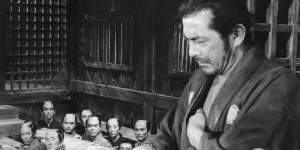
Takeuchi faces trial, receives a death sentence, and requests one final meeting with Gondo. This encounter forms the emotional and thematic climax of the entire film. Gondo agrees to see him, though nobody in the audience, or in the film, quite knows why.
In the prison visiting room, the two men sit on opposite sides of a glass partition. Takeuchi initially projects contempt and ideological defiance, insisting that Gondo’s wealth and elevated life provoked everything. He wanted to punish Gondo simply for existing comfortably above him.
Gradually, however, Takeuchi’s composure cracks. As guards come to take him to his execution, genuine fear floods his face. The mask of bitter philosophy falls away completely, and what remains is a terrified young man facing death.
Kurosawa ends on that image of the glass partition descending between them, reflecting both men’s faces onto each other. It is a visual metaphor of stunning economy: the high and the low, momentarily merged in the same reflection, then separated forever as the divider closes.
On one level it is a crime film resolution; on another it is Kurosawa’s most direct statement about class, envy, and the invisible walls society builds between people. Notably, Gondo does not gloat, does not mourn, and does not forgive. He simply witnesses. That restraint makes the ending more devastating than any dramatic speech could.
Are There Post-Credits Scenes?
High and Low contains no post-credits scenes. The film ends decisively with the prison confrontation, and Kurosawa adds nothing after the credits roll. For a 1963 film, that is entirely expected; the concept of post-credits scenes did not exist in this era of cinema.
Type of Movie
High and Low operates as a crime thriller with deep roots in social realism and moral drama. Its first half reads almost like a stage play, claustrophobic and dialogue-driven. Its second half pivots into police procedural territory with documentary-like precision.
In contrast to most genre thrillers, the film refuses to simplify its characters into heroes and villains. Tone-wise, it is cool, controlled, and relentlessly serious, with occasional flashes of dark irony.
Cast
- Toshiro Mifune – Kingo Gondo
- Tatsuya Nakadai – Inspector Tokura
- Kyoko Kagawa – Reiko Gondo, Kingo’s wife
- Tsutomu Yamazaki – Ginjiro Takeuchi
- Yutaka Sada – Aoki, the chauffeur
- Takashi Shimura – Police chief
- Kenjiro Ishiyama – Detective Bos’n
- Tatsuya Mihashi – Kawanishi, Gondo’s secretary
Film Music and Composer
Masaru Sato composed the score for High and Low, continuing his regular collaboration with Kurosawa during this period. Sato’s work here is notably restrained, often pulling back entirely to let silence and ambient sound carry scenes.
The music grows more jagged and unsettling as the investigation descends into Yokohama’s underworld. Jazz-inflected cues appear in the nightclub sequences, grounding the film in a specific social texture while amplifying its moral unease.
Filming Locations
Production took place primarily in and around Yokohama and Tokyo, Japan. Kurosawa and his team used real Yokohama locations for the second half’s street sequences, including the city’s entertainment and drug-trafficking districts.
Gondo’s hillside home, with its commanding view over the city below, is central to the film’s visual argument. Takeuchi can literally see that house from his cramped apartment, and Kurosawa makes sure the audience feels that geographic and social distance as something physical. The Tokaido express train appears in a key sequence, and Kurosawa filmed on the actual moving train with multiple cameras simultaneously.
Awards and Nominations
High and Low won several Mainichi Film Awards in Japan, including recognition for its screenplay. It also performed strongly at the Blue Ribbon Awards, which were among Japan’s most prestigious film honors at the time. Internationally, critics and festivals embraced it as a major work, though it did not compete at the major Western festivals of its release year.
Behind the Scenes Insights
- Kurosawa used multiple cameras simultaneously during the bullet train sequence, a technique he favored for capturing spontaneous, unrepeatable action.
- Toshiro Mifune reportedly threw himself into the physical and emotional stillness required for Gondo’s internal conflict, a marked contrast to his more explosive roles in Kurosawa’s samurai films.
- Kurosawa insisted on shooting the second half of the film in authentic Yokohama locations rather than studio sets, to create a documentary texture that contrasted sharply with the controlled first half.
- The film required extensive coordination with Japanese rail authorities to film aboard the actual Tokaido express service.
- Tsutomu Yamazaki, cast as Takeuchi, was still relatively early in his career at the time; Kurosawa’s casting proved remarkably astute, as Yamazaki became one of Japan’s most respected actors.
- Kurosawa designed the widescreen compositions in Gondo’s living room to visually trap characters, using the wide frame to emphasize confinement rather than freedom.
Inspirations and References
High and Low is based on King’s Ransom, a 1959 novel by Ed McBain (the pen name of Evan Hunter), part of his celebrated 87th Precinct series. McBain’s novel supplied the central kidnapping premise and the police procedural structure.
Kurosawa and his co-writers, however, transplanted the story entirely into a Japanese social context. They sharpened the class critique considerably beyond McBain’s source material, making Takeuchi’s envy of Gondo’s hilltop life the ideological engine of the entire film.
Alternate Endings and Deleted Scenes
No well-documented alternate endings or significant deleted scenes from High and Low have entered the public record. Kurosawa was famously rigorous in his pre-production scripting, often leaving little room for major variations during shooting.
Some production materials suggest Kurosawa considered extending the investigation sequences further, but specific deleted footage has not been confirmed or officially released in any home video edition.
Book Adaptations and Differences
As noted above, the film adapts Ed McBain’s King’s Ransom. In McBain’s novel, the story stays closer to a straightforward crime procedural without the intense class-warfare subtext that Kurosawa foregrounded. McBain’s setting is an American city with American social dynamics, while Kurosawa relocated everything to postwar Japan with deliberate thematic intent.
Kurosawa also elevated Gondo’s moral crisis to the center of the narrative far more than McBain did. Furthermore, the prison confrontation at the end is largely Kurosawa’s own invention and represents his most significant departure from the source novel.
Memorable Scenes and Quotes
Key Scenes
- Gondo’s agonizing decision in his living room, as police, family, and the chauffeur all wait for him to choose between his fortune and a child’s life.
- The bullet train ransom drop, filmed aboard the actual moving train with extraordinary kinetic precision.
- Detectives eating in the police station while interrogating witnesses, a long, procedural sequence that makes investigative work feel both unglamorous and genuinely suspenseful.
- The descent into Yokohama’s underworld drug dens, shot with an almost ethnographic intensity.
- Takeuchi’s face crumbling in the prison visiting room as the reality of his execution closes in.
- The final image of the glass partition descending, merging and then separating the two men’s reflections.
Iconic Quotes
- “I started hating that house. I’d lie in my sweltering room and stare up at it. I kept thinking, why should he live like a king up there while I sweat it out down here?” (Takeuchi, explaining his motive)
- “If I pay, I’m ruined. If I don’t pay, I’ll be haunted by it for the rest of my life.” (Gondo, on his impossible choice)
Easter Eggs and Hidden Details
- Kurosawa used a rare moment of color in an otherwise black-and-white film: a single puff of pink smoke from the train, marking the ransom drop point. This brief color insert is one of the earliest uses of selective color in Japanese cinema.
- Gondo’s house sits visibly on the hill in background shots throughout the second half, a persistent visual reminder of the class divide even during street-level scenes.
- Several background extras in the Yokohama nightclub sequences appear to be actual patrons rather than cast extras, giving those scenes an unscripted, documentary quality.
- Kurosawa frames Gondo’s living room windows so that the city below is always visible, functioning as a silent, recurring symbol of everything Takeuchi sees and resents.
- The briefcases used in the ransom drop sequence were reportedly designed to fall and open in a specific way on camera; the production team rehearsed the drop mechanics extensively before the actual train filming.
Trivia
- High and Low is known in Japan as Tengoku to Jigoku, which translates literally as Heaven and Hell, a title that makes the class metaphor even more explicit than the English release title.
- It was one of the most expensive Japanese productions of its time, largely due to the logistical demands of filming on a moving bullet train.
- Toshiro Mifune appears almost exclusively in the first half of the film; once the investigation begins, he largely exits the story, a bold structural choice for a star of his magnitude.
- Ed McBain reportedly admired what Kurosawa did with his source novel and expressed respect for the adaptation publicly.
- Kurosawa co-wrote the screenplay with Hideo Oguni, Ryuzo Kikushima, and Eijiro Hisaita, a collaborative writing approach he used throughout much of his career.
- At nearly two and a half hours, the film sustains its tension without a single sequence that feels like padding, which critics frequently cite as a mark of its mastery.
Why Watch?
High and Low delivers a masterclass in structural storytelling, moral complexity, and visual intelligence, all wrapped inside a crime thriller that moves with the efficiency of a Swiss watch. Kurosawa takes a simple ransom plot and transforms it into a meditation on class, guilt, and the architecture of society itself. Few films before or since have managed to be this gripping and this genuinely thought-provoking at the same time.
Director’s Other Movies
- Rashomon (1950)
- Ikiru (1952)
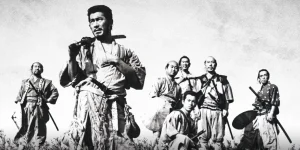
- Seven Samurai (1954)
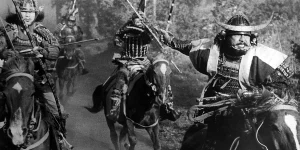
- Throne of Blood (1957)
- The Hidden Fortress (1958)
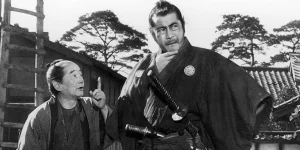
- Yojimbo (1961)
- Sanjuro (1962)
- Red Beard (1965)
- Kagemusha (1980)
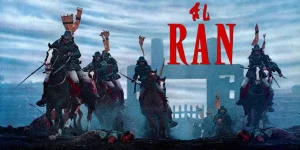
- Ran (1985)