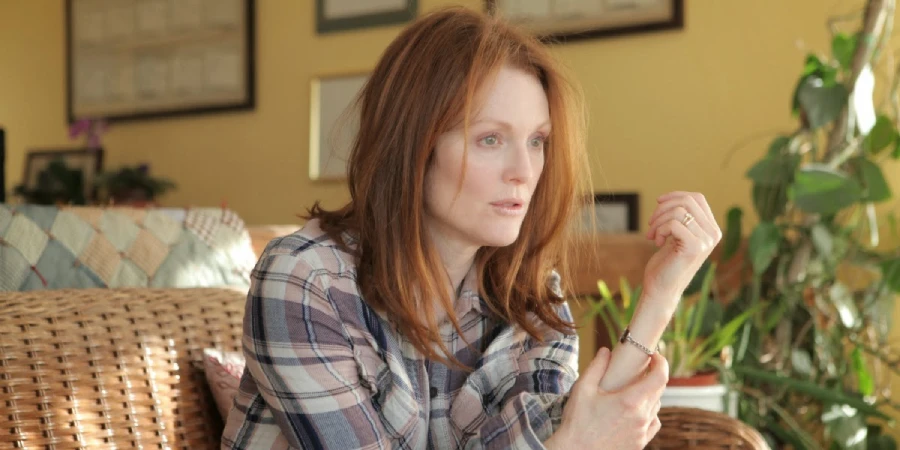

Julianne Moore won an Oscar for playing a woman who cannot remember winning an Oscar. That sentence alone tells you something about the strange, recursive cruelty at the center of Still Alice. Directors Richard Glatzer and Wash Westmoreland strip away every comfort blanket a Hollywood film usually offers, and what remains is fifty-year-old Alice Howland losing her mind one word at a time, right in front of us.
Detailed Summary
Alice at the Top of Her World
We meet Alice Howland (Julianne Moore) as a celebrated linguistics professor at Columbia University, celebrating her fiftieth birthday surrounded by her successful family. She is sharp, articulate, and professionally admired. Her husband John (Alec Baldwin) is also a scientist, equally career-driven.
Their three adult children sketch the family’s emotional geography immediately. Anna (Kate Bosworth) is polished and dutiful. Tom (Hunter Parrish) is warm but peripheral. Lydia (Kristen Stewart) is the artistic outlier, pursuing acting in Los Angeles against her mother’s quiet disapproval.
The First Signs Something Is Wrong
Alice forgets a word mid-lecture. It is just one word, but for a linguist, that single gap is catastrophic. She brushes it off, and so do we, at first.
She goes jogging on a familiar campus path and gets completely, genuinely lost. Moore plays this scene without theatrical panic; her face cycles through confusion, then a fragile attempt at reassurance, then naked fear. It is one of the most quietly devastating setups in the film.
The Diagnosis
Alice visits a neurologist and takes cognitive tests. She fails portions she should ace. After further evaluation, she receives a diagnosis of early-onset familial Alzheimer’s disease, at age fifty.
Her particular form carries a genetic mutation, meaning each of her children has a fifty percent chance of carrying it. This fact shifts the film from a personal tragedy into a family-wide reckoning.
Telling the Family
Alice and John tell their children together. Anna, already pregnant and terrified about inheritance, gets tested and discovers she carries the gene. Tom chooses not to be tested. Lydia, characteristically, focuses on her mother rather than her own risk.
Anna’s storyline threatens to become a subplot that dilutes Alice’s focus, and the film wisely keeps it at arm’s length. We see Anna process it, but the camera always returns to Moore.
Managing and Declining
Alice creates compensatory systems: phone reminders, daily questions she asks herself to measure her own decline. She gives a publicly brave speech at an Alzheimer’s Association event, calling herself a person who still lives fully inside the disease. It is her finest public moment in the film, and Moore delivers it with a slight quiver in her chin that keeps the whole thing from tipping into sentimentality.
John receives a career opportunity in Minnesota. He wants to take it. Alice cannot easily relocate, because familiarity is now a survival tool for her. Their marriage quietly fractures around this decision, and Baldwin plays John as a man who loves his wife but keeps reaching for the exit. That is not a flattering read of the character, and I think the film intends it that way.
The Butterfly Video
In one of the film’s most structurally clever moments, Alice records a video of herself on her laptop for her future self. She leaves instructions leading to a bottle of sleeping pills hidden in her desk drawer, along with a note telling her future self to swallow them all. She calls it her plan for when things get bad enough.
She then forgets she made it. Later, a much more deteriorated Alice finds the video, follows the instructions, locates the pills, and nearly takes them before a caregiver interrupts. The scene is not played as a horror moment; it is played as a sad inevitability that does not even complete itself. That ambiguity about whether the interrupted attempt was a rescue or a cruelty is the film’s darkest question.
Lydia Steps Up
As John moves to Minnesota for his position, Lydia moves in with Alice to become her primary caregiver. This is the emotional payoff of their earlier conflict. Lydia, whom Alice once pressured to pursue academia rather than acting, becomes the one child who actually stays.
Their relationship in these final scenes is the best work Kristen Stewart does in the film. She listens to Alice read aloud from a script, and there is a tenderness between them that earns every minute of groundwork laid earlier.


Movie Ending
Alice, in an advanced state of decline, sits with Lydia. Lydia reads to her from a script of Angels in America, a play Alice once dismissed as insufficient compared to academic work. Alice listens, and something registers. Lydia asks her what the passage was about. Alice struggles, searches, and produces one word: love.
It is not a cure. It is not a revelation. It is one fragile word surfacing through the wreckage, and the film ends on Moore’s face processing that word as if it arrived from somewhere very far away. Some audiences read this as hopeful. I read it as devastating, because “love” is the last word the disease cannot immediately erase, and the film offers us no certainty that it will stay.
John is largely absent by this point. Lydia holds Alice’s world together with patience that the film presents honestly, without making Lydia a saint. Alice herself exists in flashes now, present for seconds and then gone. Moore’s physicality has changed across the runtime: her posture is softer, her gaze slightly unfocused, her speech slower and more deliberate. She does not perform decline; she inhabits it incrementally.
Are There Post-Credits Scenes?
Still Alice has no post-credits scene. After the final image of Alice’s face, the film simply ends. Sit with it.
Type of Movie
Still Alice is a drama, specifically a medical family drama with strong character-study elements. Its tone is restrained, intimate, and largely unsentimental, which distinguishes it from more conventional disease-of-the-week films.
There are no villains, no melodramatic breakdowns played for tears, and no false recoveries. It is closer in spirit to a literary novel than to a Lifetime movie, which is both its strength and the reason it drew such a specific, devoted audience.
Cast
- Julianne Moore – Alice Howland
- Alec Baldwin – John Howland
- Kristen Stewart – Lydia Howland
- Kate Bosworth – Anna Howland
- Hunter Parrish – Tom Howland
- Shane McRae – Charlie
Film Music and Composer
The score was composed by Ilan Eshkeri, a British composer known for his chamber-scale emotional work. He keeps the music sparse throughout, favoring strings and piano, and wisely refuses to underscore every scene with telegraphed emotion.
Several scenes that could invite swelling orchestration instead play almost in silence, with ambient sound doing the work. That restraint is the right call, and it is one of the most underrated elements of the film’s craft. Eshkeri’s score amplifies rather than announces.


Filming Locations
Still Alice shot primarily in New York City, using Columbia University’s campus and surrounding neighborhoods to ground Alice’s world in a place of intellectual prestige and personal history. Familiarity matters enormously in this story; Alice’s terror at getting lost on her own jogging route hits harder because we see how recognizable that campus should be.
Some scenes were shot in residential New York neighborhoods to capture the domestic texture of Alice’s life outside academia. The locations never feel like backdrop; they function as markers of a world Alice is slowly losing access to.
Awards and Nominations
Julianne Moore won the Academy Award for Best Actress for her performance. She also won the BAFTA Award for Best Actress, the Screen Actors Guild Award for Outstanding Performance by a Female Actor in a Leading Role, and the Golden Globe Award for Best Actress in a Drama.
The film received additional awards recognition in various critics’ circles. Moore’s sweep across the major awards season was one of the most clear-cut consensus wins in recent memory, which is worth noting because the film itself was not widely seen until the campaign began.
Behind the Scenes Insights
- Co-director Richard Glatzer was himself living with ALS during production, communicating with cast and crew using an iPad because the disease had taken his speech. That fact reframes every decision on set as an act of extraordinary will.
- Julianne Moore spent significant time with Alzheimer’s patients and researchers to understand the specific behavioral and cognitive patterns of early-onset disease rather than generic dementia.
- Glatzer passed away in March 2015, shortly after the film’s awards season concluded. He did see Moore win the Oscar.
- Kristen Stewart reportedly took a pay cut to appear in the film, prioritizing the material over the paycheck.
- The film was shot on a modest budget, and that compression actually serves the story; small crews and intimate setups kept the atmosphere close and personal rather than cinematic in a showy way.
Inspirations and References
The film adapts Lisa Genova‘s 2007 novel of the same name. Genova, who holds a doctorate in neuroscience from Harvard, self-published the book before it found mainstream publication. Her scientific background gives the source material an accuracy that many fictional disease narratives skip entirely.
Genova has spoken about wanting to put a human face on Alzheimer’s by placing it inside a woman at the height of her intellectual powers. That conceptual foundation is what the filmmakers preserved most faithfully.
Alternate Endings and Deleted Scenes
No alternate endings or significant deleted scenes from Still Alice have been publicly detailed or released. Given the film’s tight, literary structure, the ending appears to have been close to the book’s conclusion from the start. No known cut sequences have surfaced in press materials or interviews.
Book Adaptations and Differences
The film follows Lisa Genova’s novel closely in its major beats. Alice’s diagnosis, the genetic revelation, the butterfly video plan, and Lydia’s emergence as the primary emotional anchor all come directly from the book.
One meaningful compression involves John’s character. The novel gives him more interior complexity and depicts his emotional unavailability with more nuance. In the film, Baldwin’s John reads a shade colder, partly because the screenplay keeps the camera fixed on Alice’s perspective and has less room to excavate everyone else.
Lydia’s storyline in the book is also more fully developed, including more detail about her acting work and its meaning. The film trusts Stewart’s presence to carry what the prose explains at length, and largely, that trust pays off.


Memorable Scenes and Quotes
Key Scenes
- Alice getting lost on her own jogging route on Columbia’s campus, turning in place while the camera holds steady and the background stays utterly familiar to us if not to her.
- Alice recording the butterfly video on her laptop, calm and methodical, speaking to a version of herself she cannot yet imagine becoming.
- Alice’s speech at the Alzheimer’s Association event, delivered with controlled composure and one visible crack in her voice at exactly the right moment.
- The scene where Alice searches desperately for the bathroom in her own home, a small failure that Moore plays as a private collapse she refuses to let anyone witness.
- The final scene: Lydia reading from Angels in America and Alice producing the word “love,” her face tilted upward as if the word had weight and light at once.
Iconic Quotes
- “I wish I had cancer.” Alice says this to John, and it is the most ferociously honest line in the film. Cancer, she explains, does not carry the stigma or the particular shame of losing your mind.
- “I’m not suffering. I’m struggling. Struggling to be a part of things, to stay connected to who I once was.” From her Alzheimer’s Association speech, this line articulates the film’s entire argument about personhood and disease.
- “Live in the moment.” Lydia says this to Alice late in the film, gently, and the line lands differently than any motivational poster version of it because here it is not a choice; it is Alice’s only available mode of existence.
Easter Eggs and Hidden Details
- Alice’s daily cognitive self-test on her phone uses words like “lemon,” “arm,” and “apartment.” These words reappear throughout the film, quietly marking how her retention of them erodes over time.
- The butterfly motif, embedded in the title of Alice’s video plan, connects to a broader symbolic thread about metamorphosis and impermanence that runs through the Angels in America text Lydia reads at the end.
- Alice’s wardrobe shifts subtly across the film, from crisp professional blazers and structured clothing in early scenes to softer, looser garments as her disease progresses. Costume designer Michelle Matland built this arc deliberately.
- In early scenes, Alice corrects other characters’ word choices with precision. Pay attention to how those moments disappear completely in the second half without the film ever announcing the absence.
Trivia
- Julianne Moore was the first actor to win an Oscar, BAFTA, SAG Award, and Golden Globe for the same performance in a single season, making her sweep particularly historic.
- Lisa Genova originally self-published Still Alice in 2007 after traditional publishers passed on it. It later became a New York Times bestseller before the film brought it to an even wider audience.
- Richard Glatzer and Wash Westmoreland were a married couple as well as a directing team. Their personal partnership informed how they handled the intimacy of caregiving in the film.
- Kristen Stewart’s performance received its own awards recognition and is widely considered one of her best dramatic turns, a reassessment that helped reshape critical opinion of her post-Twilight career.
- The film’s relatively short runtime keeps it from lingering on decline for its own sake; every scene earns its place by advancing either Alice’s deterioration or the family’s fracturing response to it.
Why Watch?
Julianne Moore physically changes her posture, her eye focus, and her speech rhythms across the runtime in ways that no single scene announces but that you feel accumulating scene by scene. That incremental physical precision, not the diagnosis or the family drama, is what makes the film worth your time. You are watching one of the most technically disciplined performances in contemporary American cinema, built from the inside out.
Director’s Other Movies
- Wash West (1998)
- The Fluffer (2001)
- Quinceañera (2006)
- I Am Michael (2015)
- Colette (2018)
Recommended Films for Fans
- Away from Her (2006)
- Amour (2012)
- Nebraska (2013)
- The Savages (2007)
- Gloria Bell (2018)
- On Golden Pond (1981)