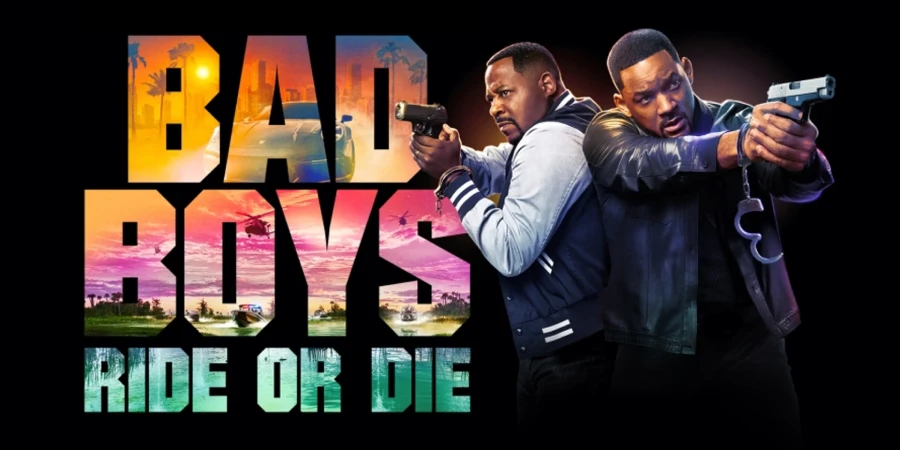

Will Smith’s heart attack mid-wedding is not the setup you expect from a movie that opens with champagne and a church full of Miami’s finest. Bad Boys: Ride or Die uses that cardiac episode as a narrative skeleton key, locking Mike Burnett into a story where his near-death either makes him invincible or untouchable, and the film never fully decides which.
Directors Adil El Arbi and Bilall Fallah keep the camera close to sweaty faces and loud suits, doubling down on the style that made Bad Boys for Life a surprise hit. This fourth installment is messier and more chaotic than its predecessor, and honestly, sometimes that works in its favor.
Detailed Summary
Mike’s Wedding and the Heart Attack
Mike Lowrey (Will Smith) marries Christine (Melanie Liburd) in a lavish ceremony at the start of the film. During the reception, Mike collapses from a cardiac event. Paramedics rush him out while Marcus Burnett (Martin Lawrence) watches in stunned silence.
Mike survives, but the experience rattles something loose in him. He becomes convinced he cannot die, a psychological shield that bleeds into every reckless decision he makes for the rest of the film.
Captain Howard’s Posthumous Accusation
A conspiracy surfaces connecting the late Captain Howard to a cartel. Fabricated digital evidence frames Howard as having worked with drug lord Armando Armas. Mike and Marcus refuse to accept that their mentor was dirty.
Internal affairs and federal investigators begin building a case. Corrupt officials, we learn, planted the false trail deliberately to cover their own tracks. Mike and Marcus quickly become targets themselves when they start pushing back.
Armando Armas Returns
Mike’s son Armando (Jacob Scipio), introduced in the previous film as a cartel assassin, resurfaces here. He is in federal custody but gets pulled into the chaos when the corrupt network tries to silence him permanently.
Armando escapes custody during a brutal attack. He teams up reluctantly with Mike and Marcus, giving the film its most interesting dynamic: a father and son who barely know each other forced to trust each other under fire.
The Corrupt Network Closes In
James McGrath (Eric Dane), a high-ranking official, turns out to be the central villain orchestrating the smear campaign against Howard. McGrath has allies inside law enforcement feeding him information in real time.
Mike and Marcus go off the grid. AMMO, their tech-support team, gets cut off from official channels. Rita (Paola Nunez) works quietly from the inside to keep the boys connected while managing blowback from her superiors.
The Everglades Chase and the Alligator Pit
One of the film’s wilder set pieces drops Marcus into a Florida swamp surrounded by alligators. It is played partly for laughs and partly for genuine tension, and it works better than it deserves to.
Mike arrives just in time, blasting his way through the sequence with the kind of gleeful excess that defines the franchise. Marcus spends most of the scene screaming, which is exactly what Martin Lawrence does best.
Infiltrating the Villain’s Base
Mike, Marcus, and Armando converge on McGrath’s heavily fortified operation. A shootout inside a crumbling industrial facility gives the film its longest sustained action sequence. Adil and Bilall shoot it with wide lenses and aggressive cutting, and it hits hard.
Armando proves himself here, covering Mike in a moment that costs him physically. Father and son finally move like a unit instead of two strangers sharing screen time.
Movie Ending
McGrath gets cornered in the final confrontation, and Mike puts him down with a directness the film earns. There is no extended monologue, no drawn-out negotiation. A corrupt official dies for what he did to Howard’s legacy.
The fabricated evidence against Howard gets officially discredited. A formal ceremony restores his reputation, giving Marcus and Mike the emotional closure the film has been building toward since the opening act. Lawrence plays the scene quietly, and it lands harder than most of the gunfights.
Mike’s post-near-death recklessness gets addressed, at least partially. Christine confronts him about it, and Smith plays the vulnerability in that scene without playing for sympathy. It is one of his better moments in the franchise.
Armando’s fate is left deliberately open. He does not return to custody, nor does he ride off clean. Instead, he exists in a moral grey zone that sets up a potential spinoff or fifth installment without demanding one.
Are There Post-Credits Scenes?
Bad Boys: Ride or Die does not include a post-credits scene. You can leave when the credits roll. No teasers, no bonus footage, no setup for a sequel hidden at the end.
Type of Movie
This is a buddy-cop action comedy with franchise blockbuster DNA. Expect car chases, shootouts, and broad humor sitting right next to genuine dramatic beats.
Tonally, the film swings between frenetic action and warm character comedy. It never fully commits to being a serious crime thriller, which is exactly the right call for a fourth entry in this particular series.
Cast
- Will Smith – Mike Lowrey
- Martin Lawrence – Marcus Burnett
- Jacob Scipio – Armando Armas
- Joe Pantoliano – Captain Howard (via recordings/flashbacks)
- Eric Dane – James McGrath
- Paola Nunez – Rita Secada
- Vanessa Hudgens – Kelly
- Alexander Ludwig – Dorn
- Melanie Liburd – Christine
- Ioan Gruffudd – Lockwood
Film Music and Composer
Lorne Balfe composed the score. Balfe has a long resume of high-octane franchise work, including entries in the Mission: Impossible series and Black Adam. His approach here leans percussive and relentless, matching the film’s pace rather than shaping it.
The score does not try to be art. It functions as fuel, pushing scenes forward and filling the silence between explosions. For this kind of film, that is the correct brief.
Hip-hop and Miami bass tracks fill the soundtrack alongside Balfe’s orchestral work. The blend keeps the movie feeling culturally rooted in South Florida even when the plot drags it across the state.
Filming Locations
Production filmed primarily in Atlanta, Georgia, with additional work in Miami, Florida. Atlanta doubles for many of the interior and industrial locations. Miami supplies the exteriors, the light, and the visual identity that makes the franchise feel like a product of its city.
Shooting in Atlanta gave the production access to large studio infrastructure while keeping costs manageable. Miami remained essential for authenticity; you cannot fake that flat, white-sky humidity, and the film knows it.
The Everglades sequences add a genuinely Florida texture. Using real swamp environments instead of a backlot set gives those scenes a tactile danger that a green-screen version would have drained completely.
Awards and Nominations
Bad Boys: Ride or Die did not receive significant awards attention from major bodies. It performed commercially but sat outside the awards conversation entirely, which surprised no one.
Behind the Scenes Insights
- Directors Adil El Arbi and Bilall Fallah returned from Bad Boys for Life, giving the film visual and tonal continuity.
- Will Smith’s return marked his first major theatrical release after the 2022 Academy Awards incident, which generated substantial media attention around the film’s release.
- Martin Lawrence reportedly pushed for more comedic material for Marcus, and several scenes were adjusted during production to expand his comedic beats.
- Jacob Scipio trained extensively to prepare for the expanded physical demands placed on Armando in this installment.
- Practical stunt work was prioritized for several key sequences, including portions of the swamp chase, to avoid an over-reliance on digital effects.
- The production moved quickly through its Miami shooting days due to permitting constraints and Florida’s unpredictable summer weather.
Inspirations and References
The film draws from the long tradition of buddy-cop cinema, particularly the Miami-set crime thrillers of the 1980s and 1990s. Lethal Weapon remains the genre’s shadow presence in every frame.
Armando’s arc carries echoes of crime fiction tropes about inherited criminal identity, specifically the son forced to reckon with a violent legacy. It is not a literary adaptation; it is a genre vocabulary choice.
Will Smith’s post-incident cultural moment hovers over the film’s themes of reputation, legacy, and whether a man’s record can survive a single catastrophic event. Whether intentional or not, those resonances are hard to ignore.
Alternate Endings and Deleted Scenes
No officially confirmed alternate endings or significant deleted scenes from Bad Boys: Ride or Die have been released publicly. Some behind-the-scenes material circulated online, but no formal alternate cut has been made available.
Given the reported on-set adjustments to Lawrence’s comedic material, it is reasonable to assume earlier cuts contained different tonal balances. Nothing has been confirmed beyond that.
Book Adaptations and Differences
Bad Boys: Ride or Die is not based on a book. It is an original screenplay built on characters and world-building from the existing franchise. No source novel exists to compare it against.
Memorable Scenes and Quotes
Key Scenes
- Mike’s cardiac arrest at the wedding reception: The tonal whiplash from celebration to emergency sets the film’s entire psychological premise. Will Smith flat on the floor while guests scatter is a genuinely jarring image for a franchise opener.
- The alligator pit sequence: Marcus screaming at a slow-moving alligator while Mike fires from the tree line. Martin Lawrence’s physical comedy here is the film’s funniest sustained moment.
- The industrial facility shootout: Armando taking a hit to protect Mike. The camera sits on Jacob Scipio’s face as he processes what he just did, and it is a quieter beat than everything surrounding it.
- Howard’s posthumous exoneration ceremony: Marcus stands at the podium. Lawrence plays grief with his whole body, shoulders caved forward, hands gripping the sides of the lectern. No big speech. Just presence.
- Mike confronting his own recklessness with Christine: A two-person scene that strips away the franchise noise and asks whether Mike Lowrey can actually be known by anyone who loves him.
Iconic Quotes
- “We ride together, we die together. Bad boys for life.” Gets its franchise callback here with added weight given the film’s mortality themes.
- Marcus, during the swamp sequence: “I am too old and too fat for this, Mike!” Delivery sells it more than the line itself.
- Mike to Armando: “You don’t have to earn my respect. You already have it.” A quiet line that does genuine emotional work in a film that is rarely quiet.
Easter Eggs and Hidden Details
- Several callbacks to the original 1995 Bad Boys appear in set dressing and dialogue, rewarding long-term franchise fans without alienating newcomers.
- Mike’s all-black wedding attire mirrors his general visual coding throughout the franchise: sleek, controlled, armored even in celebration.
- Background signage in the Miami exterior shots includes references to real Miami neighborhoods, grounding the film’s geography in actual South Florida street culture.
- Armando’s weapon choices in the finale echo those established for his character in Bad Boys for Life, a small but consistent character detail.
- The medical wristband Mike still wears late into the second act is a visual reminder of the heart attack that the script otherwise lets fade into the background.
Trivia
- Bad Boys: Ride or Die is the fourth film in the Bad Boys franchise, which began in 1995.
- Will Smith and Martin Lawrence have now played Mike and Marcus four times across nearly three decades.
- Eric Dane, best known for television work on Grey’s Anatomy and Euphoria, takes his biggest studio villain role to date in this film.
- Adil El Arbi and Bilall Fallah are Belgian directors of Moroccan descent, making them an unlikely but ultimately very effective pair for a Miami-set American franchise.
- Jacob Scipio, who plays Armando, is a British-Brazilian actor whose casting in Bad Boys for Life was kept secret ahead of release.
- The film opened to solid box office numbers, continuing the commercial resurgence that Bad Boys for Life sparked after a sixteen-year gap in the franchise.
Why Watch?
Martin Lawrence is the best argument for sitting through this film: he plays Marcus’s grief over Howard with a physicality that most comedic actors never attempt, and it gives the buddy dynamic an emotional anchor the franchise has needed since the first sequel. Smith matches him scene for scene once the script lets him breathe. Scipio’s Armando adds a generational weight that makes the franchise feel like it actually has somewhere left to go.
Director’s Other Movies
- Bad Boys for Life (2020)
- Rebel (2022)
Recommended Films for Fans
- Lethal Weapon (1987)
- Rush Hour (1998)
- Miami Vice (2006)
- The Nice Guys (2016)
- Hobbs and Shaw (2019)
- Bad Boys for Life (2020)