
Terry Gilliam made a film so aggressively uncomfortable that distributors wanted nothing to do with it. Tideland drops a nine-year-old girl into a rotting farmhouse in the middle of the Texas prairie, surrounds her with a dead father, doll heads, and a neighbor who has the mind of a child and the body of a grown man, and then asks you to sit with all of it for two hours.
Gilliam insisted it was a fairy tale. He was not wrong, but fairy tales used to be genuinely disturbing before sanitization got to them. This one never got sanitized.
Detailed Summary
Jeliza-Rose and Her Parents
We meet Jeliza-Rose, a girl of about nine, preparing heroin for her rock-musician father, Noah. She cooks it, fills the syringe, ties off his arm, and hands it to him with the practiced ease of someone who has done this a hundred times. Her mother, Queen Gunhilda, is equally addicted and equally useless as a parent.
Queen Gunhilda dies early, overdosing before the film has found its footing. Noah decides to take Jeliza-Rose to his childhood home in rural Texas, a crumbling farmhouse he calls “the holiday.” Jeliza-Rose does not fully understand what she is leaving behind or what she is heading toward.
Arrival at the Farmhouse
Noah and Jeliza-Rose arrive at an isolated, sun-bleached prairie property that looks like it has been dying slowly for decades. Tall golden grass surrounds everything. Inside, the farmhouse is thick with dust, broken furniture, and the smell of neglect.
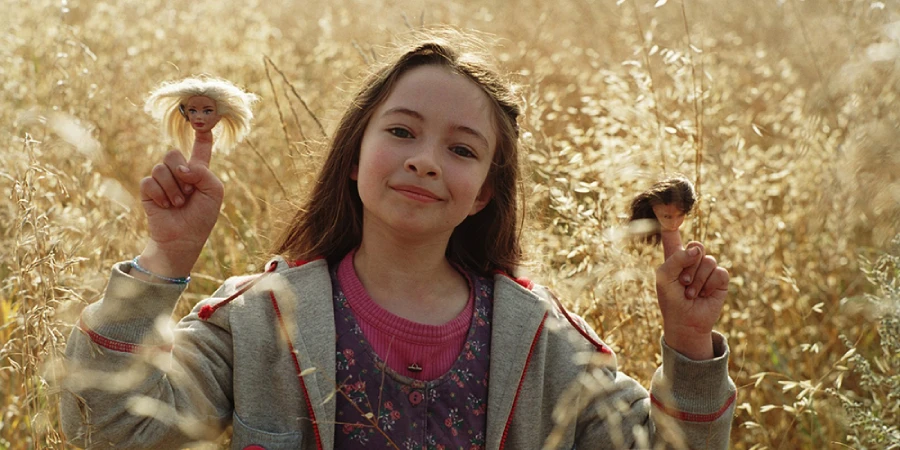
Jeliza-Rose brings her four disembodied doll heads, which she uses as finger puppets and full conversation partners. Classique, Sateen, Mustique, and Glitter Gal become her social world, each with a distinct voice and personality she performs herself. This detail, which could read as quirky shorthand for childhood imagination, is actually the film’s most quietly devastating image: a child so starved of real connection that she has built four friends from plastic and loneliness.
Noah’s Death
Noah injects himself in his armchair and does not wake up. He dies of an overdose, sitting upright, and Jeliza-Rose does not immediately understand what has happened. She goes about her days, talking to the doll heads, exploring the prairie, eating whatever scraps she can find.
Noah’s corpse begins to decompose in the chair. Gilliam shoots it matter-of-factly: the body darkens and shrivels, and Jeliza-Rose continues to interact with it, telling it about her day. The refusal to treat this as horror is a deliberate choice, and it is one of the film’s most audacious directorial decisions.
Dell and Dickens
Jeliza-Rose discovers she has neighbors. Dell is a stern, one-eyed woman who practiced amateur taxidermy and nurses a deep resentment toward her dead mother, whom she blames for ruining her brother. That brother is Dickens, a man in his thirties who survived a botched surgery that left him with severe brain damage, giving him the emotional and cognitive age of a young child.
Dell preserves Noah’s corpse, stuffing and treating it with the same methods she uses on animals. She dresses the body and props it up, which, in her mind, is an act of care and normality. It is grotesque, but Gilliam frames it with the same flat sincerity he applies to everything else in Jeliza-Rose’s world.
Jeliza-Rose and Dickens
Dickens and Jeliza-Rose form a friendship that sits in deeply unsettling territory. He is physically an adult but behaves like a peer her age, and the two play together in the grass, invent stories, and share a physical closeness that Gilliam presents through Jeliza-Rose’s perspective, where none of it registers as wrong.
Dickens is obsessed with a fantasy about a monster shark he believes lives under the prairie, which he calls “the tideland.” He and Jeliza-Rose enact this mythology together. Their relationship includes a kiss that lingers on screen uncomfortably, a moment that prompted intense critical debate about where the film’s moral responsibility lies.
Jeliza-Rose’s Interior World
Much of the film’s middle section follows Jeliza-Rose’s imagination rather than external plot. She crawls through the tall grass on her belly, imagining herself as a mermaid. Meanwhile, elaborate conversations play out between the doll heads. As she wanders through the landscape, she perceives it as both threatening and magical.
Gilliam shoots her point of view with fish-eye lenses and tilted angles that distort the prairie into something hallucinatory. It is the film’s visual argument: we are not watching this from an adult moral vantage point. We are inside her skull, and her skull is a place where dead fathers and strange men and rotting houses coexist with wonder.
The Train and the Explosion
Dickens has a fixation on the freight trains that periodically roll past the property. He has packed an old school bus with explosives, intending to derail a train as part of his war against the “shark.” Dell seems aware of this plan and does nothing meaningful to stop it.
Dell dies when the bus explodes. Dickens survives but is badly injured. The explosion derails the freight train, and rescue workers and emergency personnel flood the previously isolated landscape, shattering the sealed, dreamlike world the film has been building for its entire runtime.
Movie Ending Explained
After the explosion, Jeliza-Rose sits among the wreckage of the derailed train. Rescue workers move around her. She clutches her doll heads. A paramedic or rescue worker sits with her and she begins telling her story, the way a child narrates a fairy tale, starting from the beginning with her mother and father and the holiday.
Dickens is loaded onto a stretcher, alive. Whether he faces any consequences for the explosion, or for his relationship with Jeliza-Rose, the film refuses to say. He reaches out toward her as he is carried away, and she watches him go with an expression that reads as loss rather than relief.
What Gilliam refuses to give the audience is rescue in any meaningful emotional sense. Jeliza-Rose is not swept up into a system that will fix her. Nobody in the film’s final minutes looks at her and grasps the full scale of what she has survived. She simply sits in the noise and wreckage and keeps narrating.
The ending asks whether a child’s imagination is a form of protection or a form of damage. Jeliza-Rose has processed extraordinary trauma through fantasy so successfully that she cannot distinguish between the two. Her survival is real. Her understanding of what she has survived is not. Gilliam presents both facts simultaneously and declines to resolve the tension.
Are There Post-Credits Scenes?
Tideland has no post-credits scene. Gilliam opens the film with a short personal address to the audience, warning them that the film will be difficult, but there is nothing after the credits themselves.
Type of Movie
Tideland is a dark fantasy drama with heavy elements of psychological horror and surrealism. It resists genre classification in practice, even if the labels are technically accurate. Tonally, it sits in a place most films never go: genuinely childlike and genuinely disturbing at the same time, with no irony separating the two.
Cast
- Jodelle Ferland – Jeliza-Rose
- Jeff Bridges – Noah
- Jennifer Tilly – Queen Gunhilda
- Janet McTeer – Dell
- Brendan Fletcher – Dickens
Film Music and Composer
Mychael Danna composed the score for Tideland, with Jeff Danna co-composing. Mychael Danna has a long history working on psychologically complex films, and his work here matches the film’s refusal to signal emotion to the audience. The score does not swell when it should. It sits quietly under Jeliza-Rose’s world like something patient and slightly wrong.
The music favors sparse instrumentation and lullaby-adjacent melodies that feel innocent on the surface and increasingly hollow underneath. It earns its place as the most underrated element of the film’s craft. Most viewers are too shaken by the images to notice what the score is quietly doing beneath them.

Filming Locations
Tideland was filmed primarily in Saskatchewan, Canada, specifically in the prairie regions around the small communities south of Saskatoon. The flat, vast, golden landscape stands in for rural Texas.
Gilliam chose Saskatchewan because it offered the unbroken horizon and enormous sky he needed to make the landscape feel like a character in itself. A child lost in that geography looks genuinely small and genuinely isolated. No set dressing could manufacture that particular weight.
The farmhouse interiors and the decayed domestic spaces were constructed and dressed to feel like they had been rotting for decades. Every surface carries grime and entropy. The production design team did not create a theatrical haunted house; they created a place that looks like time simply stopped caring about it.
Awards and Nominations
Tideland received little attention from major awards bodies, which surprised nobody given its content. Jodelle Ferland received recognition from genre and independent film circles for her performance, but the film did not penetrate mainstream awards conversation.
Behind the Scenes Insights
- Terry Gilliam prefaced early screenings with a filmed introduction in which he acknowledged the film would disturb many viewers and defended its perspective directly.
- Jodelle Ferland was around ten years old during filming and delivered a performance that required her to be on screen for virtually every scene.
- Jeff Bridges spent portions of the shoot essentially motionless in the armchair, a choice that required its own kind of physical commitment to stillness and decomposition makeup.
- Gilliam has described Tideland as one of his personal favorites among his own films, a view almost no critic or audience member shares with him.
- Janet McTeer reportedly embraced the extreme physicality and strangeness of Dell with little hesitation, which helped set the tone for the entire production.
- The doll heads used by Ferland throughout the film were specifically chosen and modified by the costume and props departments to give each one a distinct visual personality.
Inspirations and References
Tideland is based directly on the 2000 novel of the same name by Mitch Cullin. Gilliam has also cited Lewis Carroll’s Alice’s Adventures in Wonderland as a structural and thematic reference point, specifically the idea of a girl falling into a world that operates on its own internal logic.
The film draws from Southern Gothic literary traditions, with their preoccupation with decay, isolation, family dysfunction, and the grotesque. Cullin himself writes in a register that sits close to writers like Flannery O’Connor, though his focus on childhood interiority is distinctly his own.
Alternate Endings and Deleted Scenes
No officially documented alternate endings or significant deleted scenes have been released for Tideland. Gilliam’s films tend to arrive as singular visions with little publicized alternate material, and this one is no exception. If additional footage exists, it has not entered public record.
Book Adaptations and Differences
Gilliam’s film follows Mitch Cullin’s novel quite closely in its major plot points and atmosphere. The novel spends more time in Jeliza-Rose’s internal monologue, which gives readers direct access to her imaginative frameworks in ways that film can only approximate through visual distortion and Ferland’s performance.
One notable shift is pacing: the novel’s quiet, accumulating dread builds across prose in a way Gilliam tries to replicate visually. Some readers who love the book find the film too relentless; some viewers who love the film find the book too still. Both responses make sense given how differently the two mediums carry the same story.

Memorable Scenes and Quotes
Key Scenes
- Jeliza-Rose preparing her father’s heroin injection in the opening sequence, shot with no dramatic music and no reaction shots, just a child doing a chore.
- Noah’s decomposing body in the armchair while Jeliza-Rose chats to her doll heads beside him, the afternoon light coming through dusty windows as if nothing has changed.
- Jeliza-Rose crawling through the tall prairie grass on her stomach, the camera at ground level, the horizon enormous above her, playing mermaid in a dry sea.
- Dell performing taxidermy on Noah’s corpse, matter-of-factly sewing and treating him while Jeliza-Rose watches without alarm.
- Dickens and Jeliza-Rose lying in the grass together as he describes the shark beneath the tideland, his hand gestures enormous and childlike.
- The train derailment and explosion shattering the film’s sealed, dreamlike atmosphere in a single burst of noise and light.
Iconic Quotes
- “He’s just on holiday. People go on holiday.” (Jeliza-Rose, rationalizing her father’s death)
- “This is where I come from. This is my place.” (Noah, arriving at the farmhouse)
Easter Eggs and Hidden Details
- Gilliam plants visual echoes of Alice in Wonderland throughout: Jeliza-Rose’s falls and crawls through small spaces mirror Alice’s descent, and her doll-head companions function structurally like the characters Alice encounters underground.
- The doll head Classique is the one Jeliza-Rose most frequently uses when she needs to process something frightening, a detail that only becomes clear across multiple viewings.
- Dell’s single working eye is emphasized repeatedly in close-up, a visual motif that connects to her role as the film’s only adult trying to maintain any kind of domestic order, however deranged.
- The school bus packed with explosives is visible in the background of several earlier scenes before it becomes plot-relevant, sitting at the edge of the frame like a fact the film knows and isn’t sharing yet.
- Gilliam uses fish-eye lens distortion specifically when the camera adopts Jeliza-Rose’s point of view, dropping it for wider shots that show the landscape without her subjective filter.
Trivia
- Jodelle Ferland was already known for genre work before Tideland, but this film remains the most demanding performance of her early career by a significant margin.
- Gilliam funded parts of the film independently after difficulty securing conventional financing, which gave him final cut and complete creative control.
- The film received extremely polarized responses at its festival premieres, with some audiences walking out and others giving standing ovations at the same screenings.
- Jeff Bridges has spoken positively about the film in interviews despite its commercial failure and critical division.
- Jennifer Tilly’s role as Queen Gunhilda is brief but physically committed, requiring heavy makeup and costuming to sell the character’s degraded state.
- Gilliam’s introductory address to audiences, filmed and attached to early screenings and home releases, is itself a piece of cinema history as a director openly defending a film he knew would be rejected by most viewers.
Why Watch?
Jodelle Ferland carries every single frame of this film on her shoulders, and she was ten years old. Watch it because her performance, specifically the scene where she chats cheerfully to her dead father while afternoon light turns the farmhouse gold, does something no child actor has done before or since: it makes innocence feel like the most disturbing thing in the room.
Director’s Other Movies
- Brazil (1985)
- The Adventures of Baron Munchausen (1988)
- The Fisher King (1991)
- 12 Monkeys (1995)
- Fear and Loathing in Las Vegas (1998)
- The Brothers Grimm (2005)
- The Imaginarium of Doctor Parnassus (2009)
- The Zero Theorem (2013)
- The Man Who Killed Don Quixote (2018)
Recommended Films for Fans
- Pan’s Labyrinth (2006)
- Beasts of the Southern Wild (2012)
- Heavenly Creatures (1994)
- The Spirit of the Beehive (1973)
- Hanna (2011)
- Gummo (1997)
- Badlands (1973)