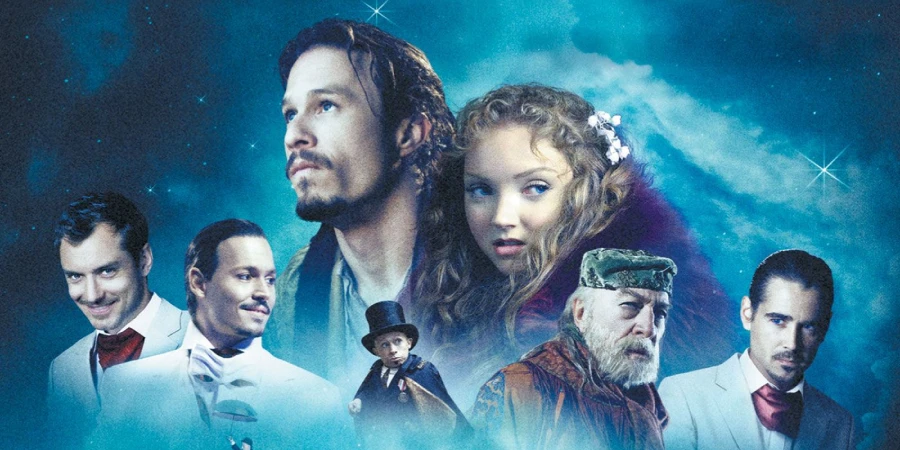

Heath Ledger died during production, and director Terry Gilliam kept filming anyway, casting three different actors to finish the role. That decision alone makes The Imaginarium of Doctor Parnassus one of the strangest production stories in modern cinema, but the film itself earns its own reputation independent of that tragedy. Gilliam built a fever dream around a traveling theater troupe, a thousand-year-old storyteller, and a mirror that swallows people whole. What came out the other side is gloriously, stubbornly weird.
Detailed Summary
The Troupe and Their Traveling Theater
A battered horse-drawn wagon creaks through contemporary London carrying a tiny theatrical stage. Doctor Parnassus, played by Christopher Plummer, runs the show alongside his daughter Valentina, the quick-handed Anton, and the dwarf Percy. They perform for indifferent modern crowds who barely glance up from their phones.
Parnassus is ancient. He made a deal with the Devil, referred to as Mr. Nick and played with reptilian glee by Tom Waits, centuries ago, trading his mortality for immortality. He followed that bet with another: whichever of them could first claim five souls would win Valentina when she turned sixteen. Her birthday is days away.
Tony Appears Under a Bridge
Anton finds a man hanging by the neck from Blackfriars Bridge. He is not dead. Anton and the others cut him down, and the stranger wakes up with no memory of how he got there. He calls himself Tony. Ledger plays him with a slippery, charming energy, all wide smiles and fast talk. Percy notices that Tony wears a flute through his neck, a pipe that sits inside a surgical incision.
Tony ingratiates himself with the troupe almost immediately. He claims to want to help them attract larger audiences, and he genuinely does boost business. Valentina responds to him. Anton, who loves Valentina, watches this with obvious misery.
Inside the Mirror
Gilliam spends real time establishing what the mirror actually does. Step through it, and you enter a world shaped by your own imagination. For Parnassus that means baroque, Magritte-influenced landscapes with floating bowler hats and skies made of stained glass. For ordinary audience members it means something more personal and more dangerous, since Mr. Nick can steer souls toward him once they are inside.
Tony steps through the mirror for the first time and finds himself transformed. Inside the Imaginarium he wears Johnny Depp’s face. Gilliam uses this not as a gimmick but as visual logic: the mirror reflects possibility, and Tony is a man reinventing himself at every moment. Depp plays the interior Tony with a theatrical looseness that contrasts nicely with Ledger’s street-level charm.
Tony’s True History
Fragments emerge. Tony ran a fake charity that laundered money for criminals. He was caught, and his handlers strung him up under the bridge to silence him. He survived by accident or by some connection to Parnassus’s world; the film keeps this slightly ambiguous. His charm is real but it is a weapon, not a gift.
Inside the mirror on a second visit, Tony wears Jude Law’s face. Law handles the slicker, more overtly dangerous version of the character, pushing a grieving widow toward Mr. Nick’s column of light while pretending to guide her to safety. This is the moment you understand that Tony is not redeemable. He is a con man at a cellular level.
Mr. Nick Tightens the Deal
Tom Waits’s Mr. Nick never raises his voice. He appears in a suit, sipping something cold, renegotiating with the patience of someone who has all of eternity. He offers Parnassus a counter-deal: win five souls before Tony can deliver five souls to Mr. Nick, and Valentina goes free. Lose, and she belongs to the Devil.
Parnassus, drunk on grief and guilt, keeps making choices that sabotage his own side. Plummer plays the character as a man who has lived so long that exhaustion has become his default state. He loves Valentina but cannot stop gambling with her future. It is one of Plummer’s most quietly devastating performances.
The Race for Souls
Tony uses his charisma to deliver souls to Mr. Nick, steering people through the mirror under the pretense of helping them. Inside, Jude Law and Colin Farrell take turns wearing his face as the moral stakes shift. Farrell’s version of Tony, which appears in the climax, carries a warmer, more confused quality. Farrell plays him as someone who has glimpsed the damage he has done and cannot quite decide whether to feel it.
Anton and Valentina discover Tony’s criminal past through physical evidence, a newspaper report and a photograph. Valentina confronts Tony, who deflects beautifully. Ledger, in his final scenes, plays the deflection with a sadness underneath the smile that reads differently knowing he filmed them weeks before his death.
Inside the Final Imaginarium
Parnassus enters his own mirror to pursue Tony. Inside, the landscape turns dark and cathedral-like, Gothic arches and black water. Tony, now wearing Farrell’s face, gets cornered. Parnassus sees a version of his own past: a younger self, a monastery, the first deal with Mr. Nick. Gilliam stages this as a kind of confession booth built from nightmare architecture.
Tony falls. The film does not linger on it, which feels right. He was always going to fall. Parnassus wins enough souls to satisfy the bet’s terms, and Valentina escapes Mr. Nick’s claim. She does not stay with her father.

Movie Ending
Valentina walks away from the troupe with Anton. She has chosen an ordinary life over her father’s eternal carnival, and the film treats this as both a loss and a relief. She was never going to inherit a traveling magic show; she was always going to choose the world she could actually touch.
Parnassus ends up alone on a street corner with a tiny toy version of his theater, performing for spare change. Percy sits beside him. Gilliam frames this as a kind of peace rather than a punishment. Parnassus has been freed from the weight of fatherhood, from the guilt of the wagers, from the responsibility of Valentina’s fate.
Mr. Nick watches from a distance and smiles. Tom Waits delivers this closing beat with no dialogue, just a slight tip of the head that suggests the game will start again with someone new. The Devil does not lose; he just pauses between rounds. That image, the contented Devil watching an old man play alone, is Gilliam’s thesis statement about storytelling and obsession.
Valentina glimpses her father across the street, and for a split second the film holds on her face. She does not go to him. She keeps walking. Gilliam cuts to the toy theater before she disappears from frame, and that restraint is the film’s best directorial decision.
Are There Post-Credits Scenes?
No. The Imaginarium of Doctor Parnassus has no post-credits scene. Once the final frame fades, the film is done. Stay if you want to read the dedication to Heath Ledger, which appears in the credits, but there is no additional footage waiting for you.
Type of Movie
This is a fantasy drama with heavy doses of dark comedy. Gilliam operates in a register that sits between fairy tale and nightmare, using practical stagecraft and early digital effects to build worlds that feel handmade rather than corporate. Tonally the film swings between melancholy, whimsy, and genuine menace.
Genre purists will struggle to file it cleanly. It shares DNA with magic realism, philosophical fantasy, and road movie, but it belongs most naturally to the sub-genre of “Terry Gilliam films,” which is a category unto itself.
Cast
- Heath Ledger – Tony (exterior world)
- Johnny Depp – Tony (first Imaginarium incarnation)
- Jude Law – Tony (second Imaginarium incarnation)
- Colin Farrell – Tony (third Imaginarium incarnation)
- Christopher Plummer – Doctor Parnassus
- Tom Waits – Mr. Nick (the Devil)
- Lily Cole – Valentina
- Andrew Garfield – Anton
- Verne Troyer – Percy
- Peter Stormare – Detective Brannagh
Film Music and Composer
Jeff Danna composed the score alongside his brother Mychael Danna. Jeff handled the bulk of the Parnassus work, blending orchestral arrangements with folk-inflected woodwinds that suit the troupe’s itinerant, archaic quality. The music never overwhelms the visuals; it operates more like a second atmosphere than a commentary track.
Danna’s score leans into the theatricality of Parnassus’s world, using music-box textures and slightly off-key strings to signal that something in any given scene is not quite safe. It is one of the most underrated elements of the film; audiences focus on the visuals, but the score is doing significant heavy lifting beneath them.

Filming Locations
Principal photography took place in London and Vancouver. The London sequences use real streets, bridges, and alleyways, grounding the fantastical wagon in a recognizable, grimy city. Blackfriars Bridge appears early and often; it gives Tony’s introduction a specific, unmistakable geography.
Vancouver stood in for various exterior locations during the Canadian portion of the shoot. Inside the Imaginarium sequences relied heavily on studio work and green screen, with production designers building physical set pieces that were then extended digitally. Gilliam insisted on physical elements wherever possible, and you can feel the texture of real materials even inside the dream worlds.
Awards and Nominations
The Imaginarium of Doctor Parnassus received nominations for its costume design and production design work at various industry ceremonies. Dave and Lou Elsey received an Academy Award nomination for Best Makeup, recognizing the film’s elaborate practical effects work. The film did not win major prizes, which remains a genuine injustice given the production design work by Anastasia Masaro.
Behind the Scenes Insights
- Heath Ledger died in January 2008 after completing roughly a third of his scenes. Gilliam initially considered shutting down the production entirely.
- Johnny Depp, Jude Law, and Colin Farrell all agreed to donate their salaries to Ledger’s daughter, Matilda.
- Gilliam used the mirror conceit as the narrative solution: since Tony transforms inside the Imaginarium, three different actors could logically play him in three different visits.
- Christopher Plummer reportedly said this was one of the most physically demanding roles of his career, partly due to elaborate costume work and outdoor night shoots.
- Tom Waits and Gilliam had discussed working together for years before Parnassus provided the right role. Waits brought much of Mr. Nick’s quiet, courtly menace on his own terms, with minimal direction from Gilliam on several key scenes.
- Andrew Garfield has cited his time on this film as formative. He was a relatively unknown actor when cast, and working alongside Plummer and Ledger shaped his approach to screen performance significantly.
- Lily Cole, primarily known as a model at the time, held her own against Plummer in their shared scenes, which surprised some crew members who had doubted the casting choice.
Inspirations and References
Gilliam and co-writer Charles McKeown drew on the tradition of Faustian bargain stories, most obviously Marlowe’s Doctor Faustus and Goethe’s Faust. Parnassus’s endless deals with the Devil follow the same logic: a man so hungry for something that he keeps signing contracts he cannot honor.
Gilliam also looked at the commedia dell’arte tradition. The troupe’s traveling theater, its archetypes, and its blend of comedy and moral instruction all trace back to that Italian performance form. Percy functions almost as a Harlequin figure, quick and observant inside a world that keeps overlooking him.
Surrealist painting runs through the Imaginarium sequences visually. René Magritte’s floating objects and impossible scales appear almost literally in several shots. Salvador Dali’s melting, organic architecture informs the darker interior sequences.
Alternate Endings and Deleted Scenes
No officially confirmed alternate endings have entered the public record. Given the production’s disrupted circumstances, it is likely that certain planned Tony scenes with Ledger were never filmed and therefore never had alternate versions to cut.
Gilliam has spoken in interviews about material that was trimmed for pacing, primarily scenes that elaborated on Parnassus’s backstory and his relationship with Percy. Those cuts tightened the film but left some of the mythology slightly underdeveloped. No formal deleted scenes package has received wide release.
Book Adaptations and Differences
The Imaginarium of Doctor Parnassus is not based on a book. Gilliam and Charles McKeown wrote the original screenplay together. No source novel exists to compare it against.
Memorable Scenes and Quotes
Key Scenes
- Tony’s body hangs motionless under Blackfriars Bridge while the troupe debates whether he is alive. Percy prods him with a long pole. The casual absurdity of that image sets the film’s entire tonal register in one shot.
- Johnny Depp’s Tony dances across a surreal rooftop landscape while a chorus of Russian police officers in tutus pursues him. It is pure Gilliam: funny, visually extravagant, and slightly alarming.
- Jude Law’s Tony steers the grieving widow toward Mr. Nick’s light. Law plays the scene with a practiced warmth that makes Tony’s betrayal land harder than any act of obvious villainy would.
- Parnassus confronting a vision of his younger self inside the final Imaginarium sequence. Plummer stands very still while the Gothic architecture collapses around him. He does not flinch.
- The closing image of Parnassus at his tiny toy theater, Percy beside him, a street corner their whole world. It earns its melancholy without begging for it.
Iconic Quotes
- “Once upon a time, there was a man who knew everything.” Doctor Parnassus opens his show with this line, and it doubles as a self-indictment.
- “Imagine a world without stories.” Mr. Nick delivers this quietly, without threat. Tom Waits makes it sound like an honest question rather than a taunt.
- “What does Dr. Parnassus do? He tells stories!” Percy, defending his employer with more loyalty than the old man perhaps deserves.
Easter Eggs and Hidden Details
- The flute through Tony’s neck is a visual callback to the Hanged Man tarot card, which traditionally represents suspension, transition, and sacrifice.
- Mr. Nick’s suits change color slightly between his appearances. Each shade sits a degree closer to red as the bet’s deadline approaches, though the shift is subtle enough to miss on a first viewing.
- The toy theater Parnassus operates at the end is a miniature replica of the larger wagon seen throughout the film, right down to the painted side panels.
- Several of the audience members who enter the Imaginarium wear costumes that reference earlier scenes in the film, suggesting the mirror pulls from real memory as well as pure imagination.
- Gilliam includes a brief image of a floating bowler hat inside the Imaginarium that references his earlier film Brazil, specifically the bureaucratic imagery woven throughout that picture.
Trivia
- This was Heath Ledger’s final completed film appearance. The Dark Knight was released first, but Parnassus was the last film he worked on before his death.
- Tom Waits plays the Devil here, and Waits has a long personal mythology around that archetype in his music. Gilliam cast him partly because Waits already understood the character from the inside.
- Lily Cole was nineteen years old during filming. She had no substantial acting experience before this production.
- Andrew Garfield auditioned multiple times before landing Anton. Gilliam reportedly liked his energy but needed convincing he could hold his own against the older cast members.
- Verne Troyer’s Percy is a rare example of a small-stature character in a fantasy film who functions as a genuine moral anchor rather than comic relief. Gilliam was specific about this in pre-production.
- Gilliam shot in sequence as much as possible to keep the narrative coherent given the constantly shifting cast situation after Ledger’s death.
Why Watch?
Watch it for Christopher Plummer, who plays a thousand-year-old con man with the weariness of someone who genuinely remembers every bet he lost. Plummer keeps the film emotionally honest while everything around him dissolves into gorgeous visual chaos. Add Tom Waits as the Devil, delivering every line like a patient landlord collecting overdue rent, and you have two performances that justify the runtime on their own.
Director’s Other Movies
- Monty Python and the Holy Grail (1975)
- Time Bandits (1981)
- Brazil (1985)
- The Adventures of Baron Munchausen (1988)
- The Fisher King (1991)
- 12 Monkeys (1995)
- Fear and Loathing in Las Vegas (1998)
- The Brothers Grimm (2005)
- Tideland (2005)
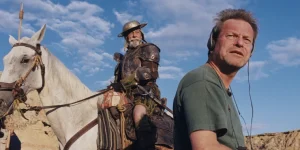
- The Man Who Killed Don Quixote (2018)