Two men sit in an electric chair, and an entire country watches, doing nothing. Giuliano Montaldo’s 1971 film about the trial and execution of Nicola Sacco and Bartolomeo Vanzetti does not soft-pedal its fury.
From the opening frames, this is a film with a verdict already in mind, and it dares you to argue with it. What makes it worth your time is not its politics but its craft, and the performances at its center are some of the finest work Italian cinema produced in that decade.
Detailed Summary
Arrest and First Impressions
Set in post-World War I America, the film opens on a climate of fear. Italian immigrants are viewed with suspicion, and anarchist political activity has made certain communities targets of government crackdowns during the Red Scare.
Nicola Sacco, a shoemaker, and Bartolomeo Vanzetti, a fish peddler, are arrested in 1920 in connection with a payroll robbery and double murder in South Braintree, Massachusetts. Both men are openly anarchist and immigrant. Both carry firearms when arrested, which prosecutors use against them immediately.
The Weight of Circumstantial Evidence
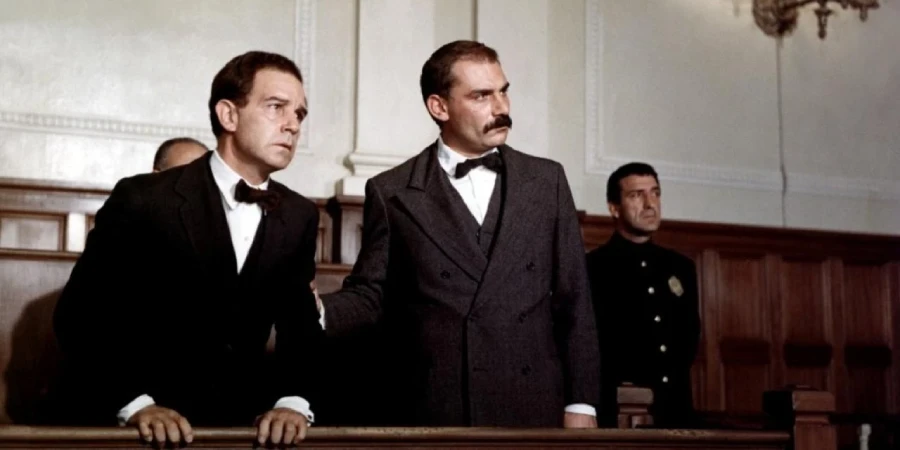
Much of the film’s mid-section focuses on the mechanics of the trial. Montaldo lingers on the flimsiness of the prosecution’s case, showing witness testimonies that contradict each other and evidence that, at best, places the men loosely near the scene.
Gian Maria Volonté plays Vanzetti with a fierce, almost preacherly intensity. His Vanzetti is not a victim who begs for sympathy; he is a man who has thought deeply about why the state wants him dead. Riccardo Cucciolla plays Sacco with a quieter, more domestic sadness, a man less interested in ideological argument than in his family and his work.
Watching these two performances side by side is one of the film’s great pleasures. Cucciolla and Volonté play completely different registers of the same injustice, and the contrast never feels manufactured.
Public Outcry and Political Theater
As the trial drags on, the film widens its scope. International protests erupt. Writers and intellectuals publicly question the fairness of the proceedings. Montaldo cuts between the courtroom and the streets, making clear that everyone watching the trial understands what is really happening, even if the court pretends otherwise.
Judge Webster Thayer is portrayed as openly contemptuous of the defendants. He makes no real effort to hide his prejudice, and the film treats him as less a villain than a symptom, a man doing what his world expects of him.
Appeals and Delays
Years pass. Multiple appeals are filed and denied. A convicted murderer named Celestino Madeiros confesses to the South Braintree crime and names a different gang as responsible. The court rejects his confession as credible grounds for a new trial, which is one of the film’s most quietly devastating moments.
Sacco goes on a hunger strike in prison. Vanzetti writes, argues, and keeps his voice sharp even as hope erodes. Montaldo never lets the film become a passive endurance test; he keeps the pacing tight even as the years accumulate.
Final Verdict
Governor Alvan Fuller reviews the case and appoints an advisory committee, including the presidents of Harvard and MIT, to examine whether the trial was fair. Their conclusion: the trial was fair. Their report effectively seals the men’s fate.
Sacco and Vanzetti are sentenced to death. Vanzetti delivers his famous courtroom statement, and Volonté’s delivery of it is the film’s emotional peak. He speaks slowly, choosing every word, looking directly at the court as if cataloguing each face for history.
Movie Ending
On August 23, 1927, Nicola Sacco and Bartolomeo Vanzetti are executed by electric chair at Charlestown State Prison. Montaldo does not flinch from showing this. He does not cut away at the crucial moment or soften the imagery with music swells.
What makes the ending land so hard is the intercutting with protests across the world. Cities burn with demonstrations. People weep in the streets of Paris, London, Buenos Aires. The scale of international grief contrasts with the small, bureaucratic efficiency of the execution itself, two men, a chair, a switch.
Joan Baez’s song plays over the final images, and it is one of those rare cases where a folk song inserted into a film actually earns its place rather than feeling like a marketing decision. Her voice strips away any remaining pretense of detachment.
Montaldo closes with text noting that Massachusetts formally acknowledged the injustice of the case decades later. It lands like a verdict that came far too late to matter to anyone it should have protected. The film makes sure you feel that gap.
Are There Post-Credits Scenes?
No. There are no post-credits scenes. This is a serious 1971 political drama, not a franchise tentpole. When it ends, it ends, and that blunt finality feels entirely appropriate.
Type of Movie
This is a political drama and courtroom thriller with documentary-style ambitions. Montaldo shoots parts of it with a realist, almost journalistic gaze, but the film never pretends to be neutral. It is openly polemical, and proud of it.
Tonally, it sits somewhere between a legal procedural and a political indictment. There is grief in it, and anger, but very little sentimentality.
Cast
- Gian Maria Volonté – Bartolomeo Vanzetti
- Riccardo Cucciolla – Nicola Sacco
- Cyril Cusack – Frederick Katzmann
- Milo O’Shea – Fred Moore
- Geoffrey Keen – Judge Webster Thayer
- William Prince – William Thompson
- Rosanna Fratello – Rosa Sacco
Film Music and Composer
Ennio Morricone composed the score. This is, frankly, some of his most restrained and purposeful work. He does not reach for the sweeping romantic orchestrations that made him famous in Westerns; instead, he writes music that sits under the images like a low current of dread.
Joan Baez performed and co-wrote the vocal pieces for the film, including Here’s to You, with music by Morricone and lyrics by Baez. That song became one of the most recognizable pieces of protest music associated with the case, and it outlasted the film by decades.
Here’s to You lifts two lines directly from Vanzetti’s final statement, which gives it a documentary authenticity that a purely original lyric could never achieve. Morricone’s collaboration with Baez here is one of the most interesting creative pairings of his career.
Filming Locations
Principal photography took place in Italy, with production design working to recreate early 20th-century New England. The film was an Italian-French co-production, which meant shooting on American soil was never really the plan.
Italian locations standing in for Massachusetts give the film a slightly stylized quality that, oddly, suits it. Montaldo was not making a documentary. He was making an argument, and a slightly theatrical visual space reinforces that intent rather than undermining it.
The courtroom interiors are particularly well constructed. They feel suffocating and formal, all dark wood and rigid spatial hierarchies, which tells you everything about who holds power in that room before a single word is spoken.
Awards and Nominations
Riccardo Cucciolla won Best Actor at the Cannes Film Festival in 1971 for his performance as Sacco. That recognition was well-deserved; his is the quieter of the two lead performances, and quieter work at Cannes rarely gets its due.
The film also received significant attention at other European festivals and was a notable entry in the political cinema conversation of the early 1970s.
Behind the Scenes Insights
- Gian Maria Volonté was already known for politically committed work and brought genuine ideological investment to Vanzetti, not just professional preparation.
- Ennio Morricone and Joan Baez had not worked together before this film; their collaboration produced one of the most recognized pieces of political film music of the decade.
- Director Giuliano Montaldo had a background in politically engaged Italian cinema and saw the Sacco and Vanzetti case as directly relevant to contemporary debates about state power and immigrant rights.
- The film was released during a period of intense political radicalism in Europe, particularly in Italy, which shaped how audiences received it and how urgently the filmmakers felt about making it.
- Cucciolla’s Cannes win was considered a surprise by some observers who expected Volonté’s more theatrical performance to dominate awards attention.
Inspirations and References
The film draws directly from the historical record of the Sacco and Vanzetti case, one of the most controversial criminal prosecutions in American history. The real trial ran from 1920 to 1927 and drew international attention.
Montaldo and screenwriter Fabrizio Onofri consulted historical documents, court transcripts, and letters written by the two men during their imprisonment. Vanzetti was a prolific and eloquent writer, and his actual words shape several key speeches in the film.
The broader context of Italian-American anarchism and the Red Scare of the early 1920s informs every scene. The film situates the case within a specific political moment rather than treating it as an isolated miscarriage of justice.
Alternate Endings and Deleted Scenes
No documented alternate endings or significant deleted scenes have been widely reported for this film. Given its subject matter, an alternate ending would have required rewriting history, which was clearly not on Montaldo’s agenda.
Book Adaptations and Differences
This film is not based on a single source novel or book. It is a dramatic reconstruction of historical events. The screenplay draws from multiple primary and secondary sources about the Sacco and Vanzetti case rather than adapting any one published work.
Memorable Scenes and Quotes
Key Scenes
- Vanzetti’s final courtroom statement, delivered by Volonté in a single sustained take that builds from quiet dignity to barely contained fury, without ever tipping into melodrama.
- The moment Madeiros’s confession is dismissed by the court; the camera holds on Vanzetti’s face as he processes the news, and Volonté does almost nothing, which makes it devastating.
- Sacco’s hunger strike sequence, where Cucciolla’s physical deterioration feels genuinely alarming; his cheekbones sharpen across scenes in a way that reads as real rather than costumed.
- The execution itself, cut against street protests worldwide, which makes the state’s small, procedural act feel both intimate and monstrous at the same time.
- An early scene of Vanzetti selling fish from his cart, a quietly observed moment of daily life that makes everything that follows feel like a theft.
Iconic Quotes
- “If it had not been for these thing, I might have live out my life talking at street corners to scorning men. I might have die, unmarked, unknown, a failure.” (Vanzetti’s actual words, incorporated into the film)
- “We are not criminals. We are two men who love liberty.” (Vanzetti, during the trial sequence)
Easter Eggs and Hidden Details
- Several of Vanzetti’s speeches in the film use near-verbatim language from his actual letters and court statements, which Montaldo and Onofri wove into the script without always flagging them as direct quotations.
- The fish-cart scene early in the film echoes descriptions in historical accounts of Vanzetti’s daily routine, grounding the character in documented reality before the trial machinery takes over.
- Morricone’s score includes a recurring motif that first appears during a mundane domestic scene and returns during the execution, linking ordinary life to state violence in a way that functions almost subliminally.
- Joan Baez’s two vocal lines in Here’s to You are lifted from Vanzetti’s last public statement, which means every time the song plays, it is literally Vanzetti speaking across time.
Trivia
- Riccardo Cucciolla won Best Actor at Cannes in 1971 for this role, making it one of the rare cases where a supporting-scale performance in a politically focused film received top individual acting honors at a major festival.
- Here’s to You by Morricone and Baez has been reused in other films and media over the decades, including in a Sergio Leone film, giving it a second life well beyond this production.
- Gian Maria Volonté was one of the most politically committed actors working in European cinema during this period, and several of his film choices in the early 1970s reflect a consistent engagement with left-wing causes.
- The film was an Italian-French co-production, which was a common structure for ambitious European political films of the era seeking broader distribution.
- Giuliano Montaldo directed this film during a particularly active period for Italian political cinema, alongside contemporaries like Francesco Rosi who were making similarly charged work.
Why Watch?
Volonté’s delivery of the final courtroom speech alone justifies the runtime; he builds it phrase by phrase, his voice staying controlled even as his eyes give everything away. Cucciolla won at Cannes, and rightly so, but watching these two men share the screen is a reminder of how rare it is for two lead performances to complement rather than compete with each other. Morricone and Baez’s Here’s to You closes the film in a way that a conventional score never could have managed.
Director’s Other Movies
- Grande Slalom (1967)
- Gli intoccabili (1969)
- Giordano Bruno (1973)
- Il giocattolo (1979)
- Marco Polo (1982)
- Gli occhiali d’oro (1987)
- Tempo di uccidere (1989)
Recommended Films for Fans
- The Battle of Algiers (1966)
- Investigation of a Citizen Above Suspicion (1970)
- Z (1969)
- Nickel and Dime (1992)
- In the Name of the Father (1993)
- Paths of Glory (1957)
- The Confession (1970)