
A dying man travels from hospital to hospital while bureaucracy quietly kills him. The Death of Mr. Lazarescu is one of the most quietly devastating films ever made, a Romanian masterpiece that turns a mundane medical nightmare into something approaching Greek tragedy. Director Cristi Puiu presents no villains, no heroes, and no easy comfort. Just a man, a system, and an ending you already know is coming from the very first frame.
Detailed Summary
Mr. Lazarescu at Home
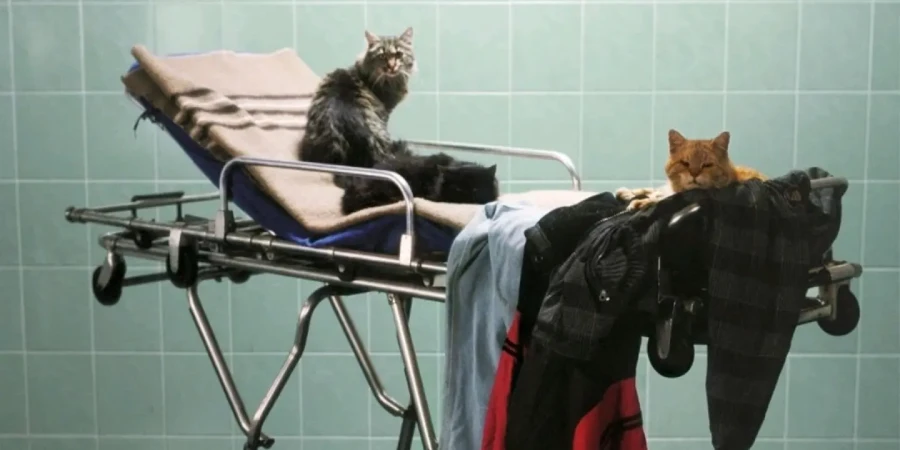
Dante Remus Lazarescu is a 63-year-old retired engineer living alone in a Bucharest apartment with his three cats. He drinks too much, eats poorly, and has been feeling unwell for several hours. His neighbors, a couple who frequently argue with him, reluctantly check in on him after he knocks on their door looking pale and disoriented.
He calls an ambulance. Meanwhile, his condition slowly worsens. He vomits, complains of severe headaches, and struggles to maintain coherent conversation.
The Ambulance Arrives Late
Paramedic Mioara Avram arrives with a crew after a long delay, partly because the city’s emergency services are overwhelmed following a major bus accident that same night. She is competent, patient, and genuinely concerned about Lazarescu. In contrast, her colleagues are largely indifferent.
Mioara quickly recognizes that Lazarescu is seriously ill. She suspects a brain hemorrhage or similar neurological crisis and pushes to get him admitted to a hospital immediately.
First Hospital: Rejection and Condescension
At the first hospital, doctors examine Lazarescu but focus heavily on his alcoholism as the root of his problems. One doctor is openly dismissive and condescending, lecturing him about his drinking rather than treating his acute symptoms. His blood work and initial scans raise flags, but the staff decide he does not need urgent care there.
Consequently, Mioara pushes to have him transferred elsewhere. She is tireless in her advocacy for a man who increasingly cannot advocate for himself.
Second Hospital: More Delays
At the second hospital, Lazarescu’s condition has noticeably deteriorated. He is confused, his speech is slurring, and he can barely respond to simple questions. Doctors here perform additional tests and argue among themselves about the correct diagnosis and the appropriate course of action.
Moreover, the hospital is strained by the same bus accident flooding the city’s medical resources that night. Lazarescu sits waiting, growing worse by the minute. Staff are not cruel exactly, but they are busy, detached, and ultimately unhelpful.
Third Hospital: Consent and Deterioration
By the time Lazarescu reaches the third hospital, he can barely speak or move. Doctors determine he has a subdural hematoma and needs immediate surgery. However, getting him to sign a consent form becomes a grim procedural obstacle, because he is now too impaired to give meaningful consent.
His sister arrives briefly but contributes little practical help. Mioara, still present, watches helplessly as the bureaucratic and medical machinery grinds forward without real urgency.
The Operating Room
Surgeons prepare Lazarescu for a craniotomy. His body is shaved and cleaned. He has lost almost all awareness of his surroundings by this point, reduced from a living, speaking person to a body on a gurney.
Mioara finally leaves. She has done everything she could. What follows now belongs entirely to the hospital.

Movie Ending
Lazarescu is wheeled into surgery, unconscious and entirely at the mercy of strangers. Puiu never shows the operation itself, and he never shows a death scene in any conventional sense. Instead, the film simply ends as the doors close and Lazarescu disappears from view.
It is a deeply intentional choice. Puiu denies the audience any catharsis or dramatic finality. We never see Lazarescu die on screen, yet the film’s title has told us from the beginning that he will. The ambiguity is the point: his death is not a dramatic event but an administrative one, folded quietly into a system that has been processing him like paperwork all night.
Furthermore, the name Lazarescu carries obvious biblical weight. Lazarus, in the New Testament, rose from the dead. This Lazarescu does not. The name functions as a bitter inversion, a promise of resurrection that the film refuses to honor. There is no miracle here, only attrition.
Mioara’s departure before the end is equally significant. She represents human decency in a system that does not reward it. Her exit signals that decency alone cannot save anyone. Ultimately, what kills Lazarescu is not one villain or one bad decision but the cumulative weight of indifference, fatigue, and institutional inertia.
Are There Post-Credits Scenes?
The Death of Mr. Lazarescu contains no post-credits scenes. The film ends as quietly as it began, with no additional footage or epilogue after the credits roll.
Type of Movie
This is a social realist drama with elements of dark satire. Its tone is deliberately cold, observational, and unglamorous. Puiu shoots in a documentary-style with handheld cameras and long, unbroken takes that refuse to editorialize.
It belongs to the broader movement known as the Romanian New Wave, which prioritizes authenticity over spectacle. In contrast to most medical dramas, there is no score swelling at emotional peaks, no hero’s journey, and no redemptive arc.
Cast
- Ion Fiscuteanu – Dante Remus Lazarescu
- Luminita Gheorghiu – Mioara Avram
- Doru Ana – Sandu Sterian (neighbor)
- Monica Barladeanu – Miki Sterian (neighbor)
- Florin Zamfirescu – Dr. Ardelean
- Gabriel Spahiu – Ambulance driver
Film Music and Composer
The Death of Mr. Lazarescu uses no original score. Puiu made a deliberate decision to strip away all non-diegetic music. This choice forces the viewer to sit with silence, ambient hospital noise, and awkward conversation without any musical cue telling them how to feel.
This absence of score is itself a formal statement. It mirrors the film’s refusal to sentimentalize its subject. The only sounds are the sounds of the world Lazarescu inhabits, which is a world that offers him no comfort.


Filming Locations
Principal photography took place in Bucharest, Romania. Puiu shot in real hospitals and real residential areas of the city, giving the film its unmistakable texture of authenticity. The locations are unglamorous and entirely functional.
Shooting in actual medical settings rather than constructed sets added significant logistical challenges but paid off enormously in visual credibility. For instance, the cramped corridors and harsh fluorescent lighting of real hospitals create a claustrophobia that no studio set could fully replicate.
Awards and Nominations
The Death of Mr. Lazarescu won the Prix Un Certain Regard at the Cannes Film Festival in 2005, which represented a major international breakthrough for both Puiu and the Romanian New Wave. It received widespread critical acclaim across European and American festival circuits.
Luminita Gheorghiu’s performance earned particular recognition from critics, though the film’s awards focus remained largely at the festival level rather than at major industry ceremonies.
Behind the Scenes Insights
- Cristi Puiu spent extensive time researching Romania’s healthcare system before writing the script, conducting interviews with medical professionals and patients.
- Ion Fiscuteanu gave a physically demanding performance, spending much of the film in various states of deterioration while remaining largely non-verbal in the final act.
- Puiu shot the film over an extended period using a small, flexible crew to maintain the documentary feel he wanted.
- Many of the medical personnel in the film were played by actual doctors and nurses, which contributed to the authenticity of the procedural scenes.
- Luminita Gheorghiu largely improvised the emotional rhythm of her performance within Puiu’s framework, bringing warmth to a character the script could have made feel mechanical.
- Puiu conceived The Death of Mr. Lazarescu as the first film in a planned series of six films about mortality and human connection, collectively titled Six Stories from the Outskirts of Bucharest.
Inspirations and References
Puiu drew inspiration from a real newspaper story about an elderly Romanian man who was refused treatment at multiple hospitals and died as a result. He used this as an emotional anchor rather than a strict blueprint.
Thematically, the film engages with questions about dignity, mortality, and institutional failure that echo writers like Leo Tolstoy, particularly The Death of Ivan Ilyich. Both works examine how society abandons the dying. Both treat death as something society processes rather than witnesses.
Additionally, Puiu has cited the influence of John Cassavetes on his approach to long takes and naturalistic performance. The film also sits in dialogue with Italian neorealism in its commitment to unglamorous, working-class realities.
Alternate Endings and Deleted Scenes
No officially documented alternate endings or deleted scenes from The Death of Mr. Lazarescu have been released or widely discussed in interviews. Puiu’s filmmaking process tends to be deliberately controlled and thematically consistent, making radical alternate versions unlikely.
Similarly, no extended cut or director’s cut has been released. The theatrical version remains the definitive text of the film.
Book Adaptations and Differences
The Death of Mr. Lazarescu is not based on a book. Cristi Puiu co-wrote the original screenplay with Razvan Radulescu. It draws from real events and thematic influences rather than any single literary source.

Memorable Scenes and Quotes
Key Scenes
- Lazarescu knocking on his neighbors’ door, already pale and clearly unwell, setting the film’s quiet dread in motion from the very first act.
- Mioara’s arrival and her immediate, clear-eyed assessment of Lazarescu’s condition while her colleagues stand around doing little.
- The first hospital doctor lecturing Lazarescu about his drinking while the man is visibly deteriorating in front of him.
- Lazarescu attempting to answer a doctor’s orientation questions and failing, the moment when the audience fully registers how far he has declined.
- Mioara’s final departure from the hospital, leaving Lazarescu behind in the hands of the surgical team.
- The closing image of Lazarescu being wheeled through the operating room doors, which shut behind him as the film ends.
Iconic Quotes
- “I’m not drunk, I’m sick.” Lazarescu insisting on the distinction that no one in the medical system seems willing to honor.
- Mioara, repeatedly and patiently, explaining Lazarescu’s condition to doctor after dismissive doctor across the course of the night.
- The neighbor Sandu telling Lazarescu he drinks too much, which functions as an early, civilian-level version of the institutional condescension that will follow all night.
Easter Eggs and Hidden Details
- Lazarescu’s full name, Dante Remus Lazarescu, packs in multiple literary and mythological references: Dante for the descent into hell, Remus for the Roman founding myth of fraternal violence, and Lazarescu as the inverted Lazarus.
- The bus accident happening the same night is never shown on screen but shapes every single medical interaction Lazarescu has. It is the invisible force accelerating his death.
- Puiu frames several hospital scenes so that Lazarescu is literally lower in the frame than the doctors around him, a subtle visual marker of his diminishing power and agency.
- The three cats Lazarescu lives with at the beginning of the film are never mentioned again after he leaves his apartment. Their absence quietly underlines how completely detached he becomes from his own life.
- Mioara’s surname, Avram, connects to the name Abraham in Romanian linguistic tradition, giving her character a subtle association with shepherding the vulnerable.
Trivia
- The Death of Mr. Lazarescu runs approximately 153 minutes and unfolds largely in real time, or close to it, over the course of a single night.
- The film is widely considered the foundational work of the Romanian New Wave movement, predating or coinciding with breakout films by directors such as Cristian Mungiu and Corneliu Porumboiu.
- Cristi Puiu has described the film as being, at its core, about love and human solidarity rather than simply a critique of the healthcare system.
- Despite its grim subject matter, the film contains several moments of dark, almost absurdist humor, particularly in the interactions between Lazarescu and the various medical staff who quiz him on orientation.
- International critics frequently cite Ion Fiscuteanu’s performance as one of the great unheralded acting achievements in European cinema of the 2000s.
- Puiu has stated that the film is intended as the first in a six-film cycle, though subsequent entries have arrived slowly over the years.
Why Watch?
The Death of Mr. Lazarescu is essential viewing for anyone who takes cinema seriously as an art form. It is unflinching, deeply human, and formally brilliant, a film that uses restraint as a weapon. No other film quite captures the specific horror of dying in a system that is too busy to care.
Director’s Other Movies
- Stuff and Dough (2001)
- Aurora (2010)
- Three Exercises of Interpretation (2013)
- Sieranevada (2016)
- Malmkrog (2020)
Recommended Films for Fans
- 4 Months, 3 Weeks and 2 Days (2007)
- Police, Adjective (2009)
- Tuesday, After Christmas (2010)
- Caché (2005)
- The Son (2002)
- Amour (2012)
- Rosetta (1999)
- I, Daniel Blake (2016)