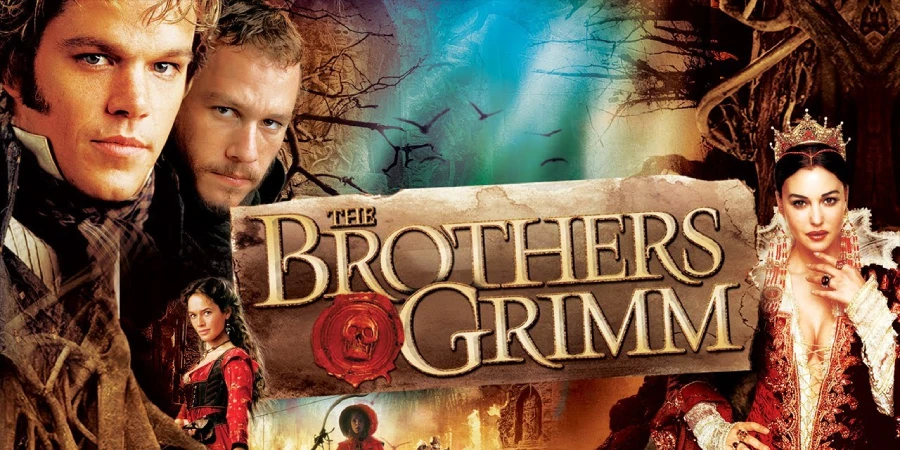

Terry Gilliam spent most of his career fighting studios, and The Brothers Grimm is the film where the studio fought back hardest. Matt Damon and Heath Ledger play con-artist versions of the famous fairy-tale collectors, stumbling into a forest where the stories are horrifyingly real.
Gilliam’s visual fever dream collides with a Miramax-mandated commercial sheen, and the result is genuinely strange: flawed, overstuffed, and oddly charming in ways a more polished film never could be.
Detailed Summary
The Con Men of Karlstadt
We open in 1811 Germany, under French occupation. Will Grimm (Matt Damon) and his brother Jake (Heath Ledger) run a scam: they stage supernatural infestations in superstitious villages, then charge to “cleanse” them. Jake genuinely believes in magic; Will just wants the money.
Their first scene together tells you everything. Will orchestrates the performance with slick confidence, while Jake nervously reads from old folklore texts, half-hoping the rituals are real. The con works, the villagers pay, and the brothers pocket the cash.
The French Authorities Close In
French General Delatombe (Jonathan Pryce) and his Italian torturer Cavaldi (Peter Stormare) catch the brothers mid-scam and force them into a deal. Rather than execute them, Delatombe sends Will and Jake to the village of Marbaden to expose what he assumes is another fraud: children have been disappearing into the nearby enchanted forest.
Delatombe is a magnificent comic villain. Pryce plays him as a man so committed to rationalist scorn that he becomes almost cartoonish, and that is entirely the point.
Marbaden and the Enchanted Forest
Marbaden is a village drained of joy and children. Local hunter Angelika (Lena Headey) becomes an uneasy guide into the forest, where her two sisters vanished years earlier. She knows the woods far better than either brother.
Jake starts collecting evidence of genuine magic: gingerbread that moves, a horse that eats children whole, a tower glimpsed through impossible mist. Will keeps rationalizing, insisting on logical explanations even as the evidence piles up against him.
The Tower and the Mirror Queen
At the forest’s heart stands a tower, sealed for centuries. Inside sleeps the Mirror Queen (Monica Bellucci), a vain medieval ruler who struck a bargain centuries ago: she would stay young and beautiful forever by consuming the life force of twelve young girls. She has been dormant, waiting for her ritual to complete.
Children from Marbaden have been lured into the forest and absorbed into the tower walls, cocooned in webs, their youth feeding her slow resurrection. Each abduction follows a fairy-tale logic, children walking into gingerbread traps, wolves that speak, enchanted lakes.
Jake Falls Under the Spell
Jake becomes increasingly enchanted by the forest itself. He feels a pull toward magic that Will has always dismissed. When Jake finds and touches the magic mirror, the Queen’s influence reaches him directly, drawing him toward the tower.
This is Ledger’s best work in the film. He plays Jake’s wonder and vulnerability without making him seem foolish, conveying genuine awe with wide eyes and a stillness that contrasts sharply with Damon’s rapid-fire scheming.
Will Grimm Grows Up
Will spends most of the film as the cynic being proved wrong, scene by scene. His arc is the more conventional one: a con man who must accept that the world contains real wonder and real danger. Damon plays it with enough self-deprecating humor to keep it watchable, even when the script gives him little to work with.
His feelings for Angelika push him toward genuine bravery. She refuses to play the damsel, which gives their dynamic at least some friction worth watching.
Cavaldi’s Comedic Torments
Peter Stormare’s Cavaldi provides much of the film’s physical comedy, suffering increasingly absurd indignities in the forest, getting smeared with mud, harassed by enchanted creatures, and generally humiliated at every turn. Stormare commits fully to the bit, and his scenes land better than many of the scripted jokes.
The Ritual Nears Completion
As more children disappear, the Mirror Queen grows stronger. Her resurrection requires the blood of twelve girls and a final act tied to the magic mirror. With eleven children already taken, the brothers race against the ritual’s completion.
Angelika’s sister Sasha is among the captured children. This gives Angelika’s urgency a personal weight that Lena Headey plays straight, refusing to let the film’s tonal goofiness undercut her character’s grief.
Movie Ending
Will and Jake finally breach the tower together. Inside, the Mirror Queen has nearly completed her resurrection, absorbing the life from the cocooned children. Jake, still drawn toward her magic, must choose between surrendering to her enchantment and actively fighting it.
Will destroys the magic mirror, which is the source of the Queen’s immortality. Without it, her centuries of borrowed time catch up with her instantly. She ages rapidly and collapses, the tower beginning to crumble around her.
Breaking the mirror also releases the children from their cocoons. They fall free, alive, their stolen youth returned. Sasha is among them, reuniting with Angelika in the film’s most emotionally direct moment.
Jake survives his enchantment. Will survives his skepticism. Both brothers emerge from the forest changed, Jake more grounded, Will more open. Cavaldi and Delatombe, stripped of their authority and their certainty, effectively fade from the story as the supernatural overwhelms any French rationalist framework for making sense of events.
What matters most about this ending is what it says about Jake’s folklore obsession. Every horror in the forest maps onto a fairy tale he already knew. His collections were never just stories: they were field notes. The film closes with the implication that Will and Jake will now record these real experiences as the famous Grimm tales, reframing the brothers’ entire literary legacy as documented truth rather than invented fiction.
Are There Post-Credits Scenes?
The Brothers Grimm has no post-credits scene. Once the story wraps, the film ends cleanly. You can leave when the credits roll.
Type of Movie
This is a dark fantasy adventure with heavy doses of horror and comedy mixed in. Gilliam pitches the tone somewhere between fairy-tale horror and slapstick farce, which creates tonal whiplash that some audiences embrace and others find exhausting.
Think Tim Burton without the restraint, or a Grimm’s anthology told by someone who just drank three espressos and refused to sit still. It earns a PG-13 rating but pushes that rating harder than most films bother to.
Cast
- Matt Damon – Will Grimm
- Heath Ledger – Jake Grimm
- Monica Bellucci – The Mirror Queen
- Lena Headey – Angelika
- Jonathan Pryce – General Delatombe
- Peter Stormare – Cavaldi
- Richard Ridings – Bunst
- Mackenzie Crook – Hidlick
Film Music and Composer
Dario Marianelli composed the score. He leans into Eastern European folk textures, using fiddles, woodwinds, and choir elements to root the music in a fairy-tale Germanic atmosphere without going full orchestral bombast.
Marianelli would go on to win an Academy Award for his work on Atonement two years later, but his work here is underrated. The score for the forest sequences layers dissonant strings under a deceptively simple folk melody, creating unease without announcing itself.
Filming Locations
Principal photography took place in the Czech Republic, primarily in and around Prague. The production also used locations in Germany.
Prague’s mix of Baroque architecture and accessible forests gave the film its authentic Central European texture. Gilliam wanted real stone streets and genuine forest density rather than studio approximations, and the Czech locations delivered that without the budget demands of Western Europe.
The enchanted forest sequences used a combination of practical forest locations and studio-built sets. Gilliam’s production design team extended real trees with constructed elements to create the sense of a forest that does not quite obey natural laws.
Awards and Nominations
The Brothers Grimm received a Saturn Award nomination from the Academy of Science Fiction, Fantasy and Horror Films, but it did not win major awards on the circuit. The film’s reputation during its release was mixed enough to keep it off the major shortlists.
Behind the Scenes Insights
- Gilliam had a notoriously difficult production on this film, clashing repeatedly with producers Bob and Harvey Weinstein over creative control, pacing, and the film’s tone.
- Gilliam wanted a darker, stranger cut of the film; the Weinsteins pushed for something more commercially accessible, and the resulting compromise pleased neither side fully.
- Matt Damon and Heath Ledger reportedly had different acting approaches on set, with Ledger favoring a more improvisational style and Damon preferring a structured preparation method.
- Gilliam considered the shoot one of the most difficult of his career, citing interference at almost every stage of post-production.
- Monica Bellucci’s Mirror Queen role required extensive makeup and costume work for her resurrection sequences, with prosthetic aging applied for the finale.
- The horse-that-eats-children scene required significant visual effects work and was one of the most technically demanding sequences in the production.
Inspirations and References
Ehren Kruger’s screenplay draws directly from the actual biography of Jacob and Wilhelm Grimm, the 19th-century German academics who collected and published fairy tales. The real brothers did travel through German villages gathering folk stories, though obviously without the supernatural encounters the film invents.
The film remixes specific Grimm tales throughout its plot. Rapunzel appears in the tower imagery, Little Red Riding Hood echoes in the wolf sequences, Hansel and Gretel supplies the gingerbread trap, and Snow White contributes the magic mirror and the sleeping queen motif.
Gilliam’s broader visual sensibility pulls from Hieronymus Bosch, Czech surrealist cinema, and his own earlier work on Time Bandits and The Adventures of Baron Munchausen.
Alternate Endings and Deleted Scenes
Gilliam’s conflict with the Weinsteins meant the film went through multiple editorial passes. A longer, darker cut of the film reportedly existed at various points in post-production, though no official director’s cut has been released.
Several scenes with Cavaldi were reportedly trimmed for pacing. Given that Stormare’s scenes are among the film’s most entertaining, those cuts feel like genuine losses.
Book Adaptations and Differences
The Brothers Grimm is not based on a specific book. Ehren Kruger wrote an original screenplay that uses the real Grimm brothers as characters and incorporates elements from their published fairy-tale collections, but no single source novel exists. A novelization of the film was published alongside its release, reversing the usual adaptation direction.
Memorable Scenes and Quotes
Key Scenes
- The gingerbread horse sequence, in which a child follows a trail of crumbs and is swallowed whole by a horse whose mouth opens impossibly wide: disturbing, darkly funny, and the film’s purest distillation of Grimm horror logic.
- Jake’s first full sight of the tower through the mist, scored with Marianelli’s folk melody swelling underneath, Ledger standing completely still while Damon tries to pull him away.
- The Mirror Queen’s resurrection scene, with Bellucci emerging from a web-covered alcove as children’s life force flows visibly into her skin.
- Cavaldi’s running encounter with the mud monster, played for pure physical comedy with Stormare using his entire body in a performance that belongs in a much broader farce.
- Will smashing the mirror while the Queen ages in real time, a practical effects moment that actually works.
Iconic Quotes
- “You don’t believe in magic, Will. But magic believes in you.” (Jake Grimm)
- “There is no magic. There is only what men do when they are desperate.” (Will Grimm)
- “I am French. I do not have to explain myself.” (General Delatombe)
Easter Eggs and Hidden Details
- The twelve children taken by the Mirror Queen mirror the structure of several Grimm tales that use twelve as a ritual number, including The Twelve Dancing Princesses.
- Jake’s notebook, visible in several scenes, contains sketches that reference specific Grimm tale illustrations from 19th-century published editions.
- The French soldiers’ uniforms contain deliberate anachronistic details as a nod to Gilliam’s habit of slightly distorting historical accuracy for visual effect, a technique he used extensively in Brazil.
- The gingerbread trail leading to the horse is a direct visual quotation of Hansel and Gretel, with the horse substituting for the witch’s house.
- Angelika’s red riding hood, worn in several forest scenes, is an unmistakable visual reference that the film never draws explicit attention to, letting the audience catch it on their own.
Trivia
- The real Jacob and Wilhelm Grimm published their first collection of folk tales in 1812, one year after the film is set, which is a deliberate narrative choice implying the film’s events inspired the collection.
- Gilliam described this as a “film for hire” in several interviews, distinguishing it from his more personal projects, though his visual fingerprints are all over it despite the studio interference.
- Heath Ledger’s performance was widely praised even by critics who dismissed the film overall, with many noting his ability to carry emotional weight in a broad genre context.
- Jonathan Pryce and Terry Gilliam had previously worked together on Brazil, making Pryce’s casting a deliberate reunion.
- The film sat on the shelf for a significant period before its release while Gilliam and the Weinsteins disputed the final cut.
- Peter Stormare’s Cavaldi was originally written as a less comedic character; Stormare pushed the physical comedy further during production.
Why Watch?
Watch it for Heath Ledger, who finds genuine feeling inside a film that often does not deserve him: the scene where he stands frozen at the tower’s edge, torn between wonder and terror, is a small master class in physical restraint. Gilliam’s forest set design also earns a look on its own terms, all wrong angles and impossible growth that no amount of CGI smoothing can fully neutralize.
Director’s Other Movies
- Jabberwocky (1977)
- Time Bandits (1981)
- Brazil (1985)
- The Adventures of Baron Munchausen (1988)
- The Fisher King (1991)
- 12 Monkeys (1995)
- Fear and Loathing in Las Vegas (1998)
- The Imaginarium of Doctor Parnassus (2009)
- The Zero Theorem (2013)
- The Man Who Killed Don Quixote (2018)
Recommended Films for Fans
- Sleepy Hollow (1999)
- Pan’s Labyrinth (2006)
- Snow White and the Huntsman (2012)
- Into the Woods (2014)
- Hansel and Gretel: Witch Hunters (2013)
- The Adventures of Baron Munchausen (1988)
- Time Bandits (1981)
- Crimson Peak (2015)