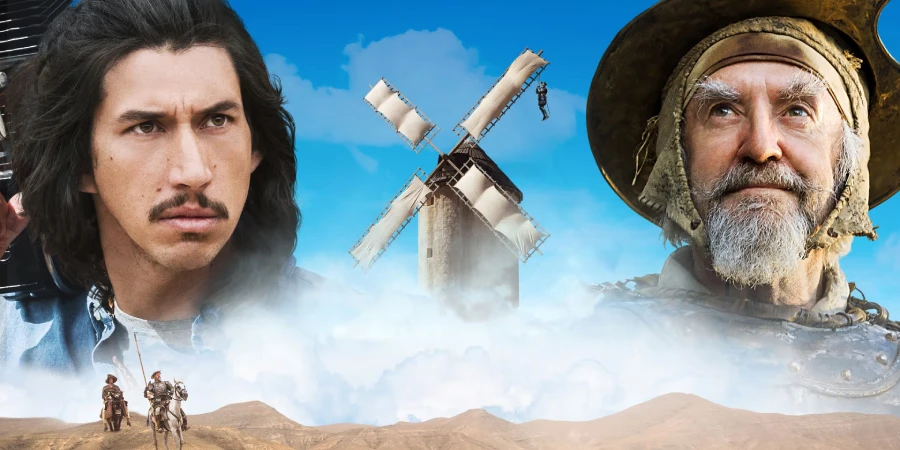
Terry Gilliam spent nearly three decades trying to make this film, and the finished product feels like it. The Man Who Killed Don Quixote is a story about obsession eating itself alive, and Gilliam somehow made that the entire point. A cynical commercial director gets pulled into the delusions of an old man who genuinely believes he is Sancho Panza, and neither the film nor its protagonist can quite escape that gravity. Adam Driver and Jonathan Pryce anchor the chaos with performances that keep the absurdity from collapsing into pure noise.
Detailed Summary
Toby’s Arrival in Spain
Toby Grisoni (Adam Driver) is a burned-out advertising director shooting a commercial in a Spanish village. He once made a student film in that same region, and finding a bootleg copy of it triggers his curiosity. He sets off to locate the people he cast as a young man, and that decision unravels everything.
Rediscovering the Old Film
Toby tracks down Javier (Jonathan Pryce), the elderly shoemaker he cast as Don Quixote in his student project. Javier now believes he actually is Don Quixote. He greets Toby as his faithful squire Sancho Panza, and Toby, initially resistant, gets dragged along.
Angelica’s Fate
Toby also searches for Angelica (Joana Ribeiro), the young woman he cast as Dulcinea. He discovers that his film changed her life in a destructive direction. She left the village, became involved with wealthy and dangerous men, and now moves through a world of exploitation and parties thrown by a Russian oligarch named Alexei (Jordi Molla).
Toby as the Reluctant Sancho
Much of the film’s middle section follows Toby and Javier riding through the Spanish countryside. Javier attacks windmills, mistakes travelers for knights, and charges at perceived enemies. Toby keeps trying to ground him in reality, but reality keeps sliding away.
This is where Driver does his best work. He plays Toby’s mounting panic with a physical restlessness, constantly shifting, wincing, half-reaching out to stop Javier before pulling back. His discomfort reads as guilt, not irritation.
The Boss and the Party
Toby’s employer, the shady producer Alexei, hosts a medieval-themed party. Javier crashes it, still inhabiting his Quixote persona. Toby tries to contain the chaos while also confronting the full damage his youthful filmmaking ambition caused to Angelica and her village.
Angelica and the Mirror
Angelica eventually reconnects with Toby. Their scenes carry a low current of mutual reproach. She blames him for putting ideas in her head, and he cannot entirely disagree. Her arc is the film’s moral spine, even if the script does not always give Ribeiro enough space.
Javier’s Deterioration
As the story progresses, Javier’s physical condition worsens. His belief in himself as Don Quixote never wavers, but his body clearly struggles. The film treats his delusion with a strange tenderness rather than mockery.
Movie Ending
Javier dies in the film’s final act. He goes out fully believing he is Don Quixote, killed by an arrow during a skirmish that feels both ridiculous and genuinely sad. Pryce plays the death scene with a quiet dignity that catches you off guard after two hours of broad comedy.
Toby cradles him, and something shifts. He stops resisting the fiction. In the film’s closing moments, Toby rides Javier’s horse through the landscape, and a group of local children begin calling him Don Quixote. He does not correct them.
Toby has become the thing he spent the whole film running from. He accepts the role of the deluded knight, willingly stepping into a story that destroyed its previous believer. Whether Gilliam reads this as liberation or tragedy is deliberately left open, and that ambiguity is the most honest choice in the film.
Angelica watches him ride away. Her expression is unreadable, somewhere between pity and recognition. She understands what has happened to him, because the same film that broke Javier first broke her.
Are There Post-Credits Scenes?
No. The Man Who Killed Don Quixote has no post-credits scene. Once the story closes, it closes completely.
Type of Movie
This is a surrealist comedy-drama with strong elements of magical realism and road movie structure. It sits somewhere between Cervantes-inflected fable and meta-cinematic satire about filmmaking ambition. Tonally it swings from slapstick to melancholy without much warning, which is either a feature or a bug depending on your patience for Gilliam.
Cast
- Adam Driver – Toby Grisoni
- Jonathan Pryce – Javier / Don Quixote
- Joana Ribeiro – Angelica
- Stellan Skarsgard – Alexei
- Olga Kurylenko – Jacqui
- Jordi Molla – The Boss
- Jason Watkins – Rupert
- Hovik Keuchkerian – Raul
Film Music and Composer
Roque Banos composed the score. He is a Spanish composer with a career spanning both Hollywood productions and Spanish-language cinema, which made him a natural fit for a film so rooted in Iberian landscape and literary history.
His score blends flamenco textures with orchestral passages, grounding the fantasy sequences in something earthy and specific. It never oversells the whimsy, which is exactly right for this material.
Filming Locations
Principal photography took place in Spain and Portugal. The production shot in locations that evoke the arid, windmill-dotted plains associated with Cervantes’s original novel, giving the film an authentic geographical texture that Gilliam clearly wanted.
Shooting in actual Spanish landscapes rather than studio recreations pays off. When Javier charges at a real windmill under a real Castilian sky, the image lands differently than any set could produce. That friction between genuine location and absurd fiction is central to Gilliam’s whole argument.
Awards and Nominations
The Man Who Killed Don Quixote received a modest awards profile. It screened at Cannes in 2018, where it received the Honorary Palme d’Or of the evening screening but did not compete for the main prize. Jonathan Pryce’s performance attracted considerable critical praise but did not translate into major awards nominations.
Behind the Scenes Insights
- Gilliam first attempted to shoot the film in 2000. That failed production became the subject of the documentary Lost in La Mancha (2002), which captured the flood damage, cast illness, and military jets that destroyed the shoot.
- Jeff Bridges and Jean Rochefort were originally cast in the ill-fated 2000 version. Rochefort, who played Don Quixote, suffered a hip problem that made riding a horse impossible, which helped end that production.
- Multiple actors passed through the project over the decades, including Robert Duvall and John Hurt, before Jonathan Pryce finally took the role.
- Gilliam fought a legal battle with producer Paulo Branco, who attempted to block the film’s Cannes premiere. Gilliam won, and the film screened on its original date.
- Adam Driver signed on after a long search for a lead who could balance physical comedy with genuine dramatic weight.
- Gilliam shot the film largely on location in Spain and Portugal, insisting on practical environments rather than green screen for the fantasy sequences.
Inspirations and References
Miguel de Cervantes’s novel Don Quixote (published in two parts, 1605 and 1615) is the primary source. Gilliam does not adapt the novel directly. He uses it as a mirror held up to filmmaking itself, with Toby standing in for any director who casts real people in a fantasy and then walks away from the damage.
Federico Fellini’s 8½ hangs over the entire film. Both stories follow artists confronting the gap between their self-image and the wreckage they have left behind. Gilliam has cited Cervantes and various cinematic influences on the project over the years of its development.
Luis Bunuel’s surrealist tradition is also visible, particularly in the blurring of what is real and what Javier perceives. Spain as a dreamscape with a violent undertow connects the film to that lineage.
Alternate Endings and Deleted Scenes
No officially released alternate ending or major deleted scenes package has been made public. Given the film’s notoriously fractured production history across nearly three decades, earlier versions of the screenplay circulated with different structural approaches, but nothing from those drafts has been presented as a formal alternate cut.
Book Adaptations and Differences
This film is not a direct adaptation of Don Quixote by Cervantes. It borrows characters, imagery, and thematic obsessions from the novel but builds an entirely original story around them. Cervantes’s Quixote is an aged gentleman who reads too many chivalric romances and loses his grip on reality. Gilliam’s Javier is a man whose reality was reshaped by a young filmmaker’s vanity project, which is a pointed update to the source’s central diagnosis.
Memorable Scenes and Quotes
Key Scenes
- Javier’s first encounter with a windmill in the present-day story: he charges it on horseback with total conviction while Toby watches in horror, and the camera holds on Toby’s face long enough to confirm his guilt is already setting in.
- Toby watching his own student film on a small screen: Driver sits perfectly still, and you can see him calculating every bad decision he made as a young man.
- Javier’s death: Pryce drops the comic register entirely and plays it straight, arms extended, face turned upward, the absurd costume suddenly looking like something from a painting rather than a joke.
- The medieval party sequence: costumed guests mill around Alexei’s estate while Javier wanders through, the only person present who genuinely believes in the fiction everyone else is performing ironically.
- Toby riding away at the end: no dialogue, just the horse moving through pale light while children trail behind calling out the wrong name.
Iconic Quotes
- “I made you what you are. And now you want to walk away?” Javier to Toby, early in their reunion, which hits differently by the final scene.
- “Sancho, there are no windmills here. Only giants.” Javier, with complete sincerity, pointing at something only he can see.
- Toby, near the end: “Maybe I was always Sancho.” A small admission that carries the weight of the entire film behind it.
Easter Eggs and Hidden Details
- Several props in the film’s contemporary advertising sequences mirror objects from Cervantes’s original text, including a battered helmet that resembles the famous barber’s basin Quixote mistakes for the legendary Helmet of Mambrino.
- Toby’s student film within the film uses a visual grammar that deliberately echoes early Gilliam work, blurring the line between the character’s past and the director’s autobiography.
- Background extras at the medieval party are dressed in costumes that reference specific Cervantes characters beyond Quixote and Sancho, rewarding viewers familiar with the novel.
- The village where Toby originally shot his student film is presented as nearly unchanged, suggesting time stopped there when he left, a quiet visual nod to Quixote’s own suspension outside ordinary time.
Trivia
- Gilliam first conceived the project in the early 1990s, making its 2018 completion a nearly 30-year odyssey.
- The failed 2000 production is one of the most documented disasters in film history, largely because of Lost in La Mancha, which remains essential viewing alongside the finished film.
- Jonathan Pryce learned to ride a horse for the role at an age when most actors would have negotiated a stunt double for every scene.
- Adam Driver shot the film during a period when his profile was rising rapidly thanks to the Star Wars sequel trilogy, giving his casting a certain irony: a newly minted blockbuster actor playing a man who regrets his youthful artistic compromises.
- Gilliam is British-American but has made Spain and Portugal a recurring backdrop in his work; his personal connection to Iberian landscape is well documented.
- The film’s title refers to the meta-layer of the story: the student film Toby made was literally called The Man Who Killed Don Quixote, so the finished Gilliam film shares its title with the fictional student film nested inside it.
Why Watch?
Watch it for Jonathan Pryce, who makes a delusional old man on horseback feel genuinely heartbreaking without ever asking for your sympathy. His death scene alone justifies sitting through the film’s more self-indulgent stretches. Gilliam’s 30-year obsession gives every frame a strange biographical charge that no other director could manufacture.
Director’s Other Movies
- Monty Python and the Holy Grail (1975)
- Time Bandits (1981)
- Brazil (1985)
- The Adventures of Baron Munchausen (1988)
- The Fisher King (1991)
- 12 Monkeys (1995)
- Fear and Loathing in Las Vegas (1998)
- The Brothers Grimm (2005)
- Tideland (2005)
- The Imaginarium of Doctor Parnassus (2009)
- The Zero Theorem (2013)