
Jacques Demy’s debut feature is not a love story so much as a meditation on waiting, and on the people we become while we wait. Set in the port city of Nantes, Lola (1961) follows a constellation of restless souls circling one another with quiet longing. It arrives dressed in the visual language of the French New Wave but carries the emotional warmth of a Hollywood musical, minus the songs. Moreover, it launched one of cinema’s most quietly radical careers.
Detailed Summary
Roland and His Restlessness
We meet Roland Cassard, a young man adrift in Nantes with no real job, no clear direction, and a persistent sense that life is happening somewhere else. He turns down a lucrative but morally compromised offer involving diamond smuggling, which tells us something important: Roland has principles, even if he lacks purpose.
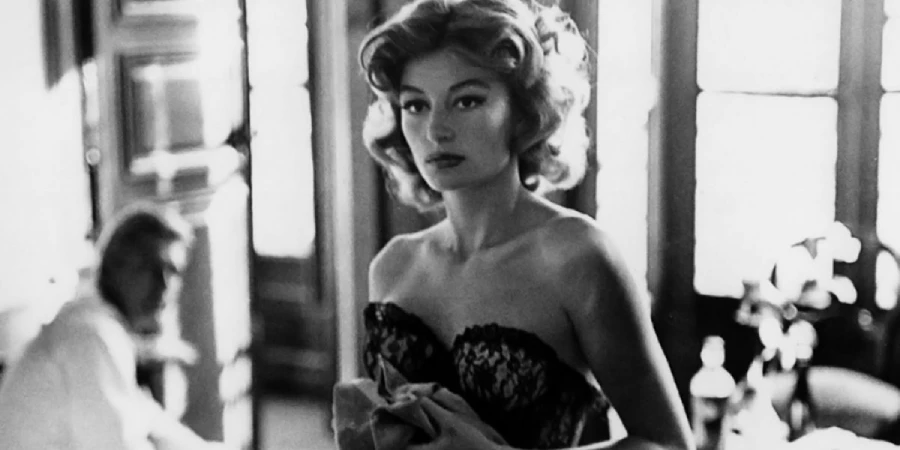
Roland reconnects with a childhood acquaintance, Lola, who works as a cabaret dancer. She is warm, luminous, and completely unavailable in spirit, because every inch of her heart belongs to a man named Michel, the father of her young son, who vanished years ago.
Lola and the Ghost of Michel
Lola, whose real name is Cecile, has constructed her entire emotional life around Michel’s eventual return. She refuses to love anyone else fully. Roland clearly loves her, but she keeps him at arm’s length with a gentle, almost apologetic affection.
Her situation is neither desperate nor bitter. In contrast, she radiates a kind of luminous patience. Demy frames her as someone who has chosen hope over pragmatism, and the film never mocks her for it.
The American Sailor
A subplot introduces Frankie, an American sailor stationed near Nantes, who becomes enchanted with Lola. He represents a different kind of attention, uncomplicated, physical, and temporary. Lola enjoys his company without confusing it for love.
Frankie also befriends a young girl named Cecile (sharing the name with Lola, which is one of Demy’s quiet games). This Cecile is a teenager navigating her own daydreams about romance and escape. Their dynamic adds a layer of gentle innocence to a film already rich in emotional texture.
Madame Desnoyers and Her Own Longing
Roland’s mother, Madame Desnoyers, carries a subplot about her own solitude. She is aging, observant, and quietly resigned to a life that did not unfold as she imagined. Her presence grounds the film in something universal: the way longing persists across generations.
Roland’s Departure
Roland ultimately accepts the diamond deal and prepares to leave Nantes. Before he goes, he says a tender goodbye to Lola. He knows she does not love him the way he loves her, and he accepts this without bitterness, which makes him one of cinema’s more quietly dignified heartbroken figures.
His departure feels less like defeat and more like release. Consequently, Demy frames it as melancholic but not tragic, a man moving forward because staying still has stopped making sense.
Michel’s Return
In the film’s closing movement, Michel finally returns, arriving in a white car, wealthy and transformed. Lola’s long vigil ends. He has come back for her and for their son. Her faith, which the film has treated with absolute sincerity, turns out to be justified.
Movie Ending
Michel’s arrival does not feel like a conventional happy ending, though it functions as one on the surface. He pulls up in Nantes looking prosperous and purposeful, and Lola rushes to him with the kind of joy that only years of patient waiting can produce. Demy stages it simply, without fanfare, which makes it hit harder.
Meanwhile, Roland is gone. He has taken a path toward something uncertain but forward-moving. The film positions these two trajectories side by side without judging either. Roland’s absence at the moment of Lola’s fulfillment gives the ending a bittersweet edge that pure romance would not allow.
What Demy seems to argue is that time operates differently for different people. Lola waited and was rewarded. Roland moved on and may find his own version of arrival elsewhere. Notably, Demy would later revisit Roland’s character in Bay of Angels (1963) and eventually in The Umbrellas of Cherbourg (1964), extending this sense that his films share a living, breathing world.
The ending also validates Lola’s emotional logic, which the film never dismissed as naivety. She knew Michel. She trusted that knowledge. Demy treats female intuition and devotion not as weakness but as a form of courage. That is a genuinely radical choice for 1961.
Are There Post-Credits Scenes?
Lola contains no post-credits scenes. It was released in 1961, well before that convention existed in cinema. Once the film ends, it ends completely, which is entirely in keeping with Demy’s clean, uncluttered storytelling style.
Type of Movie
Lola occupies a graceful intersection of romantic drama and lyrical realism. Demy was clearly influenced by both the French New Wave and classic Hollywood melodrama, and this film sits between those two worlds without fully belonging to either.
Its tone is gentle, wistful, and occasionally playful. There is no villain, no catastrophe, no explosive conflict. Instead, Demy builds tension entirely out of longing, timing, and the emotional weight of ordinary encounters.
Cast
- Anouk Aimee – Lola (Cecile)
- Marc Michel – Roland Cassard
- Jacques Harden – Michel
- Alan Scott – Frankie
- Annie Duperoux – Cecile (the young girl)
- Elina Labourdette – Madame Desnoyers
Film Music and Composer
Michel Legrand composed the score for Lola, beginning one of cinema’s most celebrated director-composer partnerships. Legrand and Demy would go on to collaborate on The Umbrellas of Cherbourg and The Young Girls of Rochefort, both of which became landmarks of musical cinema.
Legrand’s work here is more understated than his later work with Demy. The score supports the film’s emotional rhythms without overwhelming them. It leans into jazz-inflected romanticism, which perfectly suits a story set in a port city full of transient longing.



Filming Locations
Lola was shot almost entirely in Nantes, Demy’s hometown. This choice was deeply personal. Demy grew up there, and his affection for the city’s streets, arcades, and harbor permeates every frame.
Nantes functions as more than a backdrop. Its port gives the story a natural metaphor for arrivals and departures, for people passing through and people waiting. The city’s architecture, simultaneously provincial and full of maritime energy, mirrors Lola’s emotional state precisely.
Awards and Nominations
Lola received critical admiration upon release and is now considered a landmark of French cinema, though it did not collect major international awards at the time. It screened at the Cannes Film Festival in 1961, where it gained significant attention from critics and fellow filmmakers.
Behind the Scenes Insights
- Demy originally wanted to shoot Lola in color but lacked the budget; he chose high-contrast black and white cinematography instead, which ultimately became one of the film’s defining visual qualities.
- Raoul Coutard, the cinematographer closely associated with Godard’s early work, was considered for the project; Raoul Coutard did not shoot the film. Instead, Henri Decae served as director of photography, bringing a crisp, luminous quality to the Nantes locations.
- Demy dedicated the film to Max Ophuls, whose swirling, romantically fatalistic filmmaking style clearly shaped Demy’s own sensibility.
- Anouk Aimee brought significant improvisational warmth to the role; Demy reportedly gave her considerable freedom in her physical performance, particularly in the dance sequences.
- The film was made on a very tight budget, which forced creative solutions that ended up enhancing the film’s naturalistic feel rather than limiting it.
Inspirations and References
Demy openly cited Max Ophuls as his primary inspiration, and the influence shows in the film’s circular, fate-driven structure and its treatment of romantic longing as a kind of gravitational force. Ophuls’ La Ronde and Lola Montes both echo through Demy’s debut.
The Hollywood musical also shaped Demy’s vision here, particularly in his desire to blend stylization with genuine emotional realism. Furthermore, the film references the tradition of American film noir in its use of shadowy port-city atmosphere and a protagonist who skirts moral compromise.
Demy also drew on his own memories of Nantes, making the film partly autobiographical in its geography if not its plot. The city and its particular quality of waiting-by-the-water clearly came from lived experience.
Alternate Endings and Deleted Scenes
No verified alternate endings or significant deleted scenes from Lola are part of the public record. Given the film’s tight production and Demy’s precise creative vision from the outset, major structural changes during editing appear unlikely.
Book Adaptations and Differences
Lola is not based on a book or any pre-existing literary source. Jacques Demy wrote the original screenplay himself. It is an entirely original work, rooted in his personal connection to Nantes and his affection for romantic cinema traditions.



Memorable Scenes and Quotes
Key Scenes
- Lola dancing in the cabaret, luminous and unselfconscious, establishing her character’s particular brand of joyful melancholy in a single sequence.
- Roland and Lola’s gentle, almost resigned conversation in which he makes his feelings clear and she makes her unavailability equally clear, without either of them raising their voice.
- Frankie and young Cecile wandering the streets of Nantes, a scene that captures the film’s theme of people orbiting one another without quite connecting.
- Michel’s arrival in the white car at the film’s end: simple, unannounced, and completely devastating in its quiet fulfillment of everything Lola has been waiting for.
- Roland walking away from Nantes, his figure receding into a city that never quite belonged to him, setting up his future appearances in Demy’s other films.
Iconic Quotes
- “You have to believe in something.” (Lola, on why she keeps waiting for Michel)
- “I’m not unhappy. I’m just waiting.” (Lola, capturing the film’s central emotional register)
Easter Eggs and Hidden Details
- Both the cabaret dancer and the young girl share the name Cecile, which is Lola’s real name. This doubling suggests that Lola sees something of her younger, pre-waiting self in the teenager.
- Demy’s dedication to Max Ophuls appears in the credits, pointing viewers toward the film’s primary cinematic ancestor and essentially providing a reading guide for the film’s style.
- Roland Cassard reappears as a character in Demy’s later films, meaning Lola contains the seed of an entire shared cinematic universe; catching his name in other Demy films rewards attentive viewers.
- The white car in which Michel returns echoes the visual symbolism of purity and promise; in a film shot in black and white, Demy goes out of his way to highlight that the car is white through dialogue and emphasis.
- Nantes’ famous Passage Pommeraye, a stunning nineteenth-century shopping arcade, appears in the film and later became a recurring Demy location, functioning almost as a signature of his hometown films.
Trivia
- Lola was Jacques Demy’s feature debut, released when he was just thirty years old.
- Anouk Aimee went on to international stardom the following year with Federico Fellini’s 8 1/2, but her performance in Lola remains among the most celebrated of her career.
- Michel Legrand and Demy’s collaboration on this film led directly to their work on The Umbrellas of Cherbourg, which won the Palme d’Or at Cannes in 1964.
- Demy considered Lola the foundation of a loosely connected fictional world; characters from the film reappear across his filmography, making repeat viewings of his work richly rewarding.
- The film’s title refers to a stage name, not a real name, which is itself a clue about the character’s relationship to identity and performance.
- Demy shot the film in a style that was simultaneously influenced by Italian neorealism and classic Hollywood studio romance, a combination almost nobody else was attempting in French cinema at the time.
Why Watch?
Lola offers something rare: a romantic film that respects both its characters and its audience, never forcing sentiment, never cheating its way to resolution. Anouk Aimee gives a performance of extraordinary lightness and depth. For anyone curious about French cinema or the origins of Demy’s singular world, this is the essential starting point.
Director’s Other Movies
- Bay of Angels (1963)
- The Umbrellas of Cherbourg (1964)
- The Young Girls of Rochefort (1967)
- Model Shop (1969)
- Donkey Skin (1970)
- A Slightly Pregnant Man (1973)
- Lady Oscar (1979)
- Une chambre en ville (1982)
- Parking (1985)
- Three Seats for the 26th (1988)
Recommended Films for Fans
- The Umbrellas of Cherbourg (1964)
- La Ronde (1950)
- Breathless (1960)
- Jules and Jim (1962)
- 8 1/2 (1963)
- Cleo from 5 to 7 (1962)
- Bay of Angels (1963)
- A Woman Is a Woman (1961)