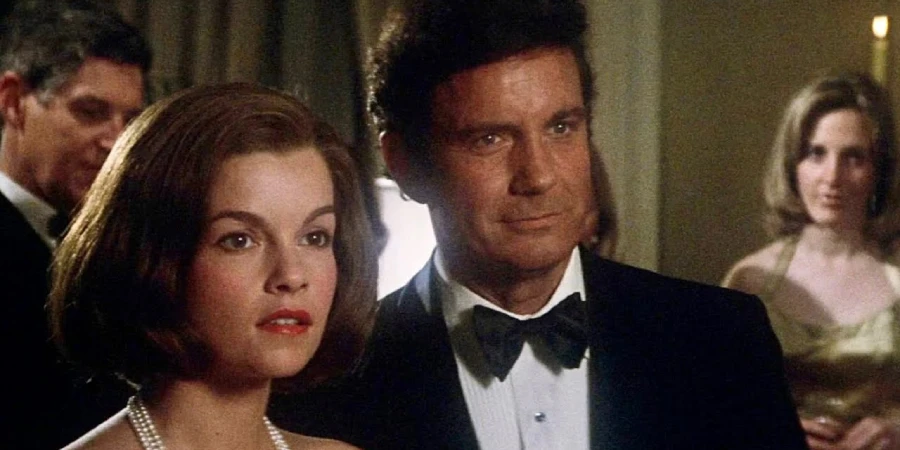

Brian De Palma made a film about grief, obsession, and incest, and somehow convinced audiences they were watching a love story. Obsession (1976) is one of Hollywood’s most audacious Hitchcock homages, borrowing the skeleton of Vertigo and dressing it in Bernard Herrmann’s sweeping, tragic score. It stars Cliff Robertson as a man so destroyed by loss that he rebuilds his wife from a stranger, only to discover the stranger is his own daughter. This film is gloriously, dizzyingly wrong in the best possible way.
Detailed Summary
New Orleans, 1959: A Perfect Life Shattered
Michael Courtland (Cliff Robertson) is a wealthy New Orleans real estate developer celebrating his anniversary with his wife, Elizabeth (Genevieve Bujold), and their young daughter, Amy. Life looks picture-perfect on the surface. However, a kidnapping shatters everything in one devastating night.
Criminals abduct Elizabeth and Amy, demanding a ransom. Michael cooperates with the FBI, who persuade him to hand over marked bills. The exchange goes catastrophically wrong: Elizabeth and Amy die in a car accident during the botched handoff.
Michael spends years consumed by guilt. He blames himself, and arguably he should, since following the FBI’s advice cost him everything. His business partner, Bob LaSalle (John Lithgow), watches helplessly as Michael withdraws from the world.
Florence, 1975: The Double Appears
Sixteen years later, Michael travels to Florence, Italy, the city where he and Elizabeth honeymooned. He visits the church of San Miniato al Monte, the very spot where he and Elizabeth first fell in love. There, he sees her.
Sandra Portinari (also played by Genevieve Bujold) is a young art restoration student working inside the church. She looks identical to the dead Elizabeth. Michael is immediately, hopelessly transfixed.
He begins pursuing Sandra with an intensity that crosses every reasonable boundary. Consequently, he essentially recreates his courtship of Elizabeth, revisiting the same church, the same gestures, the same emotional beats. Sandra, somewhat improbably, falls for him.
The Courtship and the Warning Signs
Michael brings Sandra back to New Orleans and installs her in his life like a replacement part. Bob watches this with visible unease. He recognizes what Michael is doing, and he understands something Michael does not yet know.
Sandra plays along, but small moments suggest she knows more than she reveals. Her reactions to certain locations feel too specific, too personal. Moreover, her emotional responses to Michael carry a weight that pure infatuation alone cannot explain.
Michael proposes marriage to Sandra, and she accepts. Everything seems to be moving toward a twisted fairy-tale resolution. In contrast, the audience begins sensing that something far darker is operating beneath the surface.
The Kidnapping Repeats
History repeats itself with brutal precision. Sandra is kidnapped, mirroring the original abduction of Elizabeth and Amy almost exactly. Michael receives ransom demands and faces the same agonizing choices he faced in 1959.
This time, Michael defies the FBI. He pays the ransom himself, determined not to repeat his past mistake. As a result, he hands over the money and goes to retrieve Sandra.
Bob, meanwhile, has been acting strangely throughout the film’s second half. His nervousness and evasiveness have accumulated into something that now demands explanation. Everything converges in the film’s final act.

Movie Ending
Michael arrives at the location where Sandra is held and finds her alive. Relief lasts approximately thirty seconds. Sandra then reveals the truth that reframes every single scene the audience has watched.
Sandra is Amy, his daughter. She did not die in the 1959 accident. Bob LaSalle, who secretly loved Elizabeth, orchestrated the original kidnapping and then raised Amy in Italy under a new identity. Bob blamed Michael for Elizabeth’s death and built this entire elaborate scheme as revenge, engineering the situation so that Michael would fall in love with his own child.
Amy, raised as Sandra and told a distorted version of her history, came into this knowing who Michael was. Her motivations are layered and genuinely disturbing: she wanted to confront her father, perhaps punish him, perhaps connect with him, perhaps all three simultaneously. Genevieve Bujold plays the revelation with an expression that contains grief, anger, and something uncomfortably close to love.
Bob dies during the climax, either from a heart attack or in the chaos of the confrontation, removing himself as a clean narrative villain before he can fully answer for what he engineered. Michael, shattered and disoriented, faces his daughter at the airport as she attempts to flee.
In the film’s final image, Michael and Amy run toward each other in slow motion as the camera rotates around them. De Palma shoots it exactly like a romantic reunion. Herrmann’s score swells with the same overwhelming emotion it uses for the love scenes. This deliberate ambiguity is the film’s most provocative choice: De Palma refuses to editorialize. He presents incest-adjacent reunion as rapture, forcing the audience to sit with their own discomfort. It is deeply unsettling, and almost certainly intentional.
Are There Post-Credits Scenes?
Obsession contains no post-credits scenes. The film ends with its final shot, and the credits roll over silence. Nothing follows.
Type of Movie
Obsession is a psychological thriller with strong elements of romantic melodrama and gothic mystery. Its tone is operatic and dreamlike, occasionally tipping into surrealism. De Palma sustains a mood of swooning dread throughout.
In contrast to the grittier thrillers of the same era, this film prioritizes emotional intensity over action. It is slow-burn by design, building its horror through mood rather than violence.
Cast
- Cliff Robertson – Michael Courtland
- Genevieve Bujold – Elizabeth Courtland / Sandra Portinari
- John Lithgow – Bob LaSalle
- Wanda Blackman – Amy Courtland
Film Music and Composer
Bernard Herrmann composed the score for Obsession, and it ranks among the finest work of his final years. Herrmann had famously scored Vertigo for Hitchcock in 1958, which makes his presence here feel almost cosmically appropriate. De Palma specifically sought him out for that reason.
Herrmann wrote a lush, sweeping, choral-driven score built around romantic excess. The music consistently oversells the emotion on screen, which is precisely the point: it mirrors Michael’s delusional grandeur. Tragically, Herrmann died on December 24, 1975, just after completing the recording sessions for this film.
His death gave Obsession an additional layer of melancholy. Furthermore, it made this score a kind of farewell, the final statement of one of Hollywood’s greatest film composers.


Filming Locations
Production used New Orleans, Louisiana extensively for the American sequences. The city’s lush, decaying grandeur suits Michael’s world perfectly: beautiful on the surface, rotten underneath. Spanish moss and antebellum architecture do atmospheric heavy lifting throughout.
For the Italian sequences, the crew filmed on location in Florence, Italy, most notably at the Basilica di San Miniato al Monte. This real church sits above Florence on a hilltop, lending the Sandra scenes a genuinely ethereal quality that a studio set could never replicate.
De Palma’s location choices reinforce the film’s themes of memory and idealization. Florence, a city defined by Renaissance beauty and artistic devotion, becomes the perfect setting for a man worshipping an image rather than a person.
Awards and Nominations
Genevieve Bujold received a BAFTA nomination for Best Actress for her dual performance. Bernard Herrmann’s score also earned significant critical recognition following his death. However, the film did not achieve major awards success at the time of its release.
Behind the Scenes Insights
- Brian De Palma and screenwriter Paul Schrader reportedly had significant creative disagreements during production, particularly regarding the film’s ending and its moral framing.
- De Palma has openly cited Vertigo as the primary inspiration, describing Obsession as a conscious act of homage rather than imitation.
- Genevieve Bujold had to modulate two distinct versions of essentially the same character, differentiating Elizabeth and Sandra through subtle physical and emotional adjustments rather than obvious performance choices.
- Bernard Herrmann reportedly embraced the project enthusiastically, partly because it allowed him to revisit the emotional territory of Vertigo, a film he considered among his best work.
- John Lithgow, relatively early in his screen career at this point, plays Bob LaSalle with a nervous energy that retrospectively signals guilt in every scene.
- De Palma’s use of slow motion and 360-degree camera rotations became signatures of his style, and Obsession represents some of his earliest and most sustained use of these techniques.
Inspirations and References
Obsession draws its central architecture almost entirely from Alfred Hitchcock’s Vertigo (1958): a man loses a woman, finds her double, becomes obsessed with transforming the double into the original, and discovers a devastating hidden truth. De Palma transplants this structure into a Southern Gothic setting and amplifies the transgressive elements considerably.
Paul Schrader has discussed the film’s debt to classic melodrama traditions, particularly the work of directors like Douglas Sirk. Schrader’s screenplay layers psychological complexity beneath what could easily have been a simple thriller premise.
Notably, the Florentine church setting carries an echo of Dante’s Vita Nuova, in which the poet Dante Alighieri first sees Beatrice Portinari near Florence, a connection reinforced by Sandra’s surname, Portinari.
Alternate Endings and Deleted Scenes
Paul Schrader has indicated that his original screenplay envisioned a darker, more explicitly condemnatory ending than the one De Palma filmed. Schrader reportedly wanted the film to confront the incestuous implications more directly rather than dissolving them into romantic imagery.
De Palma pushed for the ambiguous slow-motion reunion, which Schrader found troubling. This creative tension between the two has been discussed in interviews over the years, though no alternate cut appears to have been officially released or preserved for public viewing.
Book Adaptations and Differences
Obsession is not based on a book. Paul Schrader wrote an original screenplay for the project. No novelization or source novel exists.


Memorable Scenes and Quotes
Key Scenes
- Michael’s first sight of Sandra inside the Basilica di San Miniato al Monte, shot with a slow, reverent camera that treats the moment as religious experience.
- The original 1959 kidnapping and botched ransom exchange, establishing the trauma that drives every subsequent event in the film.
- Michael recreating his honeymoon with Sandra in Florence, revisiting identical locations and gestures, creating an eerie doubling effect.
- Bob LaSalle’s confession, in which the full scope of his revenge scheme spills out and retroactively recontextualizes his every earlier appearance.
- The final airport sequence and slow-motion reunion, rotating camera and all, shot with the same visual language as the film’s love scenes.
Iconic Quotes
- “I don’t want to lose you again.” (Michael to Sandra, carrying unbearable dramatic irony given the truth the audience later learns.)
- “You didn’t lose her. You just couldn’t see her.” (Bob, whose line carries a double meaning that only registers fully in retrospect.)
Easter Eggs and Hidden Details
- Sandra’s surname, Portinari, directly references Beatrice Portinari, the woman Dante idealized and immortalized in his poetry, framing Michael’s obsession as a kind of doomed literary devotion.
- De Palma mirrors specific shots from Vertigo almost frame-for-frame in several sequences, particularly those involving a man watching a woman from a distance in a public space.
- Herrmann’s score uses a choir prominently, adding a quasi-sacred dimension to scenes of romantic obsession, suggesting worship rather than love.
- The color palette in Florence leans warm and golden, while New Orleans scenes carry cooler, more shadowed tones, visually separating idealization from reality.
- Bob’s behavior in early scenes, his small hesitations and deflections, reads completely differently on a second viewing once his secret is known.
Trivia
- Bernard Herrmann completed the recording sessions for Obsession and died the same night, making this his final completed film score.
- Paul Schrader wrote the screenplay before achieving his breakthrough fame; he completed it around the same time he was working on early drafts of Taxi Driver.
- Genevieve Bujold performed both roles, Elizabeth and Sandra, without any co-star to play off in the scenes requiring both characters to exist in the same narrative space.
- De Palma intentionally cast the same actress in both roles from the very beginning of development, treating the casting choice as a storytelling tool rather than a budget decision.
- John Lithgow has cited this film as an early career experience that taught him how to conceal information physically, since Bob must hide guilt in plain sight for most of the runtime.
- The film was not a major commercial success on release but gained a stronger reputation over subsequent decades as De Palma’s profile rose.
Why Watch?
Few films commit this fully to operatic emotional excess while simultaneously constructing a genuinely clever mystery. Herrmann’s score and Bujold’s dual performance alone justify the runtime. For fans of psychological thrillers, this is essential viewing, a film that understands Hitchcock deeply enough to push his ideas somewhere Hitchcock himself never dared to go.
Director’s Other Movies
- Carrie (1976)
- Dressed to Kill (1980)
- Blow Out (1981)
- Scarface (1983)
- The Untouchables (1987)
- Casualties of War (1989)
- Mission: Impossible (1996)
- Snake Eyes (1998)
- Mission to Mars (2000)
- Femme Fatale (2002)
- The Black Dahlia (2006)
- Redacted (2007)