
Woody Grant shuffles down a highway median in Billings, Montana, convinced he has won a million dollars. He has not won anything. That opening image, a frail old man in a windbreaker moving against traffic, sets the entire moral compass of Alexander Payne’s 2013 film.
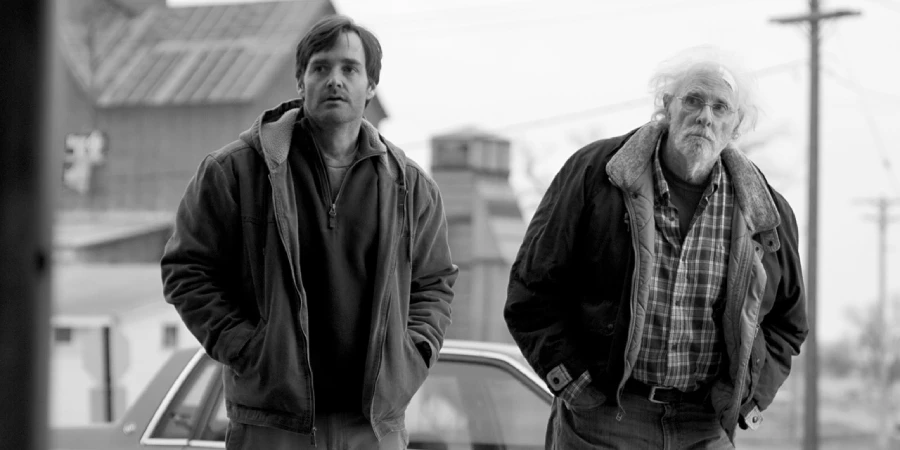
Shot in black and white across the actual Nebraska flatlands, Nebraska is a slow, funny, and quietly devastating portrait of a man who just wants to believe something good is coming his way.
Detailed Summary
Woody’s Letter and the Drive That Changes Everything
Woody Grant (Bruce Dern) receives a sweepstakes mailer and genuinely believes he has won a million dollars. His wife Kate (June Squibb) and younger son David (Will Forte) both know it is junk mail. Woody will not let it go.
David eventually agrees to drive his father from Billings to Lincoln, Nebraska, to claim the “prize.” It is partly compassion, partly exhaustion, and partly David’s own quiet desperation to connect with a father who was never fully present. He is not doing it because he thinks Woody will win; he is doing it because he cannot think of a better reason to say no.
The Hawthorne Detour
A fender bender gives them an excuse to stop in Hawthorne, Woody’s small South Dakota hometown. David calls his older brother Ross (Bob Odenkirk), who drives out with their mother. What follows is several days of sitting in living rooms, staring at walls, and revisiting old wounds.
Woody’s brothers, Ed and Ray, treat him warmly at first. His old business partner Ed Pegram (Stacy Keach) reappears too, all backslaps and fake warmth. Hawthorne is the kind of town where everyone knows your business and nobody has anything new to say.
The Million-Dollar Rumor Spreads
David makes the mistake of telling a local cousin about the sweepstakes letter. By the next morning, the entire town believes Woody is a millionaire. Neighbors, cousins, and former acquaintances all materialize, suddenly very interested in spending time with the Grants.
Ed Pegram corners Woody and insists he is owed money from a decades-old compressor deal. He gets increasingly hostile. This subplot is the film’s sharpest satirical edge, showing exactly how small human beings can get when they smell money they did not earn.
Kate’s Cemetery Tour and Family Dynamics
June Squibb’s Kate delivers one of the film’s best sequences at a local cemetery. She marches from grave to grave, commenting on each dead relative with complete candor. She calls out one man as a drunk, another for an affair, and speaks about the deceased with a cheerful ruthlessness that makes her the funniest and most honest person in the entire film.
David gradually pieces together his father’s past through these visits. Woody, it turns out, was a decent man derailed by alcoholism and a fundamental inability to communicate warmth. David is not discovering a villain; he is discovering a sad, ordinary person.
The Compressor Confrontation and Woody’s Anger
Ed Pegram and his sons escalate their pressure on Woody over the alleged debt. They break into the Grants’ motel room looking for the sweepstakes letter. David finds Woody roughed up and furious, and the confrontation outside the bar is one of the few moments in the film that crackles with something close to menace.
David retrieves the letter and shoves it in Ed’s face, pointing out it is not a check, it is not a contract, it is nothing. Ed backs down, humiliated. That small victory matters more than any million dollars.
Lincoln and the Truth
Father and son finally reach Lincoln. A sweepstakes company employee tells Woody, without cruelty but without much kindness either, that he did not win. Woody absorbs this quietly. He is not shattered; he already knew, on some level, that this was never real. He just needed someone else to confirm it.
David watches his father’s face in that moment. Dern plays it with almost no expression, which is exactly right. There is nothing to perform because the grief is too old and too familiar to be dramatic.

Movie Ending
David decides to do something concrete for his father. He visits a local car dealership and buys a used pickup truck with his own money. He hands Woody the keys and tells him he can drive it home through Hawthorne.
Woody cruises down the main street of Hawthorne in that truck, slowly, so everyone can see. Kate and Ross follow in the family car. It is a small, orchestrated moment of dignity, costing David his savings and costing Woody nothing except the admission that his son loves him enough to give him this.
The film does not pretend this fixes anything. Woody’s dementia will progress. The family dynamic will not magically heal. But David gives his father one last moment of feeling like a man who came home with something to show for himself, and the film earns every second of it without overselling the emotion.
Woody drives off frame. That is the last image of him. No tearful speech, no reconciliation monologue, just an old man in a truck doing what he wanted to do.
Are There Post-Credits Scenes?
Nebraska has no post-credits scenes. Once Woody drives away and the credits begin rolling, the film is finished. You can leave when the lights come up.
Type of Movie
Nebraska is a road movie, a family drama, and a deadpan comedy, all operating at the same time. It never leans fully into any single register, which is precisely why it works. Payne keeps the tone dry and observational, never letting sentiment tip into manipulation.
Thematically, it sits alongside films about aging, memory, and the particular American experience of feeling left behind. The black-and-white photography pushes it toward something close to elegy, but the screenplay keeps undercutting the sadness with genuinely sharp jokes.
Cast
- Bruce Dern – Woody Grant
- Will Forte – David Grant
- June Squibb – Kate Grant
- Bob Odenkirk – Ross Grant
- Stacy Keach – Ed Pegram
- Mary Louise Wilson – Aunt Martha
- Rance Howard – Uncle Ray
- Tim Driscoll – Bart
- Devin Ratray – Cole
- Angela McEwan – Pegy Nagy
Film Music and Composer
Mark Orton composed the score for Nebraska. His music leans heavily on acoustic instruments, banjo, fiddle, and guitar, giving the film a spare, plainspoken sound that matches its visual aesthetic perfectly.
Orton is also known for his work with the chamber folk group Tin Hat. His approach here strips things down to the bone; nothing in the music announces itself, which is exactly the right call for a film this understated. The score never tells you how to feel, which makes the few moments of genuine warmth land harder.

Filming Locations
Payne shot the film in actual Nebraska and South Dakota locations, including Plainview, Nebraska, which serves as the stand-in for Hawthorne. Using real small towns rather than dressed sets gives the film an almost documentary quality.
Billings, Montana opens the film, and Lincoln, Nebraska provides the destination. These are not glamorous places, and the black-and-white photography turns their flat landscapes and empty main streets into something quietly striking. Payne grew up in Omaha, and his familiarity with this geography shows in every frame.
Awards and Nominations
Nebraska received six Academy Award nominations, including Best Picture, Best Director for Alexander Payne, Best Actor for Bruce Dern, Best Supporting Actress for June Squibb, Best Original Screenplay for Bob Nelson, and Best Cinematography for Phedon Papamichael. Bruce Dern won Best Actor at the Cannes Film Festival.
June Squibb’s nomination was widely celebrated; many felt she was the most deserving nominee in that category that year. The film did not win any Oscars, which remains one of the more baffling outcomes of that awards season.
Behind the Scenes Insights
- Bob Nelson wrote the screenplay based on his own observations of small-town Midwestern life and his experiences with aging family members.
- Alexander Payne chose black and white partly to avoid the nostalgic prettiness that color photography can impose on rural American settings.
- Will Forte was primarily known for comedy before this film; Payne cast him specifically because he wanted someone who could do very little on screen and still hold attention.
- Bruce Dern prepared for the role by researching the physical and cognitive patterns of men in early cognitive decline.
- Many of the Hawthorne locals seen in crowd and background scenes are actual residents of Plainview, Nebraska, not professional extras.
- June Squibb improvised some of her delivery in the cemetery scene, and Payne kept multiple takes because her timing was consistently sharper than what was scripted.
Inspirations and References
Bob Nelson drew on his own Midwestern upbringing for the screenplay. The film reflects a specific tradition of American regional writing that finds dark comedy in tight-knit, economically struggling communities.
Payne has cited the films of Hal Ashby as an influence on his broader career, and the gentle, humanist approach to flawed characters in Nebraska connects to that tradition. Peter Bogdanovich’s The Last Picture Show is another clear visual and tonal ancestor, particularly in the use of black-and-white photography to capture a dying small-town America.
Alternate Endings and Deleted Scenes
No officially released alternate ending exists for Nebraska. Payne has not made deleted scenes widely available, and no substantial cut material has surfaced through home media releases.
Nelson’s original screenplay reportedly went through several drafts that tightened the Hawthorne section, but specifics about what was cut remain limited in public record.
Book Adaptations and Differences
Nebraska is not based on a book. Bob Nelson wrote the original screenplay directly for the screen. No source novel, short story, or other prior literary work exists to compare it against.

Memorable Scenes and Quotes
Key Scenes
- Woody walking along the highway median in the opening shot, his windbreaker flapping, a police cruiser slowing behind him.
- Kate’s cemetery tour, where she identifies each grave with the cheerful ferocity of a woman who has been biting her tongue for sixty years.
- David and Woody drinking together in a bar booth, sitting in almost complete silence, yet communicating more than any dialogue scene in the film.
- Ed Pegram confronting Woody about the compressor debt, his voice dropping into something genuinely threatening before David steps in.
- Woody driving the pickup truck down Hawthorne’s main street, moving slowly past the storefronts, Kate and Ross trailing behind.
- The sweepstakes office in Lincoln, where a woman explains to Woody, with practiced politeness, that he has won nothing.
Iconic Quotes
- “I just want to get to Lincoln.” (Woody Grant)
- “He never once said he loved us. We just figured he didn’t hate us.” (David Grant)
- “It’s his money and he wants to get it.” (David, defending Woody to Kate)
- “I’m not buying him a truck.” (Kate) “I am.” (David)
Easter Eggs and Hidden Details
- Several storefronts visible in the Hawthorne scenes are actual businesses from Plainview, Nebraska, giving the film an accidental time-capsule quality for anyone familiar with the town.
- Woody’s hearing aid is frequently visible but never commented on by other characters; it functions as a quiet visual shorthand for how much the family has learned to speak around rather than to him.
- The sweepstakes letter design is deliberately generic, closely resembling actual bulk-mail sweepstakes mailers from that era.
- Angela McEwan, who plays Woody’s former girlfriend Pegy, was a real Nebraska television personality rather than a professional actress; Payne cast her specifically for that authenticity.
- Phedon Papamichael’s camera frequently places Woody in the center of wide, flat compositions, making the landscape dwarf him without drawing explicit attention to his diminished state.
Trivia
- Bruce Dern was 77 years old during production, making Woody one of the most physically demanding roles of his late career.
- Will Forte wore minimal makeup and worked to physically restrain his natural comedic energy throughout filming; Payne wanted stillness from him above all else.
- The film premiered at the Cannes Film Festival in May 2013, where it competed for the Palme d’Or.
- Bob Nelson had the screenplay circulating in Hollywood for years before Payne attached himself to direct it.
- Alexander Payne is himself from Omaha, Nebraska, which gave him an intuitive grasp of the specific rhythms and attitudes the film depicts.
- The black-and-white format was not a marketing gimmick; Payne and Papamichael shot tests in color and found that color made the locations look more picturesque than they felt in reality.
Why Watch?
Bruce Dern does something rare here: he plays cognitive decline without a single moment of actorly vanity, letting Woody be genuinely frustrating before the film reveals why he deserves our patience. That performance alone justifies the runtime. Squibb’s Kate is the scene-stealing counterweight, and watching those two performances work against each other is better entertainment than most films manage with twice the budget.
Director’s Other Movies
- Citizen Ruth (1996)
- Election (1999)
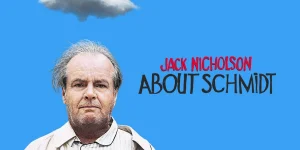
- About Schmidt (2002)
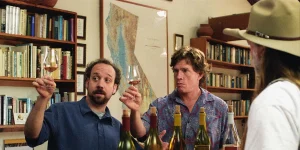
- Sideways (2004)
- The Descendants (2011)
- Downsizing (2017)
- The Holdovers (2023)