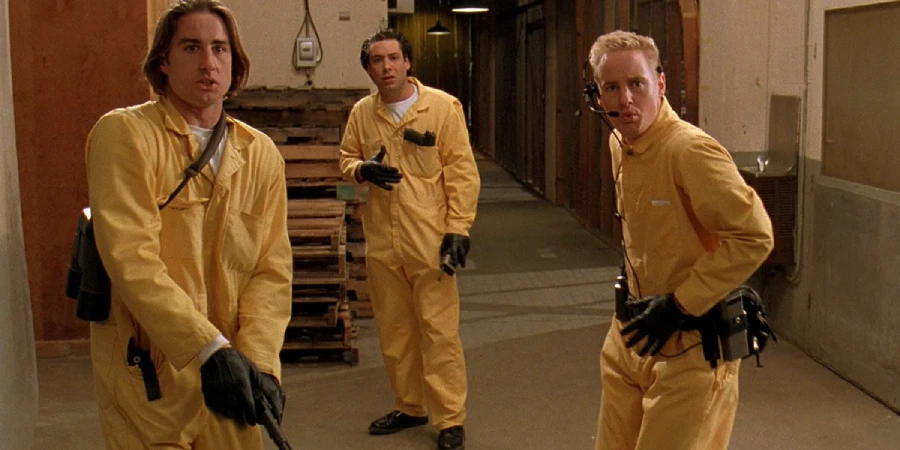

Bottle Rocket launched Wes Anderson’s career on a shoestring budget and a mountain of misplaced ambition, which is exactly the point. Three friends in suburban Texas convince themselves they are career criminals, plan a heist so small it barely qualifies as a crime, and somehow make it feel like the most important thing in the world. It is charming, melancholy, and funnier than it has any right to be.
Detailed Summary
Dignan’s Grand Plan
Anthony Adams checks himself out of a voluntary psychiatric clinic by climbing out the window, even though the front door was never locked. His best friend Dignan treats this theatrical escape as the opening act of their new life as criminals. Dignan arrives with a hand-written 75-year plan, a list of heists, and an infectious certainty that destiny awaits them both.
Anthony’s other friend, Bob Mapplethorpe, reluctantly loans them his car and his older brother’s connections. Bob is the only one with real resources, yet he gets the least respect. This dynamic quietly drives much of the film’s gentle comedy.
The Bookstore Job
Their first heist is a robbery of a local bookstore. Dignan has cased the place, drawn diagrams, and assigned everyone roles. In reality, the job takes about four minutes, yields almost nothing, and leaves the trio giddy with unearned pride.
Anderson frames this sequence with total sincerity, which is precisely what makes it funny. Dignan narrates the getaway with the seriousness of a bank robber fleeing a vault. For a moment, you almost believe him.
On the Road and Off Track
After the bookstore job, the three check into a motel to lay low. Anthony promptly falls for Inez, a Paraguayan housekeeper who speaks almost no English. Their romance is quiet and tender, built on looks and awkward proximity rather than conversation.
Dignan grows frustrated that Anthony’s romantic distraction derails the 75-year plan. Meanwhile, Bob faces pressure from his domineering older brother Future Man, whose nickname suggests far more menace than he actually delivers. The road trip stalls into something resembling real life.
Meeting Mr. Henry
Dignan reconnects with Mr. Henry, a landscaper he once worked for and idolizes as a criminal mastermind. Mr. Henry is smooth, charming, and clearly using Dignan’s admiration as a tool. He invites the group to join a proper heist crew, and Dignan nearly collapses with gratitude.
Bob eventually gets arrested, and the group fractures. Anthony and Dignan part ways temporarily, each drifting back toward ordinary life. However, Dignan cannot let the dream die.
The Cold Storage Facility Heist
Dignan assembles a crew for a cold storage facility robbery, the biggest job in his mind and still laughably modest by any real standard. Mr. Henry puts the operation together and assigns roles. Dignan finally feels like he belongs to something legitimate.
Anthony rejoins out of loyalty rather than conviction. Bob, having posted bail, also returns. The heist begins with comical tension and the creeping sense that nothing will go according to plan.

Movie Ending
Everything unravels fast. The cold storage heist collapses into chaos, and the police arrive before the crew can escape. Dignan, in a desperate and characteristically selfless act, creates a distraction so Anthony and Bob can get away. He sprints across an open lot and gets caught almost immediately.
Anthony and Bob escape but feel no triumph. They visit Dignan in prison, meeting him across a table in the visitation room. Dignan, still wearing his jumpsuit and still buzzing with optimism, tells them he is doing great and that things are going to work out.
Consequently, the film ends not with failure but with something stranger: Dignan is genuinely, improbably happy. He has lived a version of the adventure he always wanted, even if it landed him in prison. Anderson refuses to punish the character’s delusion, and that refusal is the film’s emotional center.
Anthony walks away from the prison looking moved and slightly lost. He got free, but Dignan got something he arguably values more: a story where he was the protagonist. In contrast, Anthony’s freedom feels hollow, which inverts every expectation a heist film sets up.
Are There Post-Credits Scenes?
Bottle Rocket contains no post-credits scenes. Anderson wraps the story in the prison visitation room and lets the credits roll without any additional footage. You can safely leave when the titles begin.
Type of Movie
Bottle Rocket is a indie crime comedy with strong undercurrents of friendship drama and quiet melancholy. Its tone is gentle and deadpan, never cruel. Anderson uses the heist genre as a container for a story really about loyalty, self-delusion, and the ache of wanting your life to mean something.
Cast
- Luke Wilson – Anthony Adams
- Owen Wilson – Dignan
- Robert Musgrave – Bob Mapplethorpe
- Lumi Cavazos – Inez
- James Caan – Mr. Henry
- Andrew Wilson – Future Man
- Shea Fowler – Grace
Film Music and Composer
Mark Mothersbaugh, co-founder of the new wave band Devo, composed the score. His music for Bottle Rocket is bouncy and slightly absurd, matching the film’s tone of cheerful incompetence. Mothersbaugh went on to score several subsequent Anderson films, making this the beginning of a long creative partnership.
The score leans on light, playful instrumentation that keeps the mood buoyant even during moments of failure. It never condescends to the characters. Instead, it treats their small adventures with the same musical weight a studio film might give a real heist.
Filming Locations
Bottle Rocket was shot primarily in and around Scottsdale and Mesa, Arizona. Anderson and co-writer Owen Wilson originally developed the story in Texas, but production moved to Arizona for practical reasons. The flat, sun-bleached suburban landscape suits the story perfectly, giving the characters nowhere glamorous to hide.
The motel where Anthony meets Inez grounds the film’s most tender section. Its ordinariness contrasts with the romance blooming inside it. Anderson would later refine this trick of finding magic in unremarkable American architecture.
Awards and Nominations
Bottle Rocket did not receive major awards recognition upon release. Critics largely admired it, but the film was a commercial disappointment, and awards bodies overlooked it entirely.
Behind the Scenes Insights
- Bottle Rocket began as a 13-minute short film, also directed by Anderson, made in 1994 with the same core cast.
- Owen Wilson and Wes Anderson wrote the screenplay together, drawing on their own friendship and youthful restlessness.
- James Caan agreed to take the role of Mr. Henry after reading the script; his presence gave the production serious credibility.
- Columbia Pictures funded the feature after producer Polly Platt championed the short film and brought it to the studio’s attention.
- The film was shot on a modest budget, which forced creative solutions that Anderson later described as formative for his visual style.
- Owen Wilson drew heavily on real experiences and real feelings of aimlessness when shaping Dignan’s character.
Inspirations and References
Anderson and Owen Wilson cited French New Wave cinema, particularly the films of Jean-Luc Godard, as a touchstone. Godard’s crime films treated small-time criminals with romantic seriousness, which Bottle Rocket consciously echoes. The influence shows in the film’s tone rather than its style.
Personal experience also fed the story heavily. Both Anderson and Wilson grew up in Texas feeling like outsiders with grand ambitions and no clear outlet. Moreover, the 75-year plan that Dignan carries is reportedly inspired by real lists Wilson wrote as a young man.
Alternate Endings and Deleted Scenes
No officially released alternate endings or significant deleted scene packages exist for Bottle Rocket in the public record. Anderson has discussed scenes that were trimmed during editing, but no major cut sequences have been officially released. Furthermore, no director’s cut or extended version has been made available.
Book Adaptations and Differences
Bottle Rocket is not based on any book or pre-existing source material. Anderson and Owen Wilson wrote the screenplay as an original work. The story grew directly from their personal friendship and the short film they had already made.

Memorable Scenes and Quotes
Key Scenes
- Anthony’s staged escape from the voluntary clinic, lowering himself from a window on bedsheets while the door behind him stands unlocked.
- Dignan presenting the 75-year plan to Anthony in the parking lot, reading it aloud with complete conviction.
- The bookstore robbery, executed with intense seriousness and yielding almost nothing of value.
- Anthony and Inez’s wordless courtship in and around the motel, conveying genuine warmth without a shared language.
- Dignan getting caught on the open lot while Anthony and Bob escape, sacrificing himself for his friends.
- The prison visitation scene, where Dignan tells his friends everything is fine and smiles like he means it.
Iconic Quotes
- “I want to be a great man someday.” (Dignan, delivering his entire character in one line)
- “You know what I want? I want to be undistracted.” (Anthony, explaining why he checked himself into the clinic)
- “Does that make sense to you? I mean, does it make sense as a person?” (Dignan, lobbying for the plan)
- “We have to get out of here before we turn into our parents.” (Dignan, summing up the existential stakes)
Easter Eggs and Hidden Details
- Several character names and situations in Bottle Rocket reappear in loose form across later Anderson films, suggesting a shared thematic universe rather than a literal one.
- Dignan’s orange jumpsuit in the prison visitation scene visually mirrors the color palette Anderson would later make a signature of his work.
- The 75-year plan is written in the kind of meticulous, hand-lettered style that Anderson would formalize into a visual trademark across his career.
- Bob’s brother goes by the nickname Future Man, a joke that quietly mocks the characters’ delusions about destiny and the future.
- Anthony’s first scene, descending from the window rather than using the open door, immediately establishes that these characters create difficulty where none exists.
Trivia
- This was Wes Anderson’s feature directorial debut.
- Owen Wilson, Luke Wilson, and Andrew Wilson are real brothers, and their on-screen chemistry reflects genuine familiarity.
- Martin Scorsese publicly named Bottle Rocket as one of his favorite films of the 1990s, which helped rescue its reputation after its quiet theatrical run.
- The film grossed well under one million dollars at the domestic box office during its original release.
- Lumi Cavazos, who plays Inez, was a well-known actress in Mexico before this role, notably for her performance in Like Water for Chocolate.
- The short film version preceded the feature by two years and screened at the Sundance Film Festival.
Why Watch?
Bottle Rocket is where one of cinema’s most distinctive voices found its footing, and watching it feels like catching something rare in the moment before it fully knows what it is. Owen Wilson gives a performance so genuinely felt that Dignan becomes one of the most lovable fools in American indie film. For anyone who has ever mistaken enthusiasm for a plan, this film will land somewhere close to the bone.
Director’s Other Movies
- Rushmore (1998)
- The Royal Tenenbaums (2001)
- The Life Aquatic with Steve Zissou (2004)
- The Darjeeling Limited (2007)
- Fantastic Mr. Fox (2009)
- Moonrise Kingdom (2012)
- The Grand Budapest Hotel (2014)
- Isle of Dogs (2018)
- The French Dispatch (2021)
- Asteroid City (2023)
Recommended Films for Fans
- Rushmore (1998)
- Clerks (1994)
- Slacker (1990)
- Breathless (1960)
- Flirting with Disaster (1996)
- Stealing Harvard (2002)
- SubUrbia (1996)
- The Royal Tenenbaums (2001)