
Richard Linklater pointed a 16mm camera at Austin, Texas, and let it wander for ninety minutes without ever landing on a traditional protagonist. Nobody saves anyone, falls in love or even gets a name. What you get instead is a procession of oddballs, conspiracy theorists, and philosophical loudmouths, each holding the screen for a few minutes before the film drifts away to follow someone new. It is one of the most formally radical American films of 1990, and it cost around $23,000.
Detailed Summary
The Bus Arrives: A Young Man Talks About Parallel Realities
A young man, credited only as “Should Have Stayed at Bus Station,” rides a bus into Austin. Across from another passenger, he delivers a monologue about alternate realities, arguing that every choice you fail to make spawns a parallel universe where you did make it.
Later, he hails a cab. Inside the vehicle, he continues the same thread for the driver: every missed possibility, he insists, is still unfolding somewhere.
The character is played by Richard Linklater himself, and opening the film with his voice is a quiet assertion of authorship—present but unshowy, like another idea drifting through the same speculative universe.
A Hit and Run and a Son Who Won’t Grieve
A woman is struck by a car and killed near the road. Her son arrives on the scene. Instead of collapsing with grief, he wanders around the area making detached, strange observations. Police interview him. His affect is flat, almost clinical.
This sequence sets the film’s emotional temperature immediately: nobody here behaves the way movies have trained us to expect. Grief, guilt, and horror all get rerouted through a filter of alienation.
The Conspiracy Theorist and the Moon Landing Doubter
A man holds court in what appears to be a house or apartment, insisting that the moon landing was faked. He lays out his evidence with the calm confidence of someone who has rehearsed this a thousand times. His listener nods, half-convinced.
Linklater gives this guy real screen time, enough that his argument starts to feel almost compelling. That is the film’s quiet joke: it never mocks these people openly, so you have to decide for yourself whether they are visionaries or cranks.
The Old Anarchist and His Television
An elderly man sits alone in a cluttered house, surrounded by books and pamphlets. He talks about anarchy, political resistance, and the failure of institutions. His speech is lucid and passionate.
A young burglar breaks in while he rambles. Rather than calling the police, the old man simply keeps talking. The burglar eventually leaves. Nothing is resolved, which is entirely the point.
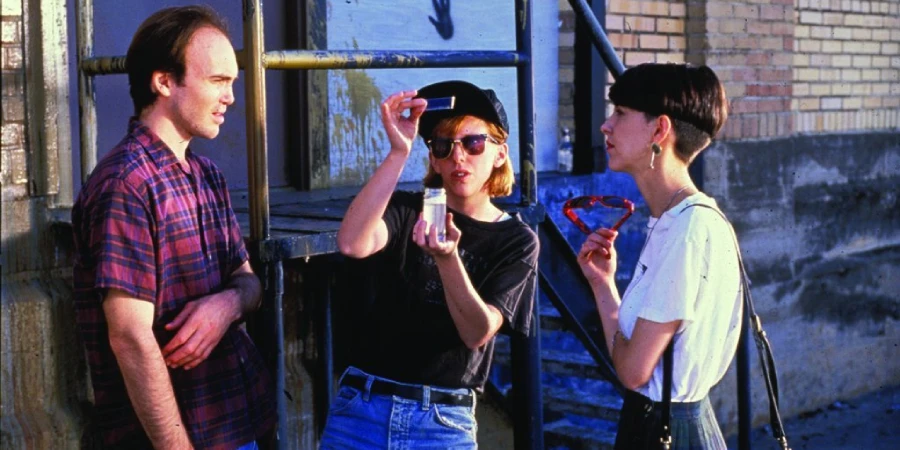
The Madonna Pap Smear Girl
A young woman approaches strangers on the street trying to sell what she claims is a Madonna pap smear on a glass slide. She is matter-of-fact about the whole thing. People react with confusion, amusement, and mild disgust.
This is one of the film’s funniest and most memorable segments. It captures something specific about early-nineties underground culture: the commodification of celebrity detritus, pushed to an absurd extreme and played completely straight.
The Coffee Shop Philosophers and Street Corner Ranters
Multiple scenes play out in diners, coffee shops, and on sidewalks. Characters debate UFOs, government surveillance, the nature of reality, and the pointlessness of work. Nobody is going anywhere. Nobody has a job that seems to require them anywhere urgently.
Linklater lets these conversations breathe. Some run long enough to become genuinely interesting on their own terms. A few feel deliberately shapeless, which is either the film trusting its audience or testing its patience, depending on your mood.
The Hit-and-Run Driver’s Guilt
A driver who may have been involved in a hit-and-run sits in his car talking to himself. His guilt is vague and free-floating. He never quite confesses to anything specific.
This segment connects loosely back to the earlier accident without tying a neat bow on it. Linklater is not interested in consequence or closure. He is interested in the texture of guilt as a mental state.
The Graduate Student Who Talks Too Much
A man buttonholes a stranger and delivers a lengthy monologue about society, freedom, and the structures that keep people trapped. His argument circles back on itself repeatedly. His listener grows visibly bored.
This is one of the film’s sharpest satirical moments. Linklater is poking fun at a certain kind of intellectual self-indulgence, the person who mistakes volume for insight. Given that the whole film is built on monologues, the self-awareness here is genuinely funny.
The Paranoid Hitchhiker
A hitchhiker gets picked up and immediately starts ranting about surveillance, government tracking, and the impossibility of true privacy. The driver listens with increasing unease.
Short and sharp, this segment works because the driver’s body language does more than any dialogue could. He grips the wheel a little tighter. He glances sideways. The comedy is entirely physical.
The Young Couple and Their Loaded Gun
A young man and woman argue in an apartment. A gun sits on a table between them. The conversation is charged with unspoken threat without ever becoming explicitly violent.
Nothing happens with the gun. Linklater puts it there and then takes it away from you. It is the film’s most deliberate act of Chekhov’s-gun trolling.

Movie Ending
A group of young people pile into a car and drive up into the hills outside Austin at night. Each of them carries a Super 8 camera. They laugh, shout, and scramble up a rocky hill, shooting footage of each other along the way.
At the top, they fling their cameras off the cliff. The film cuts to the Super 8 footage itself, grainy and lurching, spinning through the air and crashing into rocks and brush. Then it cuts to black.
What Linklater is doing here is both playful and pointed. All those cameras, all that documentation of reality, all that watching and theorizing, gets literally thrown away. The act of recording destroys itself. The watchers stop watching and just live in a moment, even if that moment is chaotic and brief.
It also functions as the film’s structural goodbye. Every segment has passed the baton forward to the next person, like a relay race with no finish line. Here, the relay simply stops. Nobody picks up the baton. The film dissolves into static and grain rather than resolving into anything clean.
For a film about people who refuse to plug into conventional society, this is the right ending: not a statement, not a resolution, just an image of willful, joyful destruction followed by silence.
Are There Post-Credits Scenes?
No. Slacker has no post-credits scene of any kind. Once the Super 8 footage ends and the screen goes dark, that is genuinely it. Given the film’s entire ethos, a post-credits stinger would have been wildly out of character.
Type of Movie
Slacker is best classified as an experimental narrative film with strong documentary sensibilities. It has no traditional plot, no protagonist, and no three-act structure. Genre-wise, it borrows from comedy, drama, and the essay film tradition.
Tonally, it is dry, curious, and occasionally satirical without ever becoming mean-spirited. Think of it as a portrait of a subculture filmed from the inside, sympathetic but not uncritical.
Cast
- Richard Linklater – Should Have Stayed at Bus Station
- Rudy Basquez – Taxi Driver
- Jean Caffeine – Roadkill
- Jan Hockey – Jogger
- Stephan Hockey – Running Late
- Mark James – Hit-and-Run Son
- Samuel Dietert – Conspiracy theorist character
- Teresa Taylor – Madonna Pap Smear
- John Slate – Old anarchist
Film Music and Composer
Slacker does not rely on a traditional orchestral score. Music in the film comes largely from the environments and characters themselves: radios playing in the background, cassette tapes, live performances glimpsed on the margins.
This approach suits the film perfectly. A composed score would impose an emotional architecture that Linklater explicitly refuses. Letting ambient sound do the work keeps the film feeling like documentary footage rather than a crafted narrative.
Various Austin-based musicians and bands contributed to the soundtrack, reflecting the city’s local music scene at the time.

Filming Locations
Almost everything was shot on location in Austin, Texas. Coffee shops, residential streets, apartments, and open scrubland all appear exactly as they were. No sets were built. No locations were dressed to look like somewhere else.
Austin in 1990 was genuinely cheap to live in, which partly explains why it had accumulated the kind of population the film depicts: educated people choosing not to pursue conventional careers because they could afford not to. The city is not just a backdrop; it is an argument.
Linklater’s own familiarity with these streets and venues gives the film a lived-in quality that no location scout could have manufactured. He knew where the real conversations were happening because he had been having them.
Awards and Nominations
Slacker did not receive major awards recognition from mainstream bodies. Its influence was felt in the independent film world rather than through trophies. The film’s real legacy came through the doors it opened for low-budget American independent cinema in the early nineties.
Behind the Scenes Insights
- Linklater shot the film over a period of several months, working around the availability of non-professional cast members and friends.
- Much of the dialogue was either improvised or written very loosely, with participants given general direction rather than strict scripts.
- The budget was approximately $23,000, raised from personal funds and small contributions from collaborators.
- Linklater had previously made a short film called It’s Impossible to Learn to Plow by Reading Books, which served as a kind of rehearsal for the observational style he used here.
- Many of the people who appear on screen were actual Austin residents, friends, and acquaintances of the director.
- The film was shot on 16mm and later blown up to 35mm for theatrical distribution.
- Linklater founded the Austin Film Society before making Slacker, and the organization became central to how the film got made and seen.
Inspirations and References
Linklater cited the work of Luis Bunuel as a structural influence, particularly the way Bunuel could build a film from disconnected vignettes without sacrificing coherence of tone. Jean-Luc Godard’s early features also shaped how Linklater thought about camera freedom and character.
The essay film tradition, associated with directors like Chris Marker, informed the film’s willingness to let ideas carry the same weight as narrative action. Slacker is fundamentally a film about people thinking out loud, and that is a European art-film impulse filtered through a very specific American city.
Robert Altman’s ensemble approach in films like Nashville is also a clear reference point, though Linklater strips away Altman’s relatively conventional plot scaffolding entirely.
Alternate Endings and Deleted Scenes
No widely documented alternate endings or significant deleted scenes have entered the public record for Slacker. Given the film’s improvisational production, it is reasonable to assume that footage exists which never made the cut, but Linklater has not made a significant issue of lost or alternate material in interviews.
Book Adaptations and Differences
Slacker is not based on any book, short story, or pre-existing written work. Linklater developed the concept and structure himself. A published screenplay for the film does exist, but it followed the film rather than preceding it.

Memorable Scenes and Quotes
Key Scenes
- The opening bus monologue, where Linklater’s character sits slightly too close to a stranger and talks about parallel universes with total sincerity.
- The Madonna pap smear pitch, where Teresa Taylor approaches strangers with absolute deadpan commitment to the bit.
- The old anarchist continuing his lecture while a burglar moves through his house behind him, completely unacknowledged.
- The loaded-gun apartment scene, where the camera keeps returning to the weapon on the table while the couple talks around it.
- The final Super 8 sequence on the hill, where cameras are hurled into the dark and the film switches to their fractured, tumbling footage.
Iconic Quotes
- “Every thought you have creates its own reality.”
- “Withdrawing in disgust is not the same thing as apathy.”
- “I may live badly, but at least I don’t have to work to do it.”
Easter Eggs and Hidden Details
- Several characters who appear briefly in one segment can be spotted in the background of other segments, quietly suggesting that these people all inhabit the same small social world.
- The television sets visible in various apartments are often playing real news footage from the period, grounding the film in a specific historical moment without calling attention to it.
- The Super 8 cameras that appear in the final sequence visually rhyme with the 16mm camera Linklater used to shoot the whole film, making the ending a self-referential comment on filmmaking itself.
- Background conversations in cafe scenes occasionally mirror or echo the foreground conversations, as if the whole city is having the same argument in slightly different registers.
Trivia
- Slacker premiered at the 1991 Sundance Film Festival and became one of the key films that put Sundance on the map as a venue for genuinely experimental American work.
- The film’s title entered the cultural vocabulary almost immediately, helping define a generational attitude in the early nineties.
- Linklater was in his late twenties when he made the film, and many of the people he cast were roughly the same age, giving the whole project an insider quality.
- The word “slacker” predates the film, but Linklater’s use of it gave the term new cultural weight and connected it specifically to a post-Reagan disillusionment with traditional American ambition.
- Roger Ebert gave the film a strong review, helping introduce it to a wider audience beyond the festival circuit.
- Criterion released the film as part of their collection, a recognition of its place in American film history.
- Teresa Taylor, who plays the Madonna pap smear character, was the drummer for the Austin punk band the Butthole Surfers at the time of filming.
Why Watch?
No American film of its era captures the texture of a certain kind of young, educated, deliberately unambitious life with this much affection and precision. Linklater lets his characters ramble long enough that you start genuinely listening, and then he takes them away before you are ready. That rhythm, accumulative and a little frustrating, is the whole argument of the film made physical.
Director’s Other Movies
- Dazed and Confused (1993)
- Before Sunrise (1995)
- SubUrbia (1996)
- The Newton Boys (1998)
- Waking Life (2001)
- School of Rock (2003)
- Before Sunset (2004)
- Fast Food Nation (2006)
- Before Midnight (2013)
- Boyhood (2014)
- Everybody Wants Some!! (2016)
- Last Flag Flying (2017)
- Hit Man (2024)
Recommended Films for Fans
- Dazed and Confused (1993)
- Metropolitan (1990)
- Clerks (1994)
- Waking Life (2001)
- My Dinner with Andre (1981)
- Short Cuts (1993)
- Nashville (1975)
- Half Nelson (2006)
- Kids (1995)