
Wes Anderson set an entire film on a garbage island populated by exiled dogs, and somehow made it one of his most emotionally resonant works. Isle of Dogs (2018) blends stunning stop-motion artistry with a sharp political allegory, wrapping a story about loyalty and corruption inside a world of meticulously crafted miniature chaos. It is funny, melancholy, and visually overwhelming all at once. If you have not seen it yet, consider this your final spoiler warning.
Detailed Summary
The Decree and the Exile
In a dystopian version of Japan, Mayor Kobayashi of Megasaki City signs a decree banishing all dogs to Trash Island, citing a fictional canine flu outbreak. His ward, a twelve-year-old boy named Atari Kobayashi, watches helplessly as his dog Spots becomes the very first dog exiled to the island.
Anderson frames this opening with newsreel-style exposition and a commanding narrator, establishing the film’s tone immediately. Kobayashi’s political machinery moves fast, and the public largely accepts the decree without resistance. However, a small pocket of scientists and students begins to question the official story.
Atari’s Crash Landing
Atari steals a small aircraft and flies himself to Trash Island to find Spots. His plane crashes on arrival, leaving him injured but alive. A pack of five dogs witnesses the crash and debates whether to help him.
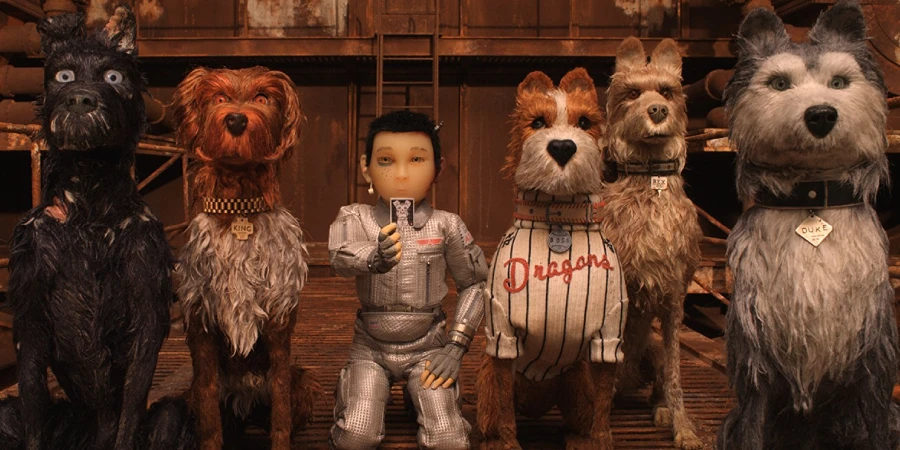
This pack includes Chief, a stray voiced by Bryan Cranston, who is resistant to human contact, and four former house pets: Rex, Boss, Duke, and Nutmeg. Chief votes against helping Atari. In contrast, the other four outvote him, and they reluctantly take the boy under their collective care.
The Search for Spots
Atari communicates mostly through gesture and broken phrases, since no translator exists on the island. Anderson makes a deliberate choice here: most dog dialogue is in English, while human Japanese dialogue is largely untranslated. This forces the audience to experience the film partly from the dogs’ perspective.
Atari carries a photograph of Spots and a mechanical translator device, both of which guide the pack’s mission. They encounter other dog factions across the island, including a theatrical troupe of dogs who perform elaborate stories. Meanwhile, Chief and Atari begin to form a tentative bond despite Chief’s fierce resistance to it.
Mayor Kobayashi’s Political Conspiracy
Back in Megasaki, the conspiracy deepens considerably. Professor Watanabe, a scientist working on a dog flu cure, is poisoned and killed by Kobayashi’s operatives before he can publish his findings. His research, however, survives in the hands of his assistant.
A foreign exchange student named Tracy Walker, voiced by Greta Gerwig, leads a student activist movement that challenges Kobayashi’s narrative. She publishes a school newspaper connecting the mayor to corporate interests tied to cat food, essentially exposing the entire exile as politically motivated rather than medically necessary. Tracy’s determination drives much of the film’s subplot in Megasaki.
Chief’s Backstory
As the journey continues, Chief gradually opens up. He reveals he bit his previous owner, a child, which led to him becoming a stray. This admission carries genuine weight, because Chief has spent years defining himself entirely by that single act of violence.
Atari bathes Chief in a rain puddle in one of the film’s most quietly moving scenes. Chief allows the contact, and something shifts between them. Consequently, the dynamic of the pack also shifts, with Chief slowly assuming more of a protective role toward Atari.
Finding Spots, or Not Quite
On reaching a distant part of the island, the pack discovers a dog who appears to be Spots. However, this dog turns out to be Jupiter, another white dog who happens to resemble Spots closely. Jupiter directs them to a laboratory compound where Spots was last seen.
At the compound, Atari finds Spots, now a guard dog who has been surgically altered and conditioned to protect a human scientist. Spots also reveals he has mated and fathered puppies. Furthermore, he tells Atari he has a new family and a new purpose, which complicates Atari’s rescue mission emotionally.
Atari Chooses Chief
Spots and Atari share an emotional reunion, but Spots ultimately chooses to stay with his new family and his duties. He asks Chief to take his place as Atari’s dog. Chief, who has resisted belonging to anyone, accepts this responsibility.
This moment functions as the film’s emotional climax before the political resolution. Chief’s acceptance of Atari is his full character arc completing itself. In addition, it gives Spots a satisfying conclusion that avoids the cliche of a simple rescue and return.


Movie Ending
Atari, Chief, and the pack return to Megasaki just as the political situation reaches a boiling point. Mayor Kobayashi’s government prepares to execute all remaining dogs on Trash Island using an incinerator drone fleet. Atari boldly commandeers a public address system to expose the cover-up to the citizens of Megasaki.
Tracy’s investigative work and the surviving research from Professor Watanabe’s lab provide the scientific proof that a dog flu cure exists and always existed. Mayor Kobayashi, confronted publicly with this evidence and facing his own ward’s defiance, experiences a change of heart. He cancels the extermination order and resigns from his position.
In a quietly poetic turn, Kobayashi receives a dog organ transplant to save his own life, with Chief’s pack donating compatible tissue. This detail ties the political resolution directly to physical sacrifice, making the reconciliation feel earned rather than cheap. Kobayashi adopts a dog of his own as a gesture of sincere change.
A new mayor takes office, and the dogs are officially welcomed back to Megasaki. Chief receives a collar and a name tag, symbolizing his formal acceptance of belonging. Atari and Chief return home together, completing both the rescue mission and Chief’s internal journey simultaneously.
Anderson does not wrap things up in a saccharine bow. The film acknowledges that institutional corruption is a choice made by individuals, and that it can be reversed by equally individual acts of courage. Atari, a twelve-year-old boy who crashed a stolen plane into a garbage island, ultimately dismantles an authoritarian political machine through sheer love for his dog.
Are There Post-Credits Scenes?
Isle of Dogs does not include any post-credits scenes. Anderson does not use that device, and the film concludes cleanly after its final frames. You can leave your seat without missing anything.
Type of Movie
Isle of Dogs occupies a fascinating genre space. Officially an animated stop-motion film, it also functions as a political satire, a dystopian adventure, and a deeply sincere character study. Anderson layers tones without letting any single one dominate.
In contrast to most animated films marketed purely at children, this one carries themes of authoritarian corruption, scientific suppression, and class inequality. Its humor is dry and literary. Its emotional beats hit harder than most live-action dramas.
Cast
- Bryan Cranston – Chief
- Edward Norton – Rex
- Bill Murray – Boss
- Jeff Goldblum – Duke
- Bob Balaban – King
- Koyu Rankin – Atari Kobayashi
- Greta Gerwig – Tracy Walker
- Scarlett Johansson – Nutmeg
- Harvey Keitel – Gondo
- F. Murray Abraham – Jupiter
- Liev Schreiber – Spots
- Tilda Swinton – Oracle
- Ken Watanabe – Mayor Kobayashi
- Akira Ito – Narrator
- Frances McDormand – Interpreter Nelson
Film Music and Composer
Alexandre Desplat composed the score for Isle of Dogs, and his work here ranks among his most inventive. Desplat built much of the score around traditional Japanese taiko drumming, weaving it into a Western orchestral framework in a way that mirrors the film’s cultural collision. The result feels urgent and ceremonial at the same time.
Notably, the score incorporates pieces by Seijiro Murayama, a taiko percussionist who brought authentic texture to the soundtrack. Anderson also included a Japanese-language version of Stardust performed by Shintaro Sakamoto. These musical choices reinforce the film’s deliberate blending of Japanese and Western cultural aesthetics.
Desplat won the Academy Award for Best Original Score for Isle of Dogs, which recognized both his compositional skill and his unusual structural approach to the soundtrack. His background spans decades of prestigious film work, including scores for The Grand Budapest Hotel and The Shape of Water.


Filming Locations
Isle of Dogs was filmed entirely in the UK, primarily at 3 Mills Studios in London. Stop-motion animation does not require on-location shooting in the traditional sense, but the studio environment shapes everything about the physical production. Anderson and his team built every set by hand at that facility.
Anderson chose to set the film in a stylized, fictional version of Japan rather than a specific real city. This decision gave the production design team freedom to blend architectural and cultural references across multiple Japanese periods and aesthetics. Furthermore, it insulated the film against accusations of geographic inaccuracy while deepening its fairy tale quality.
Awards and Nominations
Alexandre Desplat’s score won the Academy Award for Best Original Score at the 91st Academy Awards. Isle of Dogs also received a nomination for Best Animated Feature Film at the same ceremony.
Anderson won the Silver Bear for Best Director at the Berlin International Film Festival in 2018, where the film also served as the opening feature. Additionally, BAFTA nominated the film in several categories, and it appeared on numerous critics’ year-end lists as one of the best films of 2018.
Behind the Scenes Insights
- Anderson and his team created over 500 puppet characters for the production, each requiring intricate handcrafted detail.
- Each dog puppet had multiple interchangeable heads and facial components to allow for nuanced emotional expression during stop-motion capture.
- The fur on the dog puppets was individually laid using tiny pieces of material so that animators could ruffle and reshape it between frames, creating the illusion of organic movement.
- Anderson reportedly maintained a rigorous production bible detailing every visual and cultural reference, ensuring consistency across the enormous team of animators.
- Bryan Cranston recorded his Chief dialogue without initially knowing the full emotional arc of the character; Anderson revealed story details gradually during sessions.
- The production team consulted with Japanese cultural advisors throughout development to ensure accuracy in the language, design elements, and cultural references.
- Food scenes in the film, including the famous sushi preparation sequence, required individual stop-motion frames for each ingredient placement, consuming weeks of animator time.
- Anderson co-wrote the film with Roman Coppola, Jason Schwartzman, and Kunichi Nomura, who also voiced Mayor Kobayashi.
Inspirations and References
Anderson has cited the films of Akira Kurosawa as a primary visual and tonal influence. Kurosawa’s use of widescreen composition, weather as emotional punctuation, and ensemble dynamics all appear throughout Isle of Dogs. Anderson pays more direct homage through his framing choices and his deliberate use of screen wipes as transitions.
The film also draws from Japanese monster movies, specifically the Godzilla franchise aesthetic, in how it frames large-scale civic destruction and political spectacle. In addition, Anderson’s longtime love of Japanese woodblock prints, particularly the work of Hiroshige, shaped the film’s approach to landscape and color. These influences layer on top of each other rather than competing.
Politically, the film echoes real-world histories of authoritarian scapegoating and institutional corruption. Anderson never names a specific historical parallel, but the allegory reads clearly. Consequently, the film carries a weight that outlasts its whimsical surface.
Alternate Endings and Deleted Scenes
Anderson has not publicly released deleted scenes or confirmed specific alternate endings for Isle of Dogs. Given the extreme cost and time investment of stop-motion production, significant reshoots or alternate sequences would have been logistically prohibitive. Most creative decisions were locked in during pre-production and storyboarding.
Some early promotional materials suggested slightly different framing for the island sequences, implying minor structural adjustments during editing. However, no alternate cut of the film has been officially released or confirmed in detail.
Book Adaptations and Differences
Isle of Dogs is not based on a book, a comic, or any pre-existing literary source. Anderson developed the story as an original screenplay with his co-writers. A companion book was published alongside the film’s release, but it adapts the film rather than predating it.


Memorable Scenes and Quotes
Key Scenes
- The sushi preparation sequence: a wordless, hypnotic piece of stop-motion craftsmanship that shows a chef preparing sushi in real time, frame by intricate frame.
- Chief’s bath scene: Atari washes Chief in a rain puddle, a quiet and tender turning point that marks the beginning of their real bond.
- The dog pack debate: every time the pack votes on a decision, the democratic chaos that follows is both genuinely funny and surprisingly touching.
- Atari’s crash landing: the plane hitting Trash Island combines absurdist comedy with genuine stakes in a way that sets the film’s tone perfectly.
- Kobayashi’s public change of heart: the mayor facing the crowd after Atari’s broadcast lands with quiet dramatic power, particularly given how cold the character has been throughout.
- The student newspaper montage: Tracy’s investigation unfolds through a series of newspaper front pages and classroom confrontations that feel like a miniature political thriller.
Iconic Quotes
- “I bite.” – Chief, as both warning and self-definition, repeated throughout the film until it no longer holds the same meaning.
- “Every dog has its day.” – spoken with Anderson’s signature deadpan timing, this line functions as both cliche and genuine thesis statement.
- “I’m a dog’s dog.” – Chief’s description of himself, underlining his refusal of domesticity before his arc begins to shift.
- “He’s not my master.” – Chief’s early denial, which makes his eventual acceptance of Atari all the more powerful in retrospect.
Easter Eggs and Hidden Details
- Several background posters in Megasaki reference real Japanese woodblock print styles, specifically echoing the compositions of Utagawa Hiroshige.
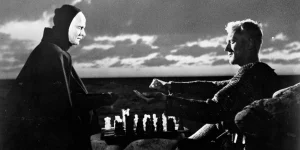
- Anderson hides visual nods to Kurosawa’s Seven Samurai in the framing of group scenes, particularly in how he lines up the dog pack against wide skylines.
- Oracle the dog, voiced by Tilda Swinton, watches television constantly and derives all her predictions from it, a subtle joke about media-driven prophesy.
- The color palette of Trash Island skews toward muted browns and grays, while Megasaki City uses cooler, more clinical blues, reinforcing the political divide visually.
- Character names in the film carry meaning: Spots is purely descriptive and innocent, while Chief carries authority he initially refuses to exercise.
- Background extras in the Megasaki crowd scenes include tiny puppet figures that reference Japanese political protest imagery from the 1960s.
- Anderson’s recurring use of centered, symmetrical compositions appears throughout, but he deliberately breaks the symmetry during scenes of political violence or chaos.
- The intercom system Atari uses to broadcast the truth mirrors a specific visual style from Japanese public address infrastructure that Anderson researched for the production.
Trivia
- Anderson chose not to subtitle the Japanese dialogue for most of the film, a deliberate decision that puts English-speaking audiences in a position of partial understanding, mirroring the dogs’ experience.
- Koyu Rankin, who voiced Atari, was a child actor with limited prior screen experience; Anderson cast him specifically for the authenticity of his voice.
- Kunichi Nomura, who co-wrote the screenplay, also voiced Mayor Kobayashi, giving the film’s villain an unusually personal creative investment.
- The film’s opening sequence uses a traditional Japanese taiko drum performance as both score and visual spectacle, establishing the cultural register before any character appears.
- Anderson shot the film at a ratio that references classic Japanese cinema formats, a technical homage that most viewers would never consciously notice.
- Every piece of trash visible on Trash Island was individually designed and fabricated by the production design team, with no two identical pieces.
- Isle of Dogs was Anderson’s second stop-motion feature, following Fantastic Mr. Fox (2009).
- The film’s title is a deliberate pun: say it quickly and “Isle of Dogs” sounds like “I love dogs.”
Why Watch?
Isle of Dogs rewards patience, attention, and genuine emotional investment in a way few animated films attempt. It operates as political allegory, visual art object, and sincere story about loyalty all at once. Moreover, Anderson’s stop-motion craft here represents some of the most technically ambitious work in contemporary animation. Watch it once for the story; watch it again for everything you missed.
Director’s Other Movies
- Bottle Rocket (1996)
- Rushmore (1998)
- The Royal Tenenbaums (2001)
- The Life Aquatic with Steve Zissou (2004)
- The Darjeeling Limited (2007)
- Fantastic Mr. Fox (2009)
- Moonrise Kingdom (2012)
- The Grand Budapest Hotel (2014)
- The French Dispatch (2021)
- Asteroid City (2023)
Recommended Films for Fans
- Fantastic Mr. Fox (2009)
- Spirited Away (2001)
- Princess Mononoke (1997)
- The Grand Budapest Hotel (2014)
- Kubo and the Two Strings (2016)
- Moonrise Kingdom (2012)
- Coraline (2009)
- Seven Samurai (1954)
- Anomalisa (2015)