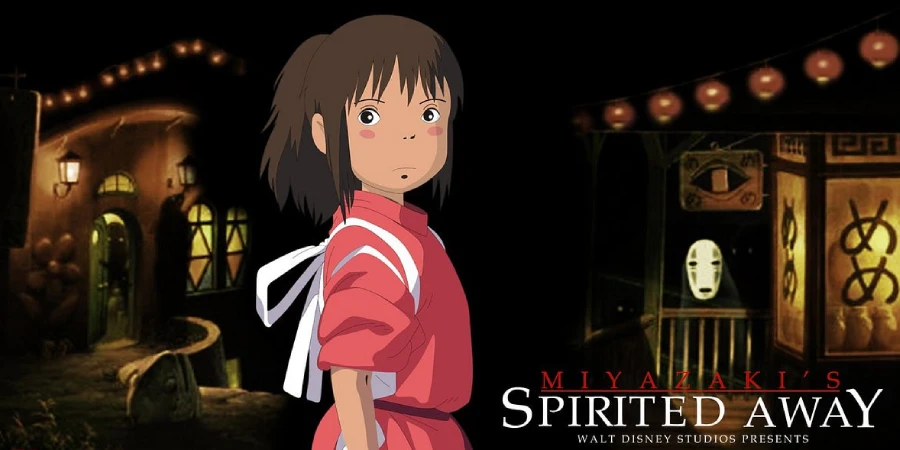

Hayao Miyazaki’s Spirited Away (2001), produced by Studio Ghibli, is not only one of the most beloved animated films ever made but also one of the most profound explorations of identity, greed, and innocence in modern cinema. It’s a surreal coming-of-age story wrapped in mythology, symbolism, and breathtaking artistry.
Detailed Summary
The Mysterious Tunnel
The story begins with 10-year-old Chihiro Ogino, sulking in the back seat as her parents drive toward their new home. Along the way, they stumble upon what appears to be an abandoned amusement park. Despite Chihiro’s apprehension, her parents explore further and discover a food stall filled with delicious dishes. They begin to eat greedily, ignoring Chihiro’s warnings.
As night falls, the park transforms into a bustling spirit world, and Chihiro’s parents turn into pigs. Terrified and alone, Chihiro realizes she’s trapped in a place where humans are not welcome.
Meeting Haku and Entering the Bathhouse
A mysterious boy named Haku appears and helps Chihiro navigate this world. He instructs her to find work in the bathhouse run by the witch Yubaba, who controls the spirits and steals the names of her workers to enslave them. To survive, Chihiro must sign a contract and accept a new name: Sen.
Her first tasks are menial and dangerous, but through courage and kindness, she earns the respect of the bathhouse staff, including the boiler man Kamaji and the worker Lin.
No-Face and the Spirit Chaos
One of the most memorable characters, No-Face, a silent, shadowy spirit, becomes fascinated by Chihiro’s kindness. When he’s invited into the bathhouse, he begins to consume food and offer gold to the greedy workers. However, the more he eats, the more monstrous he becomes, devouring several spirits in a frenzy of gluttony.
Chihiro bravely confronts him, offering him an antidote that forces him to vomit everything he’s consumed, symbolizing purification and redemption. She leads him out of the bathhouse, showing empathy where others saw only fear.
Haku’s Secret and the Paper Attack
Meanwhile, Haku, who serves Yubaba, is attacked by enchanted paper birds while in the form of a dragon. He crashes into the boiler room, gravely injured. Chihiro risks everything to save him, realizing that she and Haku share a mysterious bond from the past. Her care for him contrasts with the greed and indifference of the spirit world.
The Journey to Zeniba
Chihiro sets out on a journey to visit Zeniba, Yubaba’s twin sister, to return a stolen seal that Haku had taken. She travels by train across a hauntingly serene spirit landscape, joined by No-Face, who has calmed down and found a sense of peace with her. Zeniba proves to be kind and wise, offering Chihiro warmth and encouragement.
Movie Ending
After returning to the bathhouse, Chihiro helps break Haku’s curse by remembering his real name: Kohaku River. She recalls that as a child, she once fell into his river but was saved by him, revealing their connection from long ago. This realization frees Haku from Yubaba’s spell, restoring his identity.
Chihiro’s final test is to identify her parents among a group of pigs. Trusting her intuition, she confidently states that none of them are her parents. She’s correct, and Yubaba is forced to let her go.
Haku then escorts Chihiro to the exit, promising that they’ll meet again someday. As she crosses back through the tunnel, the spirit world fades away. Her parents reappear, human once more, unaware of what has happened. The car is covered in dust and leaves, suggesting that more time has passed than they realize.
Chihiro takes one last look back at the tunnel—hesitant, wiser, and transformed. The film closes with her facing her new life with quiet confidence. It’s a tender ending that emphasizes growth, memory, and the bittersweet nature of leaving childhood behind.
Are There Post-Credits Scenes?
No, Spirited Away does not have a post-credits scene. The story concludes with Chihiro leaving the spirit world, symbolizing closure and the end of her journey. The credits play over Joe Hisaishi’s serene score, allowing the viewer to process the emotional weight of the ending.
Type of Movie
Spirited Away is an animated fantasy adventure film, blending Japanese folklore, Shinto mythology, and psychological allegory. It’s both a coming-of-age story and a critique of consumerism and loss of identity in modern society.
Cast (Japanese Version)
- Rumi Hiiragi as Chihiro (Sen)
- Miyu Irino as Haku
- Mari Natsuki as Yubaba / Zeniba
- Bunta Sugawara as Kamaji
- Yumi Tamai as Lin
- Akio Nakamura as No-Face
(English Dub includes voices by Daveigh Chase, Jason Marsden, and Suzanne Pleshette.)
Film Music and Composer
The enchanting score was composed by Joe Hisaishi, whose music is integral to the magic of Studio Ghibli films. The main theme, “One Summer’s Day”, is one of the most recognizable pieces in modern cinema, balancing innocence and melancholy perfectly. The ending song, “Always With Me” by Youmi Kimura, became iconic in Japan.



Filming (Animation) Locations and Artistic Inspiration
Though it’s animated, many of the film’s environments were inspired by real places in Japan. The bathhouse was modeled after Dogo Onsen in Matsuyama, one of Japan’s oldest hot springs. The rural landscapes and train sequence evoke the Japanese countryside and Miyazaki’s own childhood memories. These settings create a tangible authenticity despite the fantastical tone.
Awards and Nominations
- Academy Award for Best Animated Feature (2003) – Winner
- Golden Bear at the Berlin International Film Festival (2002) – Winner
- Annie Award for Outstanding Achievement in an Animated Feature – Winner
- Multiple Japanese Academy Prizes and international accolades
It remains the first (and only) hand-drawn, non-English-language film to win the Oscar for Best Animated Feature.
Behind the Scenes Insights
- Hayao Miyazaki wrote the story without a complete script, allowing the plot to evolve naturally.
- The film’s main inspiration came from a friend’s 10-year-old daughter, who reminded Miyazaki of Chihiro.
- Many animators were encouraged to base the spirit designs on Japanese folklore rather than Western fantasy.
- The bathhouse scenes were animated with over 300 layers to create depth and light reflections.
- No-Face was inspired by the loneliness Miyazaki felt watching people consume without connection.
Inspirations and References
- Based loosely on Japanese Shinto and Buddhist traditions, where spirits inhabit all living things.
- Influenced by Alice in Wonderland and The Wizard of Oz in its narrative structure—a young girl lost in a magical world.
- Themes of greed, identity, and nature are central, reflecting Japan’s post-industrial anxieties.
Alternate Endings and Deleted Scenes
No major alternate endings were ever created. However, early drafts hinted that Chihiro’s parents might have remembered faint traces of the spirit world, but Miyazaki removed this to preserve the film’s mystery. Some storyboards included more interactions between Chihiro and Lin, but these were cut for pacing.
Book Adaptations and Differences
Spirited Away is not based on a specific book, but it shares thematic DNA with Sen to Chihiro no Kamikakushi picture books released after the film. These books expand on the movie’s imagery but do not introduce new plotlines.

Memorable Scenes and Quotes
Key Scenes
- The transformation of Chihiro’s parents into pigs
- Chihiro crossing the flooded bridge while holding her breath
- The cleansing of the “Stink Spirit,” which turns out to be a polluted river god
- No-Face’s rampage in the bathhouse
- The train ride across the water to Zeniba’s house
- Chihiro remembering Haku’s name and freeing him
Iconic Quotes
- “Once you’ve met someone, you never really forget them.”
- “You don’t remember your name? That’s the way Yubaba controls you.”
- “I finally get a bouquet, and it’s goodbye flowers.”
- “Courage is not the absence of fear, but the triumph over it.” (implied through Chihiro’s actions)
Easter Eggs and Hidden Details
- Yubaba’s office is filled with Western-style decorations, symbolizing materialism.
- The “Stink Spirit” cleansing scene was inspired by Miyazaki’s real-life experience cleaning a polluted river.
- The train scene mirrors the River of Life concept in Japanese mythology.
- The kanji on Chihiro’s work contract subtly changes after she signs it, showing her loss of identity.
Trivia
- It became Japan’s highest-grossing film for nearly two decades, until Demon Slayer: Mugen Train (2020).
- Every frame was hand-drawn, with no digital shortcuts.
- Disney localized the English version with guidance from Pixar’s John Lasseter.
- Chihiro’s age (10) was intentionally chosen to represent the border between innocence and awareness.
Why Watch?
Spirited Away isn’t just an animated film—it’s an experience. It’s about growing up, finding courage, and maintaining integrity in a world full of greed and illusion. The combination of rich storytelling, emotional depth, and stunning animation makes it timeless. Whether you’re a fan of fantasy or philosophy, this film resonates on multiple levels.
Director’s Other Movies
- My Neighbor Totoro (1988)
- Princess Mononoke (1997)
- Howl’s Moving Castle (2004)
- Nausicaä of the Valley of the Wind (1984)
- The Wind Rises (2013)
Recommended Films for Fans
- Howl’s Moving Castle (2004)
- Princess Mononoke (1997)
- Kiki’s Delivery Service (1989)
- Coraline (2009)
- Suzume (2022)
- The Tale of the Princess Kaguya (2013)
- Alice in Wonderland (1951)