Two men sit in a garden in Castel Gandolfo, one wanting to quit and the other wanting to stay, and somehow Fernando Meirelles turns that premise into one of the most quietly gripping films of 2019. The Two Popes pulls off something genuinely tricky: it makes Vatican politics feel personal, funny, and occasionally devastating, all without a single car chase.
Anthony Hopkins and Jonathan Pryce carry almost the entire film on their backs, and the screenplay by Anthony McCarten gives them enough verbal ammunition to keep two hours flying past. This is a film about confession, guilt, and what it means to change your mind when you are one of the most watched men on earth.
Detailed Summary
The 2005 Conclave Opens
The film opens with the death of Pope John Paul II and the subsequent conclave to elect his successor. Cardinal Jorge Bergoglio of Buenos Aires receives enough votes to be a genuine contender, which visibly unsettles him. He does not want the papacy. He finds the politics suffocating and the institutional church increasingly out of touch with ordinary people.
Cardinal Joseph Ratzinger wins the election and becomes Pope Benedict XVI. Bergoglio returns to Argentina, quietly relieved.
Bergoglio Requests Retirement
Years pass. Bergoglio, now in his mid-seventies, writes repeated letters to the Vatican requesting permission to retire. Benedict ignores every letter. Bergoglio decides to show up in person and press the matter directly.
He travels to Rome, and the film immediately contrasts the two men in almost every frame. Bergoglio takes public buses and carries his own bags. Benedict rides in motorcades and lives inside the gilded machinery of the papacy.
First Meeting at Castel Gandolfo
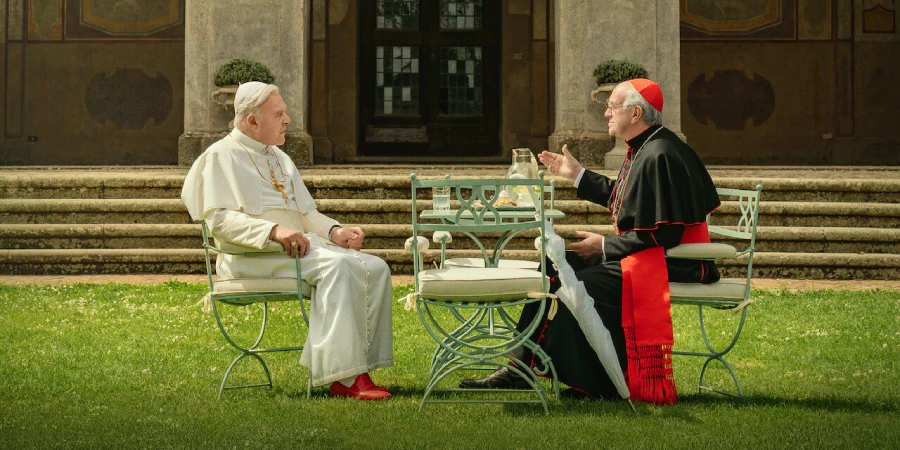
Benedict summons Bergoglio to his summer residence at Castel Gandolfo. Their first conversation crackles with barely concealed mutual frustration. Benedict accuses Bergoglio of undermining papal authority through his public statements. Bergoglio fires back that the church is haemorrhaging ordinary believers because it refuses to engage with the modern world.
What makes this opening sparring so good is how specific the disagreements are. This is not a vague debate about tradition versus progress; these are two men arguing about concrete pastoral choices, and neither is entirely wrong.
Pizza, Football, and the Sistine Chapel
Meirelles refuses to let the film stay stiff, and the middle section loosens up considerably. Benedict gives Bergoglio an unofficial tour of the Sistine Chapel, the two men sitting beneath Michelangelo’s ceiling eating pizza, trading opinions about theology and music. Bergoglio loves ABBA. Benedict is a classical pianist who considers pop music beneath dignity.
These lighter scenes do real work. They humanise both men before the film asks us to sit with much heavier material.
Bergoglio’s Confession: Argentina and the Dirty War
Here the film shifts gear entirely. In a long, painful flashback sequence, we see the young Bergoglio navigating Argentina’s military dictatorship of the 1970s. Two Jesuit priests under his authority, Orlando Yorio and Francisco Jalics, are working with the poor in the slums. The military regime targets them.
Bergoglio, as their Jesuit Provincial Superior, withdraws his formal protection from them. The military subsequently kidnaps and tortures both men. They survive, but the sequence does not let Bergoglio off lightly. He confesses to Benedict that he failed them, that his political caution may have made their capture easier.
Pryce plays these scenes with extraordinary physical stillness. His hands sit flat on his knees, his voice drops, and he delivers the confession looking at the floor rather than at Benedict. It is the film’s emotional fulcrum, and it lands hard.
Benedict’s Own Confession
Bergoglio’s confession opens a door. Benedict, in turn, reveals that he has decided to resign the papacy, something that has not happened in six centuries. He confides that he feels God has withdrawn from him, that prayer has become silence, and that he no longer trusts himself to lead.
The film frames this as its own kind of confession. Benedict is not fleeing scandal or pressure, at least not primarily. He genuinely believes he can no longer hear what he needs to hear, and staying would be a form of vanity rather than service.
Benedict Asks Bergoglio to Stay
Having decided to resign, Benedict tells Bergoglio he wants him to remain in the church rather than retire. He sees in Bergoglio the future the church needs. Bergoglio resists this entirely, arguing he is too old, too compromised by his past, and too much of an outsider to the Vatican machine.
Benedict essentially overrules him. The conversation circles back to forgiveness, and the film makes clear that Benedict granting Bergoglio absolution for his Argentine past is the emotional transaction that makes everything that follows possible.

Movie Ending
Benedict announces his resignation publicly in February 2013, the first pope to step down voluntarily in centuries. Bergoglio watches the announcement on television in Buenos Aires, visibly shaken. He did not expect Benedict to actually go through with it.
A new conclave follows. On the evening of March 13, 2013, white smoke rises from the Sistine Chapel chimney. Jorge Mario Bergoglio emerges onto the balcony of St. Peter’s Basilica as Pope Francis, the first Latin American pope in history. He introduces himself to the crowd with characteristic modesty, saying the cardinals had gone nearly to the end of the world to find him.
What makes the ending feel genuinely moving rather than merely triumphant is the film’s final image. Benedict, now retired and living in a monastery within Vatican City, watches the 2014 World Cup final on television. Argentina is playing Germany. Francis, learning of this, slips away from his own watch party and joins Benedict.
The two men sit together, a retired pope and a reigning one, watching football and bickering about their respective national teams. It is funny and warm, and it earns the warmth because the film has put both men through enough that we feel the friendship rather than just being told about it. Argentina loses to Germany, which gives Benedict a small, satisfied smile and Bergoglio a resigned shrug. Meirelles holds on both faces, and then the film ends.
The ending argues that institutional change and personal forgiveness are not separate events. Bergoglio could not become Francis until he confessed, and Benedict could not step down until he admitted his own limits. Both acts required the same thing: honesty about failure.
Are There Post-Credits Scenes?
No, there are no post-credits scenes. The Two Popes ends cleanly with the football scene and fades to black. Stay through the credits if you want, but nothing is waiting for you.
Type of Movie
The Two Popes is a biographical drama with strong elements of political drama and, surprisingly, comedy. Its tone is warmer and more conversational than most prestige biopics. Meirelles keeps the pacing brisk, and the dialogue has a wit that prevents the film from ever feeling like a lecture.
Think of it as a two-hander chamber piece that occasionally explodes outward into flashback history. It sits closer to My Dinner with Andre in structure than to a traditional biopic.
Cast
- Anthony Hopkins – Pope Benedict XVI (Cardinal Joseph Ratzinger)
- Jonathan Pryce – Pope Francis (Cardinal Jorge Bergoglio)
- Juan Minujín – Young Jorge Bergoglio
- Sidney Cole – Young Ratzinger
- Thomas D. Williams – Cardinal Assistant
- Federico Torre – Father Jalics
- Cedric Poggi – Father Yorio
Film Music and Composer
Bryce Dessner composed the score, which leans quiet and string-heavy for the Vatican scenes and more restless for the Argentine flashbacks. Dessner, best known as a guitarist for The National, brings a chamber music sensibility that suits the intimate scale of the film perfectly.
The score smartly steps back during the dialogue-heavy scenes, letting Hopkins and Pryce breathe. One of the film’s best musical choices is the recurring use of ABBA’s Dancing Queen, which Bergoglio hums and which becomes a running joke that also carries genuine affection.

Filming Locations
Much of the film shot in and around Rome and Vatican City, though the actual Vatican did not grant access to interior spaces. The production recreated key locations, including a full-scale replica of the Sistine Chapel built at Cinecittà Studios in Rome.
The Argentine flashback sequences filmed on location in Buenos Aires, which lends those scenes a gritty, documentary texture that contrasts sharply with the marble stillness of the Vatican interiors. That visual contrast is deliberate and effective.
Castel Gandolfo, the papal summer residence, features prominently and was apparently accessible to the production, giving those garden scenes an authenticity that the Vatican interiors lack.
Awards and Nominations
The film received significant awards attention. Both Anthony Hopkins and Jonathan Pryce received Academy Award nominations for Best Actor in the same year, a rare occurrence. Anthony McCarten received a Best Adapted Screenplay nomination at the Oscars as well.
Hopkins and Pryce both received Golden Globe nominations, and the film picked up nominations from BAFTA and the Screen Actors Guild Awards. It did not win the major prizes, but landing two Best Actor nominees from a single film is a meaningful recognition of how strong both performances are.
Behind the Scenes Insights
- Jonathan Pryce studied Bergoglio’s posture, walk, and vocal patterns extensively. He has spoken about consciously lowering his center of gravity to capture the way the real pope carries himself.
- Anthony Hopkins learned to play the piano pieces seen in the film rather than faking it for the camera. He is an accomplished pianist in real life, which helped considerably.
- Director Fernando Meirelles shot the film with a handheld, documentary-influenced camera style to keep the conversation scenes feeling spontaneous rather than theatrical.
- The screenplay by Anthony McCarten is based on his own stage play The Pope, which he wrote before the film adaptation. He has described the process of opening up the play for the screen as involving the Argentine flashbacks specifically.
- Netflix acquired the film for distribution, which placed it in a strange awards position since it received only a limited theatrical release before going to streaming.
- Meirelles has said the project appealed to him partly because it allowed him to return to working in a more intimate register after larger-scale productions.
Inspirations and References
The film draws directly from documented real events: the 2013 resignation of Benedict XVI and the election of Francis, both of which are public record. McCarten researched both men’s backgrounds extensively, and the theological debates in the script reflect positions both figures have actually articulated publicly.
The Argentine flashback material draws on documented accounts of Bergoglio’s role during the Dirty War (1976-1983), a period of military dictatorship during which thousands of people were kidnapped, tortured, and killed by the Argentine junta. The cases of Yorio and Jalics were investigated by journalists and church historians long before the film.
McCarten’s stage play The Pope served as the direct source material. His screenwriting approach here resembles his work on other real-person biopics, including Darkest Hour and Bohemian Rhapsody.
Alternate Endings and Deleted Scenes
No officially released deleted scenes or alternate endings exist for public viewing. Netflix has not released any extended cut or supplementary footage as of this writing.
Given the film’s origins as a stage play, it is reasonable to assume that earlier drafts of the screenplay contained scenes that did not survive into the final cut, but no specific deleted content has been publicly confirmed by the production.
Book Adaptations and Differences
The Two Popes is not based on a book. It is adapted from Anthony McCarten’s original stage play The Pope. McCarten himself wrote the screenplay, so there is no third-party adaptation layer between the source material and the film.
The most significant structural addition in the film version is the Argentine flashback sequence, which the stage play could not fully dramatise. On stage, the material was primarily conveyed through dialogue. On screen, Meirelles and McCarten made the creative decision to show it, which was the right call; reading about a confession is far less powerful than watching Juan Minujín re-enact the young Bergoglio’s choices in the Buenos Aires slums.
Memorable Scenes and Quotes
Key Scenes
- The Sistine Chapel pizza scene: Benedict and Bergoglio sit beneath Michelangelo’s ceiling, eating takeaway pizza and bickering about art and God. The casual setting against that specific backdrop captures the film’s tonal balance better than any other single image.
- Bergoglio’s confession: Pryce delivers the account of the Dirty War with his gaze fixed on the floor, his hands completely still, his voice barely above speaking level. It is the kind of acting that makes you forget you are watching a performance.
- The white smoke: Bergoglio watches the conclave results alone on television. When his own name is announced, his face moves through several emotions in about four seconds, none of them simple joy.
- The football finale: Two popes watching Argentina vs Germany, arguing about whose team will win. It is absurd and warm and earns every laugh it gets.
- Benedict’s resignation admission: Hopkins delivers the line about God’s silence with no theatrical gesture, just a slight drop in his shoulders. It is the most unguarded moment Hopkins allows the character.
Iconic Quotes
- “Compromise is the great enemy of the church.” (Benedict, early in their debate)
- “God prefers the company of sinners. They are less boring.” (Bergoglio, in conversation with Benedict)
- “Change is compromise.” (Benedict, pushing back against Bergoglio’s reformist position)
- “I came nearly to the end of the world to find you.” (Francis, paraphrasing his actual words on the balcony of St. Peter’s after his election)
Easter Eggs and Hidden Details
- During the Sistine Chapel scene, the camera briefly lingers on Michelangelo’s depiction of the Last Judgment behind the altar, specifically the figures being pulled downward. Given what Bergoglio has just confessed, this framing is almost certainly deliberate.
- Bergoglio’s habit of paying his own hotel bills and carrying his own luggage is shown twice before it is ever commented on, planting the detail quietly before the film underlines what it means about his character.
- The ABBA connection runs deeper than a single joke. Dancing Queen was released in 1976, the year the Argentine military coup began. The film never makes this explicit, but the date overlap is there for viewers who notice it.
- Benedict’s cat appears briefly in a Vatican hallway scene. Benedict is known in real life for his affection for cats, and the detail is one of several small touches that show the screenplay’s research.
- Bergoglio is shown reading a detective novel early in the film. Francis is publicly known to enjoy crime fiction, and the detail is slipped in without comment.
Trivia
- Jonathan Pryce and Anthony Hopkins are both Welsh. Two of the most prominent Catholic figures in modern history are played by two men from Wales, which is not something anyone planned as a conceptual statement but is genuinely funny as a piece of casting trivia.
- Francis and Benedict did in fact meet privately at Castel Gandolfo before the 2013 conclave. The content of their conversations is not public record; the screenplay imagines what they might have discussed.
- Fernando Meirelles is Brazilian, which gave him a specific cultural affinity with the Latin American dimension of Bergoglio’s story that a European director might have approached more distantly.
- The film was shot in roughly five weeks, a fast production schedule for a prestige drama of this profile.
- Anthony McCarten’s previous papal research came partly from writing about other figures at the intersection of faith and power. His range across real-person biopics is notably wide.
- At the time of the film’s release, both Francis and Benedict were still alive, making this a biopic with two living subjects, which added a layer of scrutiny to every characterisation choice.
Why Watch?
Watch it for the forty-minute stretch in the middle where two old men sit together and slowly stop performing for each other. Pryce’s confession scene, delivered without a single actorly flourish, is worth the entire running time on its own. This film makes a genuine argument that listening is a radical act, and it makes that argument through two faces rather than a thesis statement.
Director’s Other Movies
- City of God (2002)
- The Constant Gardener (2005)
- Blindness (2008)
- 360 (2011)