
Paul Scofield delivers every line of dialogue in A Man for All Seasons like a man who has already decided to die and simply hasn’t gotten around to it yet. Fred Zinnemann’s 1966 adaptation of Robert Bolt’s celebrated stage play follows Sir Thomas More as he refuses, quietly and with devastating politeness, to endorse King Henry VIII’s break from Rome and his marriage to Anne Boleyn.
It is a film about silence as resistance, about what a person owes their own conscience when the state demands the opposite. Scofield won the Academy Award for Best Actor, and watching him you understand immediately why no one else was even close.
Detailed Summary
A Man of Position and Principle
We meet Sir Thomas More at the height of his influence in Tudor England. He is a lawyer, scholar, and beloved public figure, close to King Henry VIII and respected across Europe. From the opening scenes, the film establishes his wit and his limits: More is charming and politically astute, but there are lines he will not cross.
Cardinal Wolsey summons More and pressures him to support the king’s desire for a papal annulment from Catherine of Aragon. More declines, politely but firmly. Wolsey’s frustration is palpable; he cannot understand a man who treats his conscience like a legal contract.
The Rise and the Warning Signs
Wolsey falls from power and dies, and Henry appoints More as Lord Chancellor. It is an honor More accepts with genuine loyalty to the king, but also with dread. He knows what Henry wants, and he knows he cannot give it.
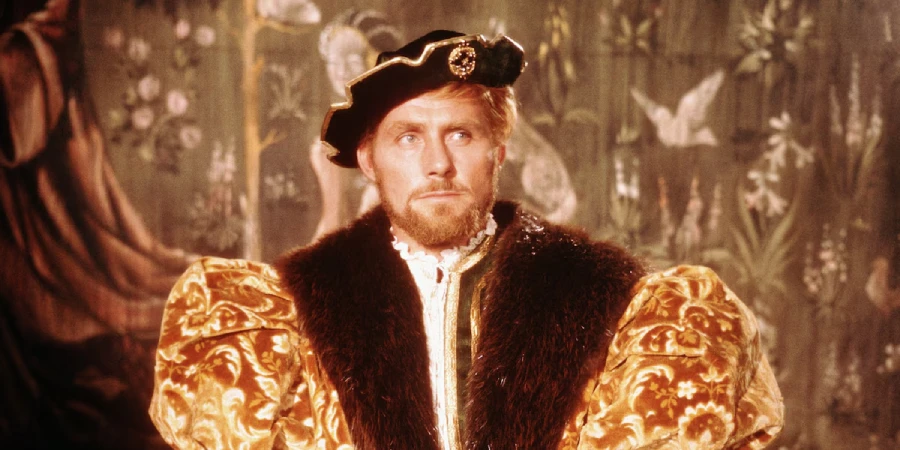
Henry visits More at Chelsea, charming and boisterous, playing the lute and flirting with More’s family. Beneath the warmth, the visit is a test. Henry wants More’s public blessing on the marriage to Anne Boleyn, and he believes friendship can accomplish what argument cannot. More gives nothing away.
Cromwell Enters the Picture
Thomas Cromwell emerges as the film’s primary antagonist, a bureaucratic predator in fine clothes. He begins building a case against More, searching for any legal foothold that would allow the crown to destroy him. Robert Shaw plays Cromwell with a cold, watchful efficiency that makes every scene with Scofield feel like a chess match with real stakes.
Richard Rich also appears early, a young man hungry for advancement who attaches himself to More, hoping for patronage. More sees the weakness in him. He warns Rich, gently but clearly, that Rich is not built for the kind of integrity public life requires. Rich smiles and takes notes.
More Resigns and Retreats
Unable to support the Act of Supremacy or the annulment, More resigns as Lord Chancellor. He retreats to private life with his wife Alice and daughter Margaret, hoping that silence will protect him. English law, he reasons, cannot punish a man for what he refuses to say.
His family watches with mounting anxiety. Alice is practical and frightened; she loves her husband but cannot entirely fathom why conscience must cost them everything. Margaret is sharper, closer to her father’s mind, but equally terrified. Wendy Hiller and Susannah York play these two women with enough grit that they never become mere supporting furniture.
The Trap Closes
Cromwell and his allies pass the Act of Succession, requiring all subjects to swear an oath acknowledging the marriage to Anne Boleyn and the children of that union as legitimate heirs. More refuses to swear. He refuses, critically, without explaining why, relying on the legal principle that silence implies consent, not dissent.
He is arrested and sent to the Tower of London. His family visits, and Alice begs him to simply swear the oath and come home. More cannot. The film does not sentimentalize this. He is not a man who enjoys martyrdom; he is a man for whom the alternative is simply unthinkable.
Richard Rich Delivers the Killing Blow
At trial, the prosecution struggles because More has said nothing legally actionable. Then Richard Rich, the young man More once tried to counsel, takes the stand. He testifies, falsely, that More denied the king’s supremacy in a private conversation in the Tower.
More’s response is one of the film’s great moments. He looks at Rich with something close to pity, then notes that Rich has been made Attorney General for Wales in return for his testimony. He asks, with quiet devastation, what profit a man gains if he wins the world and loses his soul, gesturing at Rich’s new badge of office. It is not melodrama. It is arithmetic.
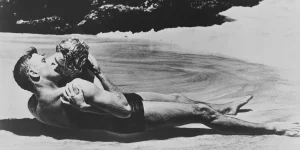
Movie Ending
More is convicted on Rich’s perjured testimony and sentenced to death. Before his execution, he gives a brief public statement affirming his loyalty to the king as his temporal lord, but denying that any parliament can make the king head of the church. He dies, the film tells us, declaring himself “the king’s good servant, but God’s first.”
Zinnemann does not linger on the execution itself. A cut, a moment of quiet, and More is gone. This restraint is exactly right. Prolonged death scenes would shift the film’s weight toward spectacle, and Zinnemann understands that More’s death carries its meaning in everything that came before it.
The Common Man, a device borrowed from the stage play and played by Leo McKern with sly brilliance, steps forward and addresses the audience directly, noting that he is still alive. It is a darkly comic punctuation mark, a reminder that ordinary people survived this era precisely by keeping their heads down and their mouths shut. More’s greatness, and his tragedy, is that he could not do either.
What haunts you afterward is not the beheading but the trial scene. Scofield sits in that courtroom, visibly tired, and methodically dismantles every false charge with the precision of a man who spent his life in the law. He knows it will not save him. He does it anyway.
Are There Post-Credits Scenes?
No. A Man for All Seasons has no post-credits scene of any kind. It is a 1966 film made in a tradition that considered the credits a closing door, not a marketing opportunity.
Type of Movie
This is a historical drama with strong elements of courtroom procedural and political thriller. Its tone is grave and intellectual, with flashes of dry wit, especially in scenes involving the Common Man character. Pacing is deliberate; this is a film that trusts its audience to sit still.
Cast
- Paul Scofield – Sir Thomas More
- Wendy Hiller – Alice More
- Leo McKern – Thomas Cromwell / The Common Man
- Robert Shaw – King Henry VIII
- Orson Welles – Cardinal Wolsey
- Susannah York – Margaret More
- Nigel Davenport – Duke of Norfolk
- John Hurt – Richard Rich
- Corin Redgrave – William Roper
- Colin Blakely – Matthew
Film Music and Composer
Georges Delerue composed the score, bringing a restrained, courtly elegance to the music that matches Zinnemann’s visual approach perfectly. Delerue was a prolific French composer whose collaborations with directors like Jean-Luc Godard and Francois Truffaut made him one of the defining musical voices of European art cinema in the 1960s.
His work here favors period-appropriate textures, lutes and strings evoking Tudor England without tipping into costume drama cliche. The music never competes with Bolt’s dialogue, which is exactly the right instinct. Silence is used as aggressively as any instrument.
Filming Locations
Principal photography took place in England, with Studley Priory in Oxfordshire serving as a key location and various English country estates providing the period texture. The Tower of London scenes used authentic architectural settings that lend real weight to More’s imprisonment.
Zinnemann and cinematographer Ted Moore shot much of the film in warm, almost painterly light, particularly in the Chelsea garden scenes. That warmth makes the cold gray of the Tower sequences hit harder by contrast. It is one of the film’s most quietly effective visual choices.
Awards and Nominations
A Man for All Seasons won six Academy Awards at the 1967 ceremony, including Best Picture, Best Director for Fred Zinnemann, Best Actor for Paul Scofield, Best Adapted Screenplay for Robert Bolt, Best Cinematography for Ted Moore, and Best Costume Design. It received eight nominations in total.
Paul Scofield also won the BAFTA Award for Best Actor. The film’s sweep at the Oscars was one of the more decisive verdicts in that era’s awards season.
Behind the Scenes Insights
- Paul Scofield had originated the role of More on stage in Robert Bolt’s original 1960 production, which made his casting feel less like a decision and more like an inevitability.
- Fred Zinnemann fought to keep the film’s tone serious and its pace unhurried, resisting pressure to add more action or visual spectacle to broaden commercial appeal.
- Robert Shaw’s casting as Henry VIII was considered a bold choice; Shaw was primarily known at the time for stage work and was not yet the international film star he would become after Jaws.
- Orson Welles reportedly prepared extensively for his relatively brief role as Cardinal Wolsey, and his physical bulk and authority in the role required minimal screen time to dominate every scene he entered.
- John Hurt, in an early film role, has spoken about the experience of working opposite Scofield as formative; Hurt’s Richard Rich is one of cinema’s more quietly devastating portraits of moral cowardice.
- Zinnemann insisted on shooting in actual English locations rather than studio sets wherever possible, believing the authenticity of the architecture would register on screen even if audiences could not name the buildings.
Inspirations and References
The film adapts Robert Bolt’s 1960 stage play of the same name, which itself drew heavily on historical record. Bolt was deeply interested in More as a figure who represented individual conscience against state power, a theme that carried obvious resonance in the Cold War era.
Bolt acknowledged the influence of Bertolt Brecht’s theatrical techniques, particularly in the Common Man device, which breaks the fourth wall and gives the audience a morally compromised everyman to identify with as a counterweight to More’s heroism.
The historical sources include William Roper’s biography of More, written by More’s own son-in-law, as well as the state papers and trial records from More’s actual prosecution in 1535. Bolt took considerable care with the historical record even while acknowledging that he was writing drama, not biography.
Alternate Endings and Deleted Scenes
No documented alternate ending exists for the film, and no significant deleted scenes have entered public discussion or appeared in home video releases. The film hews very closely to Bolt’s play, which itself had a fixed structure by the time production began.
A 1988 television film adaptation of the same play was produced, with Charlton Heston directing and starring as More. That version is essentially a separate production and not a director’s cut or alternate version of the 1966 film.
Book Adaptations and Differences
Robert Bolt published his stage play as a text, and that is the primary source for the film. Bolt adapted his own play for the screen, which means the transition is unusually faithful, more so than most stage-to-screen adaptations.
The main adjustment involves the Common Man character. On stage, the Common Man plays multiple roles, including the Boatman, the Jailer, and eventually the Headsman, all doubling as the same actor in a deliberately Brechtian conceit. The film preserves this device but streamlines it somewhat for a more naturalistic medium.
Several scenes that could be staged simply in a theater required real locations and expanded visual scope on film. Zinnemann used this to deepen atmosphere rather than to add plot, which was the right call. The play’s dialogue is so strong that adding material would have been hubris.
Memorable Scenes and Quotes
Key Scenes
- Henry VIII’s visit to Chelsea: Robert Shaw strides into the garden like a force of nature, and Scofield meets him with warm affection and careful evasion. The tension is entirely submerged beneath pleasantries, which makes it more frightening than any direct confrontation.
- More’s confrontation with Cromwell: The two men face each other across a table in a scene that plays like a fencing match in slow motion. Scofield barely raises his voice. He does not need to.
- More in the Tower with his family: Alice begs More to swear the oath. More reaches for her hand without answering. Wendy Hiller’s face in that moment contains a whole marriage’s worth of grief and fury and love.
- The trial and Richard Rich’s testimony: Scofield looks at John Hurt’s Rich and the camera stays on Scofield’s face for a long beat. No tears. No rage. Just a quiet, precise contempt that Rich’s new badge of office makes permanent.
- More’s final statement: Standing before the crowd before his execution, More speaks in a clear, unhurried voice. Scofield plays it almost conversationally, which is the most devastating choice possible.
Iconic Quotes
- “I die His Majesty’s good servant, but God’s first.” (More’s final declaration)
- “Richard, it profits a man nothing to give his soul for the whole world. But for Wales?” (More, to Rich at the trial, upon seeing his new badge as Attorney General for Wales)
- “A man should go where he won’t be tempted.” (More, advising Rich)
- “When a man takes an oath, he’s holding his own self in his own hands. Like water. And if he opens his fingers then, he needn’t hope to find himself again.” (More, to Margaret)
Easter Eggs and Hidden Details
- The Common Man’s doubling of roles across the film, playing figures like the Boatman and the Jailer, is a deliberate Brechtian device signaling that ordinary complicity makes tyranny possible, not extraordinary villainy alone.
- Robert Shaw’s Henry VIII wears rings on nearly every finger during the Chelsea visit, a historically informed detail that reflects the king’s well-documented love of personal adornment and jewelry.
- The warm amber lighting in the More family’s Chelsea home shifts noticeably cooler after More’s resignation, a subtle visual cue from cinematographer Ted Moore that the family’s security has already begun to erode.
- More is shown reading and writing Latin documents in several scenes, a quiet reminder that his world is the church’s world, rooted in a Catholic intellectual tradition that the king’s break from Rome is actively dismantling.
- Bolt’s screenplay retains the anachronistic phrase “the eye of a needle” in More’s dialogue, a deliberate choice to let More speak in the cadences of a man formed by scripture rather than scrubbed into period-accurate speech.
Trivia
- Paul Scofield is one of relatively few actors who won a major film award for a role he originated on stage rather than on screen.
- Fred Zinnemann is better known for action-driven work like High Noon and From Here to Eternity, making this chamber drama a genuine departure that many critics consider his finest film.
- John Hurt’s role as Richard Rich was an early major film appearance; he would go on to earn his own Oscar nomination years later for Midnight Express.
- Orson Welles filmed all his scenes as Wolsey in a relatively short period; his imposing physical presence meant Zinnemann required very little from him in terms of screen time to establish the character’s authority.
- Robert Bolt wrote the screenplay while dealing with personal and political pressures of his own; his interest in More’s conscientious resistance carried genuine personal weight.
- The film was a major commercial as well as critical success, unusual for a dialogue-heavy historical drama without battle scenes or romantic subplots of the conventional variety.
- Leo McKern, who plays the Common Man (and Cromwell in a doubling of roles reflecting the stage version), later became widely known as Rumpole of the Bailey in the British television series.
Why Watch?
Watch this film for Paul Scofield’s voice, specifically the way he slows down before a dangerous question as if choosing each word from a rack of knives. No other performance in 1966 Oscar competition came within reach of what he does here. Bolt’s screenplay is a masterclass in using procedural detail, statutes, oaths, legal fine print, to make theological conscience feel like a courtroom thriller.
Director’s Other Movies
- High Noon (1952)
- From Here to Eternity (1953)
- The Nun’s Story (1959)
- The Sundowners (1960)
- Behold a Pale Horse (1964)
- The Day of the Jackal (1973)
- Julia (1977)
- Five Days One Summer (1982)
Recommended Films for Fans
- Becket (1964)
- The Lion in Winter (1968)
- Witness for the Prosecution (1957)
- Gandhi (1982)
- The Madness of King George (1994)
- The Bounty (1984)
- Cromwell (1970)
- Luther (1973)