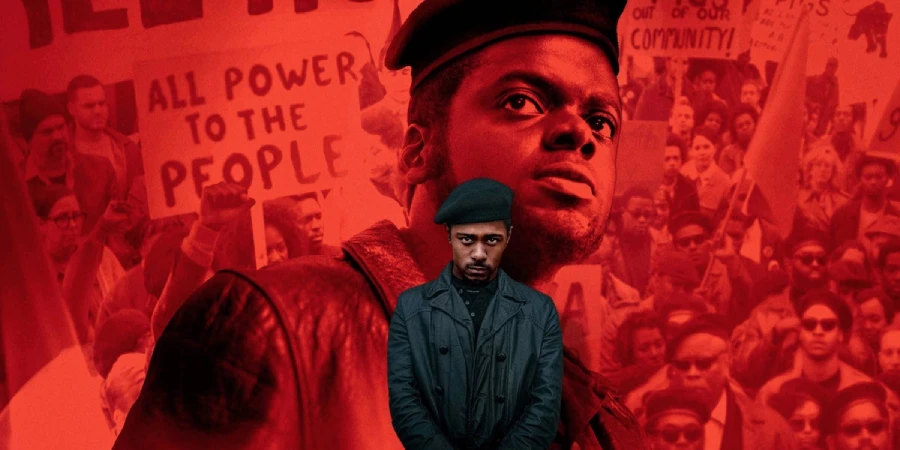

FBI informant Bill O’Neal spent two years feeding intelligence on Fred Hampton to agents who wanted Hampton dead, and the film never lets you forget that O’Neal knew exactly what he was doing. Judas and the Black Messiah opens with fake FBI credentials and closes with a real assassination, and director Shaka King refuses to let you settle into comfortable moral distance from either man. Daniel Kaluuya plays Hampton with so much physical warmth and political fire that his murder in the final minutes lands like a blow to the chest. This is a film built on a true betrayal, and it makes you feel every inch of it.
Detailed Summary
Bill O’Neal Gets Recruited
We meet Bill O’Neal (Lakeith Stanfield) mid-con, impersonating a federal agent to steal a car. FBI Agent Roy Mitchell (Jesse Plemons) catches him and offers a brutal choice: prison, or become an informant inside the Illinois chapter of the Black Panther Party. O’Neal takes the deal without much visible anguish, which is the film’s first and most important character note.
Mitchell is not a screaming villain. He is polite, reasonable, and utterly transactional. That chilling normalcy makes him more disturbing than any cartoonish antagonist would be.
O’Neal Infiltrates the Panthers
O’Neal works his way into the Panthers by performing loyalty, running errands, showing up, staying visible. He earns the trust of chapter chairman Fred Hampton (Daniel Kaluuya) through sheer persistence. Hampton, 21 years old and already commanding rooms like a seasoned preacher, gives O’Neal real responsibility.
King shoots Hampton’s speeches with a close camera that catches Kaluuya’s jaw tightening, his hands cutting the air, sweat on his forehead under hot lights. You believe this man could move people because you watch him do it, repeatedly.
Hampton Builds the Rainbow Coalition
One of the film’s best stretches covers Hampton’s effort to unite Chicago street gangs, white working-class groups, and Puerto Rican activists under a single political umbrella. He walks into rooms full of people ready to hate him and walks out with allies. Kaluuya plays these scenes with a quiet confidence that never tips into smugness.
This coalition-building is precisely what made Hampton dangerous to the FBI. J. Edgar Hoover feared a “Black Messiah” who could unify disenfranchised groups across racial lines, and Hampton was becoming exactly that.
O’Neal Rises Inside the Party
O’Neal becomes Hampton’s head of security. He attends meetings, participates in community programs, and feeds Mitchell a steady stream of intelligence. The film tracks his psychological state carefully: he is not numb, but he is not breaking down either. Stanfield plays O’Neal as a man who keeps his panic in a very small box.
Mitchell rewards O’Neal with cash, always handed over in parking garages or unremarkable rooms. King shoots these exchanges with flat, ugly lighting. Nothing about betrayal looks glamorous here.
Hampton Falls in Love
Hampton meets Deborah Johnson (Dominique Fishburne, credited as Dominique Thorne), a fellow Panther who challenges him intellectually from their first conversation. Their relationship grows with real tenderness. Deborah becomes pregnant with Hampton’s child during the events of the film.
These quieter scenes give the film its emotional core. Hampton away from the podium, washing dishes, talking to Deborah in bed, is still sharp but also just a young man in love. King earns the grief of the ending by making you genuinely like Hampton as a person, not just a symbol.
FBI Pressure Escalates
Mitchell and his superiors push O’Neal to deliver more actionable intelligence. The FBI plants a fake letter accusing a rival gang leader of targeting Hampton, engineering violence that could destabilize the Panthers. O’Neal carries out this manipulation and watches the consequences ripple outward.
Hampton gets arrested on an old robbery charge and spends time in prison. When he returns, the coalition is under strain and surveillance has tightened around him.
The Raid Is Planned
O’Neal provides the FBI with a detailed floor plan of Hampton’s apartment at 2337 West Monroe Street. He drugs Hampton’s drink the night before the raid, slipping a sedative into his food or drink so that Hampton will be incapacitated. This detail sits at the center of the film’s moral horror.
O’Neal knows a raid is coming. He has to know what a raid on a sleeping Black Panther leader means in 1969 Chicago.
Movie Ending
Before dawn on December 4, 1969, Chicago Police Department officers acting with FBI coordination storm the apartment. Hampton is in bed with Deborah, barely conscious from the sedative O’Neal administered. Officers fire into the bedroom. Hampton is shot twice in the head at close range. He is 21 years old.
Deborah survives. She is dragged out of the apartment past Hampton’s body. The film lingers on the hallway, the bullet holes in the walls, the stillness. King does not cut away quickly. He lets the camera sit in the aftermath, and the silence is brutal.
O’Neal walks away. Mitchell hands him an envelope. O’Neal takes it. The film does not give him a breakdown or a dramatic moral reckoning in this moment. Stanfield plays the scene with a hollowed-out quiet that is more devastating than tears would be.
King then cuts to real archival footage from a 1989 television interview with the actual Bill O’Neal, part of the documentary series Eyes on the Prize II. O’Neal describes his time with the Panthers. He looks uncomfortable, evasive, like a man who has been carrying something very heavy for a very long time. A title card informs us that O’Neal died on the same night that interview aired, in what was ruled a suicide. He was 40 years old.
Deborah Johnson, now known as Akua Njeri, appears in a brief on-screen title. Their son, Fred Hampton Jr., grew up to continue his father’s activism. King ends the film on these real people, pulling the story out of dramatization and back into documented history. It is a deliberate choice that refuses to let the audience treat any of this as a safely finished story.
Are There Post-Credits Scenes?
No. Judas and the Black Messiah contains no post-credits scenes. King closes with the archival O’Neal footage and the title cards about the real figures, and that is where the film ends. Stay for those closing moments, though; they are part of the film’s final argument, not an afterthought.
Type of Movie
This is a biographical political thriller with elements of a crime drama. The tone is urgent and frequently grim, with stretches of genuine warmth in the Hampton and Deborah scenes. King never lets the film become a straightforward biopic or a conventional heist of conscience story.
Pacing is deliberate rather than propulsive. Audiences expecting a kinetic thriller may find the middle sections demanding, but that slowness is doing real work, making Hampton’s world feel lived-in before it gets destroyed.
Cast
- Daniel Kaluuya – Fred Hampton
- Lakeith Stanfield – Bill O’Neal
- Jesse Plemons – Roy Mitchell
- Dominique Thorne – Deborah Johnson
- Martin Sheen – J. Edgar Hoover
- Ashton Sanders – Jimmy Palmer
- Algee Smith – Jake Winters
- Lil Rel Howery – Bobby Rush
- Darrell Britt-Gibson – Bobby Lester
- Akira Akbar – Judy Harmon
Film Music and Composer
Mark Isham and Craig Harris composed the score. Isham is a veteran film composer with decades of work across multiple genres. Harris brought a jazz and avant-garde sensibility to the project that keeps the music from feeling like a conventional Hollywood period score.
The score leans on low brass, muted percussion, and a tension between warmth and dread. It mirrors O’Neal’s position throughout: present in Hampton’s world, always carrying a chill underneath.
Period soul and R&B tracks appear throughout to anchor scenes in late 1960s Chicago. Music supervisor Randall Poster made selections that feel like research rather than nostalgia, which is exactly the right call for a film this serious about its historical setting.
Filming Locations
Principal photography took place primarily in Cleveland, Ohio, standing in for late 1960s Chicago. Production designers worked to recreate the specific textures of Chicago’s West Side, from storefront community centers to the cramped apartment on Monroe Street.
Cleveland offered the period architecture and urban geography that Chicago’s more heavily developed areas could no longer provide. This kind of practical substitution is common in period filmmaking, and King’s team executed it well enough that the locations feel specific rather than generic.
A few sequences were shot in the Chicago area itself, adding geographical authenticity to certain exterior scenes. Shooting on location, even partially, matters for a film about a specific city and a specific community that still exists.
Awards and Nominations
Daniel Kaluuya won the Academy Award for Best Supporting Actor for his performance as Fred Hampton. Judas and the Black Messiah received six Oscar nominations in total, including Best Picture and Best Original Screenplay.
H.E.R. won the Academy Award for Best Original Song for “Fight for You,” which appeared in the film. Kaluuya also won the Golden Globe and the BAFTA in the supporting actor category for this role.
Lakeith Stanfield received an Oscar nomination for Best Supporting Actor as well, meaning both leads competed in the same category, a controversial and much-debated decision by the Academy that many felt was a disservice to Stanfield’s work, which is really a lead performance by any fair measure.
Behind the Scenes Insights
- Ryan Coogler produced the film alongside Charles D. King and Shaka King. Coogler’s involvement helped get the project made at a major studio level.
- Shaka King co-wrote the screenplay with Will Berson, based on a story by King, Berson, Keith Lucas, and Kenny Lucas.
- Daniel Kaluuya has spoken in interviews about studying Hampton’s recorded speeches extensively and choosing to work from the rhythm and physicality of those recordings rather than pure imitation.
- Lakeith Stanfield noted in press interviews that he found O’Neal’s psychological state genuinely difficult to access, describing O’Neal as a man who compartmentalized in ways that resisted straightforward dramatic interpretation.
- King and his team conducted research with people who knew Hampton personally and with surviving Panthers to ensure the community programs and political activities were depicted accurately.
- The film was produced by Warner Bros. and released simultaneously in theaters and on HBO Max in February 2021, during the pandemic period when simultaneous releases were standard studio practice.
Inspirations and References
The film draws directly from documented historical record. Hampton’s speeches, the FBI’s COINTELPRO program, the floor plan O’Neal provided, and the December 4, 1969 raid are all matters of public record established through congressional investigations and civil litigation.
Jeffrey Haas’s book The Assassination of Fred Hampton documents the legal battle that followed the raid and provides extensive detail about the FBI and CPD’s involvement. King and his collaborators drew on this and similar accounts of the period.
The film also exists in conversation with a long tradition of political cinema about Black American resistance, from Malcolm X (1992) to Selma (2014). King was clearly aware of that lineage and chose to tell this story from a structural angle that those films did not use, centering the informant rather than the leader.
Alternate Endings and Deleted Scenes
No officially confirmed deleted scenes or alternate endings have been released or extensively documented in the public record. King has discussed in interviews that the decision to end with the real O’Neal archival footage was central to the film’s conception from an early stage, not a late-stage addition.
Given the historical specificity of the film, alternate endings would have required departing significantly from documented events. King showed no interest in doing that.
Book Adaptations and Differences
Judas and the Black Messiah is not an adaptation of a single book. It is an original screenplay built from historical research. Jeffrey Haas’s The Assassination of Fred Hampton is the most relevant companion text, but the film does not adapt it directly.
The screenplay makes dramatic choices that pure historical documentation would not, including the degree of interiority given to O’Neal’s psychological state and the specific texture of his relationship with Mitchell. These are creative interpretations of a documented historical framework, not departures from a source novel.

Memorable Scenes and Quotes
Key Scenes
- Hampton’s first major speech: Kaluuya paces the room, voice rising and dropping with total control, sweat visible on his face, the crowd responding to every beat. You understand immediately why the FBI considered this man a threat.
- The Rainbow Coalition meeting: Hampton walks into a room of Young Patriots, a white working-class organization, and earns their respect through argument alone. King shoots the skeptical faces in the room before cutting to the moment the room shifts.
- O’Neal delivers the floor plan: A quiet scene in a parking garage. Stanfield hands over a piece of paper. Plemons takes it without ceremony. The horror lives entirely in the mundane transaction.
- Hampton and Deborah in bed: Hampton recites a version of his famous “I am a revolutionary” speech quietly, almost to himself, in the dark. Deborah listens. It is the film’s most intimate moment, and it lands because King has earned the quietness of it.
- The raid sequence: King shoots this with controlled chaos: gunshots, smoke, shouting. Then stillness. Then Deborah being pulled down the hallway. The sequence lasts only minutes but feels much longer.
- The archival O’Neal footage: The real Bill O’Neal on camera, visibly uncomfortable, answering questions about his past. After two hours of Stanfield’s performance, seeing the actual man is a genuinely strange and affecting experience.
Iconic Quotes
- “I am a revolutionary.” (Fred Hampton, used throughout as a kind of refrain)
- “You fight racism with solidarity.” (Fred Hampton)
- “I was young, dumb, and wanted to survive.” (Bill O’Neal, from the archival footage)
- “We’re going to fight racism with solidarity. We’re going to fight capitalism with socialism. We’re going to fight imperialism with internationalism.” (Fred Hampton)
Easter Eggs and Hidden Details
- The film’s title positions O’Neal explicitly as Judas and Hampton as a messianic figure, but King resists making either parallel too clean or too comfortable. Hampton is not portrayed as a saint, and O’Neal is not portrayed as purely evil.
- Background details in the Panther offices include free breakfast program materials and community health signage, reflecting the Panthers’ actual social programs that often get obscured in popular memory.
- Mitchell’s office aesthetics, with their institutional furniture and flat light, are deliberately ordinary. King uses production design to argue that state violence does not require gothic settings.
- The sedative O’Neal administers is a reference to a detail established in the official investigation following the raid, where Hampton’s blood was found to contain a drug consistent with being sedated. King includes this not as speculation but as documented allegation.
- Hampton’s age is referenced carefully throughout. He is 21 when he dies. King keeps returning to this detail through dialogue and context to make the loss feel specific rather than abstract.
Trivia
- Fred Hampton’s actual son, Fred Hampton Jr., has been an activist for decades and was consulted during the film’s production.
- Martin Sheen plays J. Edgar Hoover with prosthetic makeup and a physical stillness that some critics found more unnerving than a louder performance would have been.
- Shaka King’s previous feature was the micro-budget comedy Newlyweeds (2013). Judas and the Black Messiah represented a massive step up in scale and a radical shift in tone.
- Daniel Kaluuya and Lakeith Stanfield both appeared in Get Out (2017), though in very different roles and with relatively limited shared screen time. Their pairing here as two men on opposite sides of a moral equation is pointed casting.
- The film’s release date, February 12, 2021, placed it close to Black History Month deliberately.
- H.E.R.’s song “Fight for You” plays over the end credits and was written specifically for the film.
- Bill O’Neal’s FBI handler in real life was indeed named Roy Mitchell, a detail the screenplay preserves accurately.
Why Watch?
Watch it for Kaluuya’s physical performance in the speeches alone: his jaw, his hands, his breath, his stillness between sentences. No other actor in recent memory has made oratory feel this visceral on film. Stanfield matches him beat for beat with a completely different register, playing concealment where Kaluuya plays disclosure. Two extraordinary performances, one impossible moral situation, and a director who trusts history to do the heavy lifting.
Director’s Other Movies
- Newlyweeds (2013)
Recommended Films for Fans
- Malcolm X (1992)
- Selma (2014)
- BlacKkKlansman (2018)
- The Trial of the Chicago 7 (2020)
- One Night in Miami (2020)
- Get Out (2017)
- If Beale Street Could Talk (2018)