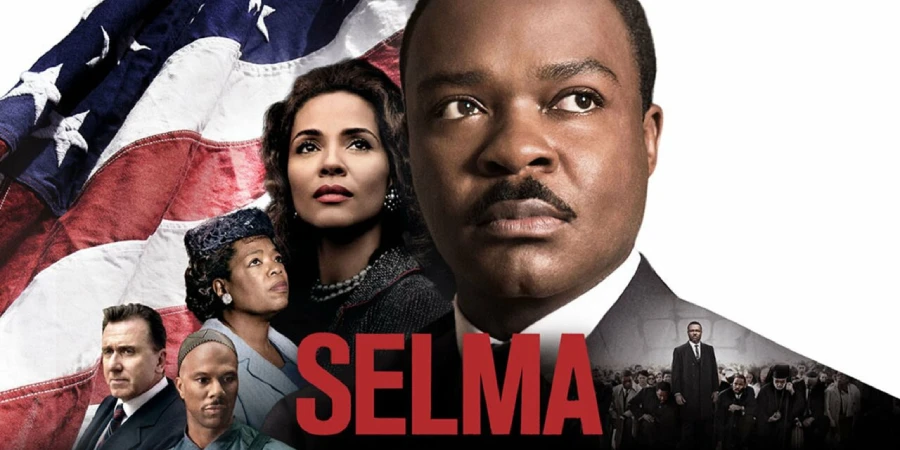

Ava DuVernay opens Selma with four little girls chatting on a church staircase, their laughter bright and ordinary, and then the screen goes white and the building collapses around them. No buildup, no warning. That bombing at 16th Street Baptist Church in 1963 happened before the film’s main timeline, and DuVernay plants it at the very start anyway, because she wants you to carry those four girls through every march, every closed door, every negotiated compromise that follows.
David Oyelowo plays Martin Luther King Jr. not as a monument but as a man who sweats through his suits and second-guesses his decisions.
Detailed Summary
King Receives the Nobel Peace Prize
In Oslo, King accepts the Nobel Peace Prize while Coretta stands beside him in a stunning gown. Back in their hotel room, the mood shifts. J. Edgar Hoover’s FBI has sent Coretta an anonymous letter implying King has been unfaithful, and DuVernay shoots the scene quietly, the two of them sitting apart on the bed, the silence doing most of the work.
The Voter Registration Problem in Selma
Annie Lee Cooper, played by Oprah Winfrey, tries to register to vote at the Dallas County courthouse in Selma, Alabama. A white registrar runs her through a humiliating quiz, demanding she recite the preamble to the Constitution and name every county judge in the state. She answers correctly every time, and he rejects her anyway.
King meets with President Lyndon B. Johnson at the White House to push for a federal voting rights bill. Johnson, played by Tom Wilkinson, tells King to wait, that the administration has other priorities. King refuses to wait, and the scene crackles because both men are right about something and wrong about something, and neither one blinks.
SCLC Chooses Selma as the Battleground
Selma, Alabama becomes the strategic target because Dallas County had almost no registered Black voters despite a large Black population. King and the Southern Christian Leadership Conference partner with local organizers, including the young Amelia Boynton Robinson. Her living room effectively becomes a war room.
Meanwhile, Hoover briefs Johnson on King’s FBI surveillance file, framing King as a troublemaker and a communist sympathizer. DuVernay never lets the audience forget that the federal government’s surveillance apparatus was actively working against the movement even while King negotiated with the White House.
The Death of Jimmie Lee Jackson
A night march in Marion, Alabama turns violent when state troopers and local police attack protesters with clubs and flashlights. In the chaos, a young activist named Jimmie Lee Jackson tries to shield his mother from a trooper who is beating her. Another trooper shoots Jimmie Lee at close range, and he later dies from the wound.
Oyelowo delivers the eulogy with controlled fury, his voice steady but his hands gripping the podium. It is one of the film’s best scenes precisely because King does not give the big, soaring speech here. He speaks through clenched grief, and the restraint hits harder than any crescendo could.
Bloody Sunday
On March 7, 1965, six hundred marchers set out from Selma toward Montgomery across the Edmund Pettus Bridge. King is not there; he has returned to Atlanta. John Lewis and Hosea Williams lead the column instead. When they crest the bridge and see the troopers waiting in a line, the film goes almost completely silent.
Sheriff Jim Clark and Colonel Al Lingo order the troopers to advance. What follows is filmed without heroic scoring, just the sound of clubs on skulls and gas canisters hitting pavement. Amelia Boynton Robinson is beaten unconscious. John Lewis’s skull is fractured. DuVernay shoots the sequence in a kind of documentary haze, and it is genuinely difficult to watch.
Television news broadcasts the footage nationwide that same evening, interrupting a broadcast of Judgment at Nuremberg. The irony of that interruption is not lost on anyone. Public outrage surges, and suddenly Johnson is facing a political crisis he can no longer defer.
Turnaround Tuesday and the Second March
King returns to Selma and leads a second march to the bridge two days later. A federal injunction prevents them from crossing, but King leads the marchers to the bridge anyway, kneels in prayer, then turns the column around. Civil rights activists from other organizations, especially SNCC, feel betrayed. They call it “Turnaround Tuesday” with contempt in their voices.
The film handles this tension honestly. SNCC chairman James Forman accuses King of cutting a deal with the federal government behind closed doors. King neither fully denies it nor fully explains himself, and that ambiguity is one of the screenplay’s sharpest choices.
The Murder of Reverend James Reeb
White Unitarian minister James Reeb travels to Selma in response to King’s call for clergy allies. White segregationists beat him in the street outside a restaurant. He dies two days later. Johnson calls Reeb’s family personally, and King notes with bitter clarity that the President called the white minister’s family but not Jimmie Lee Jackson’s.
King’s Private Doubts
DuVernay gives Oyelowo several private moments that the public King would never have shown. He calls Mahalia Jackson in the middle of the night, unable to sleep, and asks her to sing to him. She does, and he cries. It is a small scene, but it reframes every public speech that came before it.
His conversations with Coretta, played by Carmen Ejogo, carry genuine marital strain. She confronts him about the FBI tape, and he does not deny what she is implying. Ejogo does not play Coretta as a saint or a victim; she plays her as a woman making a specific choice to keep going despite specific pain.
Johnson Addresses Congress
President Johnson goes before a joint session of Congress and delivers a speech endorsing the Voting Rights Act. He closes with the words “We shall overcome.” King watches on a small television at a supporter’s home in Selma, and tears run down his face. DuVernay frames the moment simply, no swelling music, just Oyelowo’s face and a flickering screen.
Governor Wallace Tries to Block the March
Governor George Wallace of Alabama, played by Tim Roth, signs an order banning the march and refuses to protect the marchers. Johnson federalizes the Alabama National Guard and orders them to protect the column. Wallace, forced to accept federal authority on national television, looks small and cornered in a way that Tim Roth makes quietly satisfying.
Movie Ending
On March 21, 1965, the marchers set out from Selma for the third and final time, this time under federal protection. Thousands join them from across the country. The line of people walking across the Edmund Pettus Bridge stretches back as far as the camera can see, and DuVernay films it wide, showing scale rather than spectacle.
Four days later, roughly 25,000 people arrive at the steps of the Alabama State Capitol in Montgomery. King delivers his speech from those steps, the one that ends with the repeated phrase “How long? Not long.” Oyelowo builds the speech rhythmically, his body loosening as the cadence takes over, and by the end the crowd noise and his voice become nearly indistinguishable.
That same night, civil rights volunteer Viola Liuzzo, a white Detroit homemaker who had driven south to help ferry marchers, is shot and killed by Klan members on Highway 80. DuVernay includes this murder in text on screen, refusing to let the triumph of the march become the film’s final emotional note.
Title cards close the film by telling us what happened to the key figures. John Lewis went on to represent Georgia in Congress for decades. George Wallace later recanted his segregationist views and asked Black Alabamians for forgiveness. James Forman remained a lifelong activist. J. Edgar Hoover kept his position until his death in 1972.
King himself gets only the dates of his birth and assassination, 1929 to 1968. No elaboration. DuVernay trusts the audience to feel the weight of that date without being told how to feel it.
Are There Post-Credits Scenes?
Selma has no post-credits scene. The film ends, the title cards appear, and that is it. Given the subject matter, any kind of post-credits button would have been wildly out of place, and DuVernay wisely leaves the silence intact.
Type of Movie
Selma is a historical drama and biographical film. Its tone is serious and urgent, occasionally somber, but never without hope. It sits somewhere between a political procedural and a character study, more interested in King’s strategic mind and private anxieties than in delivering a straight hagiography.
Cast
- David Oyelowo – Martin Luther King Jr.
- Tom Wilkinson – President Lyndon B. Johnson
- Oprah Winfrey – Annie Lee Cooper
- Carmen Ejogo – Coretta Scott King
- Tim Roth – Governor George Wallace
- Cuba Gooding Jr. – Fred Gray
- Alessandro Nivola – John Doar
- Lorraine Toussaint – Amelia Boynton Robinson
- Wendell Pierce – Hosea Williams
- Common – James Bevel
- Lakeith Stanfield – Jimmie Lee Jackson
- Colman Domingo – Ralph Abernathy
- David Oyelowo leads the ensemble, but Colman Domingo and Wendell Pierce do exceptional supporting work that rarely gets discussed.
Film Music and Composer
Jason Moran composed the score for Selma. A jazz pianist by training, Moran brings an improvisational looseness to the underscore that suits DuVernay’s approach perfectly. He avoids the broad orchestral swells that typically accompany this kind of prestige drama.
The most discussed piece of music in the film is “Glory”, written and performed by Common and John Legend over the closing credits. It won the Academy Award for Best Original Song. Legend and Common performed it live at the ceremony in a performance that generated significant attention.
Moran’s score is frankly the most underrated element of the entire production. It keeps the film from tipping into the kind of manipulative emotional orchestration that plagues most historical biopics.
Filming Locations
Production filmed in Selma, Alabama itself, including on the actual Edmund Pettus Bridge. Shooting on that bridge gave the cast and crew an almost involuntary gravity. Oyelowo has spoken about how different it felt to stand on that bridge compared to any rehearsal space.
Parts of the film also shot in Atlanta, Georgia, which doubled for several interior and period street locations. Some scenes used period-accurate Alabama architecture in surrounding towns to fill in backgrounds DuVernay needed for the 1965 setting.
Filming in Selma was not just logistically convenient; it was a deliberate political and artistic choice. DuVernay wanted the physical memory of the place in the work.
Awards and Nominations
Selma received two Academy Award nominations, winning Best Original Song for “Glory” and receiving a nomination for Best Picture. The film’s failure to receive nominations for Oyelowo’s performance or DuVernay’s direction sparked a significant industry conversation about representation in awards voting.
At the Golden Globes, “Glory” won Best Original Song as well. The film also earned a BAFTA nomination for Best British Film, eligible through its UK production involvement.
Behind the Scenes Insights
- Ava DuVernay was not the original director attached to the project; the film spent years in development with other filmmakers before she came aboard.
- Because the estate of Martin Luther King Jr. controls the rights to his speeches, DuVernay could not reproduce the actual texts. She and Oyelowo constructed versions that captured the rhythm and intent without replicating the protected language word for word.
- Oyelowo reportedly pursued the role for years before it came together, driven by a personal conviction that he was meant to play King.
- Oprah Winfrey served as a producer on the film in addition to her acting role as Annie Lee Cooper.
- Common, who plays James Bevel, wrote and recorded “Glory” specifically for the film’s closing sequence.
- DuVernay made a point of hiring a predominantly Black crew in key creative roles, an uncommon practice on films of this scale at the time.
- The production reportedly worked with civil rights veterans and historians to reconstruct the tactical and organizational details of the Selma campaign accurately.
Inspirations and References
The film draws directly from the documented historical record of the 1965 Selma to Montgomery voting rights marches. DuVernay consulted historical accounts, civil rights scholarship, and oral histories from surviving participants.
Taylor Branch’s trilogy on King and the civil rights movement, particularly Pillar of Fire, covers this period in exhaustive detail and was a reference point for the production’s research. Branch’s work captures the internal SCLC conflicts that DuVernay brings to the screen.
The film also clearly drew on the visual archive of news photography from 1965. Several compositions feel reconstructed from specific documentary photographs, particularly the Bloody Sunday sequence on the bridge.
Alternate Endings and Deleted Scenes
No officially released deleted scenes or alternate endings have been made publicly available for Selma. DuVernay has discussed in interviews that the editing process was intensive, but specific cut material has not been detailed publicly.
Given the film’s relatively tight focus, it seems unlikely that dramatically different versions exist. DuVernay has spoken about what she chose to leave out rather than what she cut, particularly her decision not to dramatize King’s assassination.
Book Adaptations and Differences
Selma is not based on a single book. It draws from historical record and multiple sources rather than adapting one text. Screenwriter Paul Webb wrote the original script, with DuVernay doing extensive rewrites after she came aboard as director.
The film has been compared to historical accounts in Taylor Branch’s books and other civil rights histories, but it is an original screenplay, not an adaptation.



Memorable Scenes and Quotes
Key Scenes
- The opening church bombing, shown without context or warning, which sets the film’s emotional register in under two minutes.
- Annie Lee Cooper’s voter registration attempt at the courthouse, a scene so precise in its bureaucratic cruelty that it feels like a legal thriller compressed into four minutes.
- King’s midnight phone call to Mahalia Jackson, where Oyelowo sits in near-darkness and lets the exhaustion and fear show on his face in a way the daylight scenes never allow.
- The Bloody Sunday sequence on the Edmund Pettus Bridge, filmed almost without music, where the sound design carries the violence.
- King watching Johnson’s congressional address on television, tears running quietly down his face while Oyelowo keeps his body completely still.
- The final march to Montgomery, where DuVernay pulls the camera back wide to show the full column of thousands rather than focusing on any single face.
Iconic Quotes
- “We are not asking. We are demanding.” (King to President Johnson)
- “Give us the vote.” (repeated throughout King’s addresses)
- “How long? Not long, because the arc of the moral universe is long, but it bends toward justice.” (King’s Montgomery steps speech)
- “We shall overcome.” (Johnson before Congress, which makes King cry precisely because the words came from that source)
Easter Eggs and Hidden Details
- The television broadcast that Bloody Sunday footage interrupts is Judgment at Nuremberg, a 1961 film about Nazi war crimes trials. DuVernay chose this deliberately; the juxtaposition of the two atrocities on a single screen carries a specific charge.
- Several extras in the march sequences were descendants of actual Selma marchers, a detail DuVernay has mentioned in interviews.
- The framing of King at the Nobel Prize ceremony echoes formal portraiture photography of the era, almost painterly in its composition, before DuVernay deliberately roughens the visual texture as the film moves into the Alabama sequences.
- Coretta’s costuming across the film subtly tracks the emotional arc of their marriage; her color palette grows cooler as their relationship comes under strain.
- The FBI surveillance logs that appear on screen in the film are styled after actual declassified FBI documents, giving them an unsettling documentary authenticity.
Trivia
- David Oyelowo is British-Nigerian, not American, which makes his embodiment of an American cultural figure notable and, given how deeply American the role feels, genuinely impressive from a craft standpoint.
- Oprah Winfrey’s production company, Harpo Films, was among the producers on the film.
- The Edmund Pettus Bridge is named after a Grand Dragon of the Ku Klux Klan, a fact the film does not address directly but which DuVernay has discussed publicly as painful context for the shoot.
- Common’s casting was unconventional for a serious historical drama, but his performance as James Bevel is understated and effective.
- The film’s budget was relatively modest for a prestige historical drama, which DuVernay has cited as a factor in the creative freedom she maintained.
- DuVernay became the first Black woman to receive a Golden Globe nomination for Best Director for this film.
- John Lewis, who appears as a character in the film played by Stephan James, was still serving in Congress when the movie was released and attended screenings of it.
Why Watch?
Watch it for Oyelowo’s performance in the scenes nobody quotes: the midnight call to Mahalia Jackson, the hotel room silence with Coretta, the eulogy for Jimmie Lee Jackson delivered through clenched grief. DuVernay builds a portrait of King that refuses comfort and refuses myth, which is rarer in this genre than it should be. A film about a man most people think they already know somehow manages to make him surprising again.
Director’s Other Movies
- I Will Follow (2010)
- Middle of Nowhere (2012)
- 13th (2016)
- A Wrinkle in Time (2018)
- When They See Us (2019)
- Origin (2023)